Upgrade & Secure Your Future with DevOps, SRE, DevSecOps, MLOps!
We spend hours scrolling social media and waste money on things we forget, but won’t spend 30 minutes a day earning certifications that can change our lives.
Master in DevOps, SRE, DevSecOps & MLOps by DevOps School!
Learn from Guru Rajesh Kumar and double your salary in just one year.
Introduction
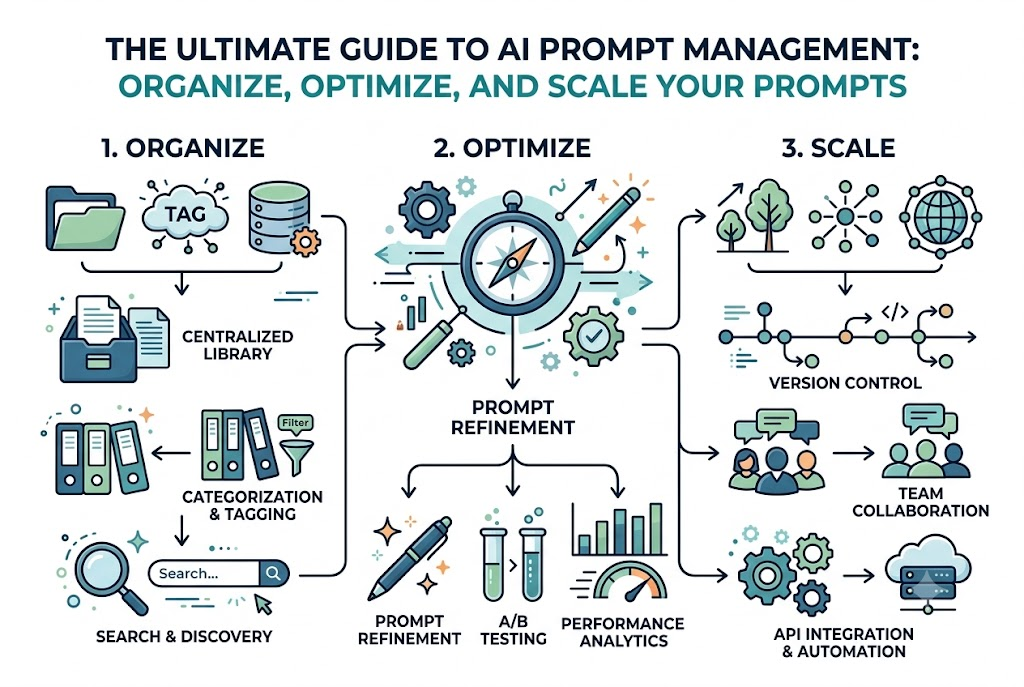
Generative artificial intelligence has redefined modern productivity across software engineering, content creation, strategic marketing, and enterprise operations. However, as individuals and organizations scale their use of Large Language Models (LLMs) like GPT-4o, Claude 3.5 Sonnet, and Gemini 1.5 Pro, they run into a major operational bottleneck: prompt chaos. Treating prompts as temporary messages limits their potential. In modern AI operations, prompts must be managed as structured, reusable digital assets. This master AI prompt management platform guide explores how structuring, optimizing, testing, and versioning your prompts turns scattered instructions into scalable AI workflows. You will learn how dedicated tools like Promptosia elevate your prompt engineering practices and transform isolated prompts into compounding digital assets.
What is an AI Prompt Management Tool?
An AI prompt management tool is a specialized software environment designed to store, organize, refine, test, and share prompts across different generative AI models. Rather than keeping text snippets in static documents or lost in chat logs, a prompt management solution treats prompts as dynamic software components or standard operating procedures.
+-----------------------------------------------------------------------+
|                    TRADITIONAL vs. MANAGED PROMPTS                    |
+-----------------------------------------------------------------------+
| Traditional: Discarded Chat Text --> Unpredictable Results --> Loss   |
| Managed:     Organized Asset    --> Version Controlled    --> Scaled  |
+-----------------------------------------------------------------------+
Why Prompt Management Matters
When individual users or enterprise teams scale their AI usage, manual prompt tracking fails quickly. Without proper centralized management, organizations face several challenges:
- Siloed Knowledge: High-performing prompts remain locked on individual screens.
- Inconsistent Results: Minor changes in phrasing lead to vastly different AI outputs.
- Lost Intellectual Property: Custom-crafted workflows disappear when chat histories refresh or employees transition.
Building a structured AI prompt library solves these operational roadblocks. By centralizing proven instructions, teams make high-performing prompts searchable, version-controlled, and immediately reusable for everyone.
Understanding Prompt Engineering
Prompt engineering is the practice of designing, refining, and structuring text inputs so generative AI models produce accurate, relevant, and actionable outputs. Using a comprehensive prompt engineering platform helps elevate prompt design from basic trial-and-error to a predictable engineering discipline.
+-----------------------------------------------------------------------+
|                    ANATOMY OF AN ENTERPRISE PROMPT                    |
+-----------------------------------------------------------------------+
|  [ROLE DEFINITION]  --> Senior Technical Copywriter                   |
|  [CONTEXT]          --> B2B SaaS Audience, Product Launch Phase       |
|  [INSTRUCTIONS]     --> Draft a 500-word feature announcement         |
|  [VARIABLES]        --> {{product_name}}, {{key_benefits}}           |
|  [CONSTRAINTS]      --> No passive voice, avoid corporate jargon      |
|  [OUTPUT FORMAT]    --> Markdown with bullet points and clear CTA     |
+-----------------------------------------------------------------------+
Core Components of a High-Performing Prompt
According to documentation from leading AI labs like OpenAI Documentation and Anthropic Documentation, effective prompts rely on key structural elements:
- Role Definition: Instructs the AI model on the exact persona or operational perspective to adopt.
- Context: Background information, target audience profiles, or environmental parameters.
- Instructions: Specific, step-by-step actions the model must execute.
- Variables: Dynamic placeholders (e.g.,
{{target_audience}},{{code_snippet}}) that make a prompt reusable across multiple scenarios. - Constraints: Explicit boundaries defining what the AI must avoid (e.g., length limits, specific terms, or tones).
- Output Formatting: Instructions specifying the exact return structure, such as JSON schemas, Markdown tables, or executive summaries.
Building an Organized AI Prompt Library
Without systematic organization, even a large collection of prompts becomes unusable. An effective AI prompt organizer gives teams the tools needed to tag, search, and categorize prompts for instant retrieval.
Key Organization Strategies
- Taxonomies and Categories: Group prompts by operational function (e.g., Development, Marketing, Customer Support, Legal, HR).
- Tagging Systems: Tag prompts by target model (e.g.,
GPT-4o,Claude-3.5), risk level (Low,Medium,High), or execution complexity. - Dynamic Search: Implement fast metadata search so users can find exact prompt assets in seconds.
- Curated Collections: Group prompts into end-to-end operational workflows (e.g., “SaaS Content Launch Suite” or “DevOps Incident Response”).
AI Prompt Optimization
A raw instruction often lacks the structure needed to yield reliable results. An AI prompt optimizer helps refine rough instructions by systematically addressing ambiguity and adding clear contextual boundaries.
+-----------------------------------------------------------------------+
|                         PROMPT OPTIMIZATION                           |
+-----------------------------------------------------------------------+
|  BEFORE: "Review this Python code and fix errors."                    |
|                                                                       |
|  AFTER:  "Act as a Senior Python Developer. Review the provided       |
|          {{code_snippet}} for syntax errors, performance bottlenecks, |
|          and security risks. Output identified issues in a table      |
|          and provide refactored code following PEP-8 rules."          |
+-----------------------------------------------------------------------+
AI Prompt Analysis
To understand why a prompt succeeds or fails, you need visibility into its structural blueprint. An AI prompt analyzer inspects a prompt’s underlying architecture, revealing its strengths and identifying missing context.
Key Structural Checkpoints
- Goal Identification: Explicitly identifies the core objective of the prompt.
- Variable Extraction: Detects unformatted text blocks that should be converted into dynamic variables.
- Output Alignment: Evaluates whether output expectations match the model’s capabilities.
- Risk and Safety Evaluation: Flags potential hallucinations, sensitive data leaks, or unconstrained edge cases.
Promptosia features Prompt DNA, an advanced diagnostic tool that analyzes risk level, target audience, variables, tone, and formatting rules to ensure maximum prompt clarity.
Prompt Quality Checking
Evaluating prompts manually relies heavily on subjective intuition. A dedicated prompt quality checker brings standard, objective scoring metrics to prompt engineering.
+-----------------------------------------------------------------------+
|                      PROMPT QUALITY SCORE CARD                        |
+-----------------------------------------------------------------------+
|  Metric               Score (0-100)    Diagnostic Focus               |
|  -------------------------------------------------------------------  |
|  Clarity               95              Explicit Instructions           |
|  Context               88              Background Information Included |
|  Formatting           90              Clear Structural Guidelines     |
|  Reusability          92              Dynamic Variables Implemented   |
|  Safety & Boundaries   85              Constraint Flags Active         |
|  -------------------------------------------------------------------  |
|  OVERALL PROMPT SCORE: 90/100 (Production Ready)                      |
+-----------------------------------------------------------------------+
Using an automated scoring system lets users address missing variables or weak constraints before deploying prompts in critical business workflows.
Version Control for AI Prompts
When AI model providers release API updates or fine-tuned versions, prompts that performed well in the past may start producing unexpected results. A robust prompt version control tool treats prompts like software code, tracking every modification across their lifecycle.
Benefits of Prompt Version Control
- Audit Trails: Track who modified a prompt, when the change occurred, and why.
- One-Click Rollbacks: Revert instantly to a previous prompt version if a model update causes performance drops.
- A/B Testing Integration: Compare performance across prompt iterations to select the most reliable variant.
Testing AI Prompts
An AI prompt testing tool allows users to run prompt variations across different models, parameters, and input conditions.
                               +-----------------------------+
                               |    PROMPT TEST BENCH        |
                               +-----------------------------+
                                              |
                     +------------------------+------------------------+
                     v                                                 v
           [ Model A: GPT-4o ]                               [ Model B: Claude 3.5 ]
                     |                                                 |
         +-----------+-----------+                         +-----------+-----------+
         |                       |                         |                       |
         v                       v                         v                       v
  Output Variant 1        Output Variant 2          Output Variant 1        Output Variant 2
Effective Prompt Testing Strategies
- Multi-Model Evaluation: Compare responses from GPT-4o, Claude 3.5, and Gemini 1.5 side-by-side using identical variables.
- Edge Case Validation: Test how prompts handle incomplete, ambiguous, or unexpected user inputs.
- Benchmarking Consistency: Run a prompt multiple times to evaluate answer stability and output variance.
Reusable AI Prompt Templates
Converting static text into reusable AI prompt templates allows teams to automate repetitive tasks and save valuable time.
Common Production Template Examples
- Software Engineering: Code review checklists, refactoring templates, unit test generators.
- Digital Marketing: SEO blog outlines, social campaign builders, ad copy variations.
- Enterprise Operations: Incident post-mortems, executive summary builders, customer support responses.
- Research and Academia: Literature synthesis tools, methodology evaluators, study guide generators.
Using flexible dynamic variables in your Prompt Library makes it easy to apply standardized prompts across dozens of operational tasks.
Promptosia for Different User Types
Different roles require distinct prompting strategies. Here is how diverse user groups leverage Promptosia to streamline their AI operations:
Writers & Content Creators
Draft outlines, refine brand tone, and build long-form content templates without losing successful creative prompts.
Developers & Software Engineers
Manage code generation prompts, run automated test suites, and keep API instructions version-controlled alongside application repos.
Marketers & Copywriters
Maintain consistent brand voice guidelines, generate campaign assets, and share high-performing copywriting frameworks across teams.
Students & Researchers
Organize study templates, synthesize complex research papers, and verify citation formats with structured academic prompts.
Educators & Instructors
Create standardized lesson plans, design rubrics, and share custom learning prompts directly with students.
Enterprise Businesses & Agencies
Enforce prompt governance, prevent sensitive data exposure, and build centralized prompt repositories to boost team productivity.
AI Professionals & Consultants
Package, benchmark, and showcase high-performing prompt assets using public Prompt Passports.
Best Practices for Prompt Management
To build an efficient prompt library, implement these industry best practices:
- Use Descriptive Titles: Name prompts clearly based on their exact function (e.g.,
[SaaS] B2B SEO Article Outline Generator v2). - Implement Dynamic Variables: Replace hardcoded values with dynamic placeholders like
{{company_name}}to make prompts reusable. - Organize by Taxonomy: Tag and categorize every prompt upon creation so team members can find them instantly.
- Track Version Iterations: Document why a prompt was updated to keep historical context clear.
- Audit Prompts Regularly: Retire obsolete prompts and refine underperforming instructions using automated quality analysis.
Common Prompt Engineering Mistakes
+-----------------------------------------------------------------------+
|               COMMON MISTAKES vs. PROMPTOSIA SOLUTIONS                |
+-----------------------------------------------------------------------+
| Mistake: Vague Instructions     --> Solution: AI-Assisted Optimization|
| Mistake: Hardcoded Text         --> Solution: Dynamic Variables       |
| Mistake: Lost Prompt History    --> Solution: Version Control History |
| Mistake: Unchecked Quality      --> Solution: Automated Quality Score |
+-----------------------------------------------------------------------+
Avoiding these frequent mistakes helps keep your AI workflows running smoothly:
- Writing Vague Instructions: Broad, unstructured prompts lead to generic AI responses. Add specific roles, context, and constraints to improve output quality.
- Hardcoding Variable Details: Including unique project details directly in primary prompt templates limits reusability.
- Ignoring Output Constraints: Failing to specify exact response formats (e.g., Markdown, JSON) forces extra manual cleanup.
- Skipping Systematic Testing: Deploying prompts without testing them across multiple inputs and models leads to unpredictable edge-case errors.
Comparison Table
| Capability | Manual Prompt Tracking (Notes/Docs) | Promptosia AI Platform |
| Organization | Scattered files, difficult to search | Centralized, categorized, and tagged |
| Version Control | Manual duplicate copies, no true history | Full version control and audit logs |
| Search Speed | Slow manual browsing across folders | Fast metadata and keyword search |
| Testing Environment | Manual copy-pasting between models | Side-by-side model testing |
| Quality Analysis | Subjective trial-and-error guessing | Automated scoring and diagnostic metrics |
| Collaboration | Disorganized links shared via messaging apps | Shared team libraries and public passports |
The Future of Prompt Engineering
As generative AI continues to mature, prompting practices are evolving from informal text tweaks into a structured software discipline.
+-----------------------------------------------------------------------+
|                   THE FUTURE OF PROMPT ENGINEERING                    |
+-----------------------------------------------------------------------+
|  [2023]  Ad-Hoc Text Inputs    --> Discarded Chat History             |
|  [2024]  Basic Prompt Libraries--> Static Text Snippets               |
|  [2026+] Prompt OS Infrastructure --> Versioned, Tested, AI Assets   |
+-----------------------------------------------------------------------+
Industry trends points toward several major developments in prompt management:
- Automated Optimization Engines: AI platforms will continuously refine prompt phrasing based on live user feedback and accuracy metrics.
- Prompt Governance and Compliance: Enterprise teams will mandate strict compliance checks to prevent security vulnerabilities and data leaks in model inputs.
- Interoperable Prompt Formats: Standardized prompt passports will allow seamless transfer of prompt assets across various AI platforms and tools.
How Promptosia Helps Users Build Better Prompts
Promptosia provides a complete environment designed specifically for prompt management. Rather than treating prompts as disposable chat messages, Promptosia helps you build a scalable library of reusable AI assets.
- Centralized Library: Save, organize, tag, and search all your prompt assets from a single workspace.
- AI-Assisted Optimization: Refine rough instructions into clear, production-ready prompts with a single click.
- Prompt DNA & Scoring: Evaluate clarity, context, variables, risk levels, and output structures using objective metrics.
- Version Management: Track revisions, compare iterations, and maintain complete audit logs across your workflows.
- Prompt Passports & Community: Share public prompts, learn from community templates, and build your profile as a prompt engineer.
Frequently Asked Questions (FAQ)
1. What is a master AI prompt management platform?
A master AI prompt management platform is a centralized digital workspace that allows users and teams to store, organize, refine, version, test, and share AI prompts. Instead of losing instructions in chat windows, it treats prompts as structured, reusable digital assets that scale across various AI tools and workflows.
2. Why should I save and organize my AI prompts?
Saving and organizing prompts prevents redundant work, maintains output consistency, and protects your intellectual property. A structured prompt library allows you to retrieve proven instructions instantly, share best practices across teams, and continuously improve your generative AI workflows.
3. How does an AI prompt optimizer work?
An AI prompt optimizer analyzes rough, informal instructions and rewrites them into structured prompts. It automatically defines target roles, adds necessary context, inserts dynamic placeholders, establishes constraints, and formats outputs to ensure reliable results from AI models.
4. What is Prompt DNA?
Prompt DNA is a diagnostic analysis framework used by Promptosia to inspect a prompt’s underlying architecture. It evaluates key characteristics like risk levels, primary goals, dynamic variables, tone, target audience, and output formats, giving you a clear structural breakdown of your prompt assets.
5. Why is version control important for AI prompts?
Generative AI models and system updates can change how prompts respond over time. Prompt version control tracks every edit, allows one-click rollbacks to earlier prompt iterations, and provides detailed audit trails so teams can verify which prompt version produced a specific output.
6. How does a prompt quality checker evaluate prompts?
A prompt quality checker uses automated diagnostic rules to score prompts across key dimensions, including clarity, context, formatting structure, reusability, safety, and practical value. This score identifies weak points—such as missing variables or missing constraints—before the prompt is deployed.
7. What are dynamic variables in reusable prompt templates?
Dynamic variables are structured placeholders (e.g., {{topic}}, {{code_language}}) embedded within a prompt template. They allow a single standardized prompt to be reused across different scenarios simply by swapping out input values, eliminating the need to rewrite instructions from scratch.
8. Can teams collaborate using a prompt management system?
Yes. Modern prompt management tools allow teams to build shared prompt libraries, establish corporate prompt standards, manage user access permissions, and collaborate on prompt optimization. This prevents team members from working in isolation and improves overall organizational AI productivity.
9. What is a Prompt Passport?
A Prompt Passport is a public profile card for a prompt asset in Promptosia. It displays the prompt text alongside its structural analysis, quality score, dynamic variables, best-fit use cases, and creator information, making it easy for others to review, copy, or adapt.
10. Who can benefit from using Promptosia?
Promptosia is built for anyone using generative AI regularly, including software engineers, digital marketers, technical writers, researchers, educators, students, and enterprise AI teams. Anyone looking to replace scattered notes with a scalable, structured AI workflow can benefit from using the platform.
Conclusion
Generative artificial intelligence is reshaping how work gets done, but its true value depends on the quality and consistency of your inputs. Treating prompts as disposable text snippets leads to redundant work, unpredictable results, and lost productivity. To scale your AI operations effectively, you must treat prompts as vital digital assets that deserve proper management, organization, and ongoing refinement. Adopting a master AI prompt management platform transforms isolated prompt engineering efforts into a reliable, repeatable system. By centralizing your prompt assets into a structured library, optimizing vague instructions, analyzing prompt architecture with automated scoring tools, and tracking revisions through version control, you create a compounding advantage in your daily AI workflows.
