Upgrade & Secure Your Future with DevOps, SRE, DevSecOps, MLOps!
We spend hours scrolling social media and waste money on things we forget, but won’t spend 30 minutes a day earning certifications that can change our lives.
Master in DevOps, SRE, DevSecOps & MLOps by DevOps School!
Learn from Guru Rajesh Kumar and double your salary in just one year.
Introduction
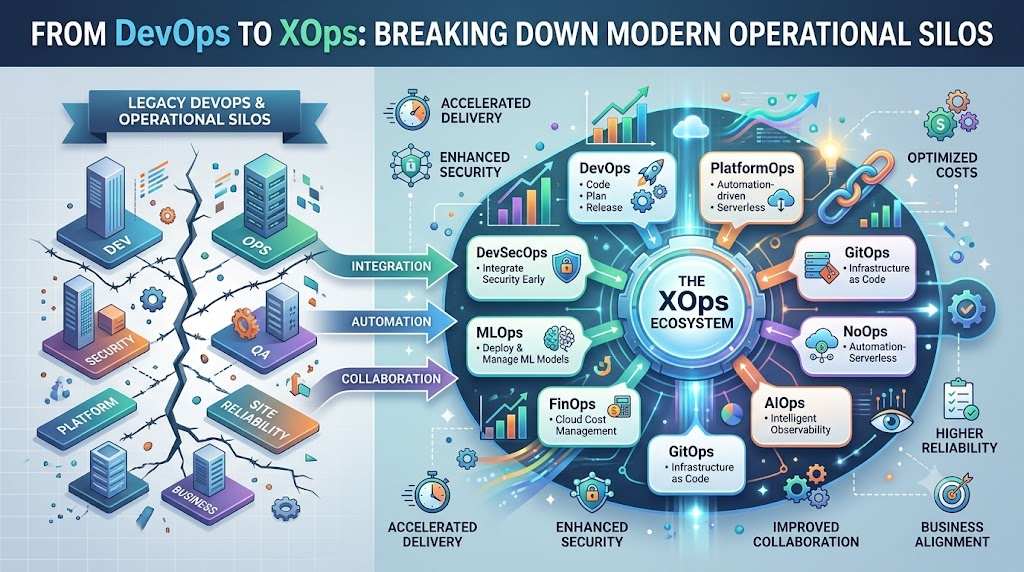
Modern software delivery no longer stops at deploying compiled application code into production. Today, enterprise architectures depend simultaneously on machine learning pipelines, streaming data transformations, multi-cloud infrastructure, strict security baselines, and cost guardrails. This expansion gave rise to a proliferation of specialized operational disciplines: DevOps, DataOps, MLOps, DevSecOps, and FinOps. While each discipline solves a targeted problem, operating them as separate functions creates fragmentation, duplicated tooling, communication breakdowns, and integration friction. XOps represents a holistic operational strategy designed to bridge these boundaries. It establishes a shared framework of automation, observability, and governance across all operational practices, linking continuous integration and continuous deployment (CI/CD) with data engineering and artificial intelligence workflows. For engineering teams looking to master these modern frameworks, platforms like XOpsSchool provide structured training and learning tracks to navigate the convergence of operations, data, and cloud-native systems. This guide explores the architectural principles of XOps, how core operational disciplines interact, and how to implement a unified operating model across your systems.
What Is XOps?
XOps (short for Everything Operations or Any-Ops) is an umbrella framework that reconciles and unifies individual operational disciplines across development, infrastructure, data engineering, machine learning, security, and finance. Rather than treating software deployment, model training, and analytical ingestion as isolated pipelines, XOps introduces unified automation, standardized interfaces, and cross-discipline governance.
The primary objective of XOps is to eliminate operational redundancy, shorten feedback loops between development and runtime monitoring, and establish common standards for packaging, testing, deploying, and observing digital assets.
Core Operational Disciplines in the XOps Ecosystem
To understand how XOps functions, it is essential to examine the operational pillars that form its foundation:
- DevOps: Focuses on the convergence of application development and IT operations. It standardizes version control, continuous integration, automated testing, and zero-downtime deployment pipelines.
- DataOps: Adapts continuous delivery practices to data engineering. It automates extraction, transformation, loading (ETL/ELT), schema validation, and data quality testing to ensure fresh, reliable data reaches analytical systems.
- MLOps: Extends operational automation to the lifecycle of machine learning models. It manages experimental tracking, feature stores, model retraining triggers, model artifact registry, and drift detection in production.
- AIOps: Applies machine learning and algorithmic analysis to operational telemetry—such as metrics, logs, and traces—to automate incident root cause analysis, predict system failures, and reduce alert fatigue.
- SecOps / DevSecOps: Embeds compliance checks, vulnerability scanning, static application security testing (SAST), and runtime threat monitoring directly into automated pipelines.
- FinOps: Introduces cloud financial management and cost accountability, ensuring infrastructure resources are tracked, allocated, and optimized based on business unit consumption.
How the Disciplines Compare
The table below outlines how each discipline within the XOps framework operates across the software and infrastructure lifecycle:
| Operational Discipline | Primary Focus Area | Key Artifacts Managed | Common Tooling | Core Business Value |
| DevOps | Application code and compute delivery | Binaries, container images, Helm charts | Jenkins, GitHub Actions, GitLab CI/CD, Docker | Fast, reliable deployment cycles |
| DataOps | Data extraction, transformation, and ingestion | Data pipelines, schemas, analytical tables | Apache Airflow, dbt, Apache Spark, Kafka | High data quality and rapid analytics |
| MLOps | Model development, validation, and serving | Weights, model files, feature store definitions | MLflow, Kubeflow, Feast, Triton Server | Scalable, production-ready AI models |
| AIOps | System telemetry and operational signals | Metrics, distributed traces, log events | Dynatrace, Datadog, BigPanda, Moogsoft | Reduced MTTR and alert triage automation |
| DevSecOps | Security scanning and compliance automation | SBOMs, vulnerability reports, security policies | Trivy, Snyk, SonarQube, Open Policy Agent | Early vulnerability remediation |
| FinOps | Cloud resource consumption and unit economics | Usage reports, cost budgets, tagging schemas | Kubecost, AWS Cost Explorer, CloudHealth | Predictable cloud expenditures |
The Architectural Workflow of XOps
In a traditional organization, an application development team deploys a service using one pipeline, a data team processes user analytics through an ad-hoc cron schedule, and a data science team manually copies trained model weights into a cloud storage bucket. If a data schema shifts, the model predictions degrade, and the production microservice crashes—with each team pointing to the other’s monitoring dashboard.
XOps structures these disciplines through a shared platform engineering foundation:
- Shared Versioning and Repository Standards: Code, schema definitions, model specifications, and Infrastructure as Code (Terraform, OpenTofu) reside under common repository guidelines.
- Interlocking CI/CD Triggers: When a data pipeline publishes a validated schema change via DataOps, it signals the MLOps pipeline to trigger automated model retraining and validation.
- Continuous Verification and Quality Gates: Automated test suites do not just check unit tests; they validate data integrity thresholds and model performance metrics before artifact publication.
- Unified Telemetry and Observability: Logs, traces, and metrics from applications, database engines, and ML inference pods feed into an AIOps telemetry engine. The engine correlates performance anomalies across the entire stack rather than isolating alerts per team.
Practical Example: Deploying an AI-Powered Fraud Detection Engine
Consider an enterprise financial institution deploying real-time fraud detection on credit card transactions:
- DataOps Pipeline: Continuously extracts transaction records from distributed message queues, cleanses missing values, runs automated schema validation, and publishes features to an enterprise feature store.
- MLOps Pipeline: Detects the newly processed feature set, trains an XGBoost classification model, validates that inference latency remains under 20 milliseconds, and registers the signed model artifact.
- DevSecOps Pipeline: Scans the model serving container image for Common Vulnerabilities and Exposures (CVEs) and confirms the artifact complies with regulatory compliance policies.
- DevOps / Platform Engineering: Packages the model server into a Kubernetes deployment, uses ArgoCD for GitOps-based rollout, and applies canary routing to verify production stability.
- AIOps / Observability: Monitors inference drift, memory utilization, and pod error rates, proactively alerting on-call site reliability engineers before end users encounter request timeouts.
- FinOps: Tracks the GPU cluster utilization, scaling down high-cost compute instances during low-volume overnight hours to optimize spend.
Key Benefits of Adopting XOps
- Reduced Operational Duplication: Standardizes container runtimes, pipeline runners, and telemetry collectors, eliminating redundant tools across engineering units.
- Shorter Time-to-Value: Facilitates faster integration between data generation, model updates, and live production features.
- Enhanced System Reliability: Correlating telemetry across data pipelines, models, and cloud infrastructure identifies cascading failures before they impact service availability.
- Integrated Governance and Compliance: Embeds audit logging, security validation, and cost monitoring into every automated pipeline rather than treating governance as an afterthought.
Challenges and Implementation Roadblocks
- Tool Sprawl and Incompatible APIs: Integrating specialized tools across data engineering, cloud infrastructure, and AI often requires writing custom adapters and middleware.
- Organizational Silos: Different departments have distinct incentives; software engineers prioritize uptime, data scientists prioritize model accuracy, and finance teams prioritize spend control. Harmonizing these incentives requires cultural buy-in.
- Steep Learning Curve: Engineers must develop cross-functional fluency. A DevOps engineer may need to understand model evaluation metrics, while a data engineer must understand container networking.
- Over-Engineering Early: Implementing a fully automated XOps pipeline before establishing stable manual processes often increases maintenance overhead without delivering immediate value.
Best Practices for Adopting XOps
- Build Around Platform Engineering: Establish an Internal Developer Platform (IDP) that offers self-service templates for infrastructure, pipelines, and monitoring to reduce cognitive load on specialized teams.
- Automate Quality Testing Across Layers: Validate data quality (using tools like Great Expectations or Soda) before triggering model training, and run smoke tests on models before shipping application code.
- Adopt GitOps for Everything: Maintain cloud configurations, pipeline definitions, and deployment manifests as declaratively versioned code in Git repositories.
- Standardize Metadata and Observability: Use open standards like OpenTelemetry across applications, data jobs, and inference pods to ensure signals can be analyzed centrally.
- Start Incrementally: Do not attempt to harmonize every operational discipline at once. Begin by connecting the two functions with the highest operational friction—typically DevOps and DataOps, or DataOps and MLOps.
Frequently Asked Questions
What does XOps stand for?
XOps stands for “Everything Operations” or “Any-Ops,” serving as an umbrella term that describes the unification of operational disciplines such as DevOps, DataOps, MLOps, AIOps, and DevSecOps into a coherent framework.
How does XOps differ from standard DevOps?
DevOps primarily addresses the lifecycle of application source code and infrastructure deployment. XOps broadens this scope to include data pipelines, machine learning lifecycles, operational AI, financial governance, and compliance requirements under a shared operating model.
Why are organizations moving toward an XOps model?
As enterprises deploy cloud-native applications alongside real-time data streams and machine learning models, managing separate pipelines for each discipline creates tooling sprawl, communication silos, and integration failures. XOps resolves these bottlenecks.
What role does Platform Engineering play in XOps?
Platform engineering provides the technical foundation for XOps by creating self-service internal developer platforms that standardize deployment, security scanning, infrastructure provisioning, and observability across all teams.
Which disciplines are considered part of the XOps umbrella?
Common disciplines include DevOps, DataOps, MLOps, AIOps, DevSecOps, FinOps, CloudOps, and Site Reliability Engineering (SRE).
Is XOps only useful for large enterprises?
While large enterprises with complex, multi-team architectures experience the highest return on investment, mid-sized organizations with interconnected software and data pipelines benefit significantly from early cross-discipline standardization.
What tools are central to an XOps environment?
Key tools include container orchestrators like Kubernetes, infrastructure automation systems like Terraform, CI/CD runners like GitHub Actions or GitLab, data pipeline orchestrators like Apache Airflow, model registries like MLflow, and observability suites like Prometheus, Grafana, and OpenTelemetry.
How does AIOps support the broader XOps workflow?
AIOps uses machine learning algorithms to ingest and parse telemetry data generated by all operations. It correlates cross-system anomalies, pinpoints root causes, and automates remediation actions to reduce service downtime.
What skills are needed to work in an XOps environment?
Practitioners need a solid foundation in Linux and cloud computing, containerization (Docker, Kubernetes), version control, continuous integration and delivery, infrastructure automation, and a working understanding of data engineering or machine learning workflows.
Can an organization adopt XOps without adopting DevOps first?
DevOps practices—such as automated testing, continuous integration, and version control—form the core operational foundation of XOps. Organizations must establish sound DevOps hygiene before successfully integrating data, machine learning, and financial workflows.
Conclusion
The modern enterprise software stack has evolved beyond traditional application boundaries, demanding an operational strategy that handles data pipelines, AI models, cloud costs, and security policies with the same rigor as compiled software. Isolated operational silos are no longer viable in fast-moving, distributed architectures. XOps provides the organizational and architectural blueprint needed to harmonize these functions. By establishing shared automation, unified telemetry, and continuous feedback mechanisms across DevOps, DataOps, MLOps, and related disciplines, teams can eliminate bottlenecks and maintain system reliability at scale. Organizations that invest in unifying these disciplines today will establish the technical agility required to operate modern digital platforms effectively.
