Upgrade & Secure Your Future with DevOps, SRE, DevSecOps, MLOps!
We spend hours scrolling social media and waste money on things we forget, but won’t spend 30 minutes a day earning certifications that can change our lives.
Master in DevOps, SRE, DevSecOps & MLOps by DevOps School!
Learn from Guru Rajesh Kumar and double your salary in just one year.
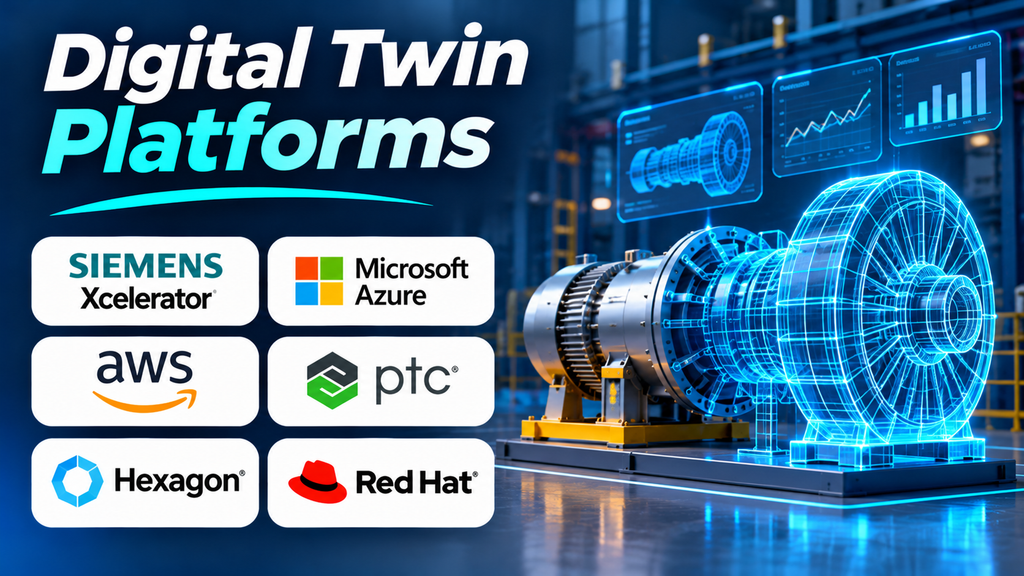
A digital twin is useful only when it reflects what is happening in the real world closely enough to support a decision. A detailed 3D model of a factory may look impressive, but without reliable equipment data, meaningful relationships, and a process for acting on insights, it remains a visualization rather than an operational digital twin.
Digital twin platforms help organizations connect physical assets with their digital representations, combining engineering models, sensor readings, operational records, and analytics. However, these platforms do not all solve the same problem. Some focus on industrial operations, others on infrastructure, connected environments, or physics-based simulation.
Choosing the right one starts with deciding what the twin must actually do.
What a Digital Twin Platform Needs to Deliver
A digital twin is more than a static 3D model or dashboard. Depending on the use case, it may represent a machine, production line, building, energy network, or large infrastructure asset. The representation can be updated with real-world data and used to understand current conditions, investigate problems, or evaluate proposed changes.
A capable platform typically supports several connected layers:
- Asset and system modeling: Represents equipment, spaces, components, and the relationships between them.
- Data integration: Connects engineering information, IoT sensors, enterprise applications, and operational systems.
- Visualization: Presents the twin through dashboards, 3D scenes, maps, or engineering views.
- Analytics and simulation: Helps teams identify patterns, test scenarios, or predict how a system may behave.
- Application development: Lets developers build workflows and interfaces around the twin.
- Governance and operations: Manages access, data quality, updates, security, and ongoing maintenance.
Not every implementation requires all six layers. A building operations team may need a connected view of equipment status and maintenance records, while an engineering team developing an autonomous production process may need detailed physics simulation. Buying a broad platform before defining the use case can introduce unnecessary cost and complexity.
Digital Twin Platforms Worth Evaluating
The following products represent different approaches to digital twins rather than a universal ranking. Their suitability depends on the asset being modeled, existing technology investments, required fidelity, and the team’s implementation capabilities.
1. Microsoft Azure Digital Twins — Model Connected Environments
Azure Digital Twins is designed to model connected environments and the relationships among their components. Its twin graph can represent spaces, devices, equipment, and the way these elements interact, making it relevant to smart buildings, facilities, energy systems, and other connected environments.
The platform is particularly worth considering when the goal is to build a structured digital representation that can be queried and connected to wider applications and analytics. Microsoft provides a modeling language, APIs, SDKs, and developer documentation for building these solutions.
The important trade-off: Azure Digital Twins is not a complete, ready-made engineering simulation suite. Teams should plan how live data will enter the model, how 3D visualization will be delivered, and which analytics or simulation services are needed around it.
2. AWS IoT TwinMaker — Connect Operational Data to a 3D Twin
AWS IoT TwinMaker focuses on creating operational digital twins from existing data sources. It can combine information from equipment sensors, video feeds, and enterprise applications, then associate those sources with a model of a factory, building, or industrial system.
Its scene-composition tools can bring existing CAD, BIM, and point-cloud assets into a 3D environment, with operational data displayed in context. That makes it relevant when maintenance or operations teams need to investigate equipment conditions without switching constantly between disconnected systems.
The official describes its data connectors, entity relationships, scene composition, and application workflows.
The important trade-off: This is an AWS service, so architecture, permissions, data storage, integrations, and operating costs need to be evaluated as part of the wider AWS environment. A 3D scene alone will not solve data-quality or sensor-reliability problems.
3. Bentley iTwin Platform — Infrastructure and Built Assets
Bentley iTwin Platform is oriented toward infrastructure digital twins. It provides APIs and services for bringing engineering data together with reality data, geospatial information, IoT data, and other asset information.
This focus makes it a strong candidate for teams working with roads, railways, utilities, bridges, industrial facilities, and major construction projects. Rather than treating the twin as a standalone model, the platform supports applications that connect information across design, construction, and operations.
Bentley’s explains its developer-oriented architecture and infrastructure use cases.
The important trade-off: Its specialization is an advantage for infrastructure work, but organizations should evaluate whether its data model, development approach, and commercial arrangements suit their asset portfolio. Teams seeking primarily factory-machine simulation may need a different core platform.
4. NVIDIA Omniverse — Simulation-Ready Industrial Environments
NVIDIA Omniverse is a collection of libraries and services for developing 3D workflows, simulation applications, and industrial digital twins. It is particularly relevant when a digital twin needs more than monitoring: engineering teams may want to evaluate layouts, simulate physical behavior, test robotics workflows, or validate changes before applying them to real equipment.
Its use of OpenUSD supports the assembly and exchange of complex 3D scenes across compatible tools and workflows. NVIDIA’s describes the platform’s development components and industrial simulation applications.
The important trade-off: Simulation-ready twins can demand substantial 3D preparation, computing resources, specialist skills, and validation. Omniverse should not be treated as a plug-and-play asset-monitoring dashboard; teams need to define which simulations are necessary and how their results will be checked against real-world behavior.
5. PTC ThingWorx — Industrial IoT and Connected Operations
PTC ThingWorx focuses on industrial connectivity and applications that use data from products, people, equipment, and processes. It is worth evaluating when a digital twin initiative is closely tied to connected manufacturing, service operations, or industrial IoT workflows.
A key distinction is that an industrial IoT platform can provide the connectivity and application layer around a digital twin without being identical to a high-fidelity simulation environment. For many operational use cases, getting dependable equipment data into a useful workflow matters more than creating a photorealistic model.
PTC describes ThingWorx and its industrial IoT capabilities on its official product page.
The important trade-off: Confirm the precise capabilities, licensing, deployment options, and integrations available for the proposed solution. If the primary requirement is detailed physics-based simulation or infrastructure-scale engineering data, evaluate those needs separately rather than assuming an industrial IoT platform covers them all.
6. Siemens Xcelerator — An Industrial Digitalization Ecosystem
Siemens Xcelerator is an industrial digital business platform and ecosystem, not a single standalone digital twin application. It brings together Siemens and partner software, hardware, and services across areas including industry, buildings, electrification, grids, and transportation.
For organizations already using Siemens technologies, its ecosystem may provide a useful path to connecting engineering, manufacturing, and operational workflows. The relevant evaluation question is not simply whether Xcelerator supports digital twins, but which specific products and services in the ecosystem are needed to implement the intended twin.
Explore the official Siemens Xcelerator overview.
The important trade-off: Because Xcelerator is an ecosystem, buyers should identify the exact component products, integrations, deployment requirements, and licensing terms in the proposed solution. A broad platform label does not define the capabilities or total cost of a specific implementation.
How the Platforms Compare
| Platform | Main orientation | Consider it when… | Main consideration |
|---|---|---|---|
| Azure Digital Twins | Connected-environment modeling | You need a structured model of assets and their relationships | Plan visualization and analytics around the core service |
| AWS IoT TwinMaker | Operational industrial twins | You want to bring existing sensor, video, and business data into a shared view | AWS architecture and data integration affect implementation |
| Bentley iTwin Platform | Infrastructure engineering | Your assets are bridges, roads, railways, utilities, or major facilities | Evaluate infrastructure-specific workflows and APIs |
| NVIDIA Omniverse | 3D simulation and industrial environments | You need to simulate or validate complex physical systems | Simulation requires technical expertise and model validation |
| PTC ThingWorx | Industrial IoT applications | Connected equipment and operational workflows are the priority | Separate IoT needs from advanced simulation requirements |
| Siemens Xcelerator | Industrial technology ecosystem | You want to connect engineering and industrial workflows across Siemens and partner offerings | Identify the specific products required within the ecosystem |
These platforms are not interchangeable. Some provide foundational modeling or development services, while others emphasize industrial connectivity, infrastructure data, or simulation. Before comparing licensing or features, ensure the shortlisted products are intended to solve the same problem.
Choose by the Decision You Need to Make
The most effective selection process starts with a business or engineering decision, not a software feature list.
Industrial Digital Twin Platform | PETRAN | Ombrulla
If your priority is monitoring equipment
Focus on data connectivity, sensor reliability, alerting, maintenance records, and integration with operational systems. AWS IoT TwinMaker and PTC ThingWorx are relevant candidates to investigate.
Bentley Systems Launches iTwin Experience iTwin Capture and iTwin IoT To Extend iTwin Platform
If your priority is infrastructure lifecycle management
Assess how the platform combines engineering models, geographic data, site observations, and asset records. Bentley iTwin Platform is designed around infrastructure use cases.
SIMATIC S7-1500 – High-Performance PLC with Safety | Siemens | Siemens
If your priority is simulation
Examine the required physical fidelity, supported simulation workflows, computing needs, and validation process. NVIDIA Omniverse is worth evaluating for simulation-intensive applications.
If your priority is modeling a connected environment
Consider how assets, spaces, devices, and their relationships will be represented and queried. Azure Digital Twins is one option for building this kind of connected model.
The Implementation Work That Often Gets Underestimated
Selecting the platform is only one part of a digital twin project. The quality of the implementation depends on the data, models, and processes connected to it.
Data quality and synchronization
Sensor readings may arrive late, use different units, or refer to equipment under inconsistent identifiers. Engineering models may also become outdated after physical modifications. Define ownership for each data source, synchronization expectations, and procedures for resolving conflicts before building operational workflows around the twin.
Model fidelity
A useful twin does not always require a highly detailed 3D representation. A building operations team may need accurate room, equipment, and sensor relationships, while a robotics engineering team may require detailed geometry, physics properties, and simulated sensors.
Choose fidelity based on the decision being supported. Excessive detail adds preparation and maintenance work without necessarily improving the result.
Integration with existing systems
Map the systems that must exchange information with the twin, such as asset management, maintenance, enterprise resource planning, building management, supervisory control, or engineering applications. Confirm whether the necessary interfaces are documented and supported, and identify where custom connectors or middleware will be required.
For operational technology, define the security boundary carefully. A monitoring twin does not automatically need permission to send commands back to physical equipment. Keep control functions separate unless a specific, reviewed use case requires them.
Security and ownership
Digital twins can consolidate sensitive engineering designs, building layouts, production information, and operational data. Review identity management, least-privilege access, network boundaries, data retention, audit logging, and vendor responsibilities.
Also establish who owns the model, sensor mappings, custom applications, and integration code. These assets can become difficult to maintain if knowledge is concentrated in one supplier or contractor.
A Practical Pilot Before You Commit
A small pilot should test the entire data-to-decision workflow rather than simply demonstrate an attractive 3D screen.
- Select one asset or process. Choose something important enough to matter but narrow enough to measure and manage.
- Define a decision. For example, identify abnormal equipment conditions, locate an infrastructure change, or compare alternative facility layouts.
- Connect a limited set of trustworthy data sources. Include only the engineering, sensor, or operational information needed for the decision.
- Set acceptance criteria. Measure data freshness, model accuracy, alert usefulness, response time, and the effort required to maintain the system.
- Test failure scenarios. Check what happens when a sensor disconnects, information becomes stale, a model changes, or an integration fails.
- Estimate the ongoing cost. Include software licensing, cloud usage, data pipelines, 3D preparation, integration development, support, and internal staff time.
- Decide whether to expand. Scale only when the pilot demonstrates a repeatable operational benefit and the team can maintain the solution.
This process helps reveal a common problem early: a platform may be technically capable, yet unsuitable for the organization’s available data, skills, or operating model.
Questions to Ask During a Vendor Demonstration
Ask vendors to demonstrate the intended workflow using representative data and realistic constraints.
- Can the platform connect to our existing systems without forcing unnecessary data duplication?
- How are asset identifiers, relationships, and engineering-model changes managed?
- Which functions require separate products, services, or licenses?
- What happens when data is delayed, missing, or inconsistent?
- Can we export our models and data if we change platforms?
- How are permissions, audit records, and sensitive engineering information managed?
- What specialist skills are needed to build and maintain the solution?
- Which costs depend on usage, data volume, compute, storage, or the number of assets?
- How can we validate simulation results against physical measurements?
- What evidence can the vendor provide for the specific workflow we intend to deploy?
Request a clear distinction between capabilities available in the proposed configuration and those that require additional components or custom development.
Frequently Asked Questions
Is a digital twin the same as a 3D model?
No. A 3D model represents an object’s geometry or appearance. A digital twin connects a digital representation to information about the real asset or system. Depending on the use case, that information may include live sensor readings, maintenance history, operating conditions, relationships, and simulation results.
Do all digital twins need real-time sensor data?
No. Some twins are updated periodically from engineering or operational records. Real-time data is important when decisions depend on current conditions, but it adds connectivity, reliability, security, and maintenance requirements. Update frequency should match the decision being supported.
Do digital twin platforms always include simulation?
No. Some platforms concentrate on modeling, data integration, visualization, or application development. Advanced physics, process, or robotics simulation may require dedicated software or additional components. Confirm the exact capabilities required by your use case.
Are digital twins suitable for small businesses?
They can be, particularly when a narrowly scoped twin addresses a measurable problem. A small implementation may use existing models and a limited set of data sources. The important question is whether the operational benefit justifies the integration and ongoing maintenance effort.
How should organizations compare total cost?
Look beyond the initial subscription or license. Include implementation, connectors, cloud infrastructure, data preparation, model updates, security, training, specialist staff, and support. A pilot with representative workloads can provide a more useful estimate than a headline license price.
The Right Platform Is the One That Supports a Real Decision
Digital twin software should be selected according to the system being represented and the decision the twin must improve. Azure Digital Twins is relevant to connected-environment modeling, AWS IoT TwinMaker to operational industrial views, Bentley iTwin Platform to infrastructure, NVIDIA Omniverse to simulation-intensive environments, PTC ThingWorx to industrial IoT applications, and Siemens Xcelerator to a broader industrial technology ecosystem.
Start with one clearly defined workflow, verify that the necessary data can be trusted, and test the platform against measurable acceptance criteria. A smaller, well-maintained digital twin that helps people act on reliable information is more valuable than a sophisticated virtual model that no one can confidently use.
