Upgrade & Secure Your Future with DevOps, SRE, DevSecOps, MLOps!
We spend hours scrolling social media and waste money on things we forget, but won’t spend 30 minutes a day earning certifications that can change our lives.
Master in DevOps, SRE, DevSecOps & MLOps by DevOps School!
Learn from Guru Rajesh Kumar and double your salary in just one year.
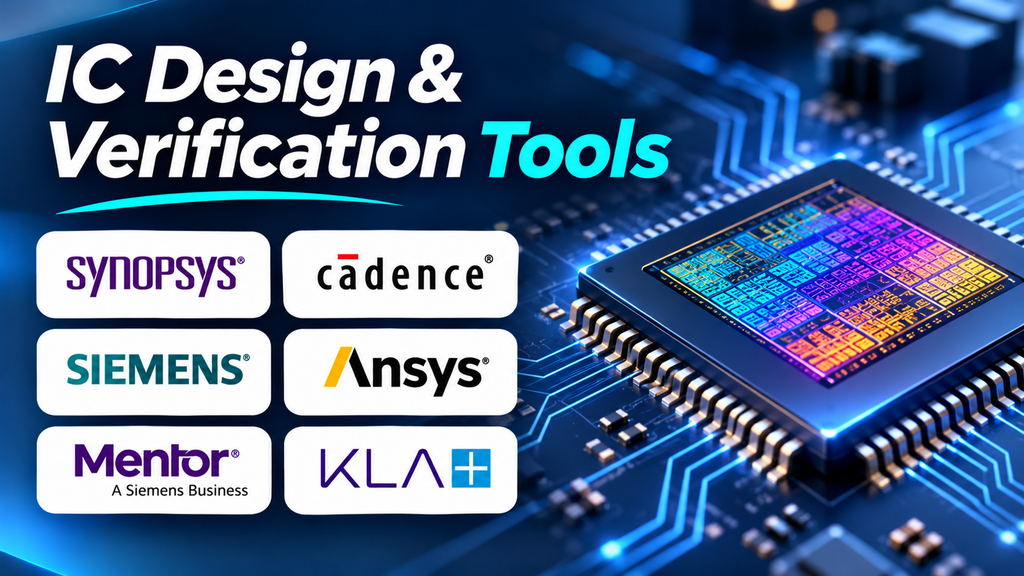
IC Design and Verification Tools: From RTL to Silicon Sign-Off
A digital chip can pass its initial simulation and still fail to meet timing, exceed its power budget, or contain a design flaw that becomes expensive to fix after fabrication. That is why integrated-circuit development relies on a chain of specialized electronic design automation (EDA) tools rather than a single application.
IC design and verification tools support different stages of that chain: describing hardware, checking its behavior, synthesizing logic, implementing physical layouts, and verifying that the finished design meets its requirements. Selecting them requires understanding the handoffs between stages as much as the capabilities of individual products.
The most important distinction is between functional correctness, implementation quality, and physical sign-off. Each answers a different question, and no single verification step proves all three.
The IC Design Workflow, Explained
A typical digital ASIC workflow moves through RTL design, functional verification, logic synthesis, physical implementation, and sign-off. Verification runs throughout this process, not just at the end. Analog and mixed-signal chips follow related but different flows.
Tools That Cover Different Parts of the Flow
Synopsys VCS supports RTL simulation. Cadence Xcelium supports digital simulation and verification. Siemens Questa supports simulation and verification. Synopsys Design Compiler and Cadence Genus support logic synthesis. Synopsys IC Compiler II and Cadence Innovus support physical implementation. Cadence Jasper supports formal verification. Siemens Calibre supports physical verification.
The Critical Distinction: Simulation, Formal Verification, and Sign-Off
RTL simulation evaluates behavior under tested scenarios. Formal verification checks specified properties under modeled assumptions. Logic synthesis creates a gate-level implementation. Static timing analysis checks constrained timing paths. Physical design-rule checking evaluates compliance with applicable layout rules, while layout-versus-schematic checking verifies correspondence between layout connectivity and the reference design.
How to Choose Tools for an IC Team
Begin with the design type: digital ASIC, FPGA, analog or mixed-signal IC. Match verification depth to risk, maintain trustworthy constraints and libraries, evaluate the whole toolchain and its data handoffs, and account for compute, licensing, and specialist support.
Common Mistakes That Weaken an IC Design Flow
Do not treat a passing simulation as proof of correctness, optimize against unreliable constraints, assume pre-route timing is final, use mismatched process files, or compare tools with different inputs.
A Practical Evaluation Plan
Select a representative design, use consistent source files and constraints, measure verification and implementation outcomes, test handoffs, document licensing and compute needs, and review results with design, verification, implementation, and sign-off engineers.
Build the Flow Around Evidence, Not Brand Preference
The best toolchain is the one that makes design assumptions explicit, produces reproducible results, and catches failures before tape-out. A small, well-integrated set of tools with clear acceptance criteria is often more valuable than a larger collection of applications whose outputs and responsibilities are poorly coordinated.
