Upgrade & Secure Your Future with DevOps, SRE, DevSecOps, MLOps!
We spend hours scrolling social media and waste money on things we forget, but won’t spend 30 minutes a day earning certifications that can change our lives.
Master in DevOps, SRE, DevSecOps & MLOps by DevOps School!
Learn from Guru Rajesh Kumar and double your salary in just one year.
Introduction
Customer relationships do not end when a sale is completed. Businesses must help customers achieve their desired outcomes, resolve challenges, and continue receiving value from the products or services they purchase. Customer Success Platforms help organizations manage these activities proactively, monitor customer health, and identify opportunities to improve retention and long-term growth.
These platforms are especially useful for software-as-a-service (SaaS) companies, subscription businesses, and organizations with ongoing customer relationships. They bring customer information, engagement history, renewal activities, and success plans into a centralized workspace.
What Is a Customer Success Platform?
A Customer Success Platform is software that helps teams monitor customer relationships after acquisition, coordinate customer engagement, identify potential risks, and support renewals or expansion opportunities.
Depending on the product, it may include customer health scores, onboarding plans, automated alerts, usage analytics, task management, renewal tracking, customer feedback, and reporting. These capabilities help customer success managers prioritize accounts and take action before small issues become larger problems.
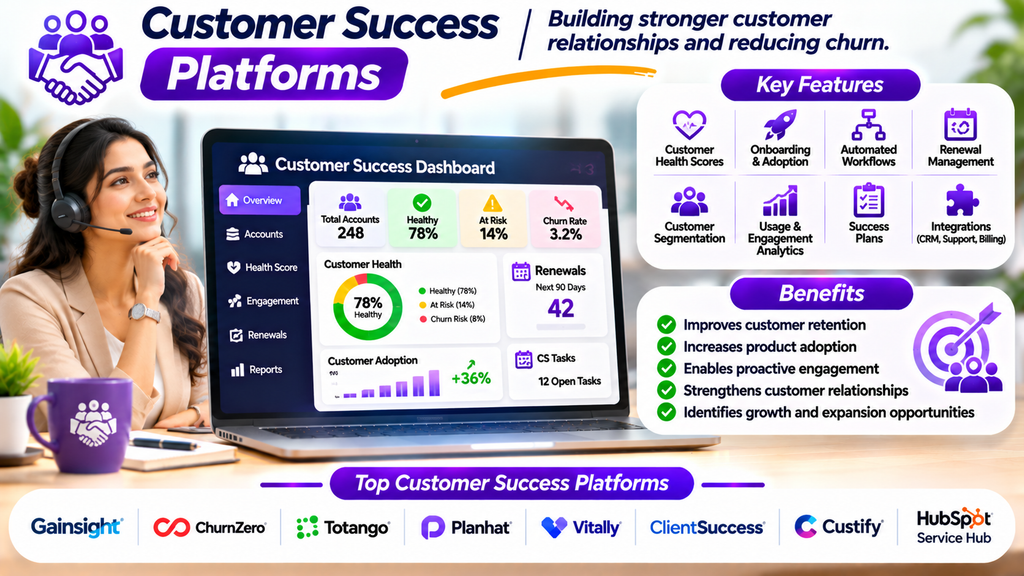
Top Customer Success Platforms
1. Gainsight
Gainsight provides customer success management capabilities, including customer health monitoring, journey management, analytics, and workflows for managing customer relationships.
Best for: Mid-sized and large organizations with structured customer success teams.
2. ChurnZero
ChurnZero helps subscription businesses monitor customer engagement, identify account risks, automate outreach, and manage customer success activities.
Best for: SaaS companies focused on customer retention and product adoption.
3. Totango
Totango supports customer segmentation, health monitoring, success plans, and coordinated customer engagement workflows.
Best for: Organizations managing customer success programs across multiple segments.
4. Planhat
Planhat combines customer data, relationship management, analytics, and workflow capabilities to help teams manage the customer lifecycle.
Best for: Customer success teams that need a consolidated view of customer activity and outcomes.
5. Vitally
Vitally provides customer success workflows, account views, health monitoring, and reporting to help teams organize customer engagement.
Best for: SaaS businesses seeking flexible customer success operations.
6. ClientSuccess
ClientSuccess supports customer relationship tracking, onboarding, renewals, and customer success planning through a centralized platform.
Best for: Teams that want to organize account management and renewal workflows.
7. Custify
Custify focuses on customer success management for subscription businesses, with capabilities for customer health, onboarding, reporting, and automated workflows.
Best for: SaaS companies building structured retention programs.
8. HubSpot Service Hub
HubSpot Service Hub provides customer service and relationship-management capabilities, including ticketing, customer feedback, and reporting. Its suitability for customer success workflows depends on the configuration and subscription.
Best for: Businesses that want to connect customer service activities with their broader CRM processes.
Available features, integrations, and pricing depend on the vendor and subscription plan.
Essential Features to Look For
- Customer health scores: Combine relevant indicators to identify accounts that may need attention.
- Customer onboarding: Organize implementation tasks, milestones, and early engagement.
- Usage and engagement analytics: Understand how customers interact with a product or service.
- Automated workflows: Trigger reminders, follow-ups, and actions based on defined conditions.
- Renewal management: Track renewal dates, responsibilities, and account risks.
- Customer success plans: Record goals, milestones, responsibilities, and desired outcomes.
- Account segmentation: Group customers by needs, value, lifecycle stage, or other relevant criteria.
- Reporting and dashboards: Review retention, adoption, engagement, and team activity.
- Integrations: Connect CRM, billing, product analytics, support, and communication systems.
- Collaboration tools: Share account context and coordinate work across customer-facing teams.
Benefits of Customer Success Platforms
Improved Customer Retention
Early identification of customer risks gives teams more time to investigate concerns and provide appropriate support.
Better Product Adoption
Usage insights and onboarding workflows help teams guide customers toward relevant features and successful outcomes.
More Proactive Engagement
Automated alerts and scheduled activities can help teams reach out before customers disengage.
Stronger Customer Relationships
A consolidated account history makes it easier to understand customer needs and maintain continuity across interactions.
More Efficient Team Workflows
Standardized processes reduce manual tracking and help customer success managers prioritize important tasks.
Opportunities for Growth
When customers achieve value, teams may be better positioned to identify suitable renewals, expansions, or additional services without relying on aggressive sales tactics.
How to Choose the Right Customer Success Platform
- Define your objectives: Decide whether your priority is onboarding, retention, adoption, renewal management, or account expansion.
- Understand your customer base: Consider customer volume, subscription models, account complexity, and team structure.
- Evaluate customer data: Confirm that the platform can access the information needed for meaningful health scores and reporting.
- Check workflow automation: Test whether common tasks and alerts can be configured without excessive manual effort.
- Review integration requirements: Verify compatibility with your CRM, billing, support, and product analytics systems.
- Assess usability: Make sure customer success managers can quickly understand account status and next steps.
- Review reporting: Confirm that dashboards support the metrics your business uses to evaluate customer outcomes.
- Consider security: Examine access controls, data handling, and relevant compliance requirements.
- Compare total cost: Include licensing, implementation, integration, and ongoing administration.
- Run a pilot: Test the platform with a representative group of accounts before a wider rollout.
Best Practices for Customer Success Management
- Define customer outcomes during onboarding.
- Establish health indicators that reflect meaningful customer behavior.
- Keep customer records accurate and up to date.
- Create clear ownership for account follow-ups and renewal activities.
- Use automation to support human relationships, not replace them.
- Review at-risk accounts regularly and investigate the reasons behind warning signals.
- Personalize communication according to customer needs and lifecycle stage.
- Coordinate customer success with sales, support, product, and finance teams.
- Measure retention and customer outcomes alongside activity metrics.
- Use customer feedback to improve products, services, and onboarding experiences.
Conclusion
Customer Success Platforms help businesses organize customer relationships, monitor engagement, identify potential risks, and support long-term retention. Tools such as Gainsight, ChurnZero, Totango, Planhat, Vitally, ClientSuccess, Custify, and HubSpot Service Hub offer different approaches to customer success and service workflows.
The right platform depends on your customer lifecycle, data sources, team size, automation needs, integrations, and budget. Software is most effective when combined with clear customer outcomes, proactive communication, accurate data, and a genuine commitment to helping customers succeed.
