Upgrade & Secure Your Future with DevOps, SRE, DevSecOps, MLOps!
We spend hours scrolling social media and waste money on things we forget, but won’t spend 30 minutes a day earning certifications that can change our lives.
Master in DevOps, SRE, DevSecOps & MLOps by DevOps School!
Learn from Guru Rajesh Kumar and double your salary in just one year.
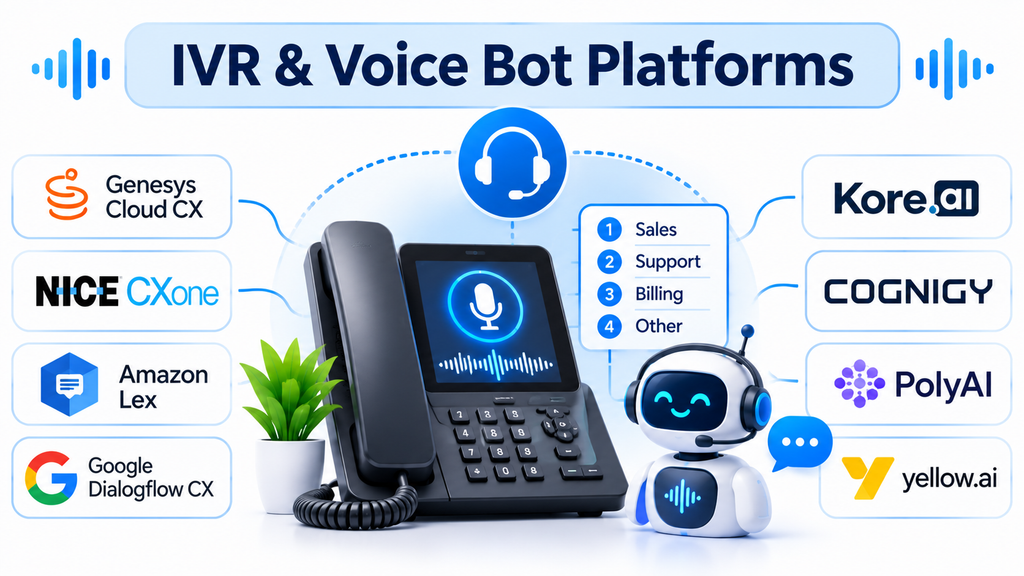
Automating Customer Conversations with Intelligent IVR and Voice Bot Technology
Telephone support remains an important part of customer service for banks, healthcare providers, telecommunications companies, retailers, financial institutions, and other service-oriented businesses.
However, handling every incoming call through a human representative can be expensive and time-consuming. Customers may experience long waiting times, repetitive questions, and unnecessary transfers between departments.
Interactive Voice Response (IVR) systems and intelligent voice bots help organizations automate these interactions. They allow callers to navigate telephone menus, ask questions, receive information, and complete selected tasks without always requiring human assistance.
Modern platforms combine speech recognition, natural language understanding, conversational AI, and integrations with business applications to create more interactive telephone experiences.
What Are IVR and Voice Bot Platforms?
IVR and voice bot platforms are software solutions that automate telephone interactions between businesses and customers.
Traditional IVR systems typically use recorded voice prompts and keypad selections to guide callers through predefined options.
For example, a caller might press 1 for sales, 2 for technical support, or 3 for billing.
Intelligent voice bots go further by allowing customers to speak naturally instead of navigating only through keypad menus.
Depending on the platform, common capabilities include:
- Automated telephone menus.
- Speech recognition.
- Natural language understanding.
- Text-to-speech conversion.
- Conversational voice automation.
- Customer identification and verification.
- Appointment scheduling.
- Automated information retrieval.
- CRM and database integrations.
- Call transfers to human agents.
- Conversation analytics.
- Multilingual voice interactions.
These technologies can help organizations automate repetitive requests while maintaining human support for complicated or sensitive situations.
Leading IVR and Voice Bot Platforms to Evaluate
1. Genesys Cloud CX
Genesys Cloud CX provides cloud-based contact center technology with capabilities for automated customer interactions.
Its environment supports IVR, intelligent routing, voice automation, and broader customer experience management.
Organizations can configure automated telephone workflows that direct customers to appropriate services or support representatives.
It is relevant to enterprises that need advanced call routing and automation integrated with their wider contact center operations.
Businesses should evaluate its voice bot functionality, language support, integration requirements, and deployment complexity.
2. NICE CXone
NICE CXone provides contact center technology focused on customer experience, automation, and operational management.
Its capabilities can support automated interactions, intelligent routing, agent assistance, and customer communication workflows.
Its conversational AI ecosystem, including NiCE Cognigy, is relevant to businesses looking to develop more advanced voice automation experiences.
Organizations should evaluate conversational capabilities, integration options, analytics, and the level of customization required.
3. Amazon Lex
Amazon Lex is a conversational AI service that enables businesses to build voice and text-based conversational interfaces.
It uses speech recognition and natural language understanding to interpret customer requests and support automated conversations.
Organizations can connect conversational workflows with backend services and other AWS infrastructure.
It is particularly relevant to businesses that want to develop customized voice bots rather than depend entirely on predefined telephone menus.
Technical teams should evaluate integration architecture, speech recognition requirements, supported languages, and usage-based costs.
4. Google Dialogflow CX
Google Dialogflow CX provides tools for building conversational agents with structured dialogue management.
It supports voice and text interactions and can be integrated with telephone and customer service environments.
Businesses can use it to develop automated customer assistance, guided conversations, and complex dialogue workflows.
Its visual conversation design capabilities can help teams organize multi-step customer interactions.
It is worth considering for organizations using Google Cloud or requiring customized conversational automation.
5. Kore.ai
Kore.ai provides enterprise conversational AI technology for building virtual assistants and automated customer interactions.
Its capabilities can support voice-based conversations, workflow automation, integrations, and customer service use cases.
Businesses can use conversational assistants to answer questions, retrieve information, and complete supported tasks through connected systems.
It is relevant to organizations seeking enterprise conversational automation across different customer interaction channels.
Evaluation should include workflow complexity, governance, integration depth, security, and deployment requirements.
6. Cognigy
Cognigy provides enterprise conversational AI technology designed for customer service automation.
Its platform supports voice and digital conversations, allowing organizations to create automated customer interaction workflows.
Businesses can use it to develop voice assistants that understand customer requests, retrieve information, and transfer conversations when human support is needed.
It is particularly relevant to contact centers that want to automate repetitive customer inquiries while maintaining connected agent workflows.
Organizations should examine voice capabilities, integration options, language support, and implementation requirements.
7. PolyAI
PolyAI focuses on conversational voice assistants designed for enterprise customer service operations.
Its technology is relevant to organizations that receive substantial volumes of incoming telephone inquiries.
Businesses can use voice automation to handle supported customer requests, provide information, and route callers to the appropriate departments.
It is particularly worth evaluating for voice-first customer service environments where natural spoken conversations are important.
Buyers should assess conversational accuracy, telephony integration, escalation workflows, supported languages, and operational requirements.
8. Yellow.ai
Yellow.ai provides conversational AI solutions supporting customer engagement through voice and digital channels.
Its technology can help organizations develop automated assistants for customer support, information retrieval, and business workflows.
Businesses can evaluate it for multilingual interactions and connected customer service automation.
It is relevant to organizations looking to combine voice automation with other digital communication channels.
Important considerations include integration capabilities, language requirements, automation workflows, and governance controls.
9. Rasa
Rasa provides an open-source conversational AI framework and enterprise solutions for developing customized conversational assistants.
It is relevant to organizations that want greater control over conversational logic, integrations, and deployment architecture.
Technical teams can build assistants that interact with customers through supported communication channels and connected business systems.
Rasa is particularly suitable for engineering-led organizations with customization and infrastructure requirements.
Businesses should assess development resources, maintenance responsibilities, deployment needs, and the complexity of their intended voice integrations.
10. Five9
Five9 provides cloud contact center technology with capabilities supporting automated customer interactions.
Its environment can help businesses organize customer calls, manage routing, and connect automation with human agent workflows.
Organizations can evaluate its contact center automation capabilities alongside its broader inbound and outbound communication features.
It is relevant to businesses looking for an integrated approach to telephone-based customer service.
Buyers should review IVR functionality, conversational AI availability, integrations, and the requirements of their selected product plans.
Comparing IVR and Voice Bot Platforms
| Platform | Primary focus | Relevant business requirement |
|---|---|---|
| Genesys Cloud CX | Enterprise contact center automation | Complex telephone workflows |
| NICE CXone | Customer experience automation | Large contact centers |
| Amazon Lex | Custom conversational AI | AWS-based applications |
| Google Dialogflow CX | Conversational agent development | Structured voice interactions |
| Kore.ai | Enterprise conversational AI | Business workflow automation |
| Cognigy | Enterprise voice and digital automation | Contact center voice bots |
| PolyAI | Conversational voice assistants | High-volume inbound calls |
| Yellow.ai | Multichannel conversational AI | Multilingual customer support |
| Rasa | Custom conversational assistants | Developer-controlled deployments |
| Five9 | Cloud contact center automation | Integrated customer calling |
These platforms differ in their architecture and intended use cases. Some provide broader contact center environments, while others specialize in conversational AI development.
Understanding Traditional IVR and Intelligent Voice Bots
Although IVR and voice bots are related, they do not operate in exactly the same way.
Traditional IVR systems
Traditional IVR systems guide callers through predefined menus.
Customers interact using keypad selections or limited speech recognition.
For example:
- Press 1 for account information.
- Press 2 for billing.
- Press 3 for technical support.
- Press 0 to speak with an agent.
Traditional IVR is useful when businesses have predictable customer inquiries and straightforward routing requirements.
Intelligent voice bots
Intelligent voice bots use conversational technologies to understand spoken customer requests.
Instead of navigating through multiple menus, a customer might say, “I want to check my payment status.”
The system can interpret the request and respond using configured workflows and connected information sources.
Depending on the implementation, voice bots can support multi-turn conversations, customer authentication, transaction inquiries, and appointment scheduling.
Hybrid IVR and voice bot systems
Some organizations combine traditional menu structures with conversational voice automation.
Customers may receive a simple menu for common tasks while retaining the option to speak naturally when appropriate.
This approach can provide predictable navigation alongside more flexible conversations.
Essential Features to Consider
Automatic speech recognition
Automatic Speech Recognition (ASR) converts spoken language into text or machine-readable information.
It enables voice bots to identify customer requests without requiring keypad selections.
Organizations should assess recognition accuracy, background noise handling, accent support, and language availability.
Natural language understanding
Natural Language Understanding (NLU) helps systems interpret the meaning behind spoken requests.
For example, different statements such as “check my balance” and “how much money is in my account?” may express the same intent.
A capable system should recognize these variations and respond through appropriate workflows.
Text-to-speech technology
Text-to-Speech (TTS) converts written responses into spoken audio.
It allows voice bots to communicate information without requiring organizations to record every possible response manually.
Businesses should evaluate voice quality, pronunciation, supported languages, and customization options.
Call routing and escalation
Not every customer request should be handled automatically.
Voice bot platforms should provide clear options for transferring conversations to human representatives.
Useful capabilities include department-based routing, agent availability checks, conversation summaries, and escalation rules.
CRM and database integration
Integration allows voice bots to retrieve relevant information from connected business systems.
For example, an authorized customer may request an order update or appointment confirmation.
The system can retrieve the required information and provide a response through the telephone conversation.
Integrations should follow authentication and access-control requirements.
Multilingual support
Organizations serving customers across different regions may need voice automation in multiple languages.
Language support should include recognition accuracy, speech generation quality, pronunciation, and handling of language switching.
Businesses should test systems with actual customer accents and common regional expressions.
Analytics and reporting
Analytics provide visibility into automated customer interactions.
Useful metrics include:
- Total automated calls.
- Successful self-service completion.
- Human transfer rate.
- Average interaction duration.
- Customer abandonment.
- Intent recognition accuracy.
- Failed interaction rate.
- Customer satisfaction.
- Repeat contact frequency.
These measurements help organizations identify where automation works effectively and where conversation flows need improvement.
Benefits of IVR and Voice Bot Implementation
Reduced waiting times: Automated systems can handle routine inquiries without requiring every caller to wait for an available representative.
Continuous availability: Properly configured voice automation can provide selected services outside normal business hours.
Improved call distribution: IVR helps route callers to the appropriate departments.
Reduced repetitive work: Agents can spend more time on complex customer issues rather than answering the same basic questions repeatedly.
Consistent responses: Configured workflows help provide standardized information across customer interactions.
Scalable customer support: Businesses can automate suitable interactions as call volumes increase.
Improved customer insights: Interaction analytics can reveal common questions, customer needs, and service problems.
The actual benefits depend on conversation design, system accuracy, integration quality, and the suitability of the automated tasks.
Common IVR and Voice Bot Implementation Challenges
Poor speech recognition
Background noise, accents, unclear pronunciation, and technical limitations can affect speech recognition.
Businesses should test voice bots with realistic customer conversations and different speaking conditions.
Complicated telephone menus
Excessive menu options can frustrate callers and make simple requests unnecessarily difficult.
Organizations should keep navigation clear and provide straightforward access to human support.
Limited conversational understanding
Voice bots may struggle with unusual requests, ambiguous language, or conversations involving multiple subjects.
Testing and continuous improvement are necessary to improve intent recognition and response quality.
Integration difficulties
Voice automation often needs access to customer databases, CRM platforms, payment systems, and appointment applications.
Integration problems can prevent bots from completing tasks even when they understand the customer’s request.
Unsuccessful human transfers
A poor escalation process can force customers to repeat information after reaching an agent.
Organizations should transfer relevant conversation context whenever supported.
Customer resistance
Some customers prefer speaking directly with human representatives.
Businesses should make automated interactions useful, provide clear alternatives, and avoid forcing customers through unnecessary automated conversations.
Security and Privacy Considerations
IVR and voice bot systems may process personal information, account details, payment-related data, and sensitive customer conversations.
Security should therefore be considered throughout implementation.
Important requirements include:
- Secure customer authentication.
- Encryption for supported voice and data communications.
- Role-based access controls.
- Secure API integrations.
- Call recording permissions.
- Data retention and deletion policies.
- Protection of authentication information.
- Audit logs and monitoring.
- Vendor security assessments.
- Applicable privacy and industry regulations.
Organizations handling payment information should evaluate secure payment workflows and avoid exposing sensitive information through unnecessary recordings or transcripts.
Automated identity verification should also be tested against impersonation and unauthorized access risks.
How to Choose the Right IVR and Voice Bot Platform
The right solution depends on the organization’s call volume, automation goals, technical environment, and customer service requirements.
A small business may need a simple IVR with department routing and recorded messages. A large enterprise may require conversational voice bots connected to CRM systems, customer databases, and multiple contact center applications.
Before selecting a platform, evaluate:
- Expected incoming call volume.
- Traditional IVR and conversational voice requirements.
- Supported languages and accents.
- Speech recognition and voice quality.
- CRM and database integrations.
- Human escalation capabilities.
- Analytics and reporting.
- Security and privacy controls.
- Customization and deployment requirements.
- Complete implementation and operating costs.
A pilot project using actual customer scenarios can help identify recognition problems, workflow gaps, and integration limitations before full deployment.
Frequently Asked Questions
What does IVR stand for?
IVR stands for Interactive Voice Response. It is a telephone technology that allows callers to interact with automated menus using keypad selections or supported speech recognition.
What is a voice bot?
A voice bot is an automated conversational system that interacts with people through spoken language. It can understand requests, provide responses, and perform supported tasks through connected applications.
What is the difference between IVR and a voice bot?
Traditional IVR generally relies on predefined menus and structured selections. Voice bots use conversational AI and speech technologies to understand natural spoken requests and manage more flexible interactions.
Can voice bots replace human customer service agents?
They can automate selected repetitive tasks, but complex complaints, sensitive requests, and unusual situations often require human assistance. A hybrid approach is usually more appropriate.
Can IVR systems support multiple languages?
Yes. Many modern solutions support multiple languages, although recognition accuracy and voice quality vary by platform and language.
Are voice bots suitable for small businesses?
Yes. Small businesses can use voice automation for appointment scheduling, business information, basic inquiries, and call routing, depending on the platform and integration requirements.
How can businesses measure voice bot performance?
Useful measurements include automated resolution rate, human transfer rate, speech recognition accuracy, customer satisfaction, interaction duration, and repeat contact frequency.
Building Smarter Telephone Experiences Through Voice Automation
IVR and voice bot technology is changing how organizations manage telephone-based customer service.
Traditional IVR remains useful for structured call routing, while conversational voice bots provide more flexible ways to understand customer requests and automate routine interactions.
Genesys Cloud CX, NICE CXone, Amazon Lex, Google Dialogflow CX, Kore.ai, Cognigy, PolyAI, Yellow.ai, Rasa, and Five9 offer different approaches to implementing these capabilities.
The right choice depends on business requirements, technical resources, language needs, integration complexity, and customer expectations.
Organizations should focus on practical automation rather than simply deploying sophisticated voice technology. Clear conversations, accurate information, secure integrations, and reliable human escalation are essential for successful implementation.
A thoughtfully designed IVR and voice bot environment can help businesses improve call management, reduce repetitive work, and create more convenient customer communication experiences.
