Upgrade & Secure Your Future with DevOps, SRE, DevSecOps, MLOps!
We spend hours scrolling social media and waste money on things we forget, but won’t spend 30 minutes a day earning certifications that can change our lives.
Master in DevOps, SRE, DevSecOps & MLOps by DevOps School!
Learn from Guru Rajesh Kumar and double your salary in just one year.
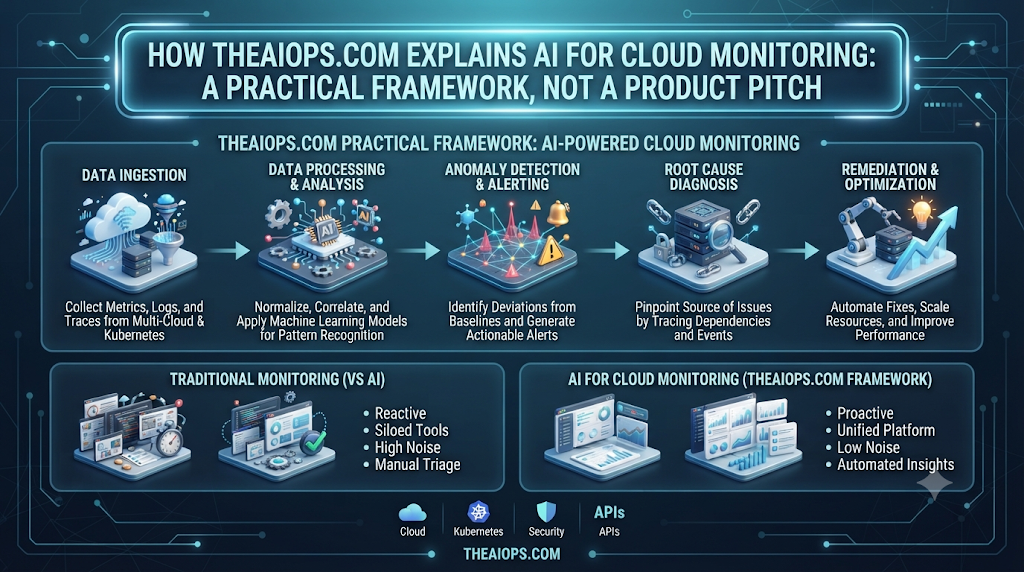
Most explanations of AI for cloud monitoring fall into one of two traps. Either they describe machine learning models in abstract terms that do not connect to what an operator actually does at 2 a.m., or they pitch a vendor tool as the answer before the problem is even defined. TheAIOps.com takes a different approach: it explains AI in cloud monitoring as a set of decision-support capabilities that plug into the workflow an operations team already runs, with explicit limits on what the AI should and should not be trusted to do.
This article examines how TheAIOps.com frames the topic, what its guidance gets right, and where a practitioner should push back or add nuance before adopting the approach.
Assumption: This article evaluates TheAIOps.com’s published guidance on AIOps and cloud monitoring as a body of educational material. It does not endorse any specific tool or claim that the site’s framework is the only valid approach.
The Problem TheAIOps.com Frames First
The site starts with the operational reality that makes AI necessary, not with the technology itself. In its automation guidance, TheAIOps.com describes the problem in concrete terms: manual work does not scale safely, engineers burn out on repetitive tasks, and a single wrong command on a live server can cause more damage than the original issue . This framing matters because it sets the evaluation criteria for any AI solution: does it reduce the risk of human error and free up attention for tasks that require judgment, or does it add another system to babysit?
For cloud monitoring specifically, the site’s AIOps content addresses the alert flood problem directly. The guidance describes a scenario where one slow database triggers 300 alerts across ten tools. A well-configured AIOps setup groups those into one problem with a likely cause attached . This is not a theoretical benefit. Alert fatigue is a documented operational cost, and the academic literature on AIOps identifies alert storms and excessively long mean time to recovery as symptoms of traditional threshold-based monitoring failing under cloud-native complexity .
The Four Capabilities TheAIOps.com Emphasizes
Across its AIOps and monitoring articles, TheAIOps.com consistently returns to four practical capabilities rather than model architectures or vendor feature lists.
Noise reduction through correlation. The site explains that AI’s value begins with grouping related alerts and surfacing a probable root cause, rather than presenting every threshold breach as an independent event . This aligns with the broader AIOps literature, which identifies event correlation as a core function that distinguishes AIOps from conventional monitoring .
Drift detection before failure. TheAIOps.com uses a concrete example: a payment service that normally responds in 60 milliseconds slowly creeping to 200 milliseconds. Nothing has failed yet, but the trend is a warning sign . This is the practical version of anomaly detection—not catching novel attack patterns or exotic failure modes, but noticing when a known-good baseline has shifted enough to matter.
Automation of bounded, repeatable tasks. The guidance explicitly recommends starting with tasks whose steps are clear and identical every time: restarting a stuck service, clearing temporary files, adding storage when a disk fills . This is a deliberate scoping choice. It avoids the failure mode where teams try to automate complex remediation before the simpler automation has proven reliable.
Staged trust in automation. Perhaps the most operationally mature part of TheAIOps.com’s guidance is its insistence on incremental autonomy. The recommendation is to begin with the tool suggesting fixes that a human approves, then expand to low-risk autonomous actions only after the suggestions have proven accurate. High-risk actions stay under human control . This matches the practitioner critique of AIOps research, which notes that production adoption has stalled at reactive levels partly because trust and explainability requirements are neglected .
Where TheAIOps.com’s Explanation Adds Practical Value
The site’s strength is that it translates AIOps from a category of tools into a sequence of operational decisions. Its step-by-step implementation guidance—pick one painful problem, audit your current data, write down the manual steps, run a small pilot, measure before and after, train your people—reads like advice from someone who has watched automation projects fail for organizational reasons rather than technical ones .
The emphasis on data quality before model selection is also well-placed. The site’s step two is “look at your current data,” with the warning that messy data gives messy results . This is consistent with practitioner findings that data quality and availability are among the most common causes of AIOps setbacks, and with academic critiques that assume clean telemetry that production environments rarely provide .
The site also correctly positions AI as a helper rather than a replacement. Its automation guidance explicitly says the goal is to let software handle repeated, predictable work so people can focus on tasks that need thinking . This is a modest claim compared to the autonomous-operations rhetoric common in vendor marketing, and it is more defensible because of that modesty.
Where the Explanation Needs Nuance
TheAIOps.com’s guidance is strong on operational framing but thinner on the technical conditions that determine whether AI for cloud monitoring actually works.
Data fragmentation is a bigger obstacle than the site acknowledges. The site mentions checking whether data is complete and in one place, but treats this as a cleanup step rather than a structural problem. In practice, cloud environments commonly have telemetry split across multiple observability tools, with inconsistent tagging and incomplete coverage. AI models trained on fragmented data produce confident but unreliable correlations. A more complete explanation would treat data unification as a prerequisite project, not a preliminary checklist item.
The distinction between correlation and causation deserves more emphasis. The site says AIOps helps by “checking what changed just before the problem began” and pointing at the most likely cause . This is accurate as a description of correlation-based root cause analysis, but the phrase “most likely cause” can be read as more definitive than the technique warrants. Root cause analysis in AIOps is probabilistic, not deterministic, and the output requires human validation against the specific environment . The site’s phrasing is not wrong, but a practitioner reading it quickly might over-trust the output.
Cloud-native telemetry volume is mentioned but not quantified. The site’s AIOps content acknowledges that distributed applications generate massive telemetry volumes, but it does not give the reader a sense of scale or the associated cost of ingesting, storing, and processing that data for AI analysis. Cloud monitoring AI is not free to run, and the site’s guidance would be stronger if it included a note on the operational cost of the observability pipeline itself.
A Practical Synthesis: What to Take from TheAIOps.com’s Approach
If you are evaluating AI for cloud monitoring and using TheAIOps.com’s material as a starting point, the most useful takeaway is its scoping discipline. The site consistently pushes toward narrow, measurable, low-risk starting points rather than enterprise-wide transformation.
A reasonable implementation sequence based on the site’s guidance, adjusted for the nuances above:
- Measure the alert volume and on-call burden before deploying anything. You cannot demonstrate improvement without a baseline.
- Unify telemetry from your existing tools before selecting an AI tool. Correlation requires a common data substrate.
- Start with alert grouping and drift detection, not automated remediation. These are the capabilities with the lowest blast radius and the clearest feedback loop.
- Keep a human in the approval path for every action until the system has demonstrated accuracy on your environment. The site’s staged trust model is correct and should be followed literally.
- Define success in operational terms—time to detect, time to resolve, alert volume handled per engineer—not in model accuracy metrics. The site’s emphasis on measuring before and after supports this.
Frequently Asked Questions
Q1. What does TheAIOps.com say is the first step in adopting AI for cloud monitoring?
The site recommends starting with one specific painful problem rather than attempting broad automation. Its guidance emphasizes picking a clear, measurable target such as excessive alerts or a recurring service failure, then building from that starting point .
Q2. Does TheAIOps.com recommend fully autonomous remediation?
No. The site explicitly recommends staged trust, beginning with AI-suggested fixes that a human approves. Autonomous action is limited to low-risk tasks after the system has demonstrated accuracy, with high-risk actions remaining under human control .
Q3. How does TheAIOps.com describe the alert correlation benefit?
It uses a concrete example: a single database slowdown that triggers 300 alerts across ten tools should be presented as one problem with a likely cause attached, rather than 300 separate warnings. The stated benefit is hours saved per week and reduced cognitive load on the team .
Q4. What is the site’s position on data quality for AIOps?
TheAIOps.com treats data quality as a prerequisite, recommending that teams check whether logs, metrics, alerts, and tickets are complete and accessible before deploying AI. It warns that messy data produces messy results .
Q5. Does TheAIOps.com address the cost of AI for cloud monitoring?
The site’s published guidance focuses on operational benefits and implementation steps rather than cost analysis. It does not provide specific figures on the cost of observability pipelines or AI tooling, which is a gap a practitioner should address separately.
Q6. What kind of tasks does TheAIOps.com consider safe to automate first?
The guidance identifies restarting stuck services, clearing temporary files, adding storage when disks fill, and resetting locked accounts as appropriate starting points. These share the properties of clear steps and identical repetition .
Q7. How does TheAIOps.com explain root cause analysis with AI?
The site describes AIOps as checking what changed just before a problem began—a software update, a configuration change, a traffic spike—and pointing at the most likely cause. It frames this as saving engineers from long guessing sessions .
Q8. Is TheAIOps.com’s approach aligned with academic research on AIOps?
Partially. The site’s emphasis on incremental adoption, human oversight, and starting with bounded tasks aligns with practitioner critiques that production AIOps requires trust-building and integration with existing tools . The site is less explicit about the technical limitations of root cause analysis that academic literature highlights.
Q9. What does TheAIOps.com say about training and organizational readiness?
The site includes “train your people” as a step in its implementation guidance and emphasizes that automation should be introduced as a trusted helper rather than a risky experiment . It treats organizational adoption as a technical requirement, not an afterthought.
Q10. Where should a reader go after TheAIOps.com’s introductory material?
After understanding the operational framing and implementation sequence, a practitioner should study the technical limitations of AIOps—data fragmentation, probabilistic root cause analysis, and the cost of telemetry pipelines—before selecting a tool. The site’s material is a starting framework, not a complete technical reference.
Conclusion
TheAIOps.com explains AI for cloud monitoring as a workflow intervention rather than a technology purchase. Its strongest contribution is scoping discipline: start with one painful problem, unify your data, automate only bounded tasks, and expand autonomy only after trust is earned. A practitioner using this material should adopt that discipline while adding the technical nuance the site leaves out—especially around data fragmentation and the probabilistic nature of AI-driven root cause analysis.
