Upgrade & Secure Your Future with DevOps, SRE, DevSecOps, MLOps!
We spend hours scrolling social media and waste money on things we forget, but won’t spend 30 minutes a day earning certifications that can change our lives.
Master in DevOps, SRE, DevSecOps & MLOps by DevOps School!
Learn from Guru Rajesh Kumar and double your salary in just one year.
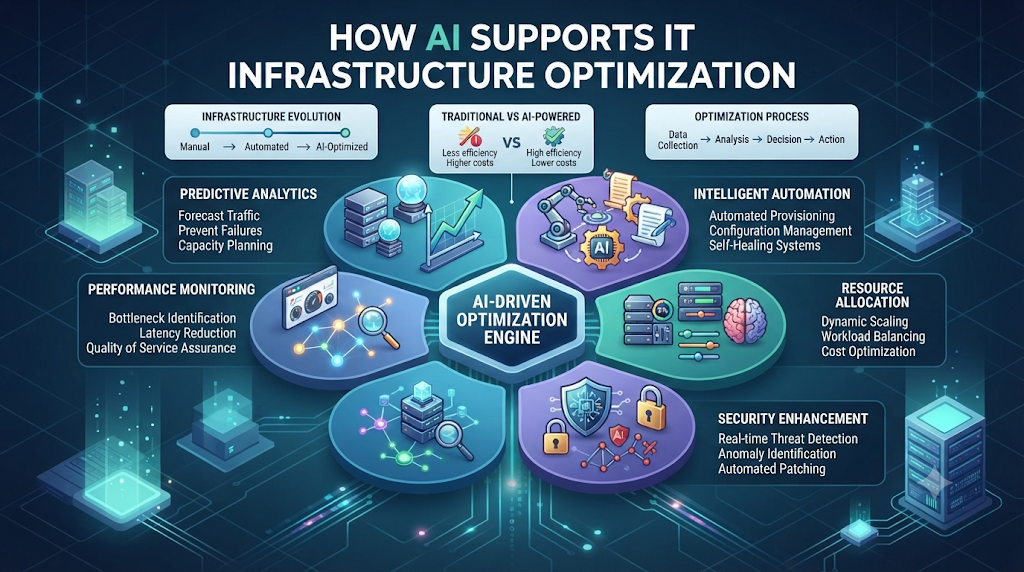
AI’s role in IT infrastructure optimization is often framed as a path to full autonomy. That framing is misleading. The more useful view is narrower and more practical: AI helps infrastructure teams make better decisions under conditions that rule-based systems and manual monitoring cannot handle—dynamic workloads, fragmented telemetry, and failure modes that emerge from the interaction between services rather than from any single component.
The gain is not magic. It comes from specific capabilities: forecasting resource demand before it peaks, correlating alerts across layers that humans mentally stitch together, and identifying idle or oversized resources that quietly consume budget. But the results depend heavily on how the technology is scoped and integrated. Only 28% of AI use cases in infrastructure and operations fully succeed and meet ROI expectations, while 20% fail outright, according to a Gartner survey of 782 I&O leaders. The difference between success and failure is rarely the sophistication of the model. It is whether the use case fits the operational reality.
Assumption: This article assumes you are evaluating AI for an environment that already has some monitoring and observability in place. It does not assume you are starting from scratch.
What AI Actually Does That Traditional Monitoring Cannot
Traditional infrastructure monitoring is threshold-based and reactive. It tells you a CPU is at 92%, a disk is filling, or a service stopped responding. What it does not tell you is whether that CPU spike is a transient batch job or the leading edge of a cascading failure, whether that disk growth is expected or anomalous for this particular workload, or whether the service failure is the root cause or a downstream symptom of something else.
AI changes the decision layer, not the data collection layer. Three capabilities matter most in production settings.
Predictive forecasting uses historical telemetry to estimate future resource demand. A framework tested on a simulated hybrid cloud with 500 virtual nodes and 1.2 million telemetry events reduced over-provisioning by 18.4% while forecasting failures up to 15 minutes ahead with 89.6% precision. The practical value is not perfect prediction. It is buying enough lead time to act—scaling a cluster, draining a node, or pre-warming capacity—before users feel impact.
Intelligent event correlation addresses alert fatigue, which is a real operational cost, not a minor annoyance. When a single incident generates dozens of alerts across network, compute, and application layers, engineers spend time reconstructing the causal chain. AIOps platforms group related symptoms and surface the likely root cause. In one industrial deployment across twelve companies, this correlation capability contributed to a 62.2% reduction in mean time to detect and a 79.3% decrease in manual tickets.
Resource rightsizing identifies waste that static policies miss. The Fraunhofer Edge Cloud project used explainable AI to generate prioritized recommendations for resizing or shutting down resources. In a proof of concept, the system freed up to 363% additional CPUs and 336% additional RAM by targeting “zombie” instances and oversized virtual machines. The key word here is explainable: recommendations that come with a reason (“this VM has averaged 4% CPU over 30 days but is provisioned for 16 cores”) are far more likely to be accepted by teams than a black-box instruction.
Where AI Fits in the Optimization Workflow
A workable pattern emerges across implementations that survive contact with production: AI does not replace the operational workflow. It inserts intelligence into specific decision points.
| Stage | Traditional approach | AI-augmented approach | What changes |
|---|---|---|---|
| Detect | Threshold alerts | Anomaly detection against behavioral baselines | Fewer false positives; catches novel patterns |
| Diagnose | Manual correlation across tools | Event grouping and root-cause ranking | Faster triage; less context switching |
| Decide | Static runbooks or human judgment | Forecasted impact and recommendation with explanation | Better resource/cost trade-offs |
| Act | Manual remediation or scripted response | Policy-bounded automation or human-approved action | Speed with guardrails |
The last row is where most failures happen. Gartner found that I&O leaders most frequently observe AI failures in auto-remediation, self-healing infrastructure, and agent-led workflow management. The failure mode is consistent: teams expect AI to handle complex, unpredictable operational tasks that exceed what the tools can reliably deliver. A practitioner critique of academic AIOps research makes the same point from the production side: evaluation on synthetic workloads misses cascading failure dynamics, and proposals often assume clean telemetry that does not exist in real environments.
A more durable approach is to start AI where the blast radius is small and the value is visible. Rightsizing recommendations that a human reviews before execution. Anomaly detection that flags but does not auto-remediate. Correlation that reduces alert noise without changing who has authority to act. Expand autonomy only after the system has demonstrated judgment on your actual infrastructure, not on a vendor’s benchmark.
What Success Requires That Is Not AI
The uncomfortable finding in Gartner’s survey is that AI success correlates more strongly with integration and governance than with model choice. Among I&O leaders with at least one successful use case, 33% attributed success to embedding AI into systems and processes people already use. Executive support mattered too: 26% of successful leaders reported full executive backing, and 25% could count on cross-functional collaboration.
Two preconditions determine whether AI produces value or becomes another stalled pilot.
Data quality is not optional. Thirty-eight percent of I&O leaders who faced setbacks said poor data quality or limited data availability was a direct cause of failure. This is not a solvable problem by buying a better model. If your CMDB is stale, your tags are inconsistent, or your logs are incomplete, AI will learn from that mess and produce confident but wrong recommendations.
The business case must tie to a metric the organization already cares about. A common mistake is measuring success by “hours saved” or “alerts reduced” without connecting those numbers to cost or reliability outcomes. Gartner’s analysis of AI ROI emphasizes that soft productivity metrics do not translate automatically into financial value; the organizations that get value track impact at the use-case level against a P&L line—reduced cloud spend, fewer SLA credits, lower mean time to resolution for revenue-impacting incidents.
Risks and Failure Modes
The most common failure mode is scope inflation. Teams start with a legitimate use case—say, rightsizing recommendations for non-production VMs—and then expand expectations to self-healing infrastructure before the first use case has proven itself. Gartner’s data supports this: 57% of I&O leaders who reported a failure said their initiatives failed because they expected too much, too fast.
A second risk is treating AI as a side project. When AI runs in a separate tool that engineers must remember to check, adoption collapses. The successful pattern is embedding it where decisions already happen: in the ticketing system, the observability dashboard, the deployment pipeline.
A third risk is ignoring the operational cost of the AI system itself. AI models require telemetry pipelines, compute for inference, and ongoing maintenance. The Fraunhofer project’s GitOps integration—where approved recommendations are automatically rolled out through existing deployment workflows—is a good model because it reuses existing automation rather than building a parallel system.
How to Verify It Is Working
Do not measure AI success by model accuracy alone. Accuracy on a test set tells you little about operational value.
Measure instead:
- Decision latency: How much faster does an operator reach a correct action? Event correlation that cuts detection time by 60% is valuable even if the underlying model is simple.
- Waste reduction: What percentage of identified idle or oversized resources were actually resized or shut down? Recommendations that are never acted on produce zero value.
- False positive trend: Does the system’s alert quality improve over time as it learns your environment? A system that generates more noise after deployment is failing.
- Cost avoidance per use case: Tie each AI function to a specific financial or reliability metric before you deploy it, and track whether that metric moved.
A Pragmatic Starting Point
If you are evaluating AI for infrastructure optimization, start with a use case that has three properties: the data already exists, the decision is low-risk, and the value is visible within a quarter. Rightsizing recommendations for non-production workloads meet all three. So does alert correlation in an environment where on-call engineers are drowning in noise.
Do not start with auto-remediation of production incidents. The technology is not reliable enough for unpredictable, high-stakes failure modes, and the failure will poison organizational trust in AI for years. Use the low-risk use case to build the data pipelines, the integration with existing tools, and the governance model. Then expand.
The organizations that get value from AI in infrastructure are not the ones with the most sophisticated models. They are the ones that matched the ambition to the operational reality and measured success by what changed in the business, not by what the model scored on a benchmark.
Frequently Asked Questions
Q1. What is the difference between AIOps and traditional monitoring?
Traditional monitoring collects metrics and fires alerts when thresholds are breached. AIOps adds a reasoning layer that correlates signals across systems, detects anomalies against learned baselines, and can forecast future conditions. The data sources are often the same; the difference is what the system does with them.
Q2. Can AI fully automate IT infrastructure optimization?
Not reliably for complex environments. AI can automate bounded tasks—rightsizing a non-production VM, grouping related alerts, or executing a pre-approved remediation for a known issue. Fully autonomous management of unpredictable production failures remains beyond current tooling, and Gartner identifies auto-remediation and self-healing as the most common failure areas.
Q3. What data do I need before starting with AI for infrastructure?
You need consistent telemetry from your compute, network, and application layers, with enough history to establish baselines. You also need accurate resource metadata: what each instance is for, who owns it, and what its service level expectations are. Without clean metadata, rightsizing and correlation recommendations become guesses.
Q4. How long does it take to see ROI from an AI infrastructure project?
It depends on the use case. Alert correlation and rightsizing recommendations can show measurable impact within a quarter if the data foundation is already in place. More complex predictive or auto-remediation projects typically take longer and carry higher risk of stalling before value is demonstrated.
Q5. Is AI infrastructure optimization only for large enterprises?
The underlying techniques work at any scale, but the tooling has historically been priced and packaged for larger environments. Smaller organizations may get more value from managed services that embed AIOps capabilities than from building an in-house AI practice around infrastructure.
Q6. What is the biggest mistake teams make with AI in I&O?
Expecting too much too fast. Gartner’s survey found that 57% of I&O leaders who experienced a failure said their initiatives failed because they expected AI to immediately automate complex tasks or fix long-standing operational issues. Start with a narrow, low-risk use case and expand based on demonstrated results.
Q7. How does AI help with cloud cost optimization specifically?
AI identifies over-provisioned resources by comparing actual utilization against provisioned capacity over time, rather than against a static threshold. It can also forecast future demand to recommend a size that will remain adequate, avoiding both waste and the risk of under-provisioning during peak periods.
Q8. What role does explainability play in AI-driven infrastructure decisions?
Explainability determines whether engineers trust and act on recommendations. A rightsizing suggestion that includes the utilization history and the reasoning behind the proposed size is far more likely to be accepted than a bare instruction. Explainable AI is a practical requirement for adoption, not a nice-to-have.
Q9. Can AI help with security-related infrastructure optimization?
AI can correlate security events with infrastructure telemetry to identify anomalies that might indicate compromise, and it can analyze semantic dependencies to understand blast radius. But security use cases have higher stakes and lower tolerance for false negatives, so they require more careful validation than performance or cost optimization use cases.
Q10. What should I do first if I want to start using AI for infrastructure optimization?
Audit your data quality and your existing tooling integration points. Pick one use case with visible value and low risk. Define the success metric in business terms before deployment. Then run a bounded pilot and measure whether the decision quality actually improved.
Conclusion
AI supports infrastructure optimization by improving specific decisions: what to resize, where to focus attention during an incident, and when demand is about to shift. The value comes from integrating those decisions into workflows people already use, not from the sophistication of the model. Start with a low-risk use case, measure it against a business metric, and expand only after the system has earned trust on your actual infrastructure.
