Upgrade & Secure Your Future with DevOps, SRE, DevSecOps, MLOps!
We spend hours scrolling social media and waste money on things we forget, but won’t spend 30 minutes a day earning certifications that can change our lives.
Master in DevOps, SRE, DevSecOps & MLOps by DevOps School!
Learn from Guru Rajesh Kumar and double your salary in just one year.
Introduction
Job interviews are an important part of recruitment, but capturing detailed feedback, comparing candidates, and identifying key insights can be challenging. Recruiters and hiring managers may struggle to remember every answer, especially when conducting multiple interviews in a busy hiring cycle.
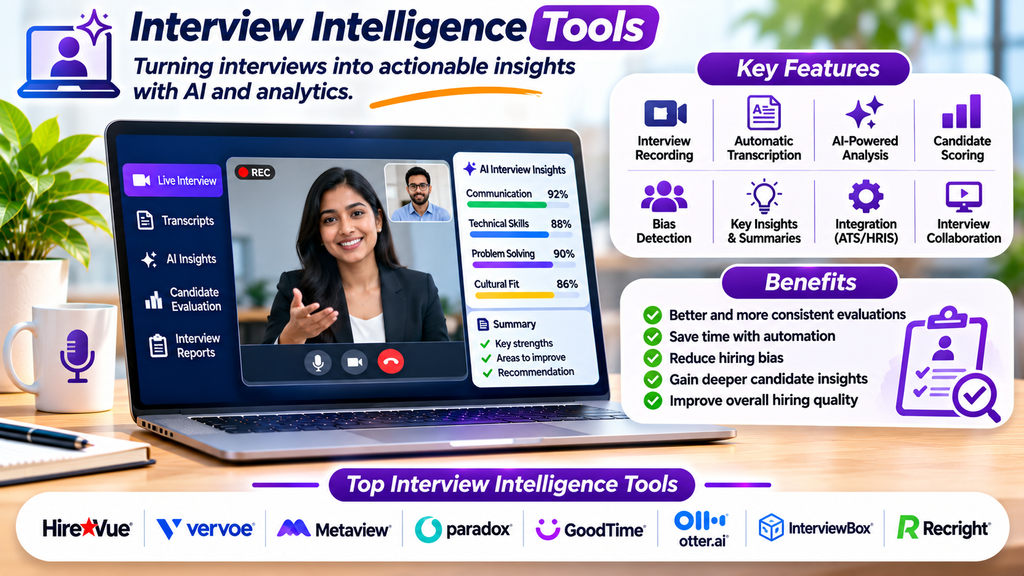
Interview intelligence tools help teams record, transcribe, analyze, and organize interview conversations. Depending on the platform, these tools can support structured interviews, searchable transcripts, automated notes, and collaboration between recruiters and hiring managers.
What Are Interview Intelligence Tools?
Interview intelligence tools are software platforms that use recording, transcription, analytics, and sometimes artificial intelligence to help teams understand interview conversations.
Recruitment-focused solutions may capture interview notes, identify discussion topics, summarize responses, and help interviewers review candidate conversations. Some platforms focus on live video interviews, while others analyze recorded conversations or integrate with recruitment systems.
These tools should support human decision-making rather than replace careful, job-related candidate evaluation.
Top Interview Intelligence Tools
1. Metaview
Metaview specializes in AI-powered recruiting notes and interview intelligence. It helps recruitment teams capture interview information and reduce manual note-taking.
Best for: Recruiters and hiring teams conducting frequent interviews.
2. BrightHire
BrightHire supports interview recording, transcription, structured feedback, and interview review workflows.
Best for: Organizations aiming to improve interview consistency and hiring collaboration.
3. HireVue
HireVue offers video interviewing and assessment solutions, with features that vary by product and configuration.
Best for: Organizations managing high-volume recruitment and structured interview processes.
4. Fireflies.ai
Fireflies.ai records and transcribes supported meetings and creates searchable conversation records and summaries.
Best for: Recruiting teams that conduct interviews through supported online meeting platforms.
5. Otter.ai
Otter.ai provides meeting transcription, summaries, and searchable notes for supported conversations.
Best for: Interviewers who want searchable transcripts and organized meeting notes.
6. Fathom
Fathom provides meeting recording, transcription, and summary features for supported video-conferencing workflows.
Best for: Small recruiting teams seeking convenient interview notes and summaries.
7. Gong
Gong focuses on revenue intelligence and conversation analytics, helping organizations analyze sales calls and customer interactions. It is not a dedicated recruitment interview platform, but may be relevant for sales-interview or broader conversation-analysis use cases.
Best for: Sales-focused organizations already using conversation intelligence.
8. Zoom AI Companion
Zoom AI Companion offers AI features within supported Zoom services, including meeting summaries and related productivity capabilities depending on the account and configuration.
Best for: Teams already conducting interviews through supported Zoom workflows.
Essential Features to Consider
- Interview recording: Capture interviews when the platform and applicable consent requirements allow it.
- Transcription: Convert spoken conversations into searchable text.
- AI-generated summaries: Create concise notes for faster review.
- Structured feedback: Help interviewers document responses against consistent criteria.
- Searchable transcripts: Locate important answers and discussion points.
- Collaboration: Share authorized interview notes with relevant hiring-team members.
- Recruitment integrations: Connect compatible applicant tracking systems and meeting tools.
- Security controls: Manage recording access, retention, and sensitive candidate information.
- Human review: Allow interviewers to verify summaries and correct transcription errors.
Benefits of Interview Intelligence Tools
Less manual note-taking: Interviewers can spend more attention on the conversation when suitable recording and transcription features are available.
Better documentation: Searchable transcripts and structured summaries can make interview records easier to review.
More consistent feedback: Standardized templates can help hiring teams assess candidates against common job-related criteria.
Improved collaboration: Recruiters and hiring managers can share authorized interview information without relying entirely on informal notes.
Faster review: Summaries and search functions can help teams revisit important parts of an interview efficiently.
Useful interview insights: Teams can identify recurring questions and improve their interview processes over time.
How to Choose the Right Tool
Start by deciding whether you need interview recording, transcription, AI-generated notes, video interviewing, or structured evaluation. Check which meeting platforms and applicant tracking systems the tool supports.
Compare pricing, transcription quality, languages, usability, integration options, and reporting capabilities. Review data protection, recording consent, retention policies, and access controls carefully. If interviews involve sensitive candidate information, confirm how that information is processed and stored.
Ask vendors to demonstrate a complete workflow, from capturing an interview to reviewing notes and sharing feedback securely.
Best Practices for Implementation
- Inform candidates when interviews will be recorded or transcribed.
- Follow applicable consent, privacy, and employment requirements.
- Use consistent, job-related interview questions and evaluation criteria.
- Review AI-generated notes for mistakes or missing context.
- Restrict access to recordings and transcripts.
- Avoid using automated analysis as the sole basis for hiring decisions.
- Regularly evaluate whether the tool improves interview quality and efficiency.
Conclusion
Interview intelligence tools help recruitment teams organize interview conversations, reduce manual note-taking, and improve access to hiring feedback. The best solution depends on interview volume, meeting platforms, recruitment workflows, and privacy requirements. When used responsibly, these tools can support more structured, efficient, and well-documented hiring decisions.
