Upgrade & Secure Your Future with DevOps, SRE, DevSecOps, MLOps!
We spend hours scrolling social media and waste money on things we forget, but won’t spend 30 minutes a day earning certifications that can change our lives.
Master in DevOps, SRE, DevSecOps & MLOps by DevOps School!
Learn from Guru Rajesh Kumar and double your salary in just one year.
Introduction
Recruiting the right employees requires more than publishing job vacancies. Recruitment teams need to source qualified candidates, maintain communication, coordinate interviews, and manage hiring pipelines efficiently. Recruiting platforms bring these activities together, helping organizations discover talent and improve their recruitment processes.
Whether a company is hiring for a single role or expanding across multiple departments, the right recruiting platform can help recruiters save time, collaborate with hiring managers, and build stronger candidate relationships.
What Are Recruiting Platforms?
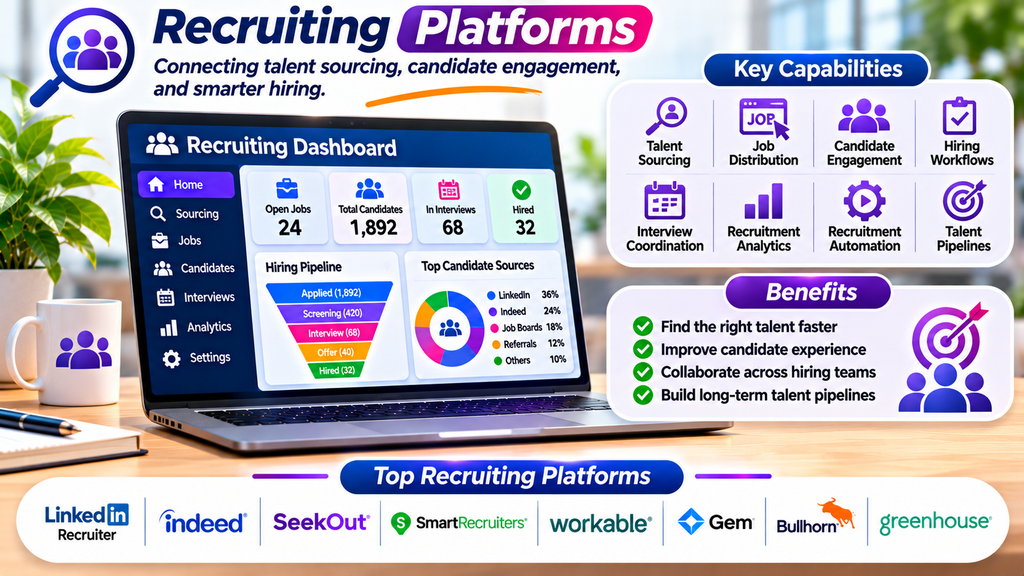
Recruiting platforms are digital tools that support different stages of talent acquisition. Depending on the product, they may offer candidate sourcing, job distribution, applicant tracking, talent relationship management, interview scheduling, recruitment marketing, and hiring analytics.
An applicant tracking system primarily organizes candidates and hiring stages, while a broader recruiting platform may also help recruiters discover new talent and maintain relationships with prospective candidates.
Top Recruiting Platforms
1. LinkedIn Recruiter
LinkedIn Recruiter helps talent acquisition teams search for professionals, identify potential candidates, and contact people through LinkedIn’s professional network.
Best for: Recruiters sourcing professionals across industries and experience levels.
2. Indeed
Indeed provides job-posting and candidate-discovery tools that help employers attract applicants. Available employer features depend on the market and product selected.
Best for: Businesses seeking broad reach for job advertisements.
3. SeekOut
SeekOut offers talent-sourcing and candidate-discovery capabilities to help recruiters identify professionals through search and talent insights.
Best for: Recruiting teams sourcing specialized or hard-to-find talent.
4. SmartRecruiters
SmartRecruiters provides talent-acquisition software for managing recruitment workflows, candidate engagement, and hiring-team collaboration.
Best for: Organizations coordinating hiring across multiple teams.
5. Workable
Workable combines recruitment workflows with candidate-sourcing and job-posting features, helping businesses manage vacancies and applicants.
Best for: Small and midsize businesses seeking an accessible recruitment platform.
6. Gem
Gem provides recruiting CRM and talent-engagement capabilities, helping recruitment teams manage candidate relationships and recruitment pipelines.
Best for: Teams building long-term talent pipelines and tracking outreach.
7. Bullhorn
Bullhorn offers recruitment software and CRM capabilities designed particularly for staffing and recruitment agencies.
Best for: Staffing firms managing clients, candidates, and placements.
8. Greenhouse
Greenhouse supports structured hiring, candidate management, interview coordination, and recruitment reporting.
Best for: Organizations seeking consistent hiring workflows and collaborative decision-making.
Essential Features to Consider
- Candidate sourcing: Discover potential applicants through supported search tools and databases.
- Job distribution: Publish vacancies on compatible job boards and career pages.
- Candidate relationship management: Maintain communication with potential and active candidates.
- Applicant tracking: Monitor candidates as they move through hiring stages.
- Interview coordination: Schedule interviews and collect hiring-team feedback.
- Recruitment automation: Automate selected reminders, notifications, and administrative tasks.
- Hiring analytics: Review pipeline activity, sourcing channels, and recruitment performance.
- Team collaboration: Share candidate information and coordinate decisions with hiring managers.
- Integrations: Connect compatible HR systems, assessment tools, and communication platforms.
- Privacy controls: Manage candidate information responsibly and restrict access appropriately.
Benefits of Recruiting Platforms
More efficient sourcing: Search and discovery tools can help recruiters identify suitable candidates more quickly.
Better candidate engagement: Centralized communication and follow-up reminders can support a more consistent candidate experience.
Improved collaboration: Shared recruitment workflows help recruiters and hiring managers coordinate decisions.
Clearer hiring visibility: Pipeline reports can reveal delays and help teams monitor recruitment progress.
Stronger talent pipelines: Relationship-management features help organizations maintain contact with potential future candidates.
Reduced administrative effort: Automation can reduce repetitive work, allowing recruiters to focus on candidate evaluation and relationship building.
How to Choose the Right Recruiting Platform
Start by identifying your hiring volume, recruitment team size, target candidate profiles, and sourcing channels. A small business may need straightforward job posting and applicant tracking, while a staffing agency may require client management, candidate databases, and placement tracking.
Compare pricing, search capabilities, integrations, usability, reporting, data protection, and customer support. Ask vendors to demonstrate a realistic recruitment process, from discovering candidates to coordinating interviews and reviewing results.
Best Practices for Implementation
- Define candidate profiles and hiring stages clearly.
- Keep job descriptions accurate and inclusive.
- Establish consistent communication and follow-up practices.
- Train recruiters and hiring managers on shared workflows.
- Review sourcing channels using relevant performance metrics.
- Use candidate data responsibly and follow applicable privacy requirements.
- Evaluate recruitment outcomes regularly and improve processes based on evidence.
Conclusion
Recruiting platforms help organizations discover talent, manage candidate relationships, and coordinate hiring activities. The best option depends on recruitment goals, team size, hiring complexity, and budget. By selecting tools that match their workflow, organizations can make recruitment more organized, collaborative, and effective.
