Upgrade & Secure Your Future with DevOps, SRE, DevSecOps, MLOps!
We spend hours scrolling social media and waste money on things we forget, but won’t spend 30 minutes a day earning certifications that can change our lives.
Master in DevOps, SRE, DevSecOps & MLOps by DevOps School!
Learn from Guru Rajesh Kumar and double your salary in just one year.
Introduction
Hiring the right candidate involves more than reviewing a resume or conducting an interview. Recruiters also need to understand whether applicants have the skills, knowledge, and abilities required for a particular role. Candidate assessment tools help organizations evaluate applicants using structured tests, practical exercises, and job-related assessments.
When used appropriately, these tools can make hiring decisions more consistent and help employers identify candidates whose abilities match the requirements of a position.
What Are Candidate Assessment Tools?
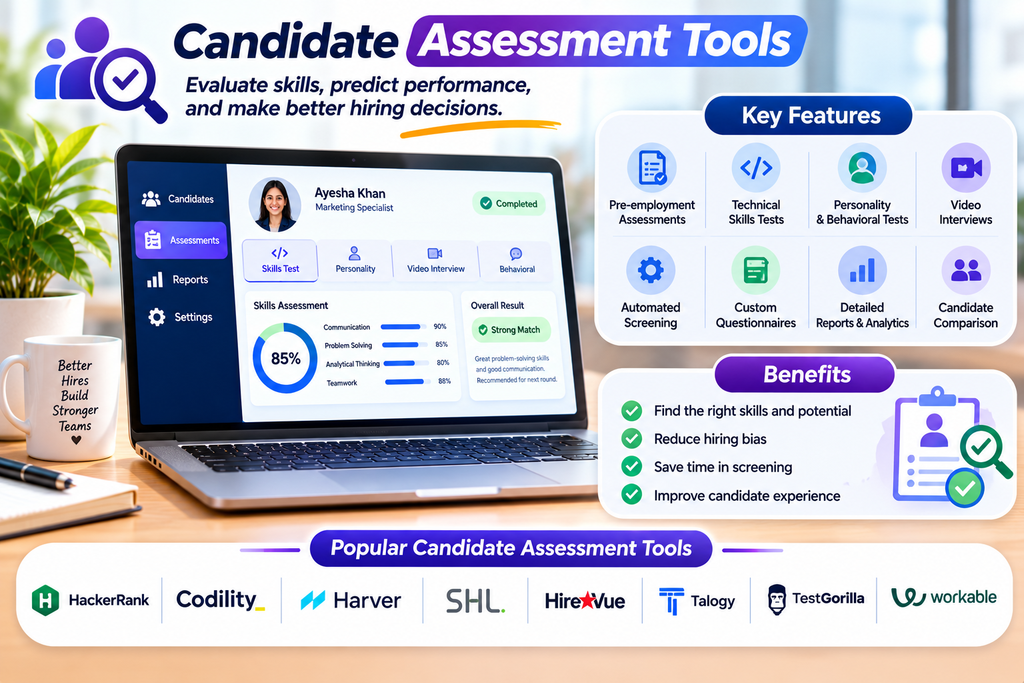
Candidate assessment tools are digital platforms that evaluate applicants before or during recruitment. Depending on the tool, assessments may measure technical knowledge, communication, cognitive ability, personality-related work preferences, language proficiency, or practical job skills.
Recruiters can use assessment results alongside resumes, interviews, and other job-related evidence. Assessments should be relevant to the role and should not be treated as the sole basis for every hiring decision.
Top Candidate Assessment Tools
1. HackerRank
HackerRank provides technical assessments and coding challenges that help employers evaluate programming skills.
Best for: Recruiting software developers and technical professionals.
2. Codility
Codility supports coding assessments and technical interviews, enabling hiring teams to evaluate candidates through programming tasks.
Best for: Technology companies recruiting software engineers.
3. TestGorilla
TestGorilla offers pre-employment assessments covering areas such as job-specific skills, cognitive ability, and other work-related competencies.
Best for: Businesses assessing candidates across different job categories.
4. SHL
SHL provides assessment solutions covering areas such as cognitive ability, personality-related workplace preferences, and job-specific capabilities.
Best for: Organizations managing structured assessments at scale.
5. Criteria
Criteria offers pre-employment testing, including cognitive aptitude, personality, and skills assessments.
Best for: Employers seeking standardized candidate evaluations.
6. iMocha
iMocha provides skills-assessment tools across technical and nontechnical domains, including digital skills and job-related competencies.
Best for: Organizations validating candidates’ professional and technical skills.
7. Mercer Mettl
Mercer Mettl offers online assessments, coding tests, psychometric assessments, and related evaluation tools.
Best for: Companies and institutions conducting structured assessments for multiple roles.
8. Vervoe
Vervoe focuses on skills-based hiring through job-related assessments that can simulate practical tasks candidates may encounter at work.
Best for: Employers prioritizing practical demonstrations of job skills.
Essential Features to Look For
- Role-specific tests: Assess skills that are relevant to the vacancy.
- Multiple assessment formats: Support coding tasks, quizzes, simulations, and other appropriate evaluations.
- Automated scoring: Score objective questions and supported tasks efficiently.
- Reporting and analytics: Compare results and identify strengths or skill gaps.
- Candidate experience: Provide clear instructions and accessible assessment interfaces.
- Integration: Connect with compatible applicant tracking and recruitment systems.
- Security: Protect candidate records and assessment results.
- Accessibility: Offer reasonable accommodations and accessible testing experiences.
- Integrity controls: Use appropriate safeguards while respecting candidate privacy.
Benefits of Candidate Assessment Tools
More structured evaluations: Standardized assessments help recruiters compare candidates against consistent job-related criteria.
Better visibility into skills: Practical tasks can reveal capabilities that may not be obvious from a resume alone.
Time savings: Automated scoring and reporting can reduce manual evaluation for suitable assessment types.
Support for technical hiring: Coding and technical exercises allow employers to evaluate applied knowledge.
More informed decisions: Assessment results can complement interviews, work samples, and employment history.
Identifying development needs: Results may also help organizations understand skill gaps among candidates or new hires.
How to Choose the Right Assessment Tool
Begin by defining the skills and competencies required for the role. A software engineering vacancy may need coding challenges, while a customer-service position may benefit from communication exercises and realistic customer scenarios.
Compare assessment quality, pricing, customization, reporting, candidate usability, integrations, and support. Ask vendors how their assessments were developed and validated for the intended use.
Also consider accessibility, data protection, and fairness. Review whether assessments disadvantage candidates for reasons unrelated to job performance, and avoid using automated scores without appropriate human oversight.
Best Practices for Candidate Assessments
- Use assessments that directly relate to the job.
- Explain the assessment process and expected completion time.
- Apply consistent evaluation criteria to comparable candidates.
- Provide reasonable accommodations when required.
- Protect candidate information and restrict access to results.
- Review assessment outcomes for potential bias.
- Combine results with interviews and other relevant evidence.
Conclusion
Candidate assessment tools help employers evaluate skills and job-related abilities through structured testing and practical exercises. The right platform depends on the role, assessment format, recruitment volume, and budget. By selecting relevant assessments and reviewing results fairly, organizations can make more informed hiring decisions and improve the candidate evaluation process.
