Upgrade & Secure Your Future with DevOps, SRE, DevSecOps, MLOps!
We spend hours scrolling social media and waste money on things we forget, but won’t spend 30 minutes a day earning certifications that can change our lives.
Master in DevOps, SRE, DevSecOps & MLOps by DevOps School!
Learn from Guru Rajesh Kumar and double your salary in just one year.
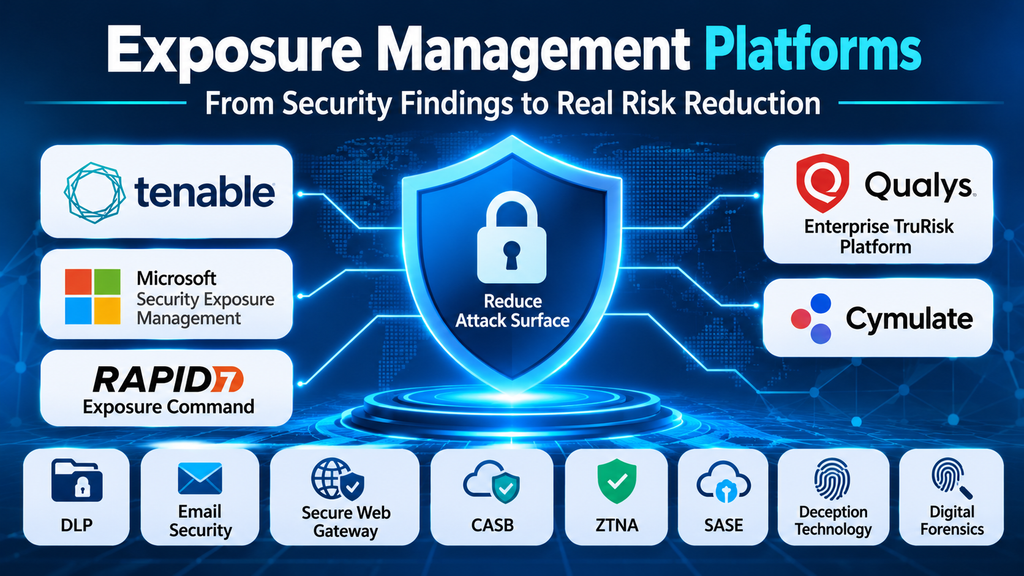
Exposure Management Platforms: Turning Fragmented Security Findings into Actionable Risk Reduction
Organizations rarely lack cybersecurity alerts. The real challenge is understanding which security weaknesses could allow attackers to reach critical systems, compromise sensitive information, or disrupt business operations.
A vulnerability scanner may identify thousands of weaknesses, while cloud security tools report configuration problems and identity systems reveal excessive permissions. External attack surface monitoring introduces another set of findings. When these systems operate independently, security teams can struggle to determine which issues deserve immediate attention.
Exposure management platforms address this problem by connecting security findings across an organization’s digital environment. They help teams discover assets, correlate weaknesses, understand potential attack paths, prioritize remediation, and measure whether security improvements are reducing actual exposure.
The important shift is from counting vulnerabilities to understanding how individual weaknesses combine to create business risk.
What Is Exposure Management?
Exposure management is a continuous cybersecurity discipline focused on identifying, assessing, prioritizing, validating, and reducing security exposures across an organization’s technology environment.
An exposure is any weakness, condition, or combination of circumstances that could create an opportunity for unauthorized access or compromise.
Examples include:
- Unpatched operating systems and applications.
- Misconfigured cloud storage and infrastructure.
- Internet-facing systems with unnecessary services.
- Excessive permissions assigned to users or service accounts.
- Vulnerable applications connected to sensitive databases.
- Inadequate network segmentation.
- Unmanaged devices and unknown internet-facing assets.
- Security controls that fail to prevent or detect relevant attack techniques.
Unlike traditional vulnerability management, exposure management considers how these weaknesses interact.
For example, a moderately severe vulnerability on an internet-facing application may deserve immediate attention if that application has access to a privileged identity and sensitive business data. A more severe vulnerability on an isolated, non-critical system may represent a lower operational priority.
This broader perspective helps security teams allocate remediation resources more effectively.
Why Exposure Management Is Different from Vulnerability Management
Vulnerability management primarily identifies, assesses, and tracks software and infrastructure vulnerabilities. Exposure management expands that process by incorporating additional security information and business context.
| Area | Vulnerability management | Exposure management |
|---|---|---|
| Primary focus | Known vulnerabilities | Broader security exposures |
| Asset visibility | Assets covered by scanning and inventory | Multiple connected asset categories |
| Risk assessment | Vulnerability severity and exploitability | Threat, asset, identity, configuration, and business context |
| Attack paths | May require separate capabilities | Often includes cross-domain relationship analysis |
| Remediation | Vulnerability-focused workflows | Coordinated exposure reduction |
| Reporting | Vulnerability and patch status | Broader organizational exposure and risk posture |
These disciplines complement each other. Exposure management does not eliminate the need for vulnerability scanning, patch management, endpoint protection, or cloud security controls.
Instead, it provides a way to connect their findings and determine which security weaknesses matter most.
The Role of Continuous Threat Exposure Management
Continuous Threat Exposure Management (CTEM) provides a useful framework for organizing an exposure management program.
Its five stages are:
- Scoping: Identify critical business services, assets, and systems that need protection.
- Discovery: Find vulnerabilities, misconfigurations, exposed assets, and other weaknesses.
- Prioritization: Determine which exposures represent the greatest potential business risk.
- Validation: Investigate whether identified weaknesses create realistic opportunities for attack.
- Mobilization: Coordinate remediation across security, IT, cloud, application, and infrastructure teams.
The framework emphasizes continuous improvement rather than relying exclusively on periodic security assessments.
A platform can support several of these activities, but buyers should verify which stages are actually covered by its native capabilities and which depend on integrations or additional products.
Exposure Management Platforms to Consider
The following products represent different approaches to exposure visibility, risk prioritization, and security validation. They are not identical solutions, and their suitability depends on existing infrastructure, licensing, and security requirements.
1. Tenable One
Primary focus: Unified exposure visibility and risk prioritization
Tenable One brings together exposure intelligence across multiple technology domains, including IT, cloud, identity, operational technology, applications, and external attack surfaces.
Its Exposure Data Fabric is designed to correlate information from Tenable products, third-party integrations, and other security data sources. This provides a broader view of assets, vulnerabilities, misconfigurations, and relationships that may contribute to organizational exposure.
An important capability is attack path analysis. Rather than presenting weaknesses as isolated findings, the platform helps security teams understand how combinations of vulnerabilities and access relationships could create routes toward critical assets.
Tenable also provides exposure prioritization capabilities and its Tenable Hexa AI orchestration layer for coordinating security workflows.
Why consider it: Organizations looking to consolidate exposure information across a broad hybrid attack surface may find its cross-domain approach useful.
What to evaluate: Determine which Tenable products and modules are included in the proposed subscription, which third-party integrations are supported, and how imported findings are normalized and correlated.
Official website: https://www.tenable.com/products/tenable-one
2. Microsoft Security Exposure Management
Primary focus: Security posture visibility and attack path analysis
Microsoft Security Exposure Management provides a unified view of organizational security posture through the Microsoft Defender portal.
It brings together security information relating to devices, identities, cloud resources, applications, data, and external attack surfaces. Its enterprise exposure graph helps connect assets and security findings so teams can investigate relationships and potential attack paths.
The platform also organizes exposure management activities around identifying critical assets, prioritizing risks, and reducing the attack surface.
For organizations using Microsoft security products, this approach can provide useful connections between existing security telemetry and broader exposure analysis.
Its integration ecosystem also supports external security data sources, including products from other security vendors.
Why consider it: It is particularly relevant to enterprises already using Microsoft Defender, Microsoft Entra, and Microsoft cloud security technologies.
What to evaluate: Review licensing eligibility, third-party connector availability, consumption-based integration costs, and the amount of external security data that can be incorporated into the exposure graph.
Official website: https://www.microsoft.com/en-us/security/business/siem-and-xdr/microsoft-security-exposure-management
3. Rapid7 Exposure Command
Primary focus: Attack surface visibility, contextual risk, and remediation
Rapid7 Exposure Command combines attack surface visibility with risk information from vulnerability management, cloud security, application testing, and other exposure-related sources.
Its relationship with Rapid7’s wider security ecosystem is important. Capabilities associated with Surface Command, InsightVM, InsightCloudSec, and InsightConnect contribute to different aspects of discovery, assessment, and operational response.
The platform also incorporates third-party exposure information and enrichment sources.
Its asset graph and blast-radius analysis help security teams understand how assets and exposures relate to one another. Native automation and integrations can support remediation workflows across security and IT operations.
Why consider it: Organizations wanting to consolidate security and IT operations information into a more connected exposure management workflow should evaluate it.
What to evaluate: Rapid7 offers different Exposure Command packages. Buyers should compare the actual capabilities included in each package, particularly cloud assessment, attack path analysis, vulnerability management, and automation.
Official website: https://www.rapid7.com/products/exposure-command/
4. Qualys Enterprise TruRisk Platform
Primary focus: Enterprise cyber risk measurement and remediation
Qualys Enterprise TruRisk Platform provides a unified environment for measuring, communicating, and reducing cyber risk.
Its capabilities cover asset management, vulnerability and configuration management, compliance, cloud security, threat detection, and risk remediation.
The platform’s TruRisk approach is particularly relevant to organizations that want to prioritize weaknesses using more than conventional vulnerability severity scores.
It combines security findings with additional risk factors and asset context to support remediation decisions. The platform also supports the integration of Qualys and non-Qualys security information.
For organizations already using Qualys vulnerability management and asset discovery, the broader platform can provide a route toward more consolidated risk management.
Why consider it: It is worth evaluating when asset discovery, vulnerability management, configuration assessment, and risk remediation need to operate within a connected platform.
What to evaluate: Examine module dependencies, asset coverage, third-party data integration, remediation workflows, and the licensing implications of expanding an existing deployment.
Official website: https://www.qualys.com/enterprise-trurisk-platform
5. Cymulate Exposure Validation
Primary focus: Continuous security control validation
Cymulate deserves consideration as a complementary exposure validation solution rather than a direct replacement for a broad asset and vulnerability management platform.
Its Exposure Validation capabilities focus on testing how effectively security controls prevent and detect attack techniques.
The platform supports automated security assessments using threat scenarios and techniques aligned with MITRE ATT&CK. It can evaluate defensive capabilities across technologies such as endpoint protection, security monitoring, web security, email security, and other controls.
This approach addresses an important gap in exposure management: discovering a weakness does not automatically establish whether existing defensive controls can detect or prevent the associated attack.
Cymulate helps organizations test that defensive effectiveness and identify opportunities to improve detection and prevention.
Why consider it: Security teams seeking continuous validation of defensive controls can use this approach alongside vulnerability and exposure management capabilities.
What to evaluate: Confirm which security controls are supported, how testing is conducted safely, what remediation guidance is available, and how validation findings can be connected to the organization’s wider exposure management process.
Official website: https://cymulate.com/exposure-validation/
Comparing the Platforms by Their Practical Strengths
| Platform | Main strength | Relevant environment |
|---|---|---|
| Tenable One | Cross-domain exposure intelligence and prioritization | Hybrid enterprise infrastructure |
| Microsoft Security Exposure Management | Unified posture and attack path visibility | Microsoft-centered environments |
| Rapid7 Exposure Command | Attack surface correlation and remediation workflows | Organizations using multiple security tools |
| Qualys Enterprise TruRisk Platform | Asset and vulnerability-based cyber risk management | Existing or planned Qualys deployments |
| Cymulate Exposure Validation | Testing security control effectiveness | Security validation and defense engineering |
The comparison should be interpreted by functional emphasis rather than as a performance ranking. Each platform has different dependencies, licensing arrangements, and coverage considerations.
Capabilities That Determine Whether a Platform Is Useful
A large collection of dashboards does not necessarily indicate effective exposure management. The value comes from the quality of the underlying data and the ability to turn findings into meaningful action.
Comprehensive Asset Discovery
The platform should provide visibility into relevant assets across the organization’s environment.
Important categories include:
- Physical and virtual infrastructure.
- Employee devices and servers.
- Cloud workloads and storage.
- Containers and Kubernetes environments.
- Applications and APIs.
- Network infrastructure.
- Human and non-human identities.
- Internet-facing services.
Asset discovery should identify unknown systems, duplicate records, and assets that are missing from established inventories.
Contextual Risk Prioritization
A useful platform should evaluate more than the technical severity of a vulnerability.
Relevant factors include exploitability, known threat activity, internet exposure, asset importance, identity privileges, configuration weaknesses, and potential attack paths.
The objective is to identify which exposures deserve remediation first.
Attack Path Analysis
Attack path analysis connects individual weaknesses into potential routes through an organization’s infrastructure.
Consider a hypothetical environment in which:
- An internet-facing application contains a vulnerability.
- The application communicates with an internal service.
- The internal service has access to a privileged identity.
- That identity can access a sensitive cloud resource.
Individually, these findings may appear unrelated. Together, they could represent a meaningful attack path.
Exposure management software can help security teams visualize such relationships and identify the weaknesses that create the greatest opportunities for compromise.
However, attack path analysis depends on accurate asset relationships, permissions, network information, and security telemetry. Its output should be validated rather than treated as proof that an attack has occurred or will succeed.
Integration with Existing Security Tools
Most enterprises already operate multiple security products. An exposure management platform should work with the existing environment rather than require unnecessary replacement.
Useful integrations may include:
- Vulnerability scanners.
- Endpoint detection and response systems.
- Cloud security platforms.
- Identity providers.
- Configuration management databases.
- SIEM and SOAR platforms.
- IT service management systems.
- Application security tools.
Check whether integrations support continuous synchronization, asset correlation, remediation actions, and status updates. Data ingestion alone does not guarantee a complete operational integration.
Remediation and Workflow Automation
Exposure identification is only valuable when teams can act on the findings.
Look for capabilities that help assign remediation ownership, create IT service tickets, coordinate security and infrastructure teams, track remediation deadlines, and verify that corrective actions have been completed.
Automation should include appropriate approval controls, particularly when changes could affect production infrastructure.
Reporting and Business Context
Security leaders need to communicate exposure in terms that business stakeholders can understand.
Reporting should help answer:
- Which critical assets remain exposed?
- Which attack paths have been eliminated?
- Which security weaknesses are recurring?
- Which teams are responsible for unresolved risks?
- Is the organization’s exposure decreasing?
- Are remediation investments producing measurable improvements?
A single risk score should not replace detailed reporting about asset coverage, exposure categories, and remediation outcomes.
How to Implement an Exposure Management Program
Buying a platform does not automatically establish an effective exposure management program. Organizations need a structured approach to data collection, prioritization, and remediation.
Step 1: Identify Critical Business Assets
Start by identifying the systems that support important business services.
These may include customer-facing applications, financial systems, production databases, identity infrastructure, cloud environments, and systems containing sensitive information.
Establish asset ownership and business criticality before attempting to prioritize every finding.
Step 2: Consolidate Existing Security Information
Identify the security tools already collecting information about the organization’s assets and weaknesses.
Connect relevant sources and investigate duplicate or inconsistent asset records.
Pay particular attention to systems that are not covered by existing scanning or monitoring processes.
Step 3: Establish Risk Prioritization Rules
Work with security, IT, cloud, and application teams to define what constitutes a high-priority exposure.
Consider exploitability, threat intelligence, internet accessibility, business criticality, privilege levels, and attack path relationships.
Document exceptions and establish remediation expectations for different risk categories.
Step 4: Validate Important Attack Paths
Investigate the most consequential attack paths identified by the platform.
Confirm the relevant asset relationships, access permissions, and security controls.
Where appropriate, use controlled security validation to establish whether existing defenses can detect or prevent the associated attack techniques.
Step 5: Assign Remediation Ownership
Every important exposure should have a responsible team or asset owner.
A vulnerability affecting an application may require the application team, while a cloud permission issue may require the cloud infrastructure team.
Clear ownership prevents security findings from remaining unresolved because multiple departments assume another team is responsible.
Step 6: Measure Actual Risk Reduction
Track remediation progress and investigate whether improvements are sustained.
Useful operational measurements include:
- Critical assets with unresolved high-priority exposures.
- Internet-facing assets without adequate monitoring.
- Time required to remediate high-risk vulnerabilities.
- Unknown assets discovered.
- Recurring configuration weaknesses.
- Attack paths eliminated.
- Remediation actions that remain blocked by operational dependencies.
The objective is to measure meaningful improvements in exposure, not simply the number of alerts closed.
Common Mistakes When Selecting Exposure Management Software
Choosing a platform based only on feature count
A long feature list does not guarantee that the platform supports the organization’s specific asset types, integrations, or remediation workflows.
Ignoring existing security investments
An organization may already have useful vulnerability scanners, cloud security tools, and identity monitoring capabilities. A new platform should make those investments more valuable rather than duplicate them unnecessarily.
Treating every vulnerability as equally important
Severity scores provide useful technical information, but remediation priorities should also consider business impact and the context in which weaknesses exist.
Overlooking data quality
Incorrect asset relationships, outdated findings, and incomplete integrations can undermine the platform’s recommendations.
Automating changes without safeguards
Remediation actions can affect production systems. Test automation carefully and establish approval procedures, rollback plans, and clear ownership.
Confusing exposure validation with exposure management
Testing security controls is valuable, but it does not replace continuous asset discovery, vulnerability management, or remediation coordination.
Questions to Ask Before Purchasing
Before selecting a vendor, use a proof of concept to investigate how the platform performs against representative organizational requirements.
Ask:
- Which assets can the platform discover natively?
- Can it identify unmanaged and internet-facing assets?
- How does it correlate duplicate records from different tools?
- Which threat intelligence sources influence risk prioritization?
- Can it identify relationships between vulnerabilities, identities, and critical systems?
- How are potential attack paths validated?
- Which integrations support remediation rather than information collection alone?
- How frequently are asset and exposure records updated?
- Where is organizational security data stored, and how is it protected?
- Which features require additional licenses or modules?
- Can the platform integrate with the organization’s existing IT service management processes?
- How can security teams demonstrate measurable exposure reduction?
A useful proof of concept should demonstrate an end-to-end workflow: discover an asset, identify a meaningful exposure, explain why it matters, assign remediation ownership, and verify the resulting improvement.
Selecting the Right Exposure Management Approach
Tenable One is worth considering for broad exposure visibility and cross-domain prioritization. Microsoft Security Exposure Management is particularly relevant to organizations with significant Microsoft security investments. Rapid7 Exposure Command offers an approach centered on connected attack surface visibility and remediation. Qualys Enterprise TruRisk Platform is relevant to organizations seeking integrated asset, vulnerability, and risk management. Cymulate provides a complementary approach for testing the effectiveness of existing security controls.
There is no universal winner because exposure management requirements differ across organizations.
A company with extensive cloud infrastructure may prioritize attack path visibility and cloud exposure assessment. An organization with an established vulnerability management program may focus on consolidating asset information and improving remediation prioritization. A security operations team may place greater emphasis on validating defensive controls.
The strongest purchasing decision is therefore the one that addresses a clearly identified security visibility gap without introducing unnecessary complexity.
Ultimately, exposure management should help an organization answer a more important question than how many vulnerabilities it has discovered: Which weaknesses could realistically put its most important systems and business operations at risk, and what actions will reduce that risk?
