Upgrade & Secure Your Future with DevOps, SRE, DevSecOps, MLOps!
We spend hours scrolling social media and waste money on things we forget, but won’t spend 30 minutes a day earning certifications that can change our lives.
Master in DevOps, SRE, DevSecOps & MLOps by DevOps School!
Learn from Guru Rajesh Kumar and double your salary in just one year.
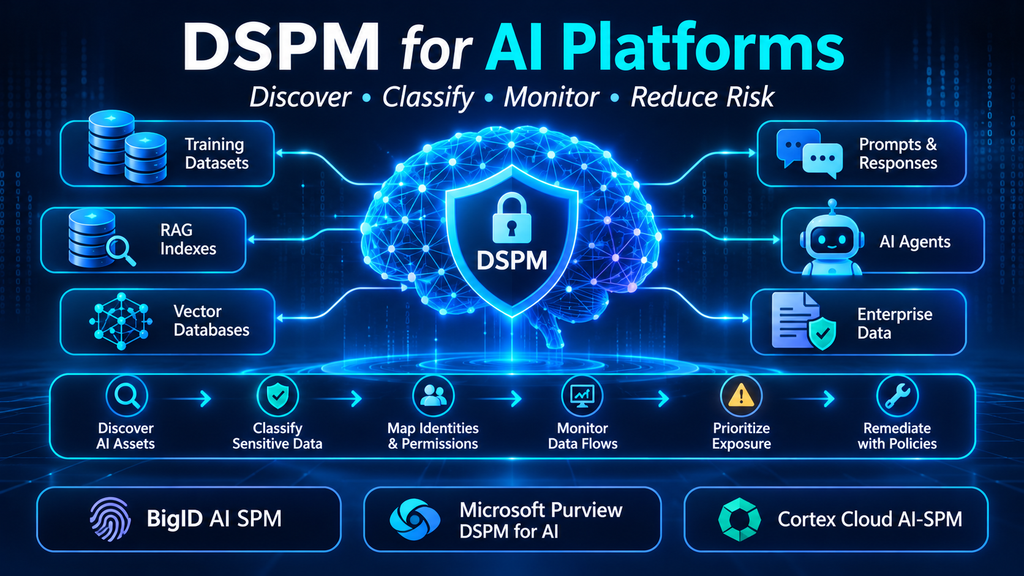
DSPM for AI Platforms: Securing the Data Behind Models, Prompts, and AI Agents
An AI application can follow its infrastructure security rules and still expose an organization’s most sensitive information. A retrieval-augmented generation (RAG) system might index confidential documents without preserving their original access restrictions. A model-training pipeline might ingest personal information that should never have entered the dataset. An employee might paste customer records into an unapproved AI assistant, while an autonomous agent inherits permissions that give it access to far more data than its task requires.
These are not simply model-security problems. They are data security problems created or amplified by AI workflows.
Data Security Posture Management for AI platforms extends data-centric security into the systems that build, operate, and use AI. It helps organizations understand which AI applications and agents exist, what information they process, where that information comes from, who or what can access it, and whether sensitive data is being exposed through prompts, training pipelines, retrieval systems, or generated responses.
The category overlaps with AI Security Posture Management (AI-SPM), AI governance, and traditional DSPM. Those labels are not interchangeable. Buyers need to understand the boundary before choosing a platform, because a tool that discovers AI applications may not inspect the data flowing through them, and a data discovery product may not provide visibility into model configuration or AI-specific threats.
Why traditional DSPM needs an AI-specific view
Traditional DSPM focuses on discovering sensitive data, classifying it, understanding access, and prioritizing exposure. AI introduces new paths through which that data can be copied, transformed, indexed, retrieved, and generated.
A conventional data repository has identifiable storage locations and access policies. An AI workflow can involve several additional components:
- Source repositories containing documents, databases, and business records
- Training and fine-tuning datasets
- Embedding pipelines that convert content into vector representations
- Vector databases and retrieval indexes
- Model endpoints and inference services
- Prompts, conversation histories, and generated responses
- Plugins, tools, connectors, and external APIs
- Autonomous agents operating under human or machine identities
Sensitive information can move through several of these components without being obvious from the original repository’s permissions.
For example, a company may correctly restrict access to a confidential project folder. If an AI application indexes that folder using a privileged service identity and does not enforce the user’s original permissions at retrieval time, an employee could receive information through a generated answer that they could not access directly.
This is the central reason AI environments need data-aware posture management: the security of the original data store does not automatically guarantee the security of every AI system that consumes its contents.
The AI data exposure points that matter most
A useful assessment follows data through the AI lifecycle rather than looking only at the model endpoint.
1. Training and fine-tuning datasets
Training datasets may contain personal information, confidential business records, proprietary material, credentials, or data collected without appropriate authorization.
Risks can arise when teams combine datasets from different business units, copy production information into development environments, or retain outdated training material after the source data has been corrected or deleted.
A DSPM-oriented assessment should help identify sensitive information in datasets, establish ownership and provenance where possible, and determine whether the data is appropriate for its intended use.
It should not be assumed that every DSPM product can inspect every model format or training pipeline. Buyers should test the actual data sources and file types used by their machine-learning teams.
2. RAG pipelines and vector databases
RAG systems retrieve relevant content from external data sources and provide it to a language model as context. This can reduce the need to retrain a model whenever information changes, but it creates a separate data access problem.
Documents may be indexed into chunks and stored as embeddings. Metadata may preserve source identifiers, but the retrieval system must still enforce appropriate authorization. If access controls are missing, incorrectly mapped, or not checked at query time, a user may receive content from a source they are not authorized to view.
DSPM for AI should therefore examine:
- Which source repositories feed the retrieval pipeline
- Whether indexed content contains sensitive information
- Whether access restrictions survive ingestion and indexing
- Which identities can query the vector store
- Whether deleted or reclassified source data is reflected in indexes
- How retrieved content is logged and governed
A vector database is not automatically safe simply because it stores numerical representations rather than readable documents. Embeddings and associated metadata can still carry information-security and privacy implications.
3. Prompts and generated responses
Prompts may contain customer details, internal reports, source code, business plans, or other confidential information. Generated responses can reproduce, summarize, or expose sensitive information from those prompts or from connected enterprise data.
Organizations need visibility into which AI applications employees use, what kinds of sensitive information appear in interactions, and whether the relevant protection policies apply.
The level of visibility depends on how an application is integrated. Browser-based monitoring, application connectors, endpoint controls, and native audit events provide different kinds of evidence. A platform should not be assumed to capture complete prompt and response content from every AI service.
4. AI agents and connected tools
Agents can use identities and permissions to retrieve documents, query databases, create records, send messages, or trigger business processes.
An agent that has broad access may create a larger exposure than a conventional chatbot because it can take actions rather than merely generate text. The security question is not only what the agent knows, but also what it can do with the data and systems it can reach.
A meaningful posture assessment should map agents to their identities, connected tools, data sources, permissions, owners, and approved purposes. It should also identify agents that are deployed without clear ownership or governance.
5. Development and experimentation environments
AI projects often move quickly. Developers may test models with copied datasets, temporary storage, notebooks, API keys, and third-party services.
These environments can become persistent data stores without receiving the same security oversight as production systems. Discovery should therefore include experimentation environments and unsanctioned AI use where technically observable.
DSPM for AI, AI-SPM, and AI governance are related but different
The terminology is still evolving, and vendors do not always use the same labels. A practical distinction helps prevent purchasing the wrong capability.
| Discipline | Primary question | Typical focus |
|---|---|---|
| Traditional DSPM | Where is sensitive data, and who can access it? | Data discovery, classification, permissions, exposure |
| DSPM for AI | How is sensitive data used or exposed in AI workflows? | Prompts, responses, training data, RAG, AI-connected data |
| AI-SPM | What AI assets and configurations create security risk? | AI models, services, applications, deployment posture, AI-specific risks |
| AI governance | Is AI being used responsibly and under organizational rules? | Approval, accountability, policy, risk ownership, compliance |
| AI runtime security | What is happening while an AI system is operating? | Runtime behavior, prompt attacks, unsafe outputs, tool use, abuse detection |
These capabilities can overlap within a single platform. However, they should not be treated as equivalent during procurement.
A product that discovers AI applications and model deployments may be strong at inventory and configuration analysis but offer limited insight into the sensitivity of the data inside prompts. Conversely, a data security platform may classify sensitive information and monitor AI interactions without providing deep model vulnerability testing.
Organizations with significant AI deployments may need several complementary control layers.
Platforms to examine
The products below illustrate different approaches to AI-related data posture. Some are extensions of broader data security platforms; others sit within wider cloud security offerings. They are not identical products, and the comparison should be understood in terms of their published capabilities rather than as a ranking.
BigID AI SPM and agentic posture capabilities
BigID’s DSPM, AI SPM, and Agentic SPM approach connects sensitive data discovery with the AI models and agents that can reach that data.
BigID describes discovery and classification across structured, unstructured, cloud, SaaS, hybrid, and AI-connected data. Its AI and agentic posture capabilities extend this view to sanctioned and unsanctioned AI assets, agent identities, data access, and the information flowing into AI pipelines, RAG indexes, and training sets. The company also describes monitoring sensitive information shared through AI prompts and governing how agents use data and interact with other agents.
The important architectural idea is that AI assets are assessed in relation to the data they can reach. This can help organizations connect an exposed dataset to the model, copilot, or agent that may consume it, rather than treating AI inventory and data inventory as separate exercises.
BigID is worth examining when the organization wants data discovery, classification, access governance, and AI-related posture within a connected data security program.
What to validate: Ask for a demonstration using the organization’s actual AI architecture. Confirm which model platforms, agent frameworks, RAG components, and data sources are supported. Test whether the platform can distinguish an AI asset that merely exists from one that can access sensitive data, and whether it can trace data lineage sufficiently to support investigation and remediation.
Microsoft Purview DSPM and DSPM for AI capabilities
Microsoft Purview’s data security documentation for AI applications describes controls for understanding and governing AI usage across Microsoft and supported third-party AI applications. Microsoft’s documentation distinguishes the earlier DSPM for AI experience, now referred to as DSPM for AI (classic), from the expanded current Data Security Posture Management experience. The newer DSPM brings together data security insights across traditional applications and AI apps and agents.
For AI interactions, Microsoft documents capabilities that can surface AI activity, sensitive information detections, and Data Loss Prevention policy matches. Depending on the AI application and configuration, Activity Explorer and audit records can provide information about interactions, users, applications, sensitive information types, and referenced files. Custom AI applications can also be integrated through documented Purview configuration paths.
This approach is particularly relevant to organizations already using Microsoft 365, Microsoft Purview, and Microsoft security controls. It can connect AI usage oversight with information protection, DLP, insider risk, and compliance workflows.
However, the depth of visibility is not identical for every AI application. Some interaction details require auditing, policy configuration, or application integration. Microsoft documentation also identifies differences between Copilot experiences, enterprise AI apps, and other AI apps detected through browser activity.
What to validate: Identify the exact AI applications employees use and determine which events and content can be captured for each one. Confirm the necessary licensing, permissions, policies, browser configuration, and integration requirements. If the organization runs custom AI applications, test the developer integration rather than assuming that browser discovery provides equivalent prompt and response visibility.
Palo Alto Networks Cortex Cloud AI-SPM
Palo Alto Networks Cortex Cloud AI Security Posture Management focuses on the security posture of AI, machine-learning, and generative AI applications. Its published material describes visibility into the AI model lifecycle, from data ingestion and training to deployment, with capabilities for AI model discovery and inventory, data exposure prevention, and posture and risk analysis.
Cortex Cloud also describes DSPM capabilities that connect sensitive data discovery and classification with exposure analysis, access governance, and data risk across cloud, SaaS, on-premises, and AI deployments. This creates a broader cloud-security context in which AI-related data exposure can be evaluated alongside identity permissions and other cloud risks.
This makes Cortex Cloud relevant to organizations that want to assess AI application risks as part of a wider cloud security program. It is important, however, to distinguish AI-SPM from the data-centric DSPM capabilities within the broader platform. Model inventory and posture analysis do not automatically provide complete visibility into every prompt, response, or data access event.
What to validate: Ask which AI frameworks, model services, deployment patterns, and data sources are covered. Determine whether the required capability is model posture assessment, sensitive-data exposure analysis, runtime detection, or all three. Confirm which components and subscriptions are required for the intended architecture.
How the approaches differ
| Evaluation dimension | BigID AI SPM and Agentic SPM | Microsoft Purview DSPM | Cortex Cloud AI-SPM |
|---|---|---|---|
| Central emphasis | Data, AI assets, agents, and access relationships | Data security and governance across AI usage and enterprise applications | AI application posture within a broader cloud security platform |
| AI usage visibility | Describes monitoring of sensitive data shared through prompts and discovery of AI assets | Documents AI activity, sensitive detections, and policy matches for supported integrations | Focuses on AI asset discovery and AI application security posture |
| Data relationship | Connects sensitive data to models, agents, and data pipelines | Connects AI interactions with Purview data protection and compliance controls | Connects AI posture and data exposure with cloud security context |
| Agent considerations | Describes agent discovery and governance of data access and agent interactions | Provides AI app and agent visibility within the current DSPM experience | Evaluate the agent-related coverage for the specific deployment |
| Key validation point | Depth of lineage, supported AI frameworks, and access remediation | Application-specific telemetry, configuration, and licensing | AI model coverage and separation of AI-SPM from broader DSPM functions |
The best fit depends on the security question the organization needs to answer. If the central concern is which AI agents can reach sensitive enterprise data, data-to-identity relationships deserve priority. If the concern is employee use of generative AI applications and sensitive content in interactions, application telemetry and policy integration matter more. If the concern is the security posture of AI applications and model deployments, AI-SPM capabilities need closer examination.
A practical architecture for AI data posture management
A mature program should not depend on one scanner or one dashboard. It should connect the AI lifecycle to the organization’s existing data security controls.
1. Build an inventory of AI assets
Identify approved and unapproved AI applications, model endpoints, agents, development environments, vector databases, training pipelines, and connected tools. Record owners, business purpose, deployment environment, and responsible teams.
An inventory should distinguish between a model service, an application built on that model, and an agent that uses the application or its tools. They may have different identities, permissions, and risk profiles.
2. Map the data flows
Document where data originates, how it is transformed, where it is stored, and which AI components consume it. Include training, fine-tuning, retrieval, inference, logging, and output storage.
This is where data lineage becomes important. If a sensitive record is removed or reclassified at its source, teams need to understand whether copies remain in a training dataset, cached response, retrieval index, or log store.
3. Classify data before it enters AI workflows
Apply appropriate sensitivity labels and classification policies to source data. Identify personal information, regulated records, intellectual property, credentials, and confidential business material.
Classification should be tested against representative data. Poor classification can cause two opposite problems: sensitive information may pass into an AI workflow unnoticed, or harmless content may be blocked unnecessarily.
4. Enforce identity-aware access
Map human users, service accounts, application identities, and agent identities to the data they can access. Apply least privilege and ensure that authorization is checked at the point where data is retrieved or used.
For RAG applications, test whether the system enforces source permissions at query time. Filtering documents only during initial indexing may not be sufficient when permissions change later.
5. Monitor interactions and data movement
Use supported telemetry to detect sensitive prompts, risky uploads, unexpected retrieval, unusual access, and policy violations. Connect AI interaction events to the relevant user, application, agent, and data source wherever possible.
Monitoring must be designed with privacy and retention requirements in mind. Prompt and response content can itself contain sensitive information, so collecting it creates an additional data governance responsibility.
6. Remediate and verify
Prioritize exposures according to sensitivity, access, business impact, and the likelihood of misuse. Remediation may include narrowing permissions, removing sensitive records from a dataset, rebuilding an index, changing a DLP policy, disabling an unapproved integration, or restricting an agent’s tools.
After remediation, verify that the exposure has actually disappeared from the relevant AI workflow. Fixing the original repository does not necessarily remove information already copied into a separate index or dataset.
What a proof of concept should prove
A useful proof of concept should follow a realistic AI workflow from data ingestion to generated output. Testing a dashboard with sample alerts is not enough.
Use a controlled environment containing representative source documents, a small RAG index, an AI application, and at least one agent or service identity. Include synthetic sensitive records so the test does not introduce unnecessary privacy risks.
Evaluate these scenarios:
Sensitive data entering a prompt. Submit a test prompt containing a synthetic customer identifier or confidential business detail. Determine whether the platform detects the information, records the event, and applies the intended policy.
Unauthorized retrieval through RAG. Create two user accounts with different access permissions. Confirm that the AI application does not return documents that the querying user cannot access through the original source system.
Stale information in an index. Change or remove a source document and check whether the retrieval index is updated. Measure how long the old content remains accessible and whether the process is automated or requires manual intervention.
Overprivileged agents. Give a test agent more permissions than its task requires. Determine whether the platform identifies the excessive access and whether permissions can be narrowed without breaking legitimate functionality.
Sensitive information in logs. Inspect application logs, observability systems, and stored conversation histories. Check whether prompts, responses, or retrieved content are retained, who can access them, and whether retention policies are enforced.
Unapproved AI services. Test whether the platform can identify the use of relevant unsanctioned AI applications. Establish which activity is visible through browser, endpoint, identity, and application telemetry, and where visibility ends.
The proof of concept should produce evidence of detection quality, access enforcement, remediation effectiveness, and operational effort. It should also document what the product cannot see.
Implementation challenges that are easy to underestimate
AI data lineage is more complicated than repository discovery
Finding a source dataset is relatively straightforward compared with tracking every transformation and copy derived from it. AI workflows may generate chunks, embeddings, caches, evaluation datasets, logs, and fine-tuned model artifacts.
A DSPM product may identify the original source without being able to trace every downstream representation. Organizations should establish which lineage relationships the platform actually observes and which must be maintained by application instrumentation or data engineering processes.
Prompt visibility has technical and privacy boundaries
Capturing prompts and responses can help detect sensitive information, but it can also create another repository of confidential content. Organizations must decide what to collect, how long to retain it, who can inspect it, and whether content should be redacted or excluded.
Some integrations expose detailed interaction content; others provide only metadata or limited events. A product demonstration should make this distinction explicit.
Remediation can break AI functionality
Removing access from an agent or restricting a data source may prevent legitimate workflows from functioning. A change to a RAG index may affect answer quality, while a DLP policy may block an application interaction that the business depends on.
Use staged enforcement: begin with observation, test recommended changes, obtain application-owner approval, and expand automated remediation only after the impact is understood.
Licensing and integration costs can grow
The total cost may include the core security platform, AI-specific modules, data connectors, cloud security components, endpoint or browser controls, and the services needed to integrate custom AI applications.
Ask vendors to identify which capabilities are included in the proposed subscription and which require additional licensing. Also account for connector maintenance, engineering work, policy tuning, and ongoing investigation effort.
Questions security teams should ask vendors
Before choosing a platform, ask vendors to demonstrate their answers in the organization’s actual architecture:
- Can the product discover AI applications, model endpoints, agents, and their connected data sources?
- Does it inspect training datasets, fine-tuning data, RAG indexes, vector databases, prompts, and generated responses?
- Which AI services and frameworks have native integrations?
- Can it map data access to human users, service accounts, and agent identities?
- Does it preserve source permissions during retrieval, or merely identify access risks?
- Can it identify sensitive information in prompts and responses, and what content is captured?
- How are unsanctioned AI applications detected?
- Can it trace sensitive data through transformations and downstream AI components?
- How does it identify stale data in indexes, caches, and training datasets?
- Which remediation actions can be automated, and which require application-owner approval?
- What audit evidence is available for investigations and compliance reviews?
- What data does the platform itself collect, store, and retain?
A vendor should be able to explain the evidence behind a risk finding, not simply present a severity label. If the product reports that an agent can access sensitive information, the team should be able to understand the identity, permission path, affected data, and recommended correction.
When an organization needs DSPM for AI
Not every organization needs a dedicated AI posture platform immediately. The requirement depends on the scale and sensitivity of its AI use.
| AI adoption profile | Security priority | Practical starting point |
|---|---|---|
| Employees use public generative AI tools | Detect sensitive information shared with external services | AI application discovery, DLP, and interaction monitoring |
| Enterprise copilots access internal documents | Prevent oversharing and unauthorized retrieval | Data classification, access analysis, and AI-aware data protection |
| Developers build RAG applications | Preserve permissions across ingestion and retrieval | Data lineage, vector-store governance, and identity-aware access |
| Teams train or fine-tune models | Control data provenance and sensitive training material | Dataset discovery, classification, retention, and approval workflows |
| Business units deploy autonomous agents | Govern machine identities and connected tools | Agent inventory, least privilege, activity monitoring, and remediation |
The strongest business case usually appears when AI applications have access to sensitive enterprise data, when several teams are deploying models independently, or when agents can perform meaningful actions through connected systems.
Smaller deployments may be adequately served initially by existing DLP, identity, cloud security, and data governance controls, provided those controls can observe the actual AI workflows. The organization should not buy a new platform simply because it uses AI; it should identify a visibility or control gap that existing tools cannot address.
The decision: protect the entire data path, not just the model
DSPM for AI is valuable because it shifts attention from the model alone to the information that makes AI useful. Training datasets, retrieval indexes, prompts, responses, connected tools, and agent permissions all influence whether an AI deployment handles enterprise information safely.
BigID’s AI and agentic posture approach is relevant when the priority is connecting data discovery with AI assets and agent access. Microsoft Purview is worth examining when AI usage governance needs to work alongside Microsoft information protection and compliance controls. Cortex Cloud AI-SPM is relevant when AI application posture needs to sit within a wider cloud security program.
The final choice should be based on the organization’s actual AI architecture, not the breadth of a vendor’s terminology. Require each shortlisted platform to demonstrate how it discovers sensitive information, follows its movement into AI workflows, identifies the identities that can reach it, and verifies that remediation works.
An AI system is only as trustworthy as the data paths and permissions surrounding it. Securing those paths is the real purpose of DSPM for AI.
