Upgrade & Secure Your Future with DevOps, SRE, DevSecOps, MLOps!
We spend hours scrolling social media and waste money on things we forget, but won’t spend 30 minutes a day earning certifications that can change our lives.
Master in DevOps, SRE, DevSecOps & MLOps by DevOps School!
Learn from Guru Rajesh Kumar and double your salary in just one year.
Cloud Workload Protection Platforms: Why Runtime Visibility Matters Beyond Cloud Scanning
A cloud workload can pass a configuration scan and still be vulnerable while it runs. A virtual machine may have no obvious misconfiguration, yet execute a suspicious process. A container image may pass a vulnerability check, but its application can behave unexpectedly after deployment. A serverless function may be correctly configured while its execution pattern signals abuse.
Cloud Workload Protection Platforms (CWPPs) protect software workloads in cloud and hybrid environments, combining vulnerability and configuration assessment with runtime monitoring, threat detection, and—in some products and configurations—prevention.
The central buying decision is not simply which platform finds the most vulnerabilities. It is how much visibility and control the organization needs inside running workloads, and how it will balance that depth against deployment effort, performance, and operational complexity.
The workload is the security boundary
Cloud workloads include more than virtual machines. Depending on the platform, protection may cover:
- Virtual machines and servers: Operating systems, processes, files, network activity, and installed software.
- Containers: Container images, running containers, registries, and the hosts beneath them.
- Kubernetes environments: Nodes, pods, workloads, cluster configuration, and runtime activity.
- Serverless functions: Function packages, dependencies, permissions, and execution behavior.
- Hybrid workloads: Systems distributed across public cloud, private infrastructure, and on-premises data centers.
A CWPP should help security teams understand what is deployed, identify weaknesses before exploitation, and detect suspicious behavior after a workload starts running.
That last requirement is essential. Vulnerability scanning describes known weaknesses in software and configuration. Runtime protection observes activity as it happens. Neither view is sufficient on its own.
Agentless scanning and runtime sensors solve different problems
One of the most important distinctions when evaluating CWPP products is the difference between agentless assessment and in-workload monitoring.
Agentless assessment: broad visibility with less deployment work
Agentless approaches use cloud APIs, snapshots, metadata, or other provider-supported mechanisms to inspect workloads without installing a persistent security agent on every machine.
They can help discover assets, assess operating-system packages, identify known vulnerabilities, inspect configuration, and prioritize risks across large cloud estates.
The operational advantage is straightforward: teams can often begin assessing a broad environment without coordinating an agent rollout across every workload.
But agentless assessment has a boundary. It does not automatically provide continuous visibility into every process, system call, file change, or network action occurring inside a running workload. Its ability to inspect ephemeral resources and encrypted or inaccessible data also depends on the specific collection method and product.
Runtime sensors: deeper visibility while workloads execute
An agent, sensor, or runtime integration can observe activity from inside the workload or at a relevant host or kernel boundary.
Depending on the product and operating system, runtime capabilities may include:
- Process execution and suspicious command detection
- File integrity and unexpected file modifications
- Network connections and unusual communication patterns
- Malware and exploit behavior detection
- Container and Kubernetes runtime activity
- Policy-based blocking or prevention
- Investigation data that helps reconstruct an incident
This deeper visibility comes with operational responsibilities. Teams must consider supported operating systems and kernels, sensor deployment, upgrades, resource consumption, compatibility, and what happens when a sensor is unavailable.
A product described as agentless may still require sensors or agents for specific runtime capabilities. Buyers should ask which functions work without an agent and which require an in-workload component.
CWPP platforms and approaches to consider
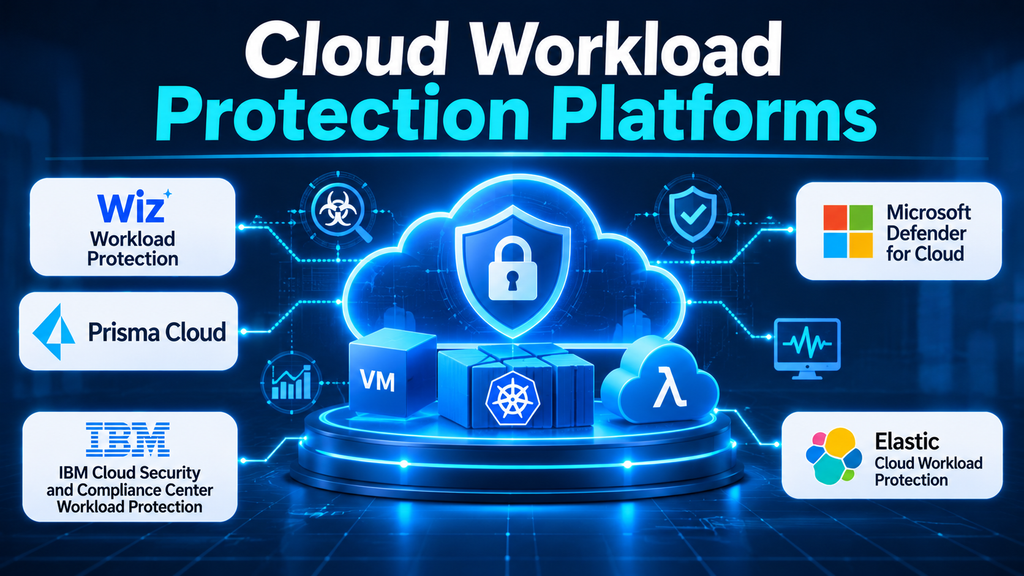
The following products illustrate different workload protection models. Some are broad cloud security platforms; others focus more directly on runtime telemetry and endpoint protection. The comparison is about architectural fit and documented capabilities, not a universal ranking.
Wiz Workload Protection
Wiz Cloud Workload Protection combines agentless workload discovery and assessment with runtime protection through its sensor-based capabilities.
Its approach is to establish broad visibility across cloud workloads, identify vulnerabilities and misconfigurations, and add runtime monitoring for threats that require in-workload telemetry. Wiz describes coverage for virtual machines, containers, serverless functions, and other cloud workloads. Its broader security graph can connect workload findings with cloud configuration, identities, and exposure context.
This combination is relevant for organizations that want to begin with wide cloud visibility and then add deeper runtime coverage where risk justifies it.
Consider it when: multicloud discovery and contextual prioritization are important, with runtime protection added for selected workloads.
Evaluate carefully: which assessments are agentless, where the Wiz Sensor is required, supported workload environments, runtime prevention controls, and the permissions needed for cloud connectivity.
Palo Alto Networks Prisma Cloud
Prisma Cloud Cloud Workload Protection brings workload security into a broader cloud-native application protection platform.
Palo Alto Networks describes protection for hosts, containers, Kubernetes, and serverless workloads. Its model combines agentless assessment with agent-based runtime capabilities. The company also documents process, file-system, and network activity policies, as well as forensic information intended to support incident investigation.
The distinction between its two protection approaches is important. Agentless scanning can help identify vulnerabilities and configuration risks without providing the same runtime prevention and forensic depth as an installed agent.
Prisma Cloud is therefore worth evaluating when an organization wants workload controls connected to application security, cloud posture, and compliance workflows. Its breadth also makes module selection and licensing clarity important.
Consider it when: the security program is consolidating code-to-cloud and runtime controls into a wider platform.
Evaluate carefully: required modules, agent coverage, supported operating systems and Kubernetes environments, deployment model, and the actual runtime features included in the proposed subscription.
Microsoft Defender for Cloud
Microsoft Defender for Cloud provides workload protection across Azure, connected multicloud environments, and supported on-premises systems.
Microsoft organizes workload protection around resource types and plans, including servers, containers, databases, storage, and other services. Its server protection options include agent-based and agentless capabilities, while other workload plans provide protections specific to their resource types.
For Microsoft-oriented security teams, the integration with the broader Microsoft security ecosystem is a significant architectural consideration. Alerts and investigations can be connected with Microsoft Defender XDR and related security operations workflows.
However, buyers should avoid treating Defender for Cloud as one uniform feature set. Coverage, detections, and prevention options depend on the resource type, enabled plan, and environment. Multicloud onboarding and the distinction between agent-based and agentless capabilities should be tested against the organization’s actual workloads.
Consider it when: Azure and Microsoft security operations are central to the environment, or the organization needs workload protection across Azure, AWS, Google Cloud, and supported hybrid infrastructure.
Evaluate carefully: plan-specific capabilities, server and container coverage, onboarding requirements, sensor dependencies, and how alerts flow into existing SOC processes.
IBM Cloud Security and Compliance Center Workload Protection
IBM Cloud Security and Compliance Center Workload Protection combines posture, compliance, vulnerability, and runtime security capabilities for cloud, hybrid, and on-premises environments.
IBM’s documentation identifies its workload protection capabilities with functionality from Sysdig Secure. It describes agent-based protection for workloads, including vulnerability identification, configuration and permission validation, runtime threat detection and blocking, and incident response.
This is a useful option to investigate for organizations operating IBM Cloud alongside other environments and looking for a consolidated approach to workload and posture security. It is important to understand the product’s architecture and dependencies rather than assume that every capability is native to every connected cloud.
Consider it when: IBM Cloud is part of a hybrid or multicloud environment and the organization wants workload protection connected with security and compliance operations.
Evaluate carefully: the specific Sysdig-derived components, agent requirements, supported platforms, cloud-provider coverage, and the distinction between posture assessment and runtime protection.
Elastic Cloud Workload Protection
Elastic Cloud Workload Protection focuses on detecting and preventing threats in running Linux virtual machines and Kubernetes workloads, with activity data integrated into Elastic Security.
Elastic documents the use of Elastic Defend for Linux virtual machines and a separate Defend for Containers integration for Kubernetes workloads. The platform can collect process, file, and network activity for security analysis, while supported protections can detect and block certain malicious behaviors.
This makes Elastic relevant for teams that already use Elastic Security or want workload telemetry to feed into a broader detection and investigation environment.
Its documented workload protection scope should be checked carefully. The available integrations and maturity differ by workload type; for example, Elastic’s documentation labels some serverless capabilities as beta. Buyers should not assume identical coverage across Linux hosts, Kubernetes, Windows, and serverless environments.
Consider it when: the organization wants runtime workload telemetry connected to an Elastic-based detection and investigation workflow.
Evaluate carefully: operating-system support, Kubernetes integration requirements, feature maturity, prevention coverage, and the additional operational work of managing integrations.
Comparing the protection models
| Platform | Main approach | Runtime visibility | Best evaluation focus |
|---|---|---|---|
| Wiz Workload Protection | Agentless discovery plus sensor-based protection | Sensor-based monitoring and response | Where agentless coverage ends and runtime coverage begins |
| Prisma Cloud | Agentless assessment plus agent-based protection | Process, file, network, and workload activity controls | Module scope and runtime deployment requirements |
| Microsoft Defender for Cloud | Resource-specific workload plans | Depends on workload type and enabled plan | Multicloud onboarding and Microsoft security integration |
| IBM Workload Protection | Agent-based workload protection within a broader platform | Runtime detection and blocking | Sysdig-derived components and supported environments |
| Elastic Cloud Workload Protection | Host and Kubernetes runtime integrations | Process, file, and network telemetry | Integration maturity and workload-specific support |
A fair proof of concept should compare the same workload types and threat scenarios. A platform with broad agentless discovery should not be judged as though it provides the same runtime telemetry as a deeply deployed sensor. Equally, a runtime-focused product should not be assumed to provide the same breadth of cloud inventory and posture management as a wider CNAPP.
What a real CWPP evaluation should test
Product demonstrations often focus on dashboards and vulnerability totals. A more useful evaluation follows a workload from deployment through detection and response.
1. Inventory and coverage
Start by listing the actual workloads in scope:
- Cloud virtual machines and operating systems
- Kubernetes distributions and cluster versions
- Container runtimes and registries
- Serverless platforms
- Hybrid and on-premises systems
- Short-lived and autoscaled workloads
Ask vendors to identify which resources are discovered automatically, which require credentials or agents, and which are unsupported. Confirm whether coverage remains accurate as workloads scale up, terminate, or move between environments.
2. Vulnerability assessment
Test whether the product identifies vulnerable packages and operating-system components, how frequently its vulnerability intelligence is updated, and how it handles exceptions.
Do not evaluate only the number of vulnerabilities detected. Check whether findings include affected package versions, severity rationale, exploitability context where available, and a practical remediation recommendation.
Also verify how the product handles images and running workloads. A vulnerability in a registry image is not necessarily present in every deployed instance, and a running workload may differ from the image originally scanned.
3. Runtime detection and prevention
Use controlled, authorized test scenarios to assess the runtime capabilities that matter to the organization.
Examples include suspicious process execution, unexpected file modification, unusual outbound communication, and attempts to perform privileged actions from a container.
Ask the vendor to demonstrate:
- What telemetry is collected
- Which detections are enabled by default
- Whether detection is behavioral, signature-based, or policy-based
- Which actions can be blocked automatically
- How false positives are investigated
- What evidence is available after an alert
A detection that arrives without useful process, user, workload, and timeline context can still leave analysts with substantial manual investigation work.
4. Sensor overhead and operational reliability
Runtime security software operates close to production applications. Test CPU and memory consumption under representative workloads, but do not rely on a single idle-state measurement.
Assess:
- Installation and upgrade procedures
- Kernel and operating-system compatibility
- Container and Kubernetes deployment requirements
- Behavior during sensor outages or connectivity loss
- Impact on autoscaling and ephemeral workloads
- Policy updates and rollback procedures
Prevention features deserve particular scrutiny. A policy that blocks suspicious activity may also disrupt a legitimate application if its behavior is misunderstood.
5. Response and integration
A CWPP should fit the incident-response process rather than create another isolated alert queue.
Check integration with SIEM, SOAR, endpoint detection, cloud operations, ticketing, and container orchestration tools. Determine whether an alert can be enriched with cloud account, workload owner, container image, process lineage, identity, and network context.
For high-risk actions, define who can isolate a workload, terminate a process, block a connection, or quarantine a resource. Automatic containment can reduce response time, but the organization needs clear approval boundaries and recovery procedures.
Why container and Kubernetes security need special attention
Container workloads are often short-lived and distributed. A traditional server-oriented agent strategy may not translate cleanly to a cluster where pods are created and destroyed continuously.
A practical CWPP evaluation should distinguish several layers:
- Image security: Identify vulnerable packages, embedded secrets, and risky image components before deployment.
- Registry security: Understand which images are trusted and which repositories are permitted.
- Kubernetes configuration: Assess cluster settings, role-based access control, admission policies, and workload permissions.
- Node protection: Monitor the host operating system and container runtime.
- Runtime behavior: Detect suspicious processes, unexpected binaries, privilege escalation, and unusual network activity inside containers.
These controls complement one another. Image scanning cannot detect every behavior that emerges after deployment. Runtime monitoring cannot make an untrusted image safe by itself. Kubernetes configuration assessment does not replace host and container threat detection.
The architecture also affects where sensors run. Some products deploy components on cluster nodes; others use admission controllers, daemon sets, sidecars, or external integrations for specific functions. Buyers should understand exactly which components are required and what privileges they receive.
CWPP versus CSPM, EDR, and CNAPP
These categories overlap, but they answer different security questions.
| Category | Primary question | Typical focus |
|---|---|---|
| CSPM | Is the cloud environment configured securely? | Cloud resources, policies, exposure, compliance, and drift |
| CWPP | Are running workloads vulnerable or behaving maliciously? | Hosts, containers, runtime telemetry, and workload response |
| EDR | Is an endpoint showing signs of compromise? | Endpoint activity, detection, investigation, and response |
| CNAPP | Can cloud-native risk be managed across the application lifecycle? | A combination of posture, workload, identity, and application security capabilities |
A CNAPP may include both CSPM and CWPP capabilities, but the presence of a single platform name does not guarantee equivalent depth in every area. Evaluate the underlying functionality rather than relying on category labels.
Common implementation mistakes
Deploying sensors everywhere before establishing scope. Start with critical workloads and representative systems. Validate compatibility and performance before expanding coverage.
Treating vulnerability counts as the main success metric. A larger count may reflect better discovery. Measure remediation of exploitable, exposed, and business-critical weaknesses instead.
Assuming agentless means runtime protection. Confirm whether the product actually observes activity inside running workloads and which capabilities require a sensor.
Enabling automatic blocking without testing. Validate policies in monitor-only or audit modes where available, then introduce prevention gradually with rollback procedures.
Ignoring ephemeral workloads. Test whether the platform discovers short-lived containers, autoscaled instances, and serverless executions within the time window that matters to the organization.
Creating an alert queue without ownership. Findings need a responsible team, a clear action, and a route into existing engineering and incident-response workflows.
Questions to ask before signing a CWPP contract
- Which workload types, operating systems, container runtimes, and Kubernetes distributions are supported?
- Which capabilities are agentless, and which require a sensor or agent?
- What runtime events can the product observe?
- Which threats can it prevent or block, rather than only detect?
- How does it handle ephemeral workloads and autoscaling?
- What are the sensor’s privileges, resource requirements, and update process?
- Can findings be correlated with cloud identity, configuration, vulnerabilities, and data exposure?
- What forensic evidence is retained, and for how long?
- Which integrations and response actions are included in the proposed plan?
- How are licensing and consumption measured across hosts, containers, clusters, and serverless resources?
Ask for a demonstration using a representative workload and a controlled detection scenario. Require the vendor to show the event, the evidence collected, the investigation path, and the response action. This is a much stronger test than a slide showing the number of protected assets.
Choosing the right depth of protection
A small, mostly serverless environment may not need the same sensor architecture as a large enterprise running mixed operating systems, Kubernetes clusters, and legacy virtual machines. An organization with a mature endpoint security program may also have overlapping host telemetry that needs to be accounted for before buying another agent.
The right CWPP is the one that closes a clearly identified workload security gap without creating more operational burden than the team can sustain.
Start by mapping workload types and critical applications. Decide where agentless assessment is sufficient and where runtime visibility is essential. Then test detection quality, prevention controls, compatibility, and response integration under realistic conditions.
Cloud workload protection is not achieved by scanning a workload once or installing an agent and assuming the problem is solved. It requires continuous visibility into what is deployed, what is running, and what changes when an application behaves unexpectedly.
