Upgrade & Secure Your Future with DevOps, SRE, DevSecOps, MLOps!
We spend hours scrolling social media and waste money on things we forget, but won’t spend 30 minutes a day earning certifications that can change our lives.
Master in DevOps, SRE, DevSecOps & MLOps by DevOps School!
Learn from Guru Rajesh Kumar and double your salary in just one year.
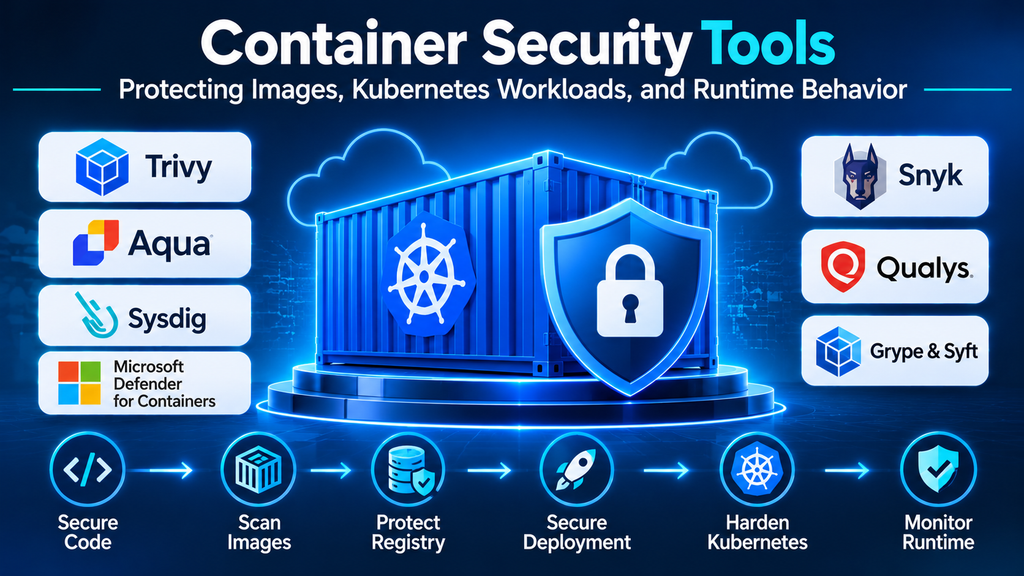
Container Security Tools: Protecting Images, Kubernetes Workloads, and Runtime Behavior
Container security protects software throughout its lifecycle, from source and image creation to registry storage, deployment admission, Kubernetes configuration, and runtime activity.
A practical container security program combines image scanning, SBOM generation, image signing, Kubernetes hardening, admission controls, and runtime monitoring. These controls are complementary rather than interchangeable.
Tools covered: Trivy, Aqua Security Platform, Sysdig Secure, Microsoft Defender for Containers, Snyk Container, Qualys Container Security, Grype, and Syft.
Trivy is an open-source scanner for container images, filesystems, Git repositories, virtual machine images, and Kubernetes resources. It detects vulnerabilities, misconfigurations, secrets, software components, and license issues. It is useful in developer workflows but is not a complete runtime defense platform.
Aqua Security Platform covers image scanning, supply-chain controls, deployment policies, and runtime protection. Evaluate included features, supported orchestrators, sensor requirements, and admission-control behavior.
Sysdig Secure combines container and Kubernetes security with runtime threat detection, vulnerability management, posture assessment, and investigation. It uses Falco rules and provides activity auditing and forensic context. Its local scanning option can keep image layers inside restricted environments while sending SBOMs and metadata for analysis.
Microsoft Defender for Containers protects Kubernetes clusters, nodes, workloads, registries, and images. Its capabilities include posture management, vulnerability assessment, runtime threat protection, software supply-chain protection, and deployment monitoring. Gated deployment rules can audit or block images based on vulnerability conditions.
Snyk Container takes a developer-oriented approach to image vulnerability management, base-image recommendations, and remediation workflows. Evaluate registry support, CI/CD integration, Kubernetes monitoring, and whether separate runtime protection is required.
Qualys Container Security provides container inventory, vulnerability assessment, compliance monitoring, and runtime threat detection, with CI/CD integrations and admission controls. Evaluate sensor coverage and how container findings connect to broader asset risk.
Grype and Syft are complementary open-source tools from Anchore. Syft generates SBOMs from images, filesystems, and archives. Grype analyzes images, filesystems, and SBOMs for known vulnerabilities. They are useful for custom pipelines but require additional controls for admission and runtime defense.
A layered container security pipeline should scan source and build artifacts, scan images and generate SBOMs, continuously assess registry images, verify signatures at deployment, enforce Kubernetes security policies, monitor runtime behavior, and route findings to owners.
Important evaluation questions include supported registries and Kubernetes distributions, scanning stages, SBOM formats, exploitability and runtime prioritization, image signature verification, admission policies, runtime detection and blocking, sensor deployment, integrations, exception management, and licensing.
There is no universal container security tool for every organization. Developers may prioritize fast scans and remediation advice; platform teams may need Kubernetes policy and admission control; security operations may need runtime telemetry and forensic evidence. The objective is to ensure that images entering production are understood and trusted, workloads run with appropriate permissions, and unexpected behavior can be detected and contained.
