Upgrade & Secure Your Future with DevOps, SRE, DevSecOps, MLOps!
We spend hours scrolling social media and waste money on things we forget, but won’t spend 30 minutes a day earning certifications that can change our lives.
Master in DevOps, SRE, DevSecOps & MLOps by DevOps School!
Learn from Guru Rajesh Kumar and double your salary in just one year.
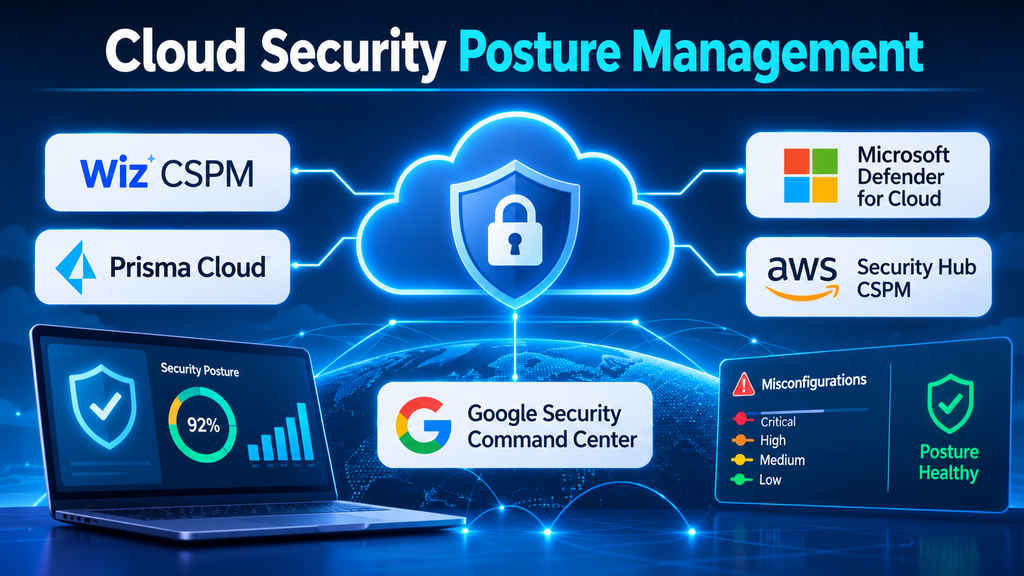
Cloud Security Posture Management: Finding the Cloud Misconfigurations That Matter
Cloud environments can accumulate security weaknesses faster than teams can review them. A storage bucket becomes publicly accessible, an identity receives broader permissions than it needs, a database loses an encryption setting, or a network rule exposes an administrative service. Each issue may look manageable in isolation. Together, they can create a path to sensitive systems and data.
Cloud Security Posture Management (CSPM) helps security teams continuously identify these weaknesses across cloud infrastructure, assess them against security policies, and guide remediation. The difficult part is not simply finding misconfigurations. It is deciding which findings represent meaningful risk, who owns the fix, and how to prevent the same problem from returning.
The strongest CSPM approach connects cloud inventory, configuration assessment, identity and exposure context, compliance requirements, and remediation workflows. A dashboard full of alerts is not the same as a better-secured cloud environment.
What CSPM actually monitors
CSPM tools assess the configuration and security state of cloud resources. Depending on the platform and licensed capabilities, those resources may include:
- Virtual machines, storage services, databases, and managed networking
- Cloud identities, roles, permissions, and access policies
- Kubernetes clusters and container-related cloud configurations
- Serverless services and managed application platforms
- Encryption settings, logging, backups, and network exposure
- Cloud accounts, subscriptions, projects, and organizational structures
A CSPM platform typically collects configuration information through cloud-provider APIs, evaluates resources against built-in or custom policies, and creates findings when a resource violates a security requirement.
For example, a policy might flag a storage service that permits public access, a database without an expected encryption configuration, or an identity role with excessive permissions. The finding should identify the affected resource, explain the policy violation, and provide enough context for an engineer to investigate it.
CSPM is not a replacement for every cloud security control. It does not automatically provide the runtime threat detection of a workload protection platform, the full software supply-chain analysis of application security tools, or the data classification depth of a dedicated data security platform. Modern cloud-native application protection platforms combine several of these capabilities, but buyers should still evaluate each capability separately.
The difference between finding a misconfiguration and understanding risk
A common weakness in CSPM programs is treating every policy violation as equally urgent.
Consider two findings:
- A test resource has a missing tag.
- A production database containing sensitive information is reachable from the public internet and uses an identity with excessive permissions.
Both may violate organizational policy, but their security implications are very different.
Useful prioritization requires more than severity labels. Teams should consider:
- Exposure: Can the resource be reached from the public internet or an untrusted network?
- Identity: Which users, roles, services, or credentials can access it?
- Data sensitivity: Does the resource store regulated, confidential, or business-critical information?
- Exploitability: Is there a realistic way to abuse the weakness?
- Business context: Does the resource support a critical application or process?
- Attack-path relationships: Can one weakness be combined with another to reach a more valuable target?
This context helps teams avoid spending the same amount of effort on a low-impact hygiene issue and a configuration that could expose important data.
CSPM findings are also not proof that a resource has been compromised. They identify conditions that may increase risk. Security teams still need investigation, validation, and, where appropriate, incident-response procedures.
CSPM platforms worth evaluating
The products below represent different approaches to cloud posture management. Some are broader cloud security platforms; others are closely integrated with a particular cloud ecosystem. They should not be treated as interchangeable simply because each can identify configuration weaknesses.
Wiz CSPM
Wiz CSPM emphasizes cloud visibility and contextual risk prioritization. Its approach uses the Wiz Security Graph to connect cloud resources and security findings, helping teams understand how individual weaknesses relate to other assets and exposures.
Wiz describes agentless cloud connectivity through cloud-provider APIs and coverage across areas such as virtual machines, containers, serverless resources, and AI environments. Its CSPM capabilities also include configuration assessment and infrastructure-as-code scanning.
The graph-based approach is particularly relevant when an organization has many cloud accounts and needs to understand relationships between identities, workloads, vulnerabilities, and exposed resources. Rather than reviewing each alert independently, analysts can investigate how several conditions combine into a more consequential risk.
Consider it when: cross-cloud visibility, contextual prioritization, and connected risk investigation are central requirements.
Evaluate carefully: API permissions, supported services, data collection scope, coverage for the specific cloud services in use, and the operational effort required to validate and remediate findings.
Prisma Cloud
Palo Alto Networks Prisma Cloud is a broader cloud-native application protection platform that includes CSPM alongside workload, application, and other cloud security capabilities.
Its CSPM functionality covers cloud configuration assessment, compliance monitoring, and policy-based detection. The platform is designed to connect security controls across cloud infrastructure and the application lifecycle, rather than operate only as a configuration dashboard.
This wider scope can be useful for organizations seeking to coordinate posture management with workload and application security. It can also introduce a more involved evaluation: buyers should determine which modules they need, how the licensing model maps to their environment, and whether their teams can operationally use the breadth of the platform.
Prisma Cloud offers SaaS and self-hosted deployment models, with product edition and deployment choices affecting the architecture and administration model.
Consider it when: the organization wants CSPM as part of a wider cloud-native security program.
Evaluate carefully: module boundaries, licensing and consumption assumptions, deployment model, integration with existing development workflows, and which capabilities are included in the proposed configuration.
Microsoft Defender for Cloud
Microsoft Defender for Cloud provides cloud security posture capabilities across Azure and connected multicloud environments, including AWS and Google Cloud.
Microsoft distinguishes Foundational CSPM from the more advanced Defender CSPM plan. Foundational capabilities include security recommendations, secure score, policy management, and multicloud posture visibility. Advanced capabilities add features such as governance, regulatory compliance views, and Cloud Security Explorer.
That distinction matters during procurement. Organizations should not assume that every advanced posture-management feature is included simply because basic CSPM is available. Microsoft also notes that some recommendations depend on enabling specific Defender plans.
For organizations already using Microsoft cloud services and security operations tooling, Defender for Cloud may offer a practical route to centralize posture findings and connect them with other Microsoft security workflows.
Consider it when: Azure is a major part of the environment, or the organization wants CSPM integrated with its Microsoft security operations.
Evaluate carefully: which capabilities require paid plans, the support matrix for connected AWS and Google Cloud resources, and whether the recommendations cover the services and configurations that matter most.
AWS Security Hub CSPM
AWS Security Hub CSPM focuses on assessing and consolidating security findings across AWS accounts and supported integrations.
It evaluates AWS resources against security controls and standards, including AWS Foundational Security Best Practices and supported industry frameworks. It also normalizes findings into the AWS Security Finding Format (ASFF), making it easier for downstream tools and workflows to process findings from different sources.
This native integration is its defining advantage. AWS-centric teams can use it to centralize posture checks and findings from AWS services and supported third-party products. It is not, however, a universal replacement for a dedicated multicloud posture platform.
Operational details matter. AWS documentation notes that Security Hub CSPM only detects and consolidates findings generated after the service is enabled, and findings are processed in the Region where it is enabled. Multi-Region and multi-account configuration therefore needs deliberate planning.
Consider it when: AWS is the primary cloud environment and native integration with AWS accounts, services, and findings is a priority.
Evaluate carefully: Region coverage, account onboarding, AWS Config dependencies, enabled standards, finding volume, and the cost implications of the checks and related services.
Google Security Command Center
Google Security Command Center provides cloud security visibility and posture management for Google Cloud environments.
Its security posture service allows organizations to define policy sets containing preventative and detective controls, deploy those postures at organization, folder, or project level, and monitor for configuration drift. Posture definitions can use predefined templates or be customized to reflect organizational requirements.
This policy-oriented model is useful when teams want to define an expected security state and monitor whether deployed resources continue to comply with it. It also supports infrastructure-as-code workflows for defining posture resources.
The important consideration is service-tier and activation requirements. Google’s documentation specifies that the security posture service requires an eligible Security Command Center subscription and organization-level activation. Buyers should verify current service-tier availability and feature requirements before designing around it.
Consider it when: Google Cloud is central to the environment and policy deployment, drift monitoring, and organization-level governance are important.
Evaluate carefully: service-tier requirements, organization-level activation, supported policies, and how posture findings will be routed into existing remediation workflows.
How the approaches compare
| Platform | Primary strength | Cloud fit | Important evaluation point |
|---|---|---|---|
| Wiz CSPM | Graph-based context and connected risk prioritization | Multicloud environments | API access, resource coverage, and remediation workflow |
| Prisma Cloud | CSPM within a broad cloud-native security platform | Hybrid and multicloud | Modules, deployment model, and licensing |
| Microsoft Defender for Cloud | Integrated Microsoft security and cloud recommendations | Azure and connected AWS/GCP | Foundational versus advanced plan capabilities |
| AWS Security Hub CSPM | Native AWS security checks and normalized findings | AWS | Regional configuration, account coverage, and dependencies |
| Google Security Command Center | Defined security postures and drift monitoring | Google Cloud | Subscription tier and organization-level activation |
This is a capability-oriented comparison, not a performance ranking. The right choice depends on cloud-provider mix, existing security investments, required controls, and the team’s ability to act on the findings.
The architecture decisions that shape CSPM effectiveness
API-based assessment or agent deployment
Many CSPM platforms use cloud-provider APIs to inspect configuration and resource metadata. This can reduce the need to install agents across every cloud resource and is particularly useful for large, dynamic environments.
However, agentless does not mean permissionless. The platform still needs appropriate access to cloud APIs. Security teams should review the permissions requested, the data collected, where that data is stored, and how credentials or delegated roles are protected.
API-based configuration assessment also has limits. It may not reveal every runtime behavior or provide the same telemetry as an agent or workload sensor. A CSPM deployment should therefore be assessed alongside runtime security requirements.
Preventive policy or detective finding
CSPM tools commonly identify policy violations after a resource has been created or changed. Some ecosystems also support preventive controls that restrict insecure configurations before deployment.
These approaches serve different purposes:
- Preventive controls block or constrain risky changes before they become deployed resources.
- Detective controls identify deviations and provide findings for investigation.
- Infrastructure-as-code checks can detect configuration problems before deployment pipelines apply changes.
A mature program uses all three where practical. Preventive policies reduce repeat violations, while detective checks help identify drift, exceptions, and resources created outside approved pipelines.
One dashboard or integration with engineering workflows
A security dashboard is useful for oversight, but developers and cloud engineers generally resolve issues in the tools where they manage infrastructure.
Before selecting a platform, confirm whether findings can be routed into the organization’s ticketing, chat, cloud operations, and development workflows. Check whether integrations preserve resource identifiers, policy details, ownership, severity, and remediation context.
A ticket that says “fix cloud misconfiguration” is not enough. It should identify the affected resource, explain the violation, show why it matters, and link to a safe remediation path.
Building a CSPM program that reduces risk
A successful deployment begins with coverage and ownership, not with enabling every available policy.
1. Establish a complete cloud inventory
Connect the relevant accounts, subscriptions, projects, and organizational units. Identify shadow environments, abandoned resources, and cloud services that are not represented in the central inventory.
Document which environments are production, development, test, or shared infrastructure. Without this context, teams may prioritize findings incorrectly.
2. Define a baseline that reflects business requirements
Start with a manageable set of high-value policies: public exposure, identity permissions, encryption, logging, network controls, and protection of critical data stores.
Map standards to actual organizational requirements. Compliance frameworks can provide useful reference controls, but passing a checklist does not establish that an environment is secure against every relevant threat.
3. Assign ownership before scaling alerts
Every finding category should have an accountable team. Identity issues may belong to IAM owners; network exposure may require cloud platform teams; storage configuration may be handled by application or infrastructure owners.
Set severity-based response expectations, but allow business criticality and exposure context to influence prioritization.
4. Automate low-risk remediation carefully
Some configuration corrections are predictable and safe to automate. Others can disrupt applications, break access, or affect availability.
Begin with reversible, well-understood actions. Use approvals for changes that could affect production services, and retain logs of automated actions. A CSPM platform should not be given broad remediation authority without clear boundaries.
5. Measure outcomes, not alert counts
Useful program measures include:
- Time taken to remediate high-risk exposed resources
- Number of critical cloud assets with unresolved policy violations
- Recurrence rate for previously corrected misconfigurations
- Percentage of cloud accounts and projects covered by assessment
- Number of findings with clear ownership
- Drift from approved infrastructure and security baselines
A rising finding count can indicate improved visibility rather than worsening security. Conversely, a low count may reflect incomplete coverage or overly permissive policies. Metrics need context.
Questions to ask during a CSPM evaluation
A product demonstration should use the organization’s own cloud architecture and realistic scenarios. Ask vendors to show:
- How are cloud accounts connected, and what permissions are required?
- Which cloud services and resource types are supported?
- How quickly are configuration changes reflected in findings?
- Can the platform explain relationships between identities, exposed resources, vulnerabilities, and sensitive data?
- Can teams create custom policies and exceptions with expiry dates?
- How are findings deduplicated when multiple standards detect the same issue?
- Can findings be assigned to resource owners automatically?
- Which remediation actions are automated, and what approval controls exist?
- What data leaves the cloud environment, where is it stored, and how long is it retained?
- Which capabilities require separate plans, modules, or usage-based charges?
Ask for a demonstration of a complete workflow: discover a misconfigured resource, understand its context, assign ownership, remediate it, and verify that the finding closes. That exercise reveals more than a polished dashboard tour.
When a dedicated CSPM platform may be unnecessary
Not every organization needs a large third-party CSPM deployment.
A company operating a relatively small environment on a single cloud provider may find that native security posture capabilities cover its immediate configuration and compliance needs. A separate platform becomes more compelling when the organization needs broader multicloud visibility, richer relationship analysis, consolidated governance, or workflows that its native tools do not provide.
The decision should be based on gaps, not on the assumption that more security products automatically create better security.
CSPM delivers value when it helps an organization maintain a known, governed cloud configuration and respond to the weaknesses that matter most. The platform is only one part of that outcome. Accurate inventory, well-designed policies, clear ownership, engineering collaboration, and verified remediation are what turn posture findings into measurable risk reduction.
