Upgrade & Secure Your Future with DevOps, SRE, DevSecOps, MLOps!
We spend hours scrolling social media and waste money on things we forget, but won’t spend 30 minutes a day earning certifications that can change our lives.
Master in DevOps, SRE, DevSecOps & MLOps by DevOps School!
Learn from Guru Rajesh Kumar and double your salary in just one year.
Introduction
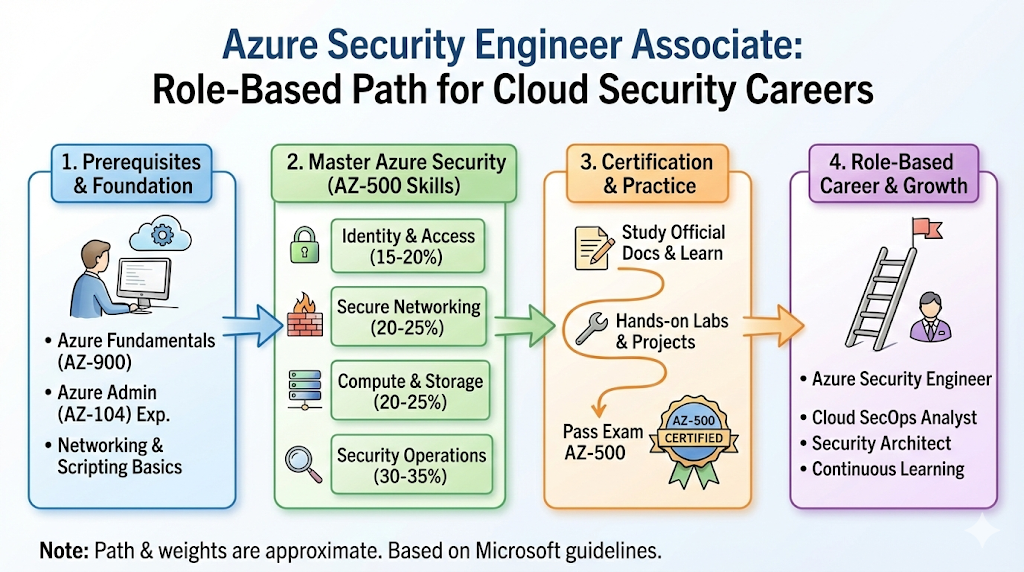
In today’s world of cloud computing, security is at the forefront of every organization’s cloud strategy. The Azure Security Engineer Associate (AZ-500) certification prepares professionals to protect Azure environments. The certification covers various aspects of security, such as securing identities, managing network security, and ensuring data protection. This guide is crafted to provide a comprehensive understanding of the AZ-500 certification, its relevance, and how it can elevate your security expertise and career. As companies adopt Azure, they need skilled engineers to secure their systems from vulnerabilities and breaches. This guide is for both aspiring and experienced engineers, helping you map out a practical preparation plan and advance your career in Azure security.
Certifications Table
| Track | Level | Certification | Who it’s for | Prerequisites | Skills covered | Recommended order |
|---|---|---|---|---|---|---|
| Azure Security | Associate | Azure Security Engineer Associate (AZ-500) | Engineers working with Azure security, cloud infrastructure, and secure delivery | Basic Azure knowledge, identity basics, networking fundamentals | IAM, network security, data protection, security posture, monitoring, incident response | 1 |
Azure Security Engineer Associate (AZ-500)
What it is
The Azure Security Engineer Associate (AZ-500) certification is designed for professionals who want to validate their skills in implementing security controls and ensuring security operations within Microsoft Azure. It focuses on the core aspects of securing Azure workloads, identity, network security, and managing incidents. It is intended for those who handle Azure’s security features and configurations, offering a solid foundation in securing cloud resources.
This certification enables professionals to prove their expertise in securing the Azure environment against various vulnerabilities, making it a key qualification for modern security engineers.
Who should take it
The AZ-500 certification is designed for cloud engineers, security engineers, and platform engineers who are responsible for securing Azure environments. It is especially useful for professionals who work in roles that involve securing infrastructure, networks, identities, and data within Azure. Additionally, DevOps engineers, security specialists, and IT managers who handle security operations, incident response, or governance tasks in Azure would greatly benefit from this certification.
If you are aiming to specialize in Azure security or enhance your knowledge in securing cloud environments, AZ-500 is an excellent step toward that goal.
Skills you’ll gain
By completing the AZ-500 certification, you will gain crucial security skills for working with Azure environments, including:
- Identity and Access Management (IAM): Configuring and managing Azure AD, RBAC, and Conditional Access policies to secure identities and access.
- Network Security: Implementing network security controls like network security groups (NSG), Azure Firewall, and VPNs to protect your networks.
- Data Protection: Managing encryption techniques and controlling access to data stored within Azure storage accounts and databases.
- Security Posture: Configuring Azure Security Center for monitoring security threats and implementing security policies.
- Incident Response: Using tools like Azure Sentinel to monitor and respond to security incidents efficiently.
These skills ensure that you can safeguard your Azure environment and act proactively in the event of a security breach.
Real-world projects you should be able to do after it
After earning your AZ-500 certification, you’ll be able to work on various real-world projects that require strong security controls within Azure, such as:
- Identity and access management design: Implementing secure role-based access control (RBAC) and managing Azure Active Directory to ensure users only access what they need.
- Secure network architecture: Building a secure network with subnets, firewalls, and secure access points to protect cloud workloads.
- End-to-end data protection: Implementing storage encryption, creating secure vaults for key management, and setting up protected access for cloud databases.
- Setting up security operations: Configuring Azure Security Center and setting up automated responses for detecting and mitigating threats.
- Incident management: Responding to live security incidents and investigating them with the help of Azure Sentinel’s threat detection tools.
These projects will prepare you for a wide range of practical security tasks within Azure and ensure your solutions are secure from the start.
Preparation plan
7–14 days plan
For professionals with existing knowledge of Azure, a 7–14 day study plan can be effective:
- Days 1–2: Familiarize yourself with the exam structure, review the security domains, and assess your knowledge gaps.
- Days 3–5: Dive deep into identity and access management, including Azure AD and RBAC configurations.
- Days 6–8: Focus on securing networks with Azure Firewall, NSGs, and VPN configurations.
- Days 9–11: Study data protection policies, such as Azure Storage encryption and key management practices.
- Days 12–14: Focus on security operations and monitoring with Azure Sentinel and Security Center. Complete mock exams to test your understanding.
30 days plan
For those with intermediate Azure experience, aim to study over 30 days:
- Week 1: Understand identity and access management, delve into Azure AD, and practice configuring RBAC and policies.
- Week 2: Focus on network security concepts such as VNETs, subnets, firewalls, and security groups.
- Week 3: Dive into data security, encryption techniques, and securing data at rest and in transit.
- Week 4: Focus on monitoring, incident detection, and incident response with Azure Security Center and Sentinel. Review all material and do practice exams.
60 days plan
For beginners, a 60-day preparation timeline will provide enough time to build foundational knowledge before focusing on exam-specific topics:
- Weeks 1–2: Get comfortable with Azure basics, services, and architecture before diving into security-specific topics.
- Weeks 3–4: Focus on implementing identity and access policies, role management, and secure identity flows.
- Weeks 5–6: Work on network security, including VPN configurations, firewalls, and setting up secure connectivity.
- Weeks 7–8: Concentrate on data protection, incident management, and security monitoring. Participate in practice labs and simulations.
Common mistakes
- Memorizing instead of applying: Many learners memorize configurations without understanding how they impact the overall security posture. It’s crucial to apply the concepts in labs and real-life scenarios.
- Ignoring monitoring and incident response: It’s easy to focus on preventive security, but without monitoring, it’s difficult to detect and respond to incidents effectively.
- Overcomplicating configurations: Security engineers often try to implement overly complex solutions when simpler, effective configurations work well.
- Skipping hands-on labs: Theoretical knowledge is helpful, but practical implementation through labs and exercises is essential for retention and real-world application.
- Not managing access control effectively: Failing to enforce least-privilege access can lead to security vulnerabilities, especially in a cloud environment.
Best next certification after this
Once you’ve completed AZ-500, you can continue your Azure security journey or branch out into related areas:
- Same track: For more advanced security roles, consider the Microsoft Certified: Azure Security Engineer Expert certification.
- Cross-track: If you want to focus on broader cloud architecture, the Azure Solutions Architect Expert certification (AZ-303) would be a good choice.
- Leadership: For those pursuing leadership, the Microsoft Certified: Azure DevOps Engineer Expert certification provides insight into securing DevOps pipelines.
Choose Your Path (6 Learning Paths)
DevOps Path
If you work with CI/CD pipelines, integrating security is a must. Focus on building secure pipelines, incorporating secure coding practices, and embedding security testing as part of your delivery process.
DevSecOps Path
DevSecOps integrates security into DevOps workflows. It requires a mindset shift to build security into everything—from code to delivery. Focus on policy-as-code and automating security checks into every phase of the pipeline.
SRE Path
Site Reliability Engineers balance reliability with security. Focus on securing your incident management systems, ensuring availability, and monitoring security threats without compromising uptime.
AIOps/MLOps Path
With machine learning and automation, security must be tightly integrated. Focus on securing models, data pipelines, and machine learning infrastructure in Azure.
DataOps Path
Data engineers need to secure data flows from start to finish. Focus on data encryption, access control, and auditing within Azure’s data storage and processing systems.
FinOps Path
In the context of cloud finance management, focus on securing cost-reducing automation and governance policies that prevent financial risks from misconfigurations.
Role → Recommended Certifications Mapping
| Role | Why AZ-500 matters | Recommended certifications |
|---|---|---|
| DevOps Engineer | Secure CI/CD pipelines, deployment workflows | AZ-500, then DevOps + security automation |
| SRE | Secure incident response and monitoring | AZ-500, then SRE + security operations |
| Platform Engineer | Implement secure platform architectures | AZ-500, then secure platform design |
| Cloud Engineer | Secure cloud subscriptions, networks, and workloads | AZ-500, then cloud security architecture |
| Security Engineer | Core Azure security implementation | AZ-500, then advanced security specialization |
| Data Engineer | Secure data storage, access policies | AZ-500, then DataOps + security patterns |
| FinOps Practitioner | Governance controls, security policies | AZ-500, then cost security and control |
| Engineering Manager | Security decision-making, risk visibility | AZ-500, then leadership-oriented governance |
Next Certifications to Take (3 Options)
Option 1: Same track (security depth)
- Further deepen your Azure security skills by taking the Microsoft Certified: Azure Security Engineer Expert.
Option 2: Cross-track (security + delivery or reliability)
- Combine your security expertise with Azure DevOps Engineer or Site Reliability Engineer certifications for a comprehensive cloud-focused skillset.
Option 3: Leadership (security strategy and governance)
- Transition into leadership with governance and risk management certifications such as Microsoft Certified: Azure Governance Expert.
Top Institutions for Training cum Certifications Support
DevOpsSchool
DevOpsSchool offers comprehensive training with a hands-on approach. The certification program ensures you understand security in real scenarios, allowing for better practical application in your job roles. Their instructors focus on bridging the gap between theoretical knowledge and real-world use cases.
Cotocus
Cotocus emphasizes practical learning through project-based training. The trainers guide you through each step of Azure security, ensuring you gain the expertise needed to solve real-world security issues effectively. This practical approach is ideal for working professionals.
Scmgalaxy
Scmgalaxy offers a wide range of Azure-focused training programs, with particular emphasis on certification prep. Their courses provide you with the essential skills to pass exams and excel in your security role by integrating theory with practice.
BestDevOps
BestDevOps is recognized for its strong emphasis on hands-on, role-based learning. Their Azure training ensures learners gain knowledge that’s directly applicable in day-to-day security engineering tasks. Their approach builds confidence and practical skills for handling complex cloud security challenges.
devsecopsschool.com
devsecopsschool.com specializes in cloud security and DevSecOps. The training programs are designed to build secure cloud infrastructure while integrating security from the beginning of the development process. This institution excels in preparing security professionals who are ready to address today’s cybersecurity challenges.
FAQs (Minimum 12) Focused on Difficulty, Time, Sequence, Value, Career Outcomes
1. How difficult is the Azure Security Engineer Associate (AZ-500) exam?
AZ-500 is moderately difficult because it tests real security decisions, not just theory. If you already work with Azure identity, networking, or monitoring, it feels easier. If you are new to Azure security, you must spend extra time on hands-on practice.
2. How much time do I need to prepare for AZ-500?
Most working engineers can prepare in 30 days with consistent study. If you have strong Azure experience, 7–14 days can work with focused revision. If you are a beginner, 60 days is more realistic to build fundamentals and confidence.
3. Can I pass AZ-500 without hands-on practice?
It is risky because this exam expects practical understanding of how controls work in Azure. Without labs, concepts like access control, monitoring, and governance feel unclear. Hands-on practice also helps you answer scenario-based questions faster.
4. What are the most important topics to focus on for AZ-500?
Identity and access management is the most critical area, followed by network security and security monitoring. Data protection and governance are also high-impact sections. If you master these, your chances of passing improve significantly.
5. What should I learn before starting AZ-500 preparation?
You should know basic Azure services, networking fundamentals, and identity basics. Understanding how subscriptions, resource groups, and permissions work will help a lot. If these basics are weak, you will feel stuck during preparation.
6. What is the best study sequence for AZ-500?
Start with Identity and access control because it connects to everything else. Then move to network security and workload protection. After that, cover data protection, governance, and finally monitoring and incident response.
7. Is AZ-500 valuable for DevOps and Platform engineers?
Yes, because DevOps and platform roles deal with access, secrets, pipelines, and production infrastructure. AZ-500 helps you build secure deployment patterns and avoid risky permissions. It also improves your ability to pass security reviews and audits.
8. Is AZ-500 useful for SRE roles and reliability-focused teams?
Yes, because SREs work close to production incidents and monitoring systems. AZ-500 strengthens your incident response mindset and helps you design secure monitoring and alerting. It also improves resilience because secure systems reduce outage risks.
9. What career outcomes can AZ-500 unlock?
It can help you move into roles like Azure Security Engineer, Cloud Security Engineer, Platform Security Engineer, or DevSecOps Engineer. It can also support promotions in cloud engineering roles with security ownership. The strongest outcomes come when you combine it with practical projects.
10. Does AZ-500 improve salary and job opportunities?
Security skills are in high demand, so it often improves interview shortlisting and job options. Salary impact depends on your role, region, and your ability to show real security work. Pairing the certification with portfolio projects creates the best results.
11. What are common mistakes candidates make while preparing for AZ-500?
Many learners memorize features instead of understanding security decisions and tradeoffs. Some ignore monitoring and incident response because they focus only on prevention. Others skip labs and struggle with scenario-based exam questions.
12. What is the best next certification after AZ-500?
If you want deeper security, stay on the same track and strengthen cloud security specialization. If you want broader growth, go cross-track into DevOps, SRE, or cloud architecture skills. If you want leadership growth, focus on governance, risk, and program-level security thinking.
FAQs on Azure Security Engineer Associate (AZ-500)
1. What does the AZ-500 certification validate?
AZ-500 validates your ability to implement security controls and manage security operations in Azure. It focuses on identity protection, network security, data security, and monitoring for threats. It proves you can secure real Azure environments, not just understand theory.
2. Who should take Azure Security Engineer Associate (AZ-500)?
It is ideal for Security Engineers, Cloud Engineers, DevOps Engineers, Platform Engineers, and SREs working on Azure. It also suits engineers moving into cloud security roles. Managers can take it to improve decision-making and security review confidence.
3. What knowledge should I have before starting AZ-500?
You should understand basic Azure services, networking concepts, and identity fundamentals. Familiarity with subscriptions, resource groups, and role-based access control helps a lot. If you lack these basics, spend a few days building them first.
4. How long does it usually take to prepare for AZ-500?
Most working professionals prepare in about 30 days with steady study. If you already work with Azure security topics, 7–14 days may be enough. Beginners usually need around 60 days to build strong foundations and practice labs.
5. What are the most important areas to focus on for the exam?
Identity and access management is the highest-impact area. Network security and security monitoring are also major scoring areas. Data protection and governance complete the picture and often appear in scenario-based questions.
6. Is hands-on practice necessary to pass AZ-500?
Yes, hands-on practice is strongly recommended because the exam is scenario-driven. Without labs, it is hard to understand how controls behave in real Azure environments. Practice also improves your speed and confidence in exam-style questions.
7. What real-world work can I do after passing AZ-500?
You can design least-privilege access models, secure networks, protect cloud data with encryption, and set up security monitoring and alerting. You can also support incident response using security signals and logs. These are practical tasks that security teams perform daily.
8. What should I do right after clearing AZ-500 to grow my career?
Build 2–3 practical projects that show your skills, like secure identity design, workload monitoring, and governance policy enforcement. Then choose your next step: deeper security, cross-track into DevOps/SRE, or leadership-focused governance growth. This combination gives the strongest career outcomes.
Testimonials
Amit
“AZ-500 helped me understand security the way it works in real Azure projects. I became more confident in setting least-privilege access, tightening network controls, and explaining my decisions during reviews.”
Neha
“I used to feel stuck between security and delivery speed. After preparing for AZ-500, I learned how to apply practical controls without breaking deployments, and my team started trusting my security suggestions.”
Rahul
“The biggest change for me was monitoring and incident thinking. AZ-500 preparation made it easier to detect issues early, investigate alerts calmly, and respond with a clear process instead of panic.”
Priya
“Before AZ-500, I knew tools but not the full security picture. Now I can connect identity, governance, data protection, and operations in one plan, which improved my interviews and project confidence.”
Vikram
“This certification pushed me to do hands-on work instead of only reading. After clearing AZ-500, I could actually build a secure setup in Azure and justify why each control matters.”
Conclusion
The AZ-500 is a critical certification for those working with or moving to cloud security. It offers hands-on knowledge of securing Azure environments, handling identity and access, protecting data, and responding to incidents. Prepare strategically with a focus on labs and real-world scenarios to pass the exam and gain valuable career skills. Whether you’re a cloud engineer, security specialist, or manager, AZ-500 positions you for success in one of the most in-demand fields today.