Upgrade & Secure Your Future with DevOps, SRE, DevSecOps, MLOps!
We spend hours scrolling social media and waste money on things we forget, but won’t spend 30 minutes a day earning certifications that can change our lives.
Master in DevOps, SRE, DevSecOps & MLOps by DevOps School!
Learn from Guru Rajesh Kumar and double your salary in just one year.
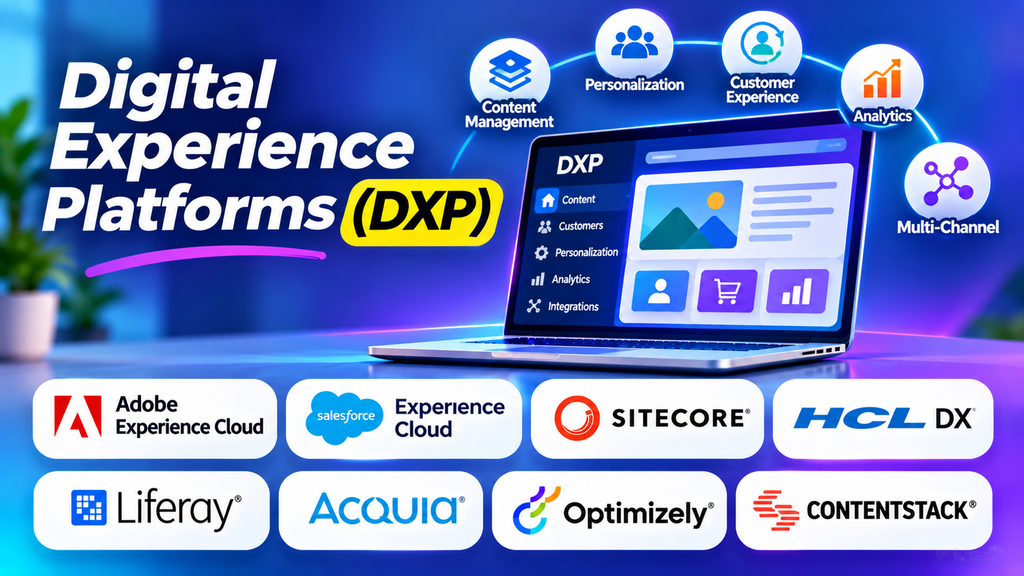
Businesses interact with customers across websites, mobile applications, online stores, customer portals, and other digital channels. Delivering a consistent and personalized experience across these touchpoints can become challenging when each channel operates independently.
A Digital Experience Platform (DXP) brings together technologies that help organizations create, manage, deliver, and optimize digital experiences. Depending on the platform, it may combine content management, personalization, analytics, customer data, commerce, and marketing integrations within a connected environment.
DXPs are particularly relevant to organizations managing complex websites, multiple brands, customer portals, or digital services that need to deliver coordinated experiences across several channels.
What Is a Digital Experience Platform?
A Digital Experience Platform is a collection of integrated technologies designed to manage and improve digital interactions throughout the customer journey. It can help businesses publish content, personalize experiences, understand user behavior, and connect digital channels with other business systems.
Unlike a standalone content management system, a DXP typically covers a broader set of digital experience capabilities. The exact scope varies by vendor: some platforms provide a broad suite of connected products, while others focus on particular areas and integrate with external tools.
Common DXP capabilities include:
- Content management: Create, organize, approve, and publish digital content.
- Personalization: Adapt content or experiences based on user attributes and behavior, where supported.
- Customer data integration: Connect relevant customer information from supported systems.
- Digital asset management: Organize and distribute images, videos, documents, and other media.
- Analytics: Measure engagement, conversions, and other digital experience metrics.
- Marketing automation: Coordinate campaigns and customer communications through integrated tools.
- Commerce integration: Connect product information, transactions, and customer journeys.
- Multichannel delivery: Support websites, applications, portals, and other digital touchpoints.
Not every DXP includes all these features natively. Organizations should distinguish between built-in capabilities, separately licensed products, and third-party integrations.
Best Digital Experience Platforms to Consider
1. Adobe Experience Manager
Adobe Experience Manager (AEM) combines digital content management capabilities with digital asset management through related products and integrations. Organizations can use it to manage websites, digital assets, and content delivery workflows across complex digital properties.
AEM may suit large enterprises, global brands, and organizations that manage substantial amounts of content across multiple markets. Its broader Adobe ecosystem can also be relevant to teams using other Adobe marketing and analytics technologies.
Implementation can be complex, and costs may be significant. Businesses should assess licensing, implementation partners, integration requirements, content workflows, and the skills needed for ongoing administration.
2. Salesforce Experience Cloud
Salesforce Experience Cloud helps organizations build connected digital experiences, including customer portals, partner portals, and online communities. It can use Salesforce data and platform capabilities to support interactions between organizations and their customers or partners.
It may be a good candidate for businesses that already use Salesforce CRM and want digital experiences connected to customer records, service workflows, or partner processes.
Before choosing it, assess licensing, customization requirements, identity management, portal permissions, integrations, and the complexity of the experience being built.
3. Sitecore
Sitecore provides digital experience technologies covering areas such as content management, digital experience management, and personalization through its product portfolio.
It can be relevant to enterprises that need to manage complex digital properties, deliver tailored experiences, and coordinate content across multiple customer touchpoints.
Organizations should review the specific Sitecore products under consideration, since capabilities and deployment models vary. Important evaluation areas include integration architecture, personalization requirements, licensing, implementation effort, and the team’s technical expertise.
4. Liferay DXP
Liferay DXP is designed to support enterprise digital experiences such as customer portals, employee portals, partner platforms, and integrated business applications.
Its capabilities can help organizations combine content, user management, workflows, and business-system integrations within a connected portal environment.
Liferay may be particularly relevant when the project involves authenticated users, structured access permissions, and connections to internal enterprise systems. Evaluate its customization options, integration requirements, deployment model, and ongoing administration needs.
5. Optimizely
Optimizely offers digital experience products covering areas such as content management, experimentation, and digital optimization. Depending on the selected products, organizations can use the platform to manage content and test changes intended to improve engagement or conversions.
It can suit marketing teams that want to connect publishing activities with experimentation and performance measurement.
When evaluating Optimizely, identify the specific products required and confirm which features are included in the proposed package. Consider testing workflows, content operations, analytics integrations, and the resources needed to interpret experiment results.
6. Bloomreach
Bloomreach provides digital experience technologies focused on areas including commerce experiences, content management, and personalization. Its offerings can help businesses connect product discovery, relevant content, and customer interactions.
It may be relevant to ecommerce organizations that want to improve product discovery and coordinate content with shopping journeys.
Evaluate its fit with your ecommerce platform, product data, customer information, search requirements, and personalization goals. Integration complexity and the availability of reliable customer and product data should be considered early.
7. Progress Sitefinity
Progress Sitefinity is a digital experience and content management platform that supports website management, content publishing, and related digital experience capabilities.
It may suit organizations seeking a managed approach to enterprise website content and digital properties, including businesses with structured publishing needs and integrations with other systems.
Assess its content modeling, personalization options, integrations, hosting choices, security controls, and total cost of ownership against the requirements of your project.
DXP Platform Comparison
| Platform | Main focus | Potential fit |
|---|---|---|
| Adobe Experience Manager | Enterprise content and digital asset management | Large, content-intensive organizations |
| Salesforce Experience Cloud | Customer and partner portals | Salesforce-centered businesses |
| Sitecore | Content and digital experience management | Enterprises with complex customer journeys |
| Liferay DXP | Enterprise portals and integrated experiences | Employee, customer, and partner portals |
| Optimizely | Content, experimentation, and optimization | Marketing teams focused on testing and improvement |
| Bloomreach | Commerce, content, and personalization | Ecommerce and digital retail |
| Progress Sitefinity | Website content and digital experience management | Organizations managing enterprise websites |
These platforms are not identical, and some rely on separate products or integrations to deliver broader DXP functionality. Compare the exact product configuration rather than assuming every capability is included.
How Does a DXP Work?
A DXP connects different parts of the digital experience lifecycle so that teams can manage content, understand customer interactions, and improve digital journeys.
1. Content creation and management
Content teams create website pages, articles, product information, media, and other digital materials through the platform’s content management tools.
2. Data and system integration
The platform connects to relevant systems, which may include CRM software, ecommerce platforms, analytics tools, customer service applications, and identity providers.
3. Experience delivery
Content and functionality are delivered through the channels supported by the implementation, such as websites, portals, and mobile applications.
4. Personalization
Where supported, the system can use permitted customer information, contextual signals, or behavioral data to adapt the content or experience presented to a user.
5. Measurement and optimization
Analytics and experimentation tools help teams evaluate user behavior and determine which changes may improve the customer experience or business outcomes.
The level of integration depends on the chosen products, available data, and how the DXP is implemented.
DXP vs. CMS: What Is the Difference?
A Content Management System primarily focuses on creating, organizing, and publishing content. A Digital Experience Platform generally covers a wider range of capabilities that may connect content management with personalization, analytics, customer data, marketing, and commerce.
| Comparison | CMS | DXP |
|---|---|---|
| Primary purpose | Manage and publish content | Coordinate broader digital experiences |
| Content editing | Core capability | Commonly included or integrated |
| Personalization | May require extensions | Often available through products or integrations |
| Analytics | May require separate tools | Can be integrated into the wider experience workflow |
| Customer data | Usually limited or externally connected | May connect data sources to support experiences |
| Commerce and marketing | Often handled by integrations | May provide broader integration or product-suite options |
| Implementation | Can be relatively straightforward | Often involves more systems and coordination |
A CMS may be sufficient for a small business website or publication. A DXP becomes worth considering when the organization needs to coordinate multiple digital channels, systems, teams, and customer journeys.
Key Benefits of a Digital Experience Platform
More consistent customer experiences
A connected platform can help organizations coordinate content, branding, and functionality across supported digital touchpoints. This can reduce inconsistencies between websites, portals, and applications.
Personalized interactions
Where appropriate data and personalization features are available, businesses can adapt content and experiences to different audiences or customer needs.
Personalization should be relevant, transparent, and aligned with applicable privacy requirements.
More efficient content operations
Centralized content management and reusable workflows can reduce duplicated work. Teams may also be able to manage content across multiple websites or markets more systematically.
Improved measurement
Connected analytics can help teams understand engagement, conversion paths, and areas where users encounter difficulties. The usefulness of these insights depends on data quality and measurement design.
Better integration across business systems
DXPs can connect digital experiences with CRM, commerce, customer support, and other applications. This can reduce fragmented workflows when integrations are designed and maintained properly.
Support for digital growth
A DXP can provide a foundation for adding channels, managing new brands, or expanding digital services. Scalability depends on architecture, licensing, operational processes, and the capabilities of the selected products.
Common Use Cases for DXP
- Enterprise websites: Coordinate content and digital experiences across departments, brands, and regions.
- Customer portals: Provide account information, service access, support resources, and authenticated experiences.
- Partner portals: Share product information, business resources, and workflows with authorized partners.
- Ecommerce: Connect product discovery, content, personalization, and shopping experiences.
- Financial services: Support digital customer journeys, information portals, and service experiences within appropriate security controls.
- Healthcare organizations: Deliver website content and patient-facing digital information while observing applicable privacy and security requirements.
- Higher education: Manage university websites, program information, student resources, and digital services.
- Global marketing: Coordinate content, campaigns, and localization across multiple markets.
The best use case depends on the organization’s scale, existing systems, customer journey, and digital transformation priorities.
Essential Features to Evaluate in a DXP
Content and asset management
Review how the platform handles content creation, structured content, media libraries, version history, publishing workflows, and localization.
Personalization and experimentation
Determine whether the platform supports the level of personalization your business needs. Check what data is required, how audience segments are managed, and whether experimentation tools are native or separately licensed.
Integration capabilities
Evaluate APIs, connectors, identity systems, CRM integrations, ecommerce integrations, and analytics compatibility. Poorly planned integrations can increase both cost and maintenance effort.
Analytics and reporting
Identify the metrics the business needs to measure and how the platform collects and reports them. Confirm whether additional analytics products are required.
Security and governance
Assess user roles, access permissions, audit records, authentication, privacy controls, data handling, and administrative oversight.
Scalability and performance
Review how the solution handles traffic, content volume, multiple websites, regional delivery, and future expansion. Validate performance through testing rather than relying solely on vendor claims.
Ease of use
Content editors, marketers, developers, and administrators have different needs. Test representative workflows with each group to understand the learning curve and operational impact.
Challenges of Implementing a DXP
High total cost
Enterprise DXP projects may involve licensing, implementation partners, custom development, integration work, training, infrastructure, and ongoing support. Budget for the entire lifecycle rather than the subscription alone.
Complex integrations
Connecting a DXP to existing systems can require data mapping, API development, identity configuration, and ongoing monitoring. Legacy systems may introduce additional limitations.
Organizational change
A new platform can change how marketing, content, IT, and customer experience teams work together. Clear responsibilities, training, and publishing governance are important.
Data quality and privacy
Personalization and analytics depend on appropriate, reliable data. Organizations should define data access, retention, consent, and usage policies before deploying personalized experiences.
Vendor and architecture dependency
A large platform can create dependencies on specific products, integrations, and specialist skills. Evaluate portability, migration options, contractual commitments, and long-term support.
How to Choose the Right DXP
- Define business objectives: Identify the customer experiences and measurable business outcomes the platform should support.
- Map existing systems: Document current CMS, CRM, ecommerce, analytics, identity, and customer service technologies.
- Identify required capabilities: Separate essential features from optional capabilities that may be added later.
- Assess user journeys: Map how customers interact with your business across digital touchpoints.
- Compare product configurations: Confirm which capabilities are included, which require additional licenses, and which depend on third-party integrations.
- Estimate total ownership cost: Include implementation, migration, integration, training, support, and future maintenance.
- Evaluate governance and privacy: Review access controls, data handling, auditability, and relevant compliance requirements.
- Run a proof of concept: Test a representative customer journey before committing to a large deployment.
DXP SEO Best Practices
A DXP can support a coordinated SEO strategy, but technical implementation and content quality remain essential.
- Maintain clear URL structures: Use descriptive URLs and manage redirects when pages change.
- Create useful content: Publish accurate information that addresses audience needs and search intent.
- Manage metadata: Provide relevant page titles, descriptions, canonical URLs, and appropriate structured data.
- Optimize page performance: Monitor mobile usability, loading behavior, and Core Web Vitals.
- Support international SEO: Configure localized content, language targeting, and suitable URL structures where needed.
- Improve internal linking: Connect related resources and important landing pages.
- Manage indexability: Check robots directives, XML sitemaps, duplicate content, and rendering behavior.
- Measure organic performance: Use analytics and search reporting tools to evaluate traffic, engagement, and conversions.
If content is delivered through a headless or composable architecture, developers should explicitly implement and test these SEO controls in the frontend.
Frequently Asked Questions
Is a DXP the same as a CMS?
No. A CMS primarily manages and publishes content. A DXP generally brings together a broader set of capabilities for delivering and optimizing digital experiences, although the exact scope varies by vendor.
Do small businesses need a DXP?
Not necessarily. A conventional CMS and a few focused marketing tools may be sufficient for a small website. A DXP is more relevant when multiple digital channels, integrations, teams, or complex customer journeys justify the added cost and complexity.
Is a DXP cloud-based?
Many DXP offerings support cloud deployment, but deployment options differ by product. Check the available hosting models, infrastructure responsibilities, data residency options, and contractual terms.
Can a DXP improve customer engagement?
It can help teams deliver more consistent content, personalize experiences, and measure interactions. Improvements depend on implementation quality, relevant content, data quality, and whether the changes address genuine customer needs.
What is a composable DXP?
A composable DXP uses selected technologies and services that can be combined to meet specific business requirements rather than relying entirely on one large, integrated suite. It offers flexibility but can increase integration and governance responsibilities.
