Upgrade & Secure Your Future with DevOps, SRE, DevSecOps, MLOps!
We spend hours scrolling social media and waste money on things we forget, but won’t spend 30 minutes a day earning certifications that can change our lives.
Master in DevOps, SRE, DevSecOps & MLOps by DevOps School!
Learn from Guru Rajesh Kumar and double your salary in just one year.
Introduction
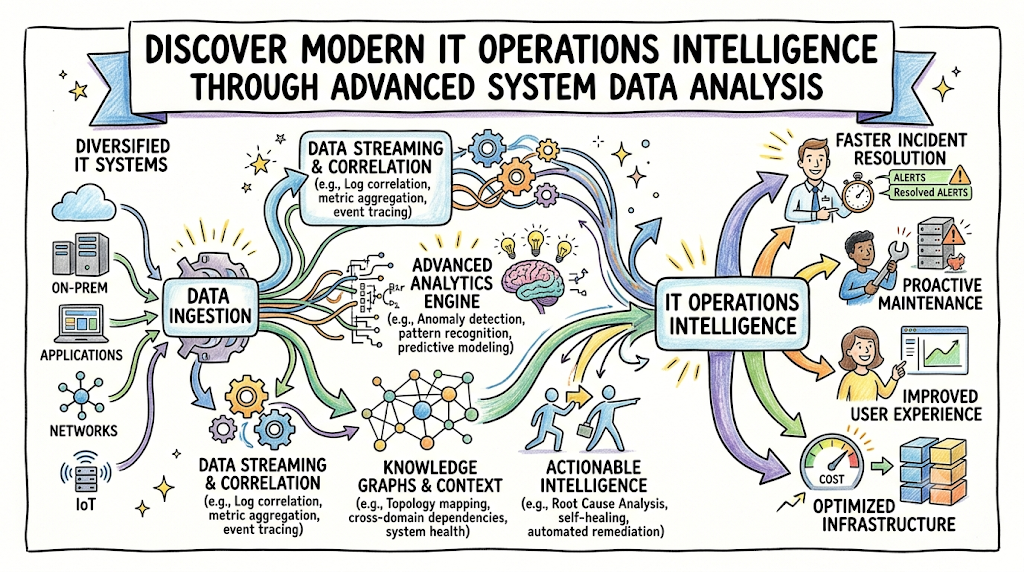
Today, data volumes are growing too fast for manual tracking, making unexpected downtime a massive risk for modern businesses. This constant pressure is driving a shift toward smarter, data-driven systems. Predictive IT analytics solves this problem by using historical data to spot potential failures before they happen. Instead of waiting for a crash, IT teams can now fix issues early, transforming operations from reactive to proactive. This strategy relies heavily on Artificial Intelligence for IT Operations, a methodology that combines big data, analytics, and machine learning to improve cloud operations and DevOps monitoring. In this comprehensive guide, we will explore how predictive data models work, compare them to traditional monitoring tools, and look at the core capabilities changing modern infrastructure. Whether you are an aspiring engineer or an operations manager, understanding these concepts is essential. You can explore these foundational topics deeply and build your skills by visiting TheAIOps, an educational platform designed to guide you through the fundamentals of systems intelligence.
Evolution of IT Operations Intelligence
Traditional IT Monitoring Challenges
For decades, IT monitoring relied on static thresholds, meaning an alert was triggered only after a metric passed a set limit. If a CPU hit 95% capacity, the system sent an urgent alert to the engineering team.
This approach creates major issues, particularly alert fatigue, where engineers are flooded with hundreds of minor notifications, making it hard to spot critical problems.
Traditional tools also operate in silos, meaning application data, network statistics, and database logs are kept separate, which makes it incredibly difficult to connect the dots during a major system outage.
Rise of AIOps Platforms
As businesses moved to cloud operations and microservices, standard monitoring tools struggled to keep pace with the sheer volume and speed of modern system data.This complexity led to the development of dedicated AIOps platforms, which integrate multi-source data streams into a centralized system for smarter analysis. By applying machine learning in IT operations, these platforms automatically analyze data across different environments, helping engineers make sense of complex cloud setups without manual filtering.
Shift Toward Predictive Analytics in IT
The ultimate goal of modern IT operations intelligence is to move away from reactive troubleshooting entirely. Instead of answering “What broke and why?”, teams want to know “What is likely to break in the next hour?” This shift relies on predictive IT analytics, turning raw logs and metrics into actionable forecasts that keep digital services running smoothly.
Understanding Predictive IT Analytics in Simple Terms
Data Collection in IT Systems
Predictive analytics starts with comprehensive data collection, gather logs, metrics, events, and traces from every part of an enterprise infrastructure.
Think of this data collection as a digital health tracker, continuously recording the pulse, temperature, and vital signs of your entire software ecosystem.
Pattern Recognition in System Behavior
- Once data flows into an analytics engine, machine learning algorithms establish a baseline of normal system behavior.
- The system learns what standard performance looks like during peak business hours versus quiet weekends.
- By understanding these regular cycles, the platform can immediately spot unusual patterns that human operators might easily miss.
Incident Prediction and Prevention
- After establishing a baseline, the analytics engine scans live data streams for early signs of trouble.
- For instance, if memory usage rises in a pattern that previously led to a system crash, the engine flags this trend.
- This early insight enables automated systems or engineers to intervene and prevent an outage before it affects users.
Role of Machine Learning in IT Operations
- Machine learning algorithms are the core engine driving predictive analytics.
- Unlike rigid, rule-based software, these algorithms adapt to changing environments and learn from historical incident logs.
- This continuous learning makes the system more accurate over time, reducing false alarms and improving incident prediction.
Continuous Monitoring and Feedback Loops
- Predictive systems rely on constant refinement through active monitoring and feedback loops.
- When the system predicts an issue, it tracks the outcome to see if its forecast was accurate.
- This continuous feedback helps the models adjust, ensuring the platform stays reliable as your cloud infrastructure grows and changes.
Core Capabilities of AIOps in Predictive Analytics
Event Correlation
- Modern environments can generate millions of alerts daily, many of which point to the exact same root issue.
- Event correlation uses machine learning to group these related alerts into a single, comprehensive incident dossier.
- This grouping filters out background noise, helping response teams focus on the actual problem rather than chasing duplicate notifications.
Anomaly Detection
- Static thresholds often fail because system health is dynamic; a metric that is normal at noon might be highly unusual at midnight.
- Anomaly detection evaluates data in context, flagging deviations based on time, user traffic, and historical trends.
- This approach helps teams spot subtle performance drops, such as a slow memory leak, long before a complete system failure occurs.
Root Cause Analysis
- When a complex system fails, finding the underlying issue manually can take hours of log digging.
- Automated root cause analysis maps dependencies across applications and infrastructure to pinpoint the exact source of a breakdown.
- Identifying the core issue instantly drastically cuts down troubleshooting times and helps restore services faster.
Performance Forecasting
- Performance forecasting looks at historical usage trends to predict future resource needs across your infrastructure.
- The system can project exactly when a storage volume will fill up or when network bandwidth will peak.
- This insight allows teams to scale resources proactively, preventing performance bottlenecks before they impact customers.
Automated Alerting Systems
- Standard alerting systems often frustrate teams by routing notifications to the wrong people or firing without helpful context.
- Predictive alerting routes messages based on the type of anomaly and includes relevant contextual data automatically.
- These smart notifications ensure the right engineer gets the exact information needed to resolve the issue quickly.
Key Principles Behind Predictive IT Analytics
Data-Driven Decision Making
- Predictive analytics replaces guesswork with clear, data-driven decisions based on real-time system metrics.
- Instead of relying on intuition during a crisis, operations teams use concrete statistical models to guide their choices.
- This analytical focus ensures fixes are based on hard data, leading to more stable and reliable infrastructure.
Proactive Incident Prevention
- The core operating philosophy of modern operations intelligence is shifting from reactive fixes to proactive prevention.
- Success is measured by the number of system incidents prevented, rather than how quickly teams resolve a crash.
- This proactive approach protects business revenue and ensures a seamless experience for end-users.
Real-Time System Visibility
- To predict issues effectively, analytics engines require complete, real-time visibility across all infrastructure layers.
- This means pulling live data from hardware, cloud instances, application codes, and network pathways simultaneously.
- High visibility ensures no hidden bottlenecks or blind spots compromise the predictive models.
Continuous Learning Systems
- Enterprise software environments change constantly through daily code deployments and shifting user traffic.
- Predictive models must learn continuously, updating their baselines automatically without requiring manual re-configuration.
- This flexibility keeps your monitoring setup accurate, even as your underlying software evolves.
Operational Efficiency Improvement
- By automating data analysis and alert filtering, predictive tools significantly boost overall operational efficiency.
- Engineers spend less time sorting through duplicate alerts and more time building resilient features.
- This optimization helps businesses scale their infrastructure smoothly without needing to scale their support teams at the same rate.
AIOps vs Traditional IT Monitoring
Core Differences Explained
Traditional monitoring tells you when something has broken, whereas AIOps uses data to predict when something might break. Traditional setups rely on human engineers to manually connect different data points, while modern platforms use automated analytics to find links across systems instantly.
Reactive vs Proactive Operations
| Feature | Traditional IT Monitoring | Modern Predictive Analytics |
| Operational Stance | Reactive (Fixes issues after failure) | Proactive (Prevents issues early) |
| Alert Thresholds | Static (Manual limits) | Dynamic (Learned by algorithms) |
| Analysis Method | Manual investigation | Automated correlation |
| Data Scope | Isolated silos | Unified data streams |
Manual vs Automated Analysis
- In traditional environments, resolving an incident requires manual data gathering, where engineers look through multiple logs to trace an issue.
- Predictive platforms automate this entirely by analyzing millions of data points across your stack instantly.
- This automation identifies patterns and dependencies that are nearly impossible for a human observer to catch manually.
Business Impact Comparison
- Moving from reactive monitoring to predictive analytics directly impacts a company’s bottom line.
- Reducing system downtime protects customer trust and prevents revenue loss during peak shopping or usage periods.
- Furthermore, lower operational costs allow IT organizations to shift their budgets from routine maintenance to strategic innovation.
Real-World Use Cases of Predictive IT Analytics
Cloud Infrastructure Monitoring
- In dynamic cloud setups, virtual servers spin up and down constantly based on shifting traffic.
- Predictive systems monitor these resources closely, forecasting load spikes and triggering auto-scaling actions ahead of time.
- This proactive scaling maintains steady application performance without wasting budget on idle cloud servers.
Application Performance Management
- Modern applications depend on complex networks of microservices and third-party APIs.
- Predictive analytics tracks transaction paths, spotting minor slowdowns in database queries before they ruin the user experience.
- Catching these micro-anomalies early allows developers to optimize code before performance drops notice-ably.
Incident Prevention Systems
- Large enterprises use predictive engines to scan historical incident logs and match them against live metrics.
- If the system detects a sequence of events that previously led to a database lock, it warns operators immediately.
- Teams can then run preventative maintenance, turning a potential major outage into a routine, low-risk update.
DevOps Optimization
- DevOps teams deploy code updates frequently, which can occasionally introduce unexpected system instability.
- Predictive monitoring analyzes system behavior during deployments, flagging subtle anomalies in log patterns immediately.
- This feedback helps developers catch software bugs early, making continuous delivery processes much safer.
Enterprise IT Operations Centers
- Centralized IT operations centers use predictive dashboards to monitor global infrastructure health on a single screen.
- These intelligent dashboards filter out day-to-day background noise, highlighting only high-probability risks that need attention.
- This clarity keeps global operations teams aligned and focused on high-priority tasks.
Common Mistakes in Predictive IT Analytics Adoption
Ignoring Data Quality
- Predictive models are only as good as the data fed into them; poor input leads directly to unreliable forecasts.
- If an organization feeds broken logs or incomplete metrics into an AI engine, the system will produce inaccurate alerts.
- Prioritizing clean, well-structured data across all infrastructure layers is essential for predictive success.
Over-Relying on Alerts Without Context
- An alert that simply states a metric is outside its normal range, without providing any context, is rarely helpful.
- Engineers need to know what dependencies are affected and what historical issues look like this anomaly.
- Without this deep context, teams can waste hours investigating alerts, reducing the value of the platform.
Lack of Automation Strategy
- Predicting an incident provides little value if your team lacks a clear plan to resolve it efficiently.
- If a system flags an upcoming issue, but the fix requires a lengthy manual approval process, the outage may still occur.
- Organizations need to pair predictive insights with automated response workflows to truly maximize efficiency.
Poor Integration Across Tools
- Many enterprises deploy advanced analytics engines but fail to connect them to their existing ticketing platforms.
- When tools operate in isolation, critical predictive insights can easily get lost in background noise.
- Building a connected ecosystem ensures alerts flow smoothly into ticketing tools, leading to faster resolutions.
Misinterpreting System Signals
- It is easy to mistake a brief spike in user traffic for a critical system failure.
- If an analytics tool is not configured correctly, it may flag normal business growth as a series of system anomalies.
- Teams must continuously tune their models to distinguish between harmless traffic variations and genuine infrastructure risks.
Essential Tools & Technologies in AIOps
- To build a reliable predictive system, organizations use an integrated ecosystem of conceptual tools.
- Modern AIOps platforms serve as the central brain, collecting and analyzing data from various infrastructure layers.
- These platforms work alongside foundational monitoring systems and deep observability tools that track application health.
- Log analytics systems process text logs from servers, translating raw code strings into structured data points.
- Cloud monitoring platforms track virtual resources, ensuring cloud-native services stay reliable and scale efficiently.
- Finally, underlying machine learning frameworks handle data correlation, pattern recognition, and trend forecasting.
Career Path in AIOps & Predictive Analytics
Skills Required
- IT Operations Basics: Understanding operating systems, networking models, and standard server architectures.
- Cloud Computing Fundamentals: Familiarity with virtual resources, cloud storage, and cloud-native application designs.
- Data Analysis Basics: Ability to interpret data trends, parse system logs, and understand basic statistical patterns.
- Monitoring Systems Understanding: Knowing how metrics are collected, aggregated, and displayed via dashboards.
- DevOps Concepts: Familiarity with continuous integration, deployment pipelines, and infrastructure as code.
- Scripting Basics: Basic automation knowledge to connect systems and manage programmatic alerts efficiently.
Learning Roadmap
- Starting a career in this field begins with mastering traditional systems administration and network engineering.
- Next, focus on cloud infrastructure, learning how modern platforms manage resources dynamically.
- From there, study observability, focusing on how logs, metrics, and traces connect across systems.
- Finally, explore data analytics and machine learning concepts to understand how predictive models forecast system trends.
Certifications & Learning Paths
- Professionals looking to stand out should consider cloud-native certifications, such as Kubernetes administration credentials.
- Earning certifications in data engineering or specialized cloud monitoring tools also adds significant professional value.
- These programs validate your ability to manage complex data workflows and run modern, resilient infrastructure.
Career Opportunities
- The demand for professionals who understand intelligent operations is growing rapidly across the tech sector.
- Key roles include Site Reliability Engineers (SREs), Cloud Operations Managers, and DevOps Solutions Architects.
- Organizations value experts who can keep systems stable, protect uptime, and prevent incidents using advanced data tools.
Learning Resources from TheAIOps
- Building a strong career foundation requires access to high-quality educational material.
- Aspiring professionals can find foundational insights, clear concept guides, and structured learning pathways through TheAIOps.
- These resources simplify complex systems data concepts, making it easier to transition into modern IT operations roles.
Future of Predictive IT Analytics
AI-Driven IT Operations
- The future of systems management points toward completely AI-driven operations that run with minimal human intervention.
- These advanced environments will analyze data patterns continuously, optimizing infrastructure performance autonomously in real time.
- This evolution will shift human teams from daily troubleshooting to designing long-term architecture strategies.
Autonomous Incident Management
- Future platforms will do more than just predict incidents; they will manage the entire response process automatically.
- When a risk is detected, the system will open a ticket, find the root cause, and assign the issue instantly.
- This automated handling will resolve minor errors before support teams even realize a glitch occurred.
Self-Healing Systems
- The ultimate goal for modern enterprise infrastructure is the widespread adoption of self-healing systems.
- If a predictive engine identifies an imminent software failure, it will automatically trigger targeted scripts to fix it.
- Whether it means restarting a failing service or reallocating storage, the system fixes itself without causing downtime.
Real-Time Predictive Infrastructure
- Future cloud environments will adapt instantly to global user traffic demands using real-time predictive data.
- Instead of reacting to traffic, networks will shift resources between global data centers ahead of time.
- This predictive provisioning will keep applications fast and reliable, even during massive global traffic surges.
Future Skills in AIOps
- As automation handles routine tasks, the skills required by IT professionals will inevitably evolve.
- Engineers will need to focus less on manual log analysis and more on training and auditing AI models.
- Data literacy, system architecture design, and automation management will become core skills for future operations teams.
FAQs
- What is AIOps and how does it relate to predictive IT analytics?
AIOps stands for Artificial Intelligence for IT Operations, a method that uses big data and machine learning to improve systems management. Predictive IT analytics is a core feature of this approach, focusing on historical data analysis to forecast and prevent future system failures. - How does predictive IT analytics differ from traditional IT monitoring?
Traditional monitoring uses static thresholds to alert teams after a system metric breaks a set limit, meaning it reacts to problems. Predictive analytics looks at live data streams and historical trends to flag anomalies early, allowing teams to fix issues before an outage happens. - Why is machine learning important in modern IT operations?
Machine learning algorithms process massive volumes of system data that are too complex for manual human analysis. These systems learn normal operational patterns over time, adapting to environment changes and spotting subtle indicators of system failure automatically. - What is the role of event correlation in reducing alert fatigue?
Event correlation analyzes thousands of incoming alerts and groups related entries into a single, comprehensive incident report. This process filters out background noise and duplicate notifications, helping engineering teams focus on solving the root problem. - Can predictive analytics tools help prevent application downtime?
Yes, by identifying minor performance drops and resource bottlenecks early, these tools give engineers time to fix issues proactively. Catching errors before they compound keeps applications stable and prevents unexpected downtime for users. - How does observability differ from basic system monitoring?
Basic monitoring tracks whether a system is running or broken by checking simple metrics like CPU use. Observability provides deeper system visibility, cross-referencing logs, metrics, and traces to help teams understand the internal state of complex cloud environments. - What is the relationship between DevOps and predictive IT monitoring?
DevOps focuses on continuous software delivery, which requires fast feedback and highly stable environments. Predictive monitoring supports this by analyzing deployments in real time, helping teams catch performance issues early in the delivery lifecycle. - What are the first steps to starting a career in AIOps?
Start by building a solid understanding of IT operations, cloud infrastructure, and standard monitoring tools. From there, learn data analysis basics and explore how modern platforms use automation to manage large-scale systems data. - Do self-healing systems require human intervention to resolve errors?
Self-healing systems use automated scripts to resolve well-defined, predictable issues without needing manual human input. However, human engineers remain essential for managing complex architectural challenges and configuring the underlying automation rules. - What are common challenges organizations face when adopting predictive analytics?
The most common hurdles include poor data quality, tool silos, lack of a clear automation strategy, and alert fatigue from unoptimized systems. Overcoming these challenges requires prioritizing clean data ingestion and ensuring tools integrate smoothly across the IT ecosystem.
Conclusion
Adopting modern IT operations intelligence is becoming essential for managing complex cloud environments. Moving away from reactive troubleshooting toward predictive IT analytics helps businesses protect uptime, reduce alert fatigue, and streamline daily operations.
Using machine learning to find patterns and automate root cause analysis allows IT organizations to stop system failures before they impact users. This proactive approach saves time, reduces maintenance costs, and keeps digital infrastructure resilient.
