Upgrade & Secure Your Future with DevOps, SRE, DevSecOps, MLOps!
We spend hours scrolling social media and waste money on things we forget, but won’t spend 30 minutes a day earning certifications that can change our lives.
Master in DevOps, SRE, DevSecOps & MLOps by DevOps School!
Learn from Guru Rajesh Kumar and double your salary in just one year.
Introduction
CRM Platforms)) Toolkits are software solutions that enable organizations to manage customer relationships, track interactions, and streamline sales, marketing, and support workflows. They centralize customer data, facilitate communication, and provide analytics to improve engagement and retention.
In , businesses face growing customer expectations, multi-channel interactions, and increasingly data-driven decision-making. CRM platforms help companies deliver personalized experiences, automate sales processes, and gain actionable insights from customer data.
Real-world use cases include:
- Tracking leads, opportunities, and pipeline management
- Automating email campaigns and customer outreach
- Managing customer support tickets and service requests
- Analyzing customer behavior and purchase history
- Reporting on sales performance and marketing ROI
Buyers should evaluate:
- Contact and lead management
- Sales pipeline automation
- Marketing automation and email campaigns
- Customer support ticketing
- Analytics and reporting dashboards
- Integration with ERP, finance, and marketing platforms
- Mobile access and employee self-service
- AI-driven recommendations and predictive analytics
- Security, compliance, and audit capabilities
- Ease of use and scalability
Best for: Sales teams, marketing departments, customer support teams, and organizations ranging from SMBs to enterprise companies.
Not ideal for: Organizations with minimal customer interaction, very small teams, or companies relying on manual customer tracking.
Key Trends in CRM Platforms
- AI-driven lead scoring and predictive analytics
- Automation of sales and marketing workflows
- Unified multi-channel customer engagement
- Enhanced mobile-first CRM access
- Cloud-native deployments for scalability and remote work
- GDPR, CCPA, and SOC 2 compliance integration
- Advanced reporting and analytics dashboards
- Integration with ERP, accounting, and marketing systems
- Subscription-based SaaS models with flexible pricing
- Personalized customer journey mapping and engagement insights
How We Selected These Tools (Methodology)
- Reviewed market adoption and mindshare across SMBs and enterprises
- Evaluated feature completeness including sales, marketing, and support modules
- Assessed reliability, uptime, and performance metrics
- Verified security posture including encryption, RBAC, and audit logs
- Checked integration options with ERP, marketing, and finance platforms
- Considered scalability for small to enterprise teams
- Prioritized AI and predictive analytics capabilities
- Reviewed ease of use, mobile accessibility, and workflow customization
- Assessed vendor support, training, and community engagement
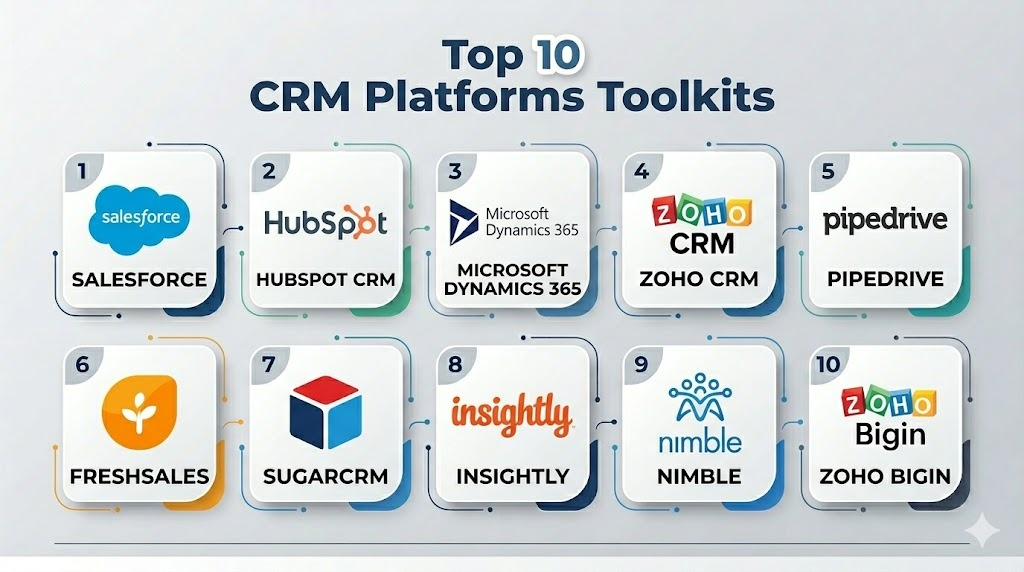
Top 10 CRM Platforms Toolkits
#1 — Salesforce CRM
Short description: Salesforce CRM provides enterprise-grade tools for sales, marketing, and customer service. It enables organizations to manage leads, opportunities, and customer interactions across multiple channels.
Key Features
- Sales pipeline management
- Marketing automation
- Customer support ticketing
- AI-driven recommendations
- Multi-channel communication
- Analytics and reporting dashboards
- AppExchange marketplace for integrations
Pros
- Highly customizable for enterprise needs
- Scalable across global teams
Cons
- Premium pricing
- Complexity in initial setup
Platforms / Deployment
- Web / iOS / Android
- Cloud
Security & Compliance
- SOC 2, ISO 27001, GDPR
- Encryption, MFA, audit logs
Integrations & Ecosystem
- ERP, finance, and marketing platforms
- AppExchange integrations
- API access for custom workflows
Support & Community
- Extensive documentation, online training, and active user community
#2 — HubSpot CRM
Short description: HubSpot CRM is an SMB-friendly platform that offers sales, marketing, and customer service modules. It provides automation, lead tracking, and reporting tools.
Key Features
- Contact and lead management
- Marketing automation
- Email campaigns and workflows
- Reporting dashboards
- Customer support ticketing
- Mobile access
- Integration with other HubSpot products
Pros
- Easy to use and adopt
- Free tier available for SMBs
Cons
- Limited enterprise customization
- Advanced features require paid tiers
Platforms / Deployment
- Web / iOS / Android
- Cloud
Security & Compliance
- Encryption, SOC 2
- GDPR compliant
Integrations & Ecosystem
- Email platforms, ERP systems, marketing tools
- API access
- Marketplace for add-ons
Support & Community
- Documentation, tutorials, and community forums
#3 — Microsoft Dynamics 365
Short description: Dynamics 365 integrates CRM and ERP capabilities to manage sales, marketing, and customer service. It provides AI insights and analytics for enterprise organizations.
Key Features
- Sales automation and lead scoring
- Customer service ticketing
- Marketing campaign management
- Predictive analytics and AI insights
- Integration with Office 365 and Teams
- Reporting dashboards
- Multi-channel support
Pros
- Deep integration with Microsoft ecosystem
- Enterprise scalability
Cons
- Complexity and training requirements
- Premium pricing for advanced modules
Platforms / Deployment
- Web / Windows / iOS / Android
- Cloud / Hybrid
Security & Compliance
- SOC 2, ISO 27001, GDPR
- Encryption and audit logs
Integrations & Ecosystem
- ERP, marketing, finance systems
- API access
- Microsoft ecosystem extensions
Support & Community
- Documentation, online support, and partner network
#4 — Zoho CRM
Short description: Zoho CRM offers sales, marketing, and customer service automation for SMBs and mid-market companies. It provides analytics and workflow automation.
Key Features
- Lead and contact management
- Sales pipeline automation
- Marketing campaign management
- Workflow automation
- Analytics dashboards
- Mobile access
- Integration with Zoho apps
Pros
- Affordable and flexible
- Easy to use for SMBs
Cons
- Limited advanced enterprise features
- Learning curve for custom workflows
Platforms / Deployment
- Web / iOS / Android
- Cloud
Security & Compliance
- Encryption, SOC 2
- GDPR compliant
Integrations & Ecosystem
- Email, accounting, marketing platforms
- API access
- Zoho marketplace
Support & Community
- Documentation, tutorials, and forums
#5 — Pipedrive
Short description: Pipedrive focuses on sales pipeline management and automation for SMBs. It provides visual pipelines, analytics, and activity tracking.
Key Features
- Sales pipeline visualization
- Lead and deal management
- Activity and task tracking
- Email integration
- Reporting and analytics dashboards
- Mobile access
Pros
- Highly intuitive and visual interface
- Easy adoption for SMB sales teams
Cons
- Limited marketing automation
- Advanced reporting requires higher plans
Platforms / Deployment
- Web / iOS / Android
- Cloud
Security & Compliance
- Encryption, SOC 2
- GDPR compliant
Integrations & Ecosystem
- Email, marketing, accounting software
- API access
- Marketplace for integrations
Support & Community
- Documentation, online tutorials, and email support
#6 — Freshsales
Short description: Freshsales provides CRM with built-in AI, lead scoring, and workflow automation for SMBs and mid-market teams.
Key Features
- Contact and lead management
- AI-based lead scoring
- Sales pipeline management
- Reporting dashboards
- Workflow automation
- Email campaigns and tracking
- Mobile access
Pros
- AI-driven insights
- User-friendly interface
Cons
- Limited enterprise features
- Advanced automation requires premium plans
Platforms / Deployment
- Web / iOS / Android
- Cloud
Security & Compliance
- SOC 2, encryption
- GDPR compliant
Integrations & Ecosystem
- Email, marketing, accounting tools
- API support
- Marketplace for add-ons
Support & Community
- Documentation, online support, and tutorials
#7 — SugarCRM
Short description: SugarCRM offers a flexible CRM platform for sales, marketing, and service automation, tailored to mid-market and enterprise organizations.
Key Features
- Sales pipeline and lead management
- Marketing automation
- Customer service and ticketing
- Reporting dashboards and analytics
- Workflow automation
- Mobile access
Pros
- Highly customizable
- Strong analytics capabilities
Cons
- Complexity in setup
- Premium cost
Platforms / Deployment
- Web / iOS / Android
- Cloud / Self-hosted
Security & Compliance
- SOC 2, encryption
- GDPR compliant
Integrations & Ecosystem
- ERP, marketing, and accounting software
- API access
- Marketplace for extensions
Support & Community
- Documentation, training, and online support
#8 — Insightly
Short description: Insightly provides CRM and project management integration for SMBs and mid-market teams. It enables lead management, workflow automation, and analytics.
Key Features
- Contact and lead management
- Project management
- Sales pipeline visualization
- Workflow automation
- Reporting dashboards
- Mobile access
Pros
- Combines CRM and project management
- Intuitive interface
Cons
- Limited enterprise scalability
- Advanced reporting requires higher plans
Platforms / Deployment
- Web / iOS / Android
- Cloud
Security & Compliance
- Encryption, SOC 2
- GDPR compliant
Integrations & Ecosystem
- Email, marketing, accounting platforms
- API support
- Marketplace for add-ons
Support & Community
- Documentation, tutorials, and email support
#9 — Nimble
Short description: Nimble is a CRM designed for SMBs, offering social media integration, contact management, and sales pipeline tracking.
Key Features
- Social media integration
- Contact and lead management
- Sales pipeline automation
- Email tracking
- Reporting dashboards
- Mobile access
Pros
- Affordable for SMBs
- Easy to use
Cons
- Limited enterprise-grade features
- Advanced integrations require paid plans
Platforms / Deployment
- Web / iOS / Android
- Cloud
Security & Compliance
- Encryption, SOC 2
- GDPR compliant
Integrations & Ecosystem
- Email, marketing tools
- API access
- Marketplace for add-ons
Support & Community
- Documentation, tutorials, and support
#10 — Zoho Bigin
Short description: Zoho Bigin is a pipeline-focused CRM for SMBs, providing simple sales automation and contact management.
Key Features
- Sales pipeline management
- Contact and lead tracking
- Task and activity management
- Mobile access
- Reporting dashboards
Pros
- Simple and intuitive
- Cost-effective for SMBs
Cons
- Limited advanced features
- Not suitable for large enterprises
Platforms / Deployment
- Web / iOS / Android
- Cloud
Security & Compliance
- SOC 2, encryption
- GDPR compliant
Integrations & Ecosystem
- Email, marketing, and accounting tools
- API access
- Zoho ecosystem
Support & Community
- Documentation, tutorials, and support
Comparison Table (Top 10)
| Tool Name | Best For | Platform(s) Supported | Deployment | Standout Feature | Public Rating |
|---|---|---|---|---|---|
| Salesforce CRM | Enterprise | Web/iOS/Android | Cloud | AI-driven analytics | N/A |
| HubSpot CRM | SMBs & mid-market | Web/iOS/Android | Cloud | Marketing automation | N/A |
| Dynamics 365 | Enterprise | Web/Windows/iOS/Android | Cloud/Hybrid | Microsoft ecosystem integration | N/A |
| Zoho CRM | SMBs & mid-market | Web/iOS/Android | Cloud | Affordable and flexible | N/A |
| Pipedrive | SMBs | Web/iOS/Android | Cloud | Visual sales pipeline | N/A |
| Freshsales | SMBs & mid-market | Web/iOS/Android | Cloud | AI-driven lead scoring | N/A |
| SugarCRM | Mid-market & enterprise | Web/iOS/Android | Cloud/Self-hosted | Customizable enterprise CRM | N/A |
| Insightly | SMBs & mid-market | Web/iOS/Android | Cloud | CRM + project management | N/A |
| Nimble | SMBs | Web/iOS/Android | Cloud | Social media integration | N/A |
| Zoho Bigin | SMBs | Web/iOS/Android | Cloud | Simple pipeline management | N/A |
Evaluation & Scoring of CRM Platforms
| Tool Name | Core (25%) | Ease (15%) | Integrations (15%) | Security (10%) | Performance (10%) | Support (10%) | Value (15%) | Weighted Total |
|---|---|---|---|---|---|---|---|---|
| Salesforce CRM | 9 | 7 | 9 | 9 | 9 | 8 | 7 | 8.3 |
| HubSpot CRM | 8 | 9 | 8 | 8 | 8 | 8 | 8 | 8.2 |
| Dynamics 365 | 9 | 7 | 9 | 9 | 8 | 8 | 7 | 8.2 |
| Zoho CRM | 8 | 8 | 7 | 8 | 8 | 7 | 8 | 7.9 |
| Pipedrive | 8 | 9 | 7 | 7 | 8 | 7 | 7 | 7.7 |
| Freshsales | 8 | 8 | 7 | 8 | 8 | 7 | 7 | 7.8 |
| SugarCRM | 9 | 7 | 8 | 9 | 8 | 8 | 7 | 8.0 |
| Insightly | 8 | 8 | 7 | 7 | 8 | 7 | 7 | 7.6 |
| Nimble | 7 | 9 | 7 | 7 | 7 | 7 | 7 | 7.5 |
| Zoho Bigin | 7 | 9 | 7 | 7 | 7 | 7 | 7 | 7.5 |
Interpretation: Weighted totals reflect comparative strengths across core CRM functionality, ease of use, integration, and value for SMB to enterprise teams. Higher totals indicate broader applicability.
Which CRM Platform Is Right for You?
Solo / Freelancer
- Zoho Bigin, Nimble for simple pipeline management and lightweight CRM.
SMB
- HubSpot CRM, Pipedrive, Freshsales for automation, ease of use, and analytics.
Mid-Market
- Zoho CRM, Insightly, Freshsales for multi-channel and integrated workflows.
Enterprise
- Salesforce CRM, Dynamics 365, SugarCRM for complex, multi-region, and AI-driven CRM.
Budget vs Premium
- Budget: Zoho Bigin, Pipedrive, Nimble
- Premium: Salesforce CRM, Dynamics 365, SugarCRM
Feature Depth vs Ease of Use
- Depth: Salesforce CRM, Dynamics 365, SugarCRM
- Ease: HubSpot CRM, Pipedrive, Zoho Bigin
Integrations & Scalability
- Enterprise-grade: Salesforce CRM, Dynamics 365, SugarCRM
- SMB-friendly: HubSpot CRM, Zoho CRM, Pipedrive
Security & Compliance Needs
- High compliance: Salesforce CRM, Dynamics 365
- Standard compliance: HubSpot CRM, Zoho Bigin
Frequently Asked Questions (FAQs)
1. How is pricing structured?
Most CRM platforms use subscription-based pricing per user, tiered by features and modules.
2. What is required for onboarding?
Account creation, data import, workflow configuration, and training.
3. Can these CRMs handle multi-region operations?
Yes, enterprise solutions like Salesforce CRM and Dynamics 365 support multi-region and multi-currency operations.
4. Are AI features available?
Yes, predictive analytics, lead scoring, and workflow suggestions are common in 2026 platforms.
5. How scalable are enterprise solutions?
Enterprise CRMs support thousands of users, complex pipelines, and multi-channel marketing.
6. Can SMBs benefit from these CRMs?
Yes, HubSpot CRM, Zoho Bigin, and Pipedrive offer cost-effective, easy-to-use CRM functionality.
7. Are mobile apps available?
Yes, all major CRMs provide mobile access for field teams and remote employees.
8. How long does implementation take?
SMB-focused CRMs can be implemented in days; enterprise deployments may take weeks.
9. Can CRM data be exported?
Yes, export options include CSV, Excel, and API access for integrations.
10. Are these platforms secure and compliant?
Top CRMs implement SOC 2, encryption, RBAC, and audit logging to ensure data security.
Conclusion
CRM Platforms Toolkits help businesses centralize customer data, automate sales and marketing workflows, and analyze performance across teams. SMBs benefit from HubSpot CRM, Pipedrive, and Zoho Bigin for simplicity and affordability. Mid-market teams gain efficiency from Zoho CRM, Freshsales, and Insightly, while enterprise organizations leverage Salesforce CRM, Dynamics 365, and SugarCRM for complex, AI-driven, and multi-region operations. Organizations should shortlist platforms, pilot integrations, and validate automation and reporting workflows before full deployment.
