Upgrade & Secure Your Future with DevOps, SRE, DevSecOps, MLOps!
We spend hours scrolling social media and waste money on things we forget, but won’t spend 30 minutes a day earning certifications that can change our lives.
Master in DevOps, SRE, DevSecOps & MLOps by DevOps School!
Learn from Guru Rajesh Kumar and double your salary in just one year.
Introduction
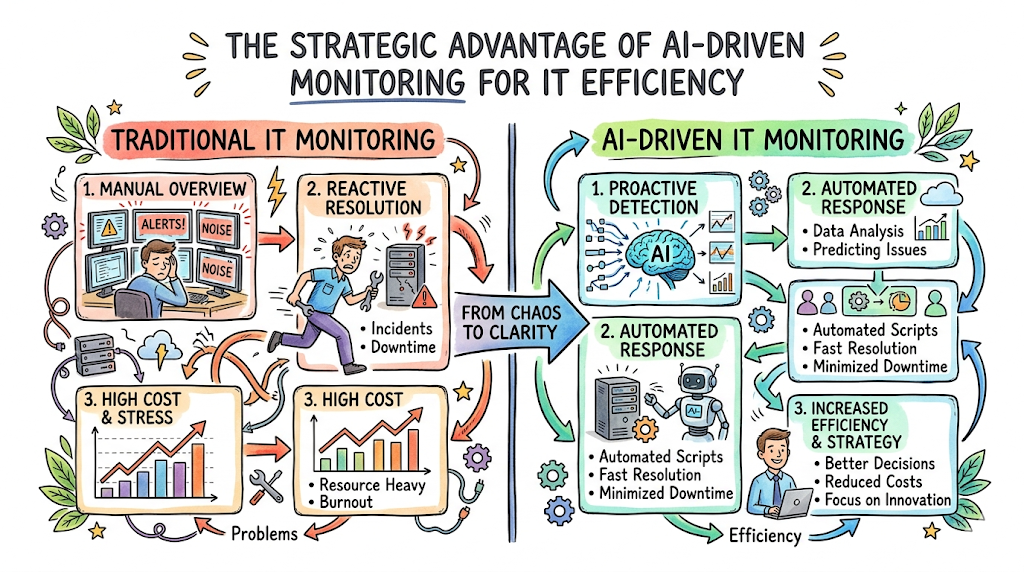
Modern IT environments have become increasingly complex, often leaving teams struggling under a mountain of data and constant alert fatigue. When manual monitoring can no longer keep pace with the demands of modern cloud-native systems, AI-driven monitoring emerges as a vital solution by using artificial intelligence and machine learning to proactively manage infrastructure health. By transforming raw, overwhelming data into clear, actionable insights and automating routine incident responses, AI-driven monitoring allows organizations to shift from reactive firefighting to a strategic, self-optimizing operation. If you are looking to master these intelligent technologies and streamline your operations, you can find expert-led guidance and structured learning paths at TheAIOps.com. This guide breaks down the core components and strategic benefits of AI-driven monitoring, helping you understand how to implement these systems to improve reliability and efficiency in your own IT ecosystem.
Understanding AI-driven Monitoring
What is IT Monitoring?
IT monitoring is the process of watching your systems, applications, and networks to ensure they are healthy. It involves collecting data on performance metrics like CPU usage, memory, and disk space to keep everything running smoothly.
What is AI-driven Monitoring?
AI-driven monitoring takes standard monitoring to the next level by applying artificial intelligence. Instead of waiting for a manual trigger, the system learns “normal” behavior and automatically flags anything that looks unusual.
Evolution from Traditional to AI-based Monitoring
Traditional monitoring relies on static thresholds—for example, “alert me if disk space goes above 80%.” AI-based monitoring uses historical data to understand that 80% might be normal on a Monday, but unusual on a Sunday, allowing for much smarter alerts.
Why IT Systems Need Intelligent Monitoring
Modern systems are distributed across multiple clouds and microservices. Because these environments change constantly, humans can no longer keep up with manual configuration. AI provides the speed and intelligence needed to keep these complex systems in check.
Core Components of AI-driven Monitoring Systems
Data Collection and Observability
Before AI can work, it needs data. This involves gathering logs, metrics, and traces from every part of your infrastructure, creating a complete picture of your IT environment.
Machine Learning and Pattern Detection
Machine learning algorithms sift through this mountain of data to find patterns. They learn what “good” performance looks like, allowing them to spot subtle anomalies that a human might never notice.
Real-time Alerting Systems
Once an issue is detected, the AI-driven system alerts the right team. Because the system understands the context, it only sends alerts for real problems, not minor fluctuations.
Predictive Analytics Engines
Predictive engines look at current trends to see the future. If a database is growing at a certain speed, the system warns you it will be full in three days, rather than waiting for it to crash.
Automation and Incident Response
The most advanced systems don’t just tell you there is a problem; they trigger automated scripts to fix it. This could mean clearing a cache or restarting a stuck service instantly.
How AI-driven Monitoring Improves IT Efficiency
Faster Incident Detection
Because AI monitors data continuously, it spots issues the second they appear.
Example: An AI-driven tool notices that a website’s response time is creeping up by milliseconds and alerts the team before users experience any slowdown.
Reduced Alert Noise and Fatigue
By grouping related events, the system turns hundreds of alerts into one single incident report.
Example: A single network failure might trigger fifty error messages. AI recognizes they all share one root cause and presents only one actionable ticket to the engineer.
Predictive Issue Resolution
It stops fires before they start.
Example: An AI system detects a hardware component is showing signs of failing and prompts a team to replace it during a scheduled maintenance window.
Improved Root Cause Analysis
It digs through the data to find the “why.”
Example: When an app crashes, the system automatically checks logs across the entire stack and points to a specific code update that caused the conflict.
Better Resource Utilization
AI keeps an eye on cloud spending and usage.
Example: The system identifies that several servers are running at 5% capacity and recommends shutting them down to save on infrastructure costs.
Enhanced System Reliability
By maintaining a stable environment, downtime becomes a thing of the past.
Example: Automated self-healing workflows restart services that hang, ensuring users never see an “Error 500” page.
Lower Operational Costs
With fewer manual hours spent on troubleshooting, your team can focus on productive development work.
Real-World Use Cases of AI-driven Monitoring
Cloud Infrastructure Monitoring
It tracks the health of virtual machines, containers, and serverless functions across multi-cloud setups.
Application Performance Monitoring (APM)
It watches how code performs in real-time, helping developers identify slow database queries or inefficient API calls.
Cybersecurity Threat Detection
It monitors network traffic for strange activity, such as massive data transfers at unusual hours, which could indicate a breach.
DevOps Pipeline Monitoring
It ensures that the software deployment process is moving smoothly, flagging bottlenecks that delay releases.
Enterprise IT Operations
It provides a high-level overview of the entire business, connecting infrastructure health to business performance metrics.
Benefits of AI-driven Monitoring in Modern IT
- Increased Uptime: Systems stay online longer thanks to proactive fixes.
- Faster Mean Time to Resolution (MTTR): You spend less time searching for the problem and more time fixing it.
- Proactive Problem Solving: Issues are handled before they impact the end user.
- Improved Customer Experience: Fast, reliable apps lead to happy customers.
- Scalability: You can add thousands of new servers without needing to hire a thousand new monitors.
Challenges in AI-driven Monitoring Adoption
Data Quality Issues
If your logs are messy, the AI will produce “garbage” results. Quality starts with clean, structured data.
Integration with Legacy Systems
Connecting modern AI tools to older, “on-premise” software can be technically difficult.
False Positives and Noise
Even AI can make mistakes, and poorly tuned models may flag normal events as critical issues.
Skill Gaps in IT Teams
Moving to AI-driven ops requires learning new tools and a shift in how your team approaches problem-solving.
Tool Complexity
Some platforms have a steep learning curve, which can overwhelm smaller teams.
Best Practices for Implementing AI-driven Monitoring
- Start with Key Systems: Don’t try to monitor everything at once; pick your most critical app first.
- Centralize Monitoring Data: Ensure all your logs and metrics are in one place.
- Use Predictive Models Gradually: Let the system learn for a few weeks before turning on automated responses.
- Align Teams: Make sure both developers and operations are looking at the same dashboards.
- Continuously Tune: Regularly review your alerts to ensure the AI remains accurate.
AI-driven Monitoring vs Traditional Monitoring
| Feature | Traditional Monitoring | AI-driven Monitoring |
| Approach | Reactive | Predictive/Proactive |
| Analysis | Manual | Automated/Machine Learning |
| Alerting | Static thresholds | Dynamic/Contextual |
| Effort | High human effort | Low human effort |
Essential Technologies Behind AI Monitoring
Machine Learning Algorithms
The core models that analyze data to identify trends and anomalies.
Big Data Processing Systems
Tools that allow you to ingest and analyze millions of data points every second.
Observability Platforms
Dashboards that provide a full, unified view of your entire IT stack.
Cloud Infrastructure Tools
The platforms that provide the flexibility and scale needed to run AI workloads.
Automation Frameworks
The “doers” that execute the repairs recommended by the AI engine.
Career Opportunities in AI-driven IT Operations
Skills Required for Professionals
You need a solid grasp of systems administration, basic coding, and an understanding of data analysis.
Popular Job Roles
Site Reliability Engineer (SRE), AIOps Architect, and IT Automation Specialist are among the fastest-growing roles.
Certifications and Learning Paths
Focus on getting certified in cloud platforms and modern monitoring tools to stay competitive.
Learning Resources from TheAIOps.com
We offer structured guides and mentorship to help you transition from traditional IT tasks to cutting-edge AI-driven operations.
Future of AI-driven Monitoring
Self-Healing IT Systems
Infrastructure that automatically repairs itself without any human input will become the standard.
Autonomous Operations
We are moving toward “lights-out” data centers where AI manages everything from power to software updates.
Predictive Infrastructure Management
IT teams will focus on long-term strategy rather than daily technical tasks.
AI-first DevOps Environments
AI will be integrated into every step of the software development lifecycle, from writing code to deployment.
Intelligent Cloud Ecosystems
Clouds will become smarter, automatically scaling and optimizing themselves to suit the application needs.
FAQ Section
1. Is AI-driven monitoring difficult to set up?
It requires an initial setup phase to connect your data sources, but it significantly reduces your workload in the long run.
2. Can I use AI monitoring with my existing tools?
Yes, most AI platforms are built to integrate seamlessly with standard monitoring tools through APIs.
3. Does AI replace the need for IT staff?
No, it replaces the manual, repetitive parts of the job, allowing staff to focus on strategic growth and improvement.
4. How does AI help with “alert fatigue”?
By using pattern recognition to group hundreds of related error messages into one single, meaningful incident report.
5. What is the most important skill for this field?
A curiosity for problem-solving combined with a foundational knowledge of how modern cloud architectures function.
6. Can small businesses benefit from AI monitoring?
Absolutely, as modern cloud-based AI tools are becoming increasingly affordable and easy to use for businesses of any size.
Conclusion
AI-driven monitoring is the bridge between the complex IT systems of today and the self-healing infrastructures of tomorrow. By embracing these intelligent tools, organizations move from being reactive participants to proactive strategists, ensuring that their systems are more reliable, efficient, and resilient to change. While the transition requires a commitment to new workflows and a deeper focus on observability, the long-term benefits—ranging from the elimination of alert fatigue to the drastic reduction of system downtime—are transformative. As the industry continues to evolve, the ability to leverage artificial intelligence for operational management will become a defining factor for professional success. Continued education and a dedication to process optimization are essential for maintaining a competitive edge, and ongoing engagement with expert resources remains a valuable way to stay prepared for the future of IT operations.
