Upgrade & Secure Your Future with DevOps, SRE, DevSecOps, MLOps!
We spend hours scrolling social media and waste money on things we forget, but won’t spend 30 minutes a day earning certifications that can change our lives.
Master in DevOps, SRE, DevSecOps & MLOps by DevOps School!
Learn from Guru Rajesh Kumar and double your salary in just one year.
Introduction
Airline reservation systems are software platforms that help airlines manage flight bookings, seat inventory, fares, passenger details, ticketing, payments, travel agency sales, online booking, and passenger servicing. In simple words, these systems are the backbone of airline sales and passenger management. When a traveler books a ticket online, through a travel agent, mobile app, call center, or airport desk, the reservation system helps manage that booking from search to confirmation.
Airline reservation systems matter because airlines need faster digital sales, better passenger service, stronger distribution, smarter pricing, secure data handling, and smoother operational workflows. These platforms support use cases such as online flight booking, ticket management, fare control, seat availability, agency distribution, ancillary sales, customer service, and schedule-change handling.
Buyers should evaluate scalability, uptime, booking speed, GDS connectivity, NDC support, API flexibility, payment support, ticketing features, security controls, reporting, vendor support, and implementation complexity.
Best for: Airlines, regional carriers, low-cost carriers, airline IT teams, aviation startups, travel technology teams, commercial teams, and passenger service departments that need strong booking, ticketing, inventory, and distribution control.
Not ideal for: Small travel agencies that only need a simple flight booking engine, non-airline businesses, tour operators without airline inventory, or companies that only need front-end booking without full reservation and passenger service management.
Key Trends in Airline Reservation Systems
- Modern airline retailing: Airlines are moving from basic ticket sales to complete retail experiences that include seats, bags, meals, priority boarding, upgrades, bundles, and personalized offers.
- API-first architecture: Reservation systems are expected to connect with websites, mobile apps, payment gateways, loyalty platforms, CRM systems, revenue management tools, and partner platforms through APIs.
- Cloud-based deployment: Many airlines prefer cloud or hosted systems because they reduce infrastructure burden, improve scalability, and support faster digital operations.
- Automation in passenger servicing: Airlines want automated rebooking, refunds, disruption handling, ticket changes, and customer service workflows to reduce manual effort.
- Stronger ancillary revenue focus: Reservation systems now help airlines sell extra services more effectively, improving revenue beyond basic seat sales.
- GDS and direct distribution balance: Airlines need systems that support both travel agency distribution and direct digital selling through websites, mobile apps, and APIs.
- NDC and offer management readiness: Modern airline commerce is moving toward richer offers, dynamic bundles, and more flexible distribution models.
- Security-first passenger data handling: Airlines manage sensitive customer and payment data, so access control, encryption, audit logs, and secure authentication are key buying factors.
- Better self-service experience: Travelers expect easy booking, modification, cancellation, refund, check-in, and notification experiences across digital channels.
- Operational resilience: Airlines need reliable systems that can handle high booking volumes, seasonal traffic spikes, schedule changes, and disruption-heavy situations.
How We Selected These Tools
The airline reservation system market includes enterprise passenger service systems, airline retailing platforms, GDS-connected systems, and solutions for regional or low-cost carriers. The tools below were selected using practical airline technology evaluation logic.
- Market adoption and recognition in airline technology
- Reservation, inventory, ticketing, and passenger service capabilities
- Fit for different airline types, including full-service, low-cost, regional, and hybrid carriers
- Support for direct sales, agency sales, and digital distribution
- Integration ecosystem and API availability
- Reliability and performance suitability for airline operations
- Security posture signals and access-control expectations
- Support for ancillary revenue and modern airline retailing
- Vendor support, onboarding, and implementation maturity
- Practical buyer fit across enterprise, mid-market, and smaller airline operators
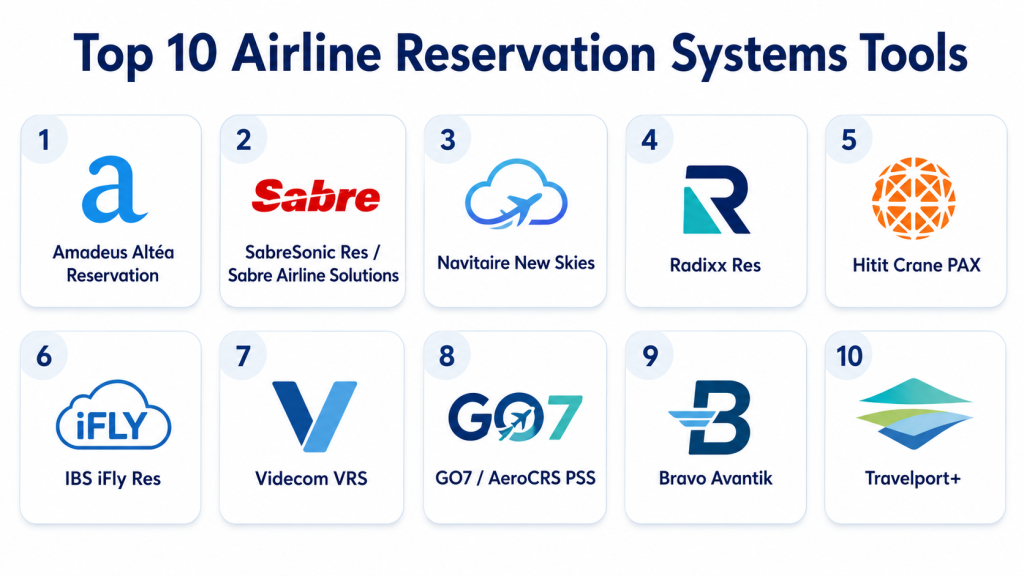
Top 10 Airline Reservation Systems Tools
#1 — Amadeus Altéa Reservation
Short description:
Amadeus Altéa Reservation is an enterprise-grade airline reservation system built for airlines that need large-scale booking, inventory, customer record management, and multi-channel distribution. It is commonly suited for full-service airlines and complex airline networks that require strong passenger management and global operational connectivity. The platform helps airlines manage bookings across direct and indirect channels while supporting customer data, itinerary information, ticketing workflows, and broader airline IT integration. It is best for airlines with high passenger volume, partner relationships, and mature commercial operations.
Key Features
- Passenger reservation and customer record management
- Multi-channel booking and distribution support
- Customer and itinerary data handling
- Fare, availability, and booking workflow support
- Integration with broader airline IT systems
- Support for complex airline network operations
- Enterprise-level airline technology ecosystem
Pros
- Strong fit for large and complex airlines
- Mature ecosystem for airline reservation and passenger service needs
- Suitable for airlines requiring global scalability and partner connectivity
Cons
- May be too complex for smaller airlines
- Implementation can require major planning and specialist support
- Pricing and full product details are not publicly stated
Platforms / Deployment
Cloud / Hosted / Enterprise airline IT environment
Security & Compliance
Specific security certifications for this product should be confirmed directly with the vendor. Enterprise airline systems generally require access control, secure data handling, and operational governance, but exact details may vary by implementation.
SOC 2, ISO 27001, GDPR, HIPAA: Not publicly stated.
Integrations & Ecosystem
Amadeus Altéa Reservation works best as part of a broader airline technology ecosystem. It can connect with ticketing, distribution, departure control, retailing, and customer service workflows.
- Airline ticketing systems
- Global distribution channels
- Airline retailing tools
- Customer service workflows
- Partner airline systems
- Payment and servicing platforms
Support & Community
Amadeus provides enterprise airline support, training, customer service portals, and professional implementation services. Community strength is mainly enterprise and aviation-industry focused rather than open public community-based.
#2 — SabreSonic Res / Sabre Airline Solutions
Short description:
SabreSonic Res is an airline reservation platform designed to support reservations, passenger records, sales workflows, and airline commercial operations. It is part of Sabre’s broader airline technology ecosystem, which includes retailing, distribution, passenger servicing, and operational capabilities. The platform is best suited for mid-size, large, and complex airlines that need mature reservation technology and travel marketplace connectivity. Sabre is also relevant for airlines looking to improve digital commerce, distribution, and passenger engagement.
Key Features
- Airline reservation and passenger data management
- Booking and servicing workflow support
- Airline retailing and sales enablement
- Travel marketplace and distribution connectivity
- Integration with airline commercial systems
- Support for large airline environments
- Enterprise airline technology ecosystem
Pros
- Strong recognition in airline and travel technology
- Suitable for airlines needing mature reservation and retailing capabilities
- Good ecosystem for distribution and passenger servicing
Cons
- May require experienced implementation teams
- Product packaging may be complex for smaller airlines
- Public pricing and security certification details are limited
Platforms / Deployment
Cloud / Hosted / Enterprise airline implementation
Security & Compliance
Security capabilities should be validated directly with the vendor. SSO, MFA, audit logs, encryption, RBAC, and compliance documentation may depend on the selected modules and contract.
SOC 2, ISO 27001, GDPR, HIPAA: Not publicly stated.
Integrations & Ecosystem
Sabre has a broad airline and travel technology ecosystem, making it useful for airlines that require booking, servicing, distribution, retailing, and commercial connectivity.
- Travel agency distribution
- Airline retailing systems
- Ticketing and servicing tools
- Payment systems
- Customer data platforms
- API-based travel integrations
Support & Community
Sabre provides enterprise support, documentation, implementation assistance, and airline technology services. Support depth depends on airline size, selected modules, region, and commercial agreement.
#3 — Navitaire New Skies
Short description:
Navitaire New Skies is a reservation and passenger service platform widely suited for low-cost, hybrid, and growing airlines. It supports reservations, e-commerce, ancillary sales, agency accounts, payment options, e-ticketing, codeshare, and interline workflows. The platform is especially useful for airlines that focus on online sales, retailing, and revenue from value-added services. It is a strong option for carriers that want flexible booking workflows, direct digital sales, and practical commercial control.
Key Features
- Reservation and passenger service management
- Internet booking engine support
- Ancillary revenue and retailing features
- Agency account support
- Payment option support
- E-ticket integration
- Codeshare and interline sales support
Pros
- Strong fit for low-cost and hybrid airline models
- Good support for online sales and ancillary revenue
- Practical option for airlines focused on commercial flexibility
Cons
- May not be the first choice for every full-service legacy airline model
- Advanced setup can require airline technology expertise
- Pricing is not publicly stated
Platforms / Deployment
Cloud / Hosted airline platform
Security & Compliance
Security details should be confirmed directly with the vendor. Access controls, data protection, and compliance features may vary by implementation and airline requirements.
SOC 2, ISO 27001, GDPR, HIPAA: Not publicly stated.
Integrations & Ecosystem
Navitaire New Skies supports airline retailing, booking, and distribution workflows. It is useful for airlines that need strong direct sales and partner-channel capabilities.
- Internet booking engine
- GDS platforms
- Payment systems
- E-ticketing workflows
- Agency accounts
- Codeshare and interline systems
Support & Community
Navitaire provides vendor-led support, airline implementation services, documentation, and training resources. Community is mainly customer and aviation-industry focused.
#4 — Radixx Res
Short description:
Radixx Res is an airline reservation and passenger processing platform designed for low-cost, regional, hybrid, and growth-focused carriers. It supports reservations, ticketed and ticketless airline models, retailing, ancillary sales, and passenger workflow management. The platform is useful for airlines that want booking control, flexible commercial models, and value-added product sales. It is especially relevant for carriers that want a practical reservation system with strong retailing and passenger processing capabilities.
Key Features
- Airline reservation management
- Passenger processing support
- Ticketed and ticketless model support
- Ancillary revenue management
- Retailing-focused workflows
- Inventory and booking control
- Partner and distribution support
Pros
- Good fit for regional, low-cost, and hybrid airlines
- Supports different airline operating models
- Strong focus on retailing and ancillary sales
Cons
- Public security and compliance details are limited
- May require technical support for complex integrations
- Pricing and implementation scope are not publicly stated
Platforms / Deployment
Cloud / Hosted / Varies by airline implementation
Security & Compliance
Security and compliance features should be confirmed directly with the vendor. Buyers should ask about MFA, SSO, encryption, RBAC, audit logs, payment security, and data protection.
SOC 2, ISO 27001, GDPR, HIPAA: Not publicly stated.
Integrations & Ecosystem
Radixx Res is commonly evaluated for airlines that need reservation, retailing, passenger processing, and distribution connectivity.
- Booking engines
- Payment systems
- Agency channels
- Airline retailing tools
- Reporting systems
- Operational airline platforms
Support & Community
Radixx provides vendor-led implementation and airline technology support. Documentation, onboarding, and support quality should be reviewed during product evaluation.
#5 — Hitit Crane PAX
Short description:
Hitit Crane PAX is a passenger service and airline reservation solution that supports reservation, ticketing, internet booking, mobile booking, check-in, departure control, loyalty, and customer care. It is designed for airlines that want broad passenger service coverage from one vendor environment. The platform is useful for carriers that need both commercial and operational passenger workflows. It can support airlines that want reservation capability, passenger servicing, and airline digital transformation in one connected suite.
Key Features
- Airline reservation and passenger service management
- Ticketing support
- Internet and mobile booking
- Check-in workflow support
- Departure control capabilities
- Loyalty management support
- Customer care features
Pros
- Broad passenger service system coverage
- Useful for airlines wanting multiple modules from one vendor
- Good fit for airlines needing reservation and operational passenger workflows
Cons
- Full-suite implementation may require careful planning
- Smaller airlines may not need every module
- Public compliance details are limited
Platforms / Deployment
Web-based / Cloud / Hosted / Varies by implementation
Security & Compliance
Security details should be validated directly with the vendor. Specific product-level information about SSO, MFA, encryption, RBAC, audit logs, and certifications may vary.
SOC 2, ISO 27001, GDPR, HIPAA: Not publicly stated.
Integrations & Ecosystem
Hitit Crane PAX works within a broader airline suite, helping airlines connect reservations with passenger processing and commercial systems.
- Internet booking engine
- Mobile booking
- Ticketing workflows
- Departure control
- Loyalty management
- Customer care systems
Support & Community
Hitit provides airline-focused support, training, onboarding, and implementation services. Support levels should be reviewed based on contract, airline size, and selected modules.
#6 — IBS iFly Res
Short description:
IBS iFly Res is an airline passenger solution focused on reservations, retailing, servicing, and passenger management. It is designed for airlines that want to modernize passenger interactions across booking, servicing, and operational touchpoints. The platform is suitable for airlines that need connected reservation workflows, omnichannel retailing, and better passenger experience. It is a strong option for carriers evaluating modernization from older passenger service systems.
Key Features
- Airline reservation management
- Passenger servicing capabilities
- Omnichannel retailing support
- Inventory and booking workflow management
- Passenger processing support
- Integration with airline operational tools
- Commercial airline workflow support
Pros
- Good fit for airlines modernizing passenger systems
- Supports reservation and servicing together
- Useful for airlines seeking omnichannel passenger engagement
Cons
- May require structured implementation planning
- Public compliance information is limited
- Pricing is not publicly stated
Platforms / Deployment
Cloud / Hosted / Enterprise airline implementation
Security & Compliance
Security capabilities should be checked directly with the vendor. Details about MFA, SSO, audit logs, encryption, RBAC, and compliance certifications may vary.
SOC 2, ISO 27001, GDPR, HIPAA: Not publicly stated.
Integrations & Ecosystem
IBS iFly Res is part of a broader airline technology environment, making it suitable for airlines that need connected reservation, servicing, and operational workflows.
- Passenger processing systems
- Retailing platforms
- Inventory systems
- Ticketing workflows
- Airline analytics tools
- Operational airline platforms
Support & Community
IBS provides enterprise-style airline technology support, implementation assistance, and professional services. Support quality depends on the project scope and selected modules.
#7 — Videcom VRS
Short description:
Videcom VRS is an airline reservation system designed for reservations, inventory management, internet booking, call center booking, travel agency sales, GDS connectivity, and interline booking workflows. It is a practical option for regional, scheduled, and smaller airlines that need hosted reservation capabilities without unnecessary enterprise complexity. The platform helps airlines manage inventory, bookings, and multiple sales channels. It is well suited for carriers that need flexibility, direct booking support, and agency distribution.
Key Features
- Airline reservation and inventory management
- Internet ticket sales and booking support
- Call center booking workflows
- Travel agency sales support
- GDS connectivity
- Interline booking support
- Departure control options
Pros
- Good fit for smaller and regional airlines
- Supports multiple sales channels
- Practical hosted reservation and inventory capabilities
Cons
- May not offer the same enterprise depth as larger platforms
- Public compliance details are limited
- Advanced customization may require vendor involvement
Platforms / Deployment
Cloud / Hosted / Web-based reservation environment
Security & Compliance
Public security details are limited. Buyers should validate authentication, role control, payment security, encryption, audit logs, and data protection practices directly with the vendor.
SOC 2, ISO 27001, GDPR, HIPAA: Not publicly stated.
Integrations & Ecosystem
Videcom VRS supports reservation, distribution, and operational workflows for airlines that need practical connectivity.
- Internet booking engine
- GDS platforms
- Travel agency systems
- Call center workflows
- Interline booking
- Departure control system
Support & Community
Videcom provides vendor-managed implementation, hosting, and support. Community strength is mostly customer and aviation-industry specific rather than public developer-led.
#8 — GO7 / AeroCRS PSS
Short description:
GO7 / AeroCRS PSS is a cloud-based passenger service system focused on reservations, payments, retailing, distribution, and airline growth. It is suitable for smaller, regional, charter, and growing airlines that want flexible booking and digital sales capabilities. The platform supports airlines that need to connect with online channels, travel sellers, and distribution partners. It is a practical option for carriers looking for modern reservation workflows without the complexity of very large enterprise platforms.
Key Features
- Cloud-based passenger service system
- Booking and reservation management
- Payment workflow support
- Airline retailing capabilities
- OTA and distribution channel support
- Virtual interlining support
- Suitable for smaller and growing airlines
Pros
- Good fit for regional and growing airlines
- Strong focus on digital distribution and payments
- Flexible platform for airlines expanding sales channels
Cons
- May not be ideal for large legacy airline environments
- Public compliance details are limited
- Advanced enterprise requirements need careful validation
Platforms / Deployment
Cloud / Web-based / API-enabled platform
Security & Compliance
Security capabilities should be verified directly with the vendor. Buyers should check MFA, RBAC, audit logs, encryption, payment security, data residency, and compliance documentation.
SOC 2, ISO 27001, GDPR, HIPAA: Not publicly stated.
Integrations & Ecosystem
GO7 / AeroCRS PSS focuses on connecting reservations, payments, retailing, and distribution workflows for airlines.
- OTA channels
- Payment systems
- Booking engines
- Distribution partners
- Virtual interline workflows
- Airline operational tools
Support & Community
GO7 provides vendor-led support and onboarding. Buyers should review training material, support response expectations, implementation guidance, and service-level options.
#9 — Bravo Avantik
Short description:
Bravo Avantik is an airline reservation platform designed for low-cost, regional, and cost-conscious carriers that need reservations, inventory control, and ancillary revenue capabilities. It focuses on practical airline booking workflows and flexible passenger transport management. The platform is useful for smaller airlines and route-based passenger transport operators that need a manageable reservation system. It is best for teams looking for cost-effective reservation software without heavy enterprise complexity.
Key Features
- Airline reservation management
- Inventory control
- Ancillary revenue support
- Flexible configuration options
- Low-cost and regional carrier support
- Passenger transport workflow support
- Practical booking management
Pros
- Good fit for smaller and regional carriers
- Practical and cost-conscious positioning
- Supports inventory and ancillary revenue needs
Cons
- May not match the scale of large enterprise platforms
- Public security and compliance details are limited
- Ecosystem depth should be validated before selection
Platforms / Deployment
Cloud / Hosted / Web-based airline reservation platform
Security & Compliance
Security and compliance details are not publicly stated in detail. Buyers should ask about authentication, user permissions, encryption, payment handling, audit trails, and data protection.
SOC 2, ISO 27001, GDPR, HIPAA: Not publicly stated.
Integrations & Ecosystem
Bravo Avantik is best evaluated around airline reservation, inventory, and ancillary sales workflows.
- Booking workflows
- Inventory control
- Ancillary sales
- Passenger transport systems
- Agency workflows
- Reporting tools
Support & Community
Bravo provides vendor-led airline support and implementation assistance. Documentation, onboarding quality, and support availability should be confirmed during vendor review.
#10 — Travelport+
Short description:
Travelport+ is a travel retailing and distribution platform that helps travel sellers, agencies, and travel technology companies access and book airline content. It is not a traditional airline-owned passenger service system in the same way as full PSS platforms, but it is important in the airline reservation ecosystem because it supports air shopping, booking, agency distribution, and travel content access. It is best for travel agencies, travel management companies, online travel businesses, and platforms that need broad booking and distribution workflows.
Key Features
- Air shopping and booking support
- Travel agency distribution workflows
- API-based travel content access
- Multi-content travel retailing environment
- Support for travel sellers and agencies
- Booking and servicing capabilities
- Useful for indirect airline sales channels
Pros
- Strong fit for travel agencies and sellers
- Useful for accessing airline content and booking workflows
- Mature travel distribution ecosystem
Cons
- Not a full airline PSS replacement
- Better suited to agencies than airline core operations
- Feature access depends on contracts and setup
Platforms / Deployment
Cloud / Web / API-based travel distribution platform
Security & Compliance
Security details are not fully public for all use cases. Buyers should validate API security, access control, data protection, authentication, and compliance requirements directly.
SOC 2, ISO 27001, GDPR, HIPAA: Not publicly stated.
Integrations & Ecosystem
Travelport+ is built around travel retailing and distribution, making it useful for agencies, booking platforms, and travel technology providers.
- Air booking APIs
- Agency desktop tools
- Travel management platforms
- Mid-office systems
- Back-office systems
- Payment and ticketing workflows
Support & Community
Travelport provides enterprise and agency support, developer documentation, and customer assistance. Support quality depends on region, commercial plan, and technical complexity.
Comparison Table
| Tool Name | Best For | Platform(s) Supported | Deployment | Standout Feature | Public Rating |
|---|---|---|---|---|---|
| Amadeus Altéa Reservation | Large and complex airlines | Web / Enterprise airline environment | Cloud / Hosted / Enterprise | Deep airline reservation and passenger service ecosystem | N/A |
| SabreSonic Res / Sabre Airline Solutions | Mid-size and large airlines | Web / Enterprise airline environment | Cloud / Hosted / Varies | Mature airline reservation and travel technology ecosystem | N/A |
| Navitaire New Skies | Low-cost and hybrid airlines | Web / Airline operational platform | Cloud / Hosted | Strong ancillary sales and low-cost carrier support | N/A |
| Radixx Res | Regional, low-cost, and hybrid carriers | Web / Hosted platform | Cloud / Hosted | Ticketed and ticketless airline model support | N/A |
| Hitit Crane PAX | Airlines needing broad PSS coverage | Web-based platform | Cloud / Hosted / Varies | Reservation, ticketing, check-in, and loyalty coverage | N/A |
| IBS iFly Res | Airlines modernizing passenger systems | Web / Enterprise airline environment | Cloud / Hosted / Varies | Omnichannel reservation and passenger servicing | N/A |
| Videcom VRS | Regional and smaller airlines | Web / Hosted system | Cloud / Hosted | Inventory hosting with web, agency, and GDS booking | N/A |
| GO7 / AeroCRS PSS | Small, regional, and growing airlines | Web / API-enabled platform | Cloud | Booking, payments, retailing, and distribution support | N/A |
| Bravo Avantik | Low-cost and regional carriers | Web / Hosted platform | Cloud / Hosted | Cost-effective reservations and ancillary revenue support | N/A |
| Travelport+ | Travel agencies and travel sellers | Web / API / Agency tools | Cloud | Travel retailing and agency booking distribution | N/A |
Evaluation & Scoring of Airline Reservation Systems
| Tool Name | Core (25%) | Ease (15%) | Integrations (15%) | Security (10%) | Performance (10%) | Support (10%) | Value (15%) | Weighted Total (0–10) |
|---|---|---|---|---|---|---|---|---|
| Amadeus Altéa Reservation | 10 | 7 | 10 | 8 | 9 | 9 | 7 | 8.75 |
| SabreSonic Res / Sabre Airline Solutions | 9 | 7 | 9 | 8 | 9 | 8 | 7 | 8.25 |
| Navitaire New Skies | 9 | 8 | 8 | 7 | 8 | 8 | 8 | 8.10 |
| Radixx Res | 8 | 8 | 8 | 7 | 8 | 7 | 8 | 7.75 |
| Hitit Crane PAX | 8 | 8 | 8 | 7 | 8 | 8 | 8 | 7.90 |
| IBS iFly Res | 8 | 7 | 8 | 7 | 8 | 8 | 7 | 7.60 |
| Videcom VRS | 7 | 8 | 7 | 6 | 7 | 7 | 8 | 7.20 |
| GO7 / AeroCRS PSS | 7 | 8 | 8 | 6 | 7 | 7 | 8 | 7.35 |
| Bravo Avantik | 7 | 8 | 6 | 6 | 7 | 7 | 8 | 7.05 |
| Travelport+ | 8 | 8 | 9 | 7 | 8 | 8 | 8 | 8.05 |
The scores are comparative and should be used as a shortlist guide, not as a final buying decision. A large airline may value scalability, ecosystem depth, and partner connectivity more than simple usability. A smaller airline may value affordability, faster setup, and direct booking support. Buyers should validate demos, implementation timelines, integration fit, security documents, and support terms before making a final choice.
Which Airline Reservation System Tool Is Right for You?
Solo / Freelancer
A solo consultant, travel technology freelancer, or independent airline technology advisor usually does not need a full airline reservation system unless working directly with an airline client. For learning, consulting, or prototype planning, tools such as GO7 / AeroCRS PSS, Videcom VRS, and Bravo Avantik may be easier to understand because they are more practical for smaller airline models.
If the goal is travel content access rather than airline-owned inventory control, Travelport+ may be more relevant. It supports agency and travel seller workflows better than a full passenger service system.
SMB
Small and medium airline operators should focus on affordability, fast implementation, staff training, direct booking, inventory control, payment support, agency sales, and ancillary revenue. GO7 / AeroCRS PSS, Videcom VRS, Bravo Avantik, Radixx Res, and Navitaire New Skies are good starting points depending on the airline model.
SMBs should avoid choosing a tool only because it is famous. The best system is the one that fits passenger volume, routes, booking channels, team size, and budget.
Mid-Market
Mid-market airlines usually need better scalability, reporting, API access, passenger servicing, partner connectivity, and commercial flexibility. Navitaire New Skies, Radixx Res, Hitit Crane PAX, IBS iFly Res, and SabreSonic Res can be strong candidates depending on the operating model.
This segment should pay close attention to integration planning. The reservation system must work smoothly with booking engines, payment gateways, revenue management tools, accounting systems, departure control, loyalty systems, and customer communication platforms.
Enterprise
Large airlines need highly scalable, secure, resilient, and deeply integrated platforms. Amadeus Altéa Reservation and SabreSonic Res / Sabre Airline Solutions are strong fits for complex airline environments. Hitit Crane PAX, IBS iFly Res, and Navitaire New Skies may also be considered depending on airline strategy and modernization needs.
Enterprise buyers should evaluate disaster recovery, high-volume performance, interline support, codeshare capability, governance, compliance, global support, and long-term vendor roadmap.
Budget vs Premium
Budget-conscious airlines should look at Bravo Avantik, Videcom VRS, GO7 / AeroCRS PSS, and selected Radixx or Hitit options. These platforms may provide practical booking and passenger service capabilities without unnecessary enterprise complexity.
Premium enterprise buyers should evaluate Amadeus, Sabre, Navitaire, IBS, and Hitit based on ecosystem depth, global airline support, scalability, and integration strength.
Feature Depth vs Ease of Use
Feature-heavy systems are powerful but usually require more planning, training, configuration, and governance. Amadeus, Sabre, Navitaire, IBS, and Hitit are better for airlines that need broader passenger service coverage.
Ease-focused buyers may prefer GO7 / AeroCRS PSS, Videcom VRS, or Bravo Avantik if the goal is to manage operations with a smaller team and simpler workflows.
Integrations & Scalability
Airlines with complex integration needs should evaluate APIs, GDS support, payment gateway support, NDC readiness, reporting exports, partner systems, and operational connectivity. Amadeus, Sabre, Travelport+, Navitaire, Hitit, and IBS are stronger candidates for broader ecosystem needs.
Smaller airlines should still evaluate integrations carefully because even simple operations need websites, payments, emails, reports, accounting, and airport workflows.
Security & Compliance Needs
Airlines handle passenger names, travel documents, contact details, payment information, booking history, and operational data. Security should be a core buying factor, not an afterthought.
Before buying, ask vendors about MFA, SSO, RBAC, encryption, audit logs, payment security, data backup, disaster recovery, data residency, user permissions, and incident response. If details are not public, request official documentation during procurement.
Frequently Asked Questions
1. What is an airline reservation system?
An airline reservation system is software that helps airlines manage flight bookings, seat inventory, fares, passenger records, ticketing, and booking channels. It connects airline teams, websites, mobile apps, travel agencies, and distribution partners so seats can be sold and managed accurately.
2. How is an airline reservation system different from a booking engine?
A booking engine is usually the front-end tool that customers use to search and book flights. An airline reservation system is deeper because it manages inventory, fares, passenger records, ticketing, agency sales, and operational booking logic.
3. What is the difference between CRS, ARS, and PSS?
CRS means central reservation system, ARS means airline reservation system, and PSS means passenger service system. A PSS is broader because it may include reservation, inventory, ticketing, departure control, check-in, and passenger servicing modules.
4. How much does an airline reservation system cost?
Pricing varies based on airline size, passenger volume, selected modules, implementation scope, support level, and distribution needs. Most enterprise vendors do not publish fixed pricing, so airlines usually need a custom quote.
5. How long does implementation usually take?
Implementation depends on airline complexity, data migration, integrations, training, booking channels, payment setup, and operational readiness. Smaller airlines may implement faster, while larger airlines often need phased planning and controlled migration.
6. What features are most important in airline reservation software?
Important features include reservation management, inventory control, fare management, ticketing, payment support, agency sales, GDS connectivity, API access, reporting, ancillary sales, user roles, audit logs, and vendor support.
7. Do airline reservation systems support mobile apps?
Many modern systems can support mobile booking through APIs, internet booking engines, or mobile-ready passenger workflows. The actual mobile capability depends on the vendor, selected modules, and the airline’s digital setup.
8. Are airline reservation systems secure?
They can be secure when properly implemented, but security depends on vendor controls and airline governance. Buyers should verify MFA, SSO, encryption, access permissions, audit logs, payment security, backup, and compliance documentation.
9. Can small airlines use enterprise reservation systems?
Small airlines can use enterprise systems, but they may not need the cost, complexity, and implementation effort. Smaller carriers often benefit more from flexible hosted systems designed for regional, low-cost, charter, or growing airline models.
10. What common mistakes should airlines avoid when selecting a system?
Common mistakes include choosing based only on brand name, ignoring integration needs, underestimating data migration, skipping security review, and failing to test real booking, payment, servicing, refund, and disruption workflows before rollout.
Conclusion
Airline reservation systems are critical platforms for airlines that need reliable booking, inventory, ticketing, distribution, and passenger service management. The best system depends on the airline’s size, route network, sales model, technical maturity, passenger volume, and commercial goals. Large airlines often need enterprise-grade platforms with deep scalability, partner connectivity, and strong operational support. Low-cost, regional, and growing airlines may prefer flexible hosted systems that support direct sales, ancillary revenue, and simpler implementation. Travel agencies and travel sellers may need distribution-focused platforms rather than full passenger service systems.
