Upgrade & Secure Your Future with DevOps, SRE, DevSecOps, MLOps!
We spend hours scrolling social media and waste money on things we forget, but won’t spend 30 minutes a day earning certifications that can change our lives.
Master in DevOps, SRE, DevSecOps & MLOps by DevOps School!
Learn from Guru Rajesh Kumar and double your salary in just one year.
Introduction
GRC (Governance, Risk & Compliance) Platforms are software solutions designed to help organizations manage corporate governance, assess and mitigate risks, and ensure compliance with industry and regulatory standards. In plain English, these platforms centralize risk management, compliance tracking, and policy enforcement, giving enterprises a unified view of their operational, IT, and regulatory risks.
In +, the complexity of compliance requirements has increased significantly due to evolving global regulations, cyber threats, and corporate accountability mandates. Organizations need GRC platforms to proactively manage risks, automate compliance workflows, and support audit readiness.
Real-world use cases:
- Tracking corporate and IT compliance against regulatory frameworks such as GDPR, SOC 2, and ISO 27001.
- Automating risk assessments and incident management workflows.
- Monitoring vendor and third-party compliance.
- Streamlining audit preparation and reporting.
- Facilitating internal policy management and employee compliance training.
Evaluation criteria buyers should consider:
- Risk management capabilities and frameworks supported
- Compliance automation and reporting
- Policy management and workflow automation
- Third-party risk assessment
- Incident and issue tracking
- Integration with ERP, ITSM, and security tools
- Customization and scalability
- Analytics and dashboards for executive reporting
- Security and access control
- Regulatory updates and alerts
Best for: Risk managers, compliance officers, IT security teams, internal auditors, and large enterprises with complex regulatory environments.
Not ideal for: Small businesses with minimal regulatory exposure or simple compliance needs.
Key Trends in GRC Platforms
- AI-Powered Risk Insights: Automated risk scoring and predictive analytics for proactive decision-making.
- Cloud-Native Deployment: SaaS-based GRC platforms for remote and distributed workforce coverage.
- Integrated Compliance Management: Consolidation of multiple regulatory frameworks within one platform.
- Automated Policy Enforcement: Real-time monitoring of policies and automated alerts.
- Third-Party Risk Management: Continuous monitoring of vendor compliance and exposure.
- Advanced Reporting and Dashboards: Real-time metrics for executives and audit teams.
- Cross-Platform Integration: Connectors to ITSM, ERP, and security monitoring tools.
- Continuous Compliance Monitoring: Automated alerts for regulatory changes and non-compliance.
- Workflow Automation: Streamlined approvals, incident response, and remediation tasks.
- Scalable Multi-Entity Management: Support for global enterprises with multiple business units.
How We Selected These Tools (Methodology)
- Reviewed market adoption and mindshare among risk and compliance teams.
- Assessed feature completeness, including risk, compliance, audit, and policy management.
- Analyzed performance and reliability in large-scale enterprise deployments.
- Evaluated security posture, access control, and data protection features.
- Examined integration capabilities with ERP, ITSM, SIEM, and cloud platforms.
- Considered customer fit across SMBs, mid-market, and global enterprises.
- Evaluated automation and AI-driven analytics for risk identification.
- Assessed reporting dashboards and audit readiness capabilities.
- Reviewed support and community resources for onboarding, training, and troubleshooting.
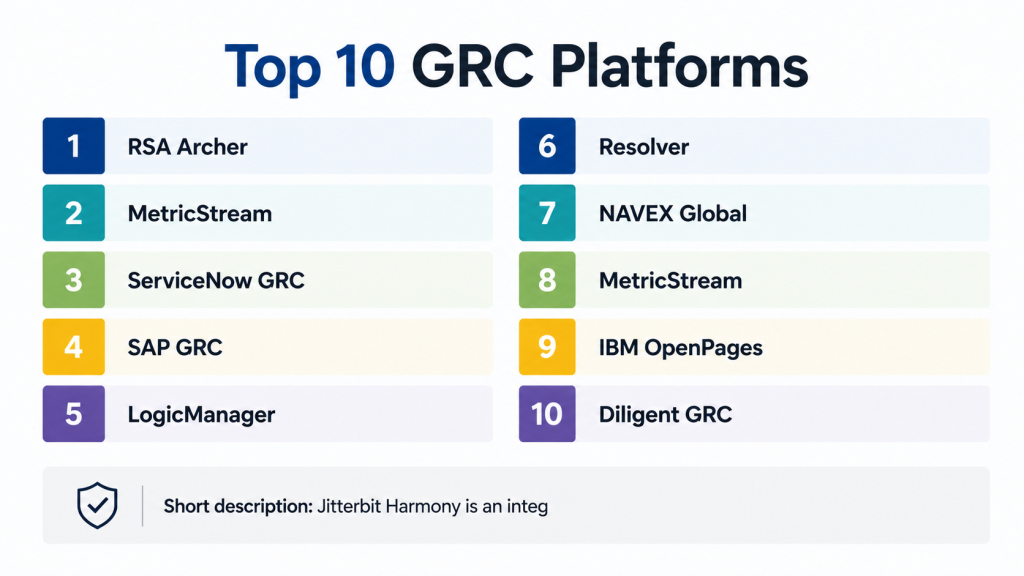
Top 10 GRC Platforms
#1 — RSA Archer
Short description: RSA Archer is a comprehensive GRC platform providing risk management, compliance automation, policy management, and incident tracking. It serves large enterprises seeking centralized governance and reporting capabilities.
Key Features
- Enterprise risk management
- Compliance tracking and reporting
- Policy and workflow automation
- Third-party risk management
- Incident and issue management
- Audit readiness dashboards
Pros
- Centralized enterprise GRC management
- Strong risk analytics and dashboards
Cons
- High licensing costs
- Complex implementation
Platforms / Deployment
- Web / Windows
- Cloud / Self-hosted
Security & Compliance
- MFA, encryption, RBAC
- SOC 2, ISO 27001
Integrations & Ecosystem
- ITSM, ERP, SIEM systems
- API support for workflow automation
Support & Community
- Professional support tiers
- Extensive documentation and user community
#2 — MetricStream
Short description: MetricStream is an enterprise GRC solution that provides risk management, compliance, audit management, and policy automation. It supports multiple frameworks and industry standards for large organizations.
Key Features
- Enterprise risk management
- Regulatory compliance tracking
- Policy and audit management
- Third-party risk monitoring
- Reporting dashboards and analytics
Pros
- Comprehensive enterprise feature set
- Supports multiple compliance frameworks
Cons
- Premium pricing
- Requires extensive configuration
Platforms / Deployment
- Web / Cloud
- Cloud / Self-hosted
Security & Compliance
- Encryption, RBAC
- GDPR, ISO 27001
Integrations & Ecosystem
- ERP, ITSM, cloud apps
- API for automation
Support & Community
- Professional support
- Online resources and training
#3 — ServiceNow GRC
Short description: ServiceNow GRC integrates risk, compliance, and audit workflows within the ServiceNow platform. It provides automation, reporting, and analytics for enterprise governance.
Key Features
- Risk and policy management
- Audit and compliance tracking
- Workflow automation
- Vendor and third-party risk
- Real-time reporting dashboards
Pros
- Seamless integration with ServiceNow ITSM
- Workflow automation for risk and compliance
Cons
- Limited standalone capabilities outside ServiceNow
- Premium pricing for smaller teams
Platforms / Deployment
- Web / Cloud
- Cloud-native
Security & Compliance
- MFA, encryption, RBAC
- GDPR, SOC 2
Integrations & Ecosystem
- ServiceNow ecosystem
- API integration for third-party apps
Support & Community
- Professional support
- Training and ServiceNow community
#4 — SAP GRC
Short description: SAP GRC provides integrated risk management, access control, and compliance automation. It is particularly suitable for enterprises using SAP ERP and cloud applications.
Key Features
- Risk and control management
- Access and authorization management
- Audit and compliance reporting
- Automated monitoring
- Incident and issue management
Pros
- Strong ERP integration
- Advanced reporting and monitoring
Cons
- Complexity in configuration
- High licensing costs
Platforms / Deployment
- Web / Windows
- Cloud / Self-hosted
Security & Compliance
- RBAC, encryption
- SOC 2, ISO 27001
Integrations & Ecosystem
- SAP ERP, cloud platforms
- Workflow APIs
Support & Community
- Professional support
- SAP community resources
#5 — LogicManager
Short description: LogicManager is a user-friendly GRC platform that provides risk management, compliance, policy management, and audit support. It emphasizes ease-of-use for mid-market enterprises.
Key Features
- Risk and issue management
- Compliance workflow automation
- Policy management
- Audit and reporting dashboards
- Third-party risk monitoring
Pros
- Intuitive interface
- Scales for mid-market enterprises
Cons
- Limited advanced analytics
- Less suitable for very large enterprises
Platforms / Deployment
- Web / Cloud
- Cloud-native
Security & Compliance
- MFA, encryption
- GDPR, SOC 2
Integrations & Ecosystem
- SaaS apps, ERP, ITSM
- API for workflow automation
Support & Community
- Professional support
- Documentation and tutorials
#6 — Resolver
Short description: Resolver offers risk, compliance, and audit management within a cloud-native platform. It emphasizes automation, reporting, and workflow efficiency.
Key Features
- Enterprise risk management
- Policy and compliance automation
- Audit and reporting dashboards
- Incident management
- Third-party risk management
Pros
- Cloud-native and scalable
- Automation features improve efficiency
Cons
- Premium pricing
- Learning curve for complex workflows
Platforms / Deployment
- Web / Cloud
- Cloud-native
Security & Compliance
- Encryption, RBAC
- GDPR, SOC 2
Integrations & Ecosystem
- ERP, ITSM, cloud apps
- API integration
Support & Community
- Professional support
- Documentation and community
#7 — NAVEX Global
Short description: NAVEX Global provides GRC solutions for risk, compliance, ethics, and policy management. It emphasizes regulatory compliance and enterprise risk monitoring.
Key Features
- Risk assessment and mitigation
- Compliance and policy management
- Incident reporting and dashboards
- Audit and reporting
- Vendor and third-party risk
Pros
- Comprehensive compliance coverage
- Enterprise-ready solution
Cons
- Complex configuration
- Premium pricing
Platforms / Deployment
- Web / Cloud
- Cloud-native
Security & Compliance
- MFA, encryption, RBAC
- GDPR, SOC 2
Integrations & Ecosystem
- ERP, ITSM, SaaS
- API support
Support & Community
- Professional support
- Knowledge base and training
#8 — MetricStream
Short description: MetricStream offers enterprise GRC with risk management, compliance automation, and audit capabilities. It provides dashboards, analytics, and workflow automation for large organizations.
Key Features
- Risk and compliance management
- Audit workflow automation
- Policy management
- Vendor risk assessment
- Analytics and reporting
Pros
- Scales for large enterprises
- Centralized dashboard and analytics
Cons
- Higher learning curve
- Premium licensing
Platforms / Deployment
- Web / Cloud
- Cloud / Self-hosted
Security & Compliance
- Encryption, RBAC
- GDPR, SOC 2
Integrations & Ecosystem
- ERP, cloud platforms, ITSM
- API integration
Support & Community
- Professional support
- Documentation and community
#9 — IBM OpenPages
Short description: IBM OpenPages provides GRC management with risk, compliance, and policy automation. It is tailored for large enterprises requiring multi-regulatory compliance.
Key Features
- Enterprise risk management
- Policy and compliance workflow
- Audit and reporting dashboards
- Vendor and third-party risk
- Incident management
Pros
- Strong enterprise GRC capabilities
- Supports multi-regulatory compliance
Cons
- Complex implementation
- Premium cost
Platforms / Deployment
- Web / Cloud
- Cloud / Self-hosted
Security & Compliance
- MFA, encryption
- SOC 2, ISO 27001
Integrations & Ecosystem
- ERP, ITSM, cloud apps
- API for workflow automation
Support & Community
- Professional support
- Documentation and training
#10 — Diligent GRC
Short description: Diligent GRC is a cloud-native platform for risk, compliance, and governance management. It focuses on analytics, dashboards, and workflow automation.
Key Features
- Risk and issue management
- Compliance workflow automation
- Policy and document management
- Audit dashboards
- Vendor and third-party risk
Pros
- Cloud-native and scalable
- User-friendly interface
Cons
- Limited on-prem support
- Premium pricing
Platforms / Deployment
- Web / Cloud
- Cloud-native
Security & Compliance
- Encryption, MFA, RBAC
- GDPR, SOC 2
Integrations & Ecosystem
- ERP, ITSM, cloud apps
- API integration
Support & Community
- Professional support
- Documentation and tutorials
Comparison Table (Top 10)
| Tool Name | Best For | Platform(s) Supported | Deployment | Standout Feature | Public Rating |
|---|---|---|---|---|---|
| RSA Archer | Enterprise risk & compliance | Web / Windows | Cloud / Self-hosted | Centralized GRC dashboards | N/A |
| MetricStream | Enterprise GRC | Web / Cloud | Cloud / Self-hosted | Multi-regulatory compliance | N/A |
| ServiceNow GRC | Workflow automation | Web / Cloud | Cloud-native | Integrated with ServiceNow ITSM | N/A |
| SAP GRC | ERP compliance | Web / Windows | Cloud / Self-hosted | ERP integration & policy mgmt | N/A |
| LogicManager | Mid-market GRC | Web / Cloud | Cloud-native | Intuitive interface | N/A |
| Resolver | Enterprise automation | Web / Cloud | Cloud-native | Automated risk & compliance | N/A |
| NAVEX Global | Compliance & ethics | Web / Cloud | Cloud-native | Enterprise compliance coverage | N/A |
| IBM OpenPages | Large enterprise GRC | Web / Cloud | Cloud / Self-hosted | Multi-regulatory compliance | N/A |
| Diligent GRC | Cloud-native GRC | Web / Cloud | Cloud-native | Analytics and workflow | N/A |
| Exterro | Legal & compliance | Web / Cloud | Cloud-native | Legal process and risk mgmt | N/A |
Evaluation & Scoring of GRC Platforms
| Tool Name | Core (25%) | Ease (15%) | Integrations (15%) | Security (10%) | Performance (10%) | Support (10%) | Value (15%) | Weighted Total |
|---|---|---|---|---|---|---|---|---|
| RSA Archer | 9 | 7 | 8 | 9 | 8 | 8 | 7 | 8.2 |
| MetricStream | 9 | 7 | 8 | 9 | 8 | 8 | 7 | 8.2 |
| ServiceNow GRC | 8 | 8 | 8 | 8 | 8 | 7 | 7 | 7.8 |
| SAP GRC | 9 | 7 | 8 | 9 | 8 | 7 | 7 | 8.1 |
| LogicManager | 7 | 8 | 7 | 7 | 7 | 7 | 7 | 7.2 |
| Resolver | 8 | 7 | 7 | 8 | 7 | 7 | 7 | 7.5 |
| NAVEX Global | 8 | 7 | 7 | 8 | 7 | 7 | 7 | 7.5 |
| IBM OpenPages | 9 | 7 | 8 | 9 | 8 | 8 | 7 | 8.2 |
| Diligent GRC | 8 | 8 | 7 | 8 | 7 | 7 | 7 | 7.5 |
| Exterro | 8 | 7 | 7 | 8 | 7 | 7 | 7 | 7.5 |
Interpretation: Weighted totals provide comparative insight into each platform’s capabilities across core features, ease of use, integrations, security, performance, support, and value.
Which GRC Platform Is Right for You?
Solo / Freelancer
- LogicManager or Diligent GRC for simplified compliance management and risk tracking.
SMB
- Resolver or NAVEX Global for mid-market compliance, policy automation, and risk workflows.
Mid-Market
- ServiceNow GRC or Exterro for workflow automation and integrated risk and compliance management.
Enterprise
- RSA Archer, MetricStream, SAP GRC, or IBM OpenPages for large-scale enterprise governance, multi-regulatory compliance, and risk reporting.
Budget vs Premium
- SMBs may choose cloud-native, subscription-based platforms; enterprises benefit from premium platforms with full automation, AI-driven insights, and multi-framework compliance.
Feature Depth vs Ease of Use
- Enterprise-grade platforms offer advanced analytics, automation, and compliance coverage; SMB solutions focus on usability and quick deployment.
Integrations & Scalability
- Enterprise platforms integrate with ITSM, ERP, and cloud systems and scale across large and distributed operations.
Security & Compliance Needs
- Organizations in regulated industries should select RSA Archer, MetricStream, or SAP GRC for audit-ready workflows and secure data handling.
Frequently Asked Questions (FAQs)
1: What is a GRC platform?
A GRC platform manages governance, risk, and compliance activities, streamlining audits, policy enforcement, and regulatory adherence.
2: Who should use a GRC platform?
Compliance officers, risk managers, auditors, IT teams, and enterprise executives benefit from GRC platforms.
3: Can GRC platforms automate risk assessments?
Yes, many platforms provide automated workflows, AI-driven insights, and risk scoring.
4: Are these platforms suitable for SMBs?
Cloud-native and subscription-based platforms like LogicManager or Resolver are ideal for mid-market companies.
5: Can GRC tools integrate with ERP and ITSM systems?
Yes, integration with enterprise applications ensures seamless risk and compliance workflows.
6: How do GRC platforms help with audits?
They provide reporting dashboards, automated documentation, and regulatory compliance tracking.
7: Do GRC tools support multi-regulatory frameworks?
Yes, enterprise-grade platforms manage GDPR, SOC 2, ISO 27001, HIPAA, and industry-specific regulations.
8: Can GRC platforms monitor vendor and third-party risk?
Yes, they provide continuous monitoring and risk scoring for external vendors.
9: Are GRC platforms secure?
Yes, they use encryption, role-based access, MFA, and audit trails to protect sensitive data.
10: How should I choose the right GRC platform?
Consider organizational size, regulatory exposure, required automation, integrations, scalability, and budget.
Conclusion
GRC platforms provide a centralized approach to governance, risk, and compliance management. Enterprises with complex regulatory requirements benefit from full-featured platforms like RSA Archer, MetricStream, or IBM OpenPages, while mid-market companies can leverage cloud-native, intuitive tools like Resolver or LogicManager. Organizations should shortlist 2–3 platforms, pilot workflows, and evaluate integration, automation, and compliance capabilities to ensure efficient, secure, and scalable governance and risk management.
