Upgrade & Secure Your Future with DevOps, SRE, DevSecOps, MLOps!
We spend hours scrolling social media and waste money on things we forget, but won’t spend 30 minutes a day earning certifications that can change our lives.
Master in DevOps, SRE, DevSecOps & MLOps by DevOps School!
Learn from Guru Rajesh Kumar and double your salary in just one year.
Introduction
GRC (Relational Database Management Systems) are specialized tools that combine traditional relational database capabilities with Governance, Risk, and Compliance (GRC) features. These platforms allow organizations to securely manage structured data while ensuring adherence to internal policies, regulatory standards, and risk management requirements. Simply put, they provide a secure, compliant, and efficient way to handle critical business data across various departments and cloud or on-premises environments.
In , the importance of relational database management systems with integrated GRC features is magnified due to increasingly complex compliance requirements such as GDPR, HIPAA, and SOC 2, alongside the rapid adoption of hybrid cloud architectures. Organizations are no longer just storing data—they are actively monitoring access, auditing activity, and enforcing risk management policies to prevent data breaches, regulatory fines, and operational inefficiencies.
Real-world use cases include:
- Managing sensitive financial records with embedded compliance checks.
- Auditing and tracking user activity for regulated industries.
- Centralized data governance across multi-cloud and hybrid environments.
- Risk assessment and mitigation for database operations.
- Optimizing query performance while ensuring regulatory compliance.
Key evaluation criteria:
- Database performance monitoring
- Real-time compliance and audit capabilities
- Security and access control (RBAC, MFA, encryption)
- Integration with GRC, IAM, and SIEM systems
- Scalability and multi-database support
- Automated reporting for regulatory frameworks
- Threat detection and anomaly analysis
- Policy enforcement and workflow automation
Best for: Enterprises, financial institutions, healthcare providers, and IT security teams managing sensitive structured data.
Not ideal for: Small businesses with limited databases or minimal compliance obligations.
Key Trends in GRC Relational Database Management Systems
- AI-powered anomaly detection: Leveraging machine learning to detect unauthorized or suspicious database activity.
- Cloud-native and hybrid support: Seamless monitoring across on-premises and cloud databases.
- Automated compliance workflows: Real-time enforcement of policies to maintain adherence to regulations.
- Real-time database performance monitoring: Continuous visibility into queries, transactions, and latency.
- Advanced role-based access control (RBAC): Fine-grained user permissions for risk mitigation.
- Integration with broader GRC platforms: Unified management for IT, risk, and compliance.
- Enhanced reporting and dashboards: Pre-built templates for SOC 2, HIPAA, and GDPR reporting.
- Cross-platform database support: SQL, PostgreSQL, MySQL, Oracle, and cloud-native databases.
- Scalable deployment models: Capable of supporting enterprise-scale relational database environments.
- Automated risk assessment: Risk scoring for users, databases, and queries based on policy compliance.
How We Selected These Tools (Methodology)
- Evaluated market adoption and customer recognition.
- Assessed feature completeness for monitoring, auditing, and risk management.
- Verified reliability and performance in enterprise environments.
- Analyzed security posture including encryption, MFA, and RBAC support.
- Examined integrations with IAM, GRC, and SIEM platforms.
- Assessed scalability and support for hybrid/multi-cloud databases.
- Considered pre-built compliance templates and reporting capabilities.
- Reviewed vendor support, documentation quality, and community engagement.
- Evaluated AI and automation features for anomaly detection and policy enforcement.
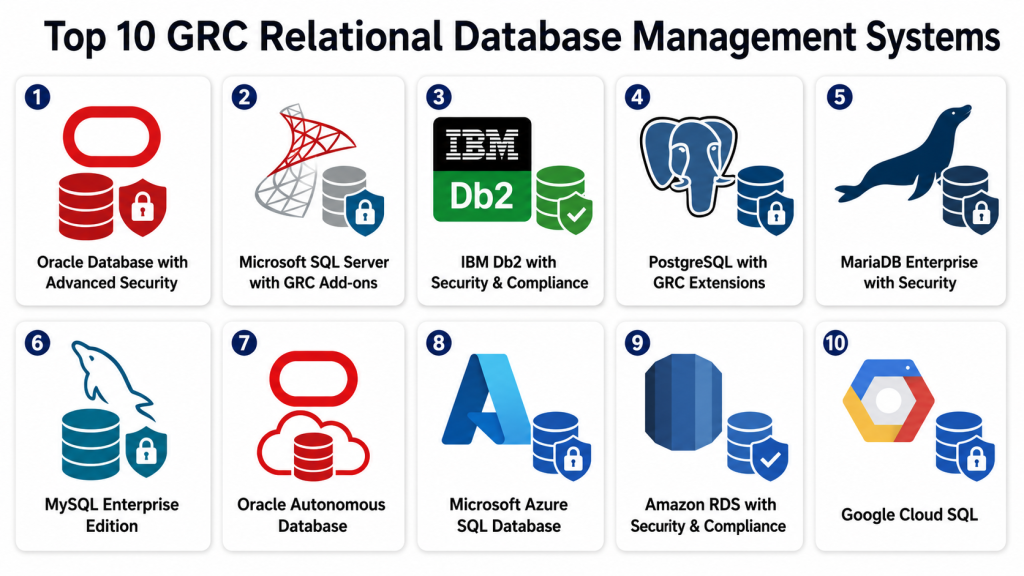
Top 10 GRC Relational Database Management Systems
#1 — Oracle Database with Advanced Security
Short description: Oracle’s RDBMS with Advanced Security integrates strong encryption, access controls, and auditing features. It is widely used in large enterprises for mission-critical workloads that require compliance and risk management.
Key Features
- Transparent data encryption (TDE)
- Real-time activity auditing
- Fine-grained access control
- Data masking for sensitive fields
- Compliance reporting for HIPAA, GDPR
- Multi-cloud and on-premises support
Pros
- Enterprise-grade security and compliance
- Scalable for large workloads
Cons
- Licensing and cost complexity
- Steep learning curve
Platforms / Deployment
- Windows / Linux / macOS / Cloud / Hybrid
Security & Compliance
- SOC 2, ISO 27001, GDPR, HIPAA
- Encryption, audit logs, RBAC
Integrations & Ecosystem
- SIEM systems
- GRC platforms
- Cloud provider integrations
Support & Community
- Vendor support and extensive documentation
- Large Oracle community
#2 — Microsoft SQL Server with GRC Add-ons
Short description: SQL Server provides relational database capabilities with compliance and auditing extensions. Ideal for organizations leveraging Microsoft ecosystems with a need for integrated GRC functionality.
Key Features
- Role-based access control
- Activity auditing and compliance reporting
- Data encryption at rest and in transit
- Policy enforcement and automated alerts
- Integration with Microsoft GRC tools
Pros
- Seamless Microsoft ecosystem integration
- Strong security and compliance reporting
Cons
- Licensing cost for enterprise features
- Limited cross-platform support
Platforms / Deployment
- Windows / Linux / Cloud / Hybrid
Security & Compliance
- SOC 2, ISO 27001, GDPR, HIPAA
- Audit logs, encryption, MFA
Integrations & Ecosystem
- Microsoft GRC and IAM tools
- SIEM integration
- APIs for automation
Support & Community
- Microsoft support
- Extensive documentation and forums
#3 — IBM Db2 with Security & Compliance
Short description: IBM Db2 integrates relational database management with robust security, auditing, and compliance capabilities. Suitable for high-security environments in regulated industries.
Key Features
- Real-time activity monitoring
- User behavior analytics
- Policy-based access controls
- Compliance reporting and audit automation
- Encryption and key management
Pros
- Strong GRC integration
- Enterprise scalability
Cons
- Complex setup
- Higher cost for small teams
Platforms / Deployment
- Windows / Linux / Cloud / Hybrid
Security & Compliance
- SOC 2, ISO 27001, GDPR, HIPAA
- Audit logs, RBAC, encryption
Integrations & Ecosystem
- SIEM and GRC platforms
- API extensibility
- Cloud integration
Support & Community
- IBM support
- Documentation and enterprise community
#4 — PostgreSQL with GRC Extensions
Short description: Open-source PostgreSQL enhanced with GRC plugins offers database monitoring, access control, and compliance reporting. Suitable for organizations seeking open-source flexibility with compliance features.
Key Features
- Access controls and auditing
- Query activity monitoring
- Compliance report generation
- Encryption and TLS support
- Multi-cloud deployment
Pros
- Open-source and cost-effective
- Flexible customization
Cons
- Requires manual configuration for full GRC
- Less vendor support
Platforms / Deployment
- Windows / Linux / macOS / Cloud / Hybrid
Security & Compliance
- Varies / N/A
- Encryption, audit logs
Integrations & Ecosystem
- Cloud monitoring tools
- SIEM integration
- API extensibility
Support & Community
- Community support
- Online documentation
#5 — MariaDB Enterprise with Security
Short description: MariaDB Enterprise provides relational database features with advanced security and compliance modules for regulated workloads.
Key Features
- Transparent data encryption
- Access control and auditing
- Compliance reporting templates
- SQL activity monitoring
- Multi-cloud deployment
Pros
- Cost-effective enterprise solution
- Strong performance
Cons
- Limited advanced GRC features compared to commercial alternatives
- Requires expertise for configuration
Platforms / Deployment
- Windows / Linux / Cloud / Hybrid
Security & Compliance
- SOC 2, ISO 27001
- Audit logs, encryption
Integrations & Ecosystem
- SIEM and GRC platforms
- Cloud integrations
- APIs for automation
Support & Community
- Vendor support
- Community documentation
#6 — MySQL Enterprise Edition
Short description: MySQL Enterprise Edition with auditing and encryption modules offers relational database management with regulatory compliance features.
Key Features
- Advanced auditing
- Transparent data encryption
- Access controls
- Policy-based alerts
- Compliance reporting
Pros
- Open-source base with enterprise enhancements
- Broad platform support
Cons
- Enterprise features require subscription
- Less native GRC automation
Platforms / Deployment
- Windows / Linux / macOS / Cloud / Hybrid
Security & Compliance
- SOC 2, ISO 27001
- Audit logs, RBAC, encryption
Integrations & Ecosystem
- SIEM tools
- API support
- Cloud service integration
Support & Community
- Vendor support
- Community forums
#7 — Oracle Autonomous Database
Short description: Combines Oracle RDBMS with AI-driven autonomous operations, including compliance monitoring and automated security controls.
Key Features
- Autonomous patching and tuning
- Real-time compliance monitoring
- Advanced encryption and key management
- Access and activity auditing
- AI-driven anomaly detection
Pros
- Reduced operational overhead
- Built-in compliance
Cons
- Expensive for small organizations
- Oracle-specific ecosystem
Platforms / Deployment
- Cloud / Hybrid
Security & Compliance
- SOC 2, ISO 27001, GDPR, HIPAA
- Audit logs, RBAC
Integrations & Ecosystem
- Oracle Cloud suite
- SIEM integration
- APIs
Support & Community
- Oracle support
- Documentation
#8 — Microsoft Azure SQL Database
Short description: Managed relational database service with GRC integrations, including security auditing and compliance automation.
Key Features
- Built-in auditing and threat detection
- Role-based access control
- Compliance reporting
- Encryption at rest and in transit
- Multi-region replication
Pros
- Fully managed service
- Scalable and secure
Cons
- Limited on-prem integration
- Subscription-based pricing
Platforms / Deployment
- Cloud
Security & Compliance
- SOC 2, ISO 27001, GDPR, HIPAA
- Audit logs, MFA
Integrations & Ecosystem
- Azure services
- SIEM and IAM integration
- APIs
Support & Community
- Microsoft support
- Community forums
#9 — Amazon RDS with Security & Compliance
Short description: AWS RDS provides managed relational databases with monitoring, encryption, and compliance automation.
Key Features
- Multi-AZ replication
- Automated backups and patching
- Encryption at rest and in transit
- Compliance monitoring
- Audit and logging
Pros
- Managed service reduces overhead
- Highly available and scalable
Cons
- Cloud-only solution
- Limited GRC customization
Platforms / Deployment
- Cloud
Security & Compliance
- SOC 2, ISO 27001, GDPR, HIPAA
- Audit logs, encryption
Integrations & Ecosystem
- AWS ecosystem
- SIEM integration
- APIs
Support & Community
- AWS support
- Online community
#10 — Google Cloud SQL
Short description: Managed relational database on Google Cloud with integrated security and compliance features for enterprise applications.
Key Features
- Automated backups and updates
- Encryption at rest and in transit
- Activity auditing
- Compliance reporting
- Multi-cloud deployment options
Pros
- Fully managed and secure
- Scalable globally
Cons
- Limited on-prem integration
- Cloud-only pricing
Platforms / Deployment
- Cloud
Security & Compliance
- SOC 2, ISO 27001, GDPR, HIPAA
- Audit logs, encryption
Integrations & Ecosystem
- Google Cloud services
- SIEM integration
- APIs
Support & Community
- Google support
- Documentation and community
Comparison Table (Top 10)
| Tool Name | Best For | Platform(s) Supported | Deployment | Standout Feature | Public Rating |
|---|---|---|---|---|---|
| Oracle Database Advanced Security | Enterprises | Windows / Linux / macOS / Cloud | Hybrid | Strong encryption & auditing | N/A |
| Microsoft SQL Server with GRC | Enterprises | Windows / Linux / Cloud | Hybrid | Microsoft ecosystem integration | N/A |
| IBM Db2 Security & Compliance | Enterprises | Windows / Linux / Cloud | Hybrid | User behavior analytics | N/A |
| PostgreSQL with GRC | SMB / Mid-market | Windows / Linux / macOS / Cloud | Hybrid | Open-source flexibility | N/A |
| MariaDB Enterprise Security | SMB / Mid-market | Windows / Linux / Cloud | Hybrid | Cost-effective compliance | N/A |
| MySQL Enterprise Edition | SMB / Mid-market | Windows / Linux / macOS / Cloud | Hybrid | Auditing & encryption | N/A |
| Oracle Autonomous Database | Enterprises | Cloud / Hybrid | Cloud | AI-driven autonomous compliance | N/A |
| Microsoft Azure SQL Database | SMB / Enterprise | Cloud | Cloud | Managed auditing & threat detection | N/A |
| Amazon RDS | SMB / Enterprise | Cloud | Cloud | Multi-AZ & compliance monitoring | N/A |
| Google Cloud SQL | SMB / Enterprise | Cloud | Cloud | Managed global relational database | N/A |
Evaluation & Scoring of RDBMS Tools
| Tool Name | Core (25%) | Ease (15%) | Integrations (15%) | Security (10%) | Performance (10%) | Support (10%) | Value (15%) | Weighted Total |
|---|---|---|---|---|---|---|---|---|
| Oracle Database Advanced Security | 9 | 7 | 8 | 9 | 9 | 8 | 7 | 8.3 |
| Microsoft SQL Server with GRC | 8 | 8 | 8 | 8 | 8 | 8 | 8 | 8.0 |
| IBM Db2 Security & Compliance | 9 | 7 | 8 | 9 | 8 | 7 | 7 | 8.0 |
| PostgreSQL with GRC | 7 | 8 | 7 | 7 | 7 | 7 | 8 | 7.3 |
| MariaDB Enterprise Security | 8 | 8 | 7 | 8 | 7 | 7 | 8 | 7.7 |
| MySQL Enterprise Edition | 7 | 8 | 7 | 7 | 7 | 7 | 8 | 7.3 |
| Oracle Autonomous Database | 9 | 7 | 8 | 9 | 9 | 8 | 7 | 8.2 |
| Microsoft Azure SQL Database | 8 | 8 | 8 | 8 | 8 | 8 | 8 | 8.0 |
| Amazon RDS | 8 | 8 | 7 | 8 | 8 | 7 | 8 | 7.8 |
| Google Cloud SQL | 8 | 8 | 7 | 8 | 8 | 7 | 8 | 7.8 |
Interpretation: Scores provide a comparative view of database performance, GRC features, integration capabilities, and value. Enterprises should weigh compliance needs and database complexity to select the most suitable tool.
Which RDBMS Tool Is Right for You?
Solo / Freelancer
- Open-source RDBMS like PostgreSQL with GRC provides sufficient compliance and monitoring capabilities for individual developers.
SMB
- MariaDB Enterprise or MySQL Enterprise offers cost-effective monitoring and security features.
Mid-Market
- Microsoft SQL Server with GRC or IBM Db2 Security & Compliance are ideal for medium-sized organizations with regulatory needs.
Enterprise
- Oracle Database Advanced Security, Oracle Autonomous Database, and Microsoft Azure SQL Database provide scalable, full-featured compliance and monitoring for large enterprises.
Budget vs Premium
- SMBs can start with open-source or cloud-managed RDBMS with add-on GRC features.
- Enterprises benefit from comprehensive security, automated compliance, and AI-driven monitoring in premium solutions.
Feature Depth vs Ease of Use
- Enterprise tools offer deep analytics and policy enforcement but require training.
- Smaller organizations benefit from managed or simpler interfaces.
Integrations & Scalability
- Multi-cloud, hybrid deployment, and SIEM/GRC integration are critical for enterprise-scale environments.
Security & Compliance Needs
- Ensure that tools support encryption, MFA, RBAC, and compliance reporting aligned with HIPAA, SOC 2, and GDPR.
Frequently Asked Questions (FAQs)
What is a relational database with GRC features?
It is a relational database that includes monitoring, auditing, and compliance capabilities to ensure data security and regulatory adherence.
Are these databases suitable for cloud deployments?
Yes, many tools support cloud, hybrid, and multi-cloud architectures.
Can these tools help with GDPR or HIPAA compliance?
Yes, pre-built compliance reporting templates and auditing features support regulatory adherence.
Which databases are supported?
SQL Server, Oracle, PostgreSQL, MySQL, MariaDB, and cloud-native relational databases.
Do they integrate with SIEM platforms?
Yes, most enterprise-grade tools provide API integration with SIEM and GRC systems.
Can these databases detect insider threats?
Yes, user activity monitoring and anomaly detection features help detect unauthorized access.
Are open-source RDBMS sufficient for compliance?
For small teams, yes, but enterprise requirements often need enhanced GRC features.
How do these tools handle encryption?
They provide encryption at rest, in transit, and may include key management features.
Is performance impacted by GRC features?
Minimal impact when properly configured; premium tools optimize performance alongside compliance.
Can I automate compliance reporting?
Yes, tools provide pre-built templates and scheduled reports to streamline compliance workflows.
Conclusion
GRC Relational Database Management Systems are essential for organizations managing sensitive structured data while adhering to regulatory standards. SMBs can leverage MariaDB or PostgreSQL with GRC for cost-effective compliance, mid-market companies benefit from Microsoft SQL Server with GRC or IBM Db2, while enterprises require Oracle Database Advanced Security, Oracle Autonomous Database, or Microsoft Azure SQL Database for full-featured, scalable compliance monitoring. Evaluating 2–3 tools in a pilot program and integrating with broader GRC and SIEM frameworks ensures effective database governance, security, and operational efficiency in 2026 and beyond.
