Upgrade & Secure Your Future with DevOps, SRE, DevSecOps, MLOps!
We spend hours scrolling social media and waste money on things we forget, but won’t spend 30 minutes a day earning certifications that can change our lives.
Master in DevOps, SRE, DevSecOps & MLOps by DevOps School!
Learn from Guru Rajesh Kumar and double your salary in just one year.
Introduction
Reservation Management Software helps businesses manage bookings, availability, customer details, confirmations, cancellations, waitlists, payments, and operational capacity from one system. It is commonly used by restaurants, hotels, resorts, tours, venues, salons, clinics, event spaces, and service businesses.
It matters now because customers expect instant online booking, real-time availability, automated reminders, flexible cancellation options, and smooth digital communication. For businesses, reservation software reduces manual work, prevents double-booking, improves staff planning, and helps teams understand demand patterns.
Common use cases include restaurant table bookings, hotel room reservations, tour reservations, event bookings, appointment slots, venue reservations, and paid experiences.
Buyers should evaluate booking experience, calendar control, payment support, waitlist tools, customer database, integrations, reporting, mobile access, security, scalability, and pricing.
Best for: Restaurants, hotels, tour operators, event venues, salons, clinics, coworking spaces, service businesses, hospitality groups, and multi-location operators.
Not ideal for: Very small businesses with rare bookings or teams that only need a simple calendar and manual phone-based reservations.
Key Trends in Reservation Management Software
- AI-assisted reservation handling is growing for phone bookings, guest questions, booking suggestions, and automated confirmations.
- Real-time availability is becoming essential because customers expect instant booking without waiting for manual approval.
- No-show reduction features such as deposits, credit card holds, automated reminders, and cancellation rules are becoming more important.
- Guest data and CRM features are becoming central, especially for restaurants, hotels, and premium hospitality businesses.
- Multi-channel booking is becoming common across websites, marketplaces, social platforms, search results, and partner channels.
- Mobile-first reservation management is important for owners, managers, front-desk teams, and floor staff.
- Integration with POS, payment gateways, CRM, email marketing, calendars, and property systems is now a major buying factor.
- Dynamic pricing and revenue optimization are becoming more useful for hotels, tours, venues, and high-demand experiences.
- Compliance and data protection expectations are rising, especially around customer data, payment information, and access controls.
- Businesses are moving from basic booking forms to full reservation operations platforms with analytics and automation.
How We Selected These Tools
The tools were selected based on:
- Market recognition in reservation-heavy industries.
- Core booking and reservation management features.
- Suitability for restaurants, hotels, venues, tours, and service businesses.
- Support for online booking, availability, confirmations, cancellations, and reminders.
- Guest or customer database capabilities.
- Integration ecosystem with POS, payments, CRM, calendars, websites, and marketplace channels.
- Security controls such as user permissions, admin controls, and payment-related safeguards.
- Scalability for single-location and multi-location businesses.
- Practical value for daily operations.
- Fit across SMB, mid-market, and enterprise use cases.
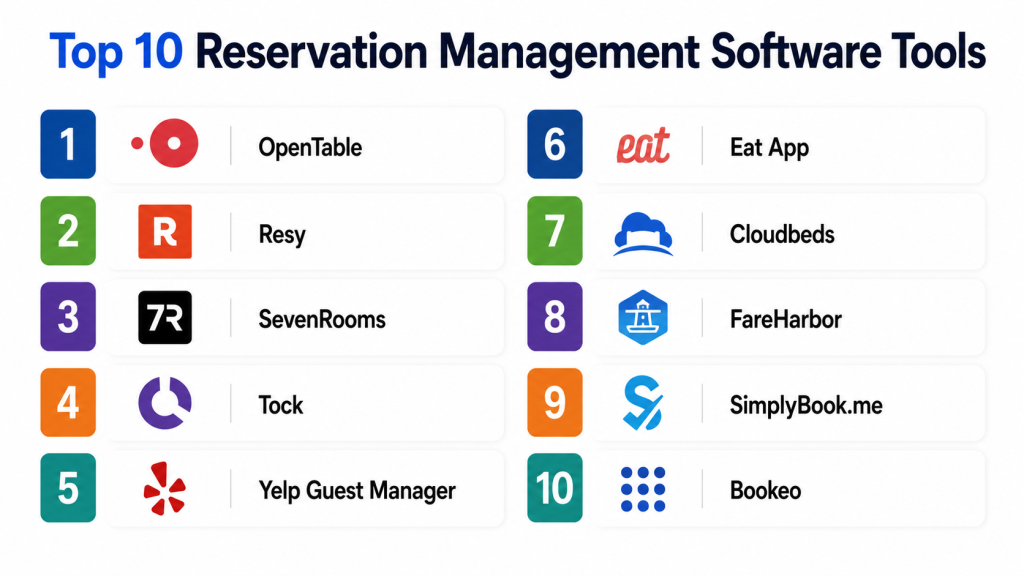
Top 10 Reservation Management Software Tools
1 — OpenTable
Short description:
OpenTable is a widely recognized reservation platform for restaurants, hospitality groups, and dining businesses. It helps restaurants manage table bookings, guest reservations, waitlists, seating, and diner discovery. The platform is useful for restaurants that want both reservation management and customer acquisition through a large dining network. It works well for busy restaurants, city venues, hotel restaurants, and multi-location operators. It is especially useful when visibility and online reservation demand are important.
Key Features
- Online restaurant reservations
- Table and floor management
- Guest profiles
- Waitlist management
- Booking confirmations
- Restaurant discovery network
- Reporting and performance insights
Pros
- Strong restaurant marketplace visibility
- Good table reservation workflow
- Useful for restaurants with high booking demand
Cons
- May be expensive for smaller restaurants
- Network-driven bookings may affect customer ownership
- Best suited mainly for restaurants, not all reservation types
Platforms / Deployment
Web / iOS / Android
Cloud
Security & Compliance
Supports account controls and reservation data management. Specific certifications: Not publicly stated.
Integrations & Ecosystem
OpenTable connects with restaurant operations and guest management workflows.
- POS systems
- Restaurant websites
- Guest database tools
- Email communication
- Waitlist workflows
- Reporting tools
Support & Community
Support resources and onboarding options are available. It has strong recognition in the restaurant industry.
2 — Resy
Short description:
Resy is a restaurant reservation and guest management platform used by restaurants, hospitality groups, and dining-focused businesses. It helps teams manage reservations, waitlists, table pacing, guest notes, and customer experience. Resy is often associated with premium, popular, and high-demand restaurants. It is useful for restaurants that want a polished booking experience and strong guest relationship tools. It works best for restaurant operators focused on service quality and guest loyalty.
Key Features
- Online reservations
- Waitlist management
- Table and floor planning
- Guest profiles
- Booking notifications
- Customer notes
- Restaurant performance insights
Pros
- Strong guest experience focus
- Good fit for premium restaurants
- Helpful waitlist and table management tools
Cons
- Mainly focused on restaurants
- May not suit general service reservations
- Pricing and availability may vary by market
Platforms / Deployment
Web / iOS / Android
Cloud
Security & Compliance
Supports user access and reservation management controls. Specific certifications: Not publicly stated.
Integrations & Ecosystem
Resy supports restaurant reservation and guest management workflows.
- Restaurant websites
- Guest profiles
- Waitlist tools
- POS-related workflows
- Marketing workflows
- Customer communication
Support & Community
Support and onboarding resources are available. It has strong awareness among restaurants and hospitality teams.
3 — SevenRooms
Short description:
SevenRooms is a guest experience and reservation management platform for restaurants, hotels, hospitality groups, and entertainment venues. It goes beyond reservations by helping businesses manage guest profiles, marketing, loyalty, waitlists, and customer engagement. The platform is useful for brands that want to own guest data and personalize service. It is strong for operators that care about repeat visits and high-value customer relationships. It is best for hospitality teams that want reservation management connected with CRM.
Key Features
- Reservation management
- Guest CRM
- Waitlist management
- Marketing automation
- Guest profiles and preferences
- Table and seating management
- Reporting and analytics
Pros
- Strong guest data and CRM capabilities
- Good for hospitality groups and premium venues
- Useful for personalization and repeat business
Cons
- May be more advanced than small restaurants need
- Setup may require planning
- Pricing can vary based on business size and needs
Platforms / Deployment
Web / iOS / Android
Cloud
Security & Compliance
Supports admin controls, user permissions, and guest data management. Specific certifications: Not publicly stated.
Integrations & Ecosystem
SevenRooms integrates with restaurant and hospitality technology stacks.
- POS systems
- Email marketing tools
- Guest CRM workflows
- Restaurant websites
- Payment-related workflows
- Analytics tools
Support & Community
Support, onboarding, and customer success resources are available. It is well-suited for hospitality teams that need structured implementation.
4 — Tock
Short description:
Tock is a reservation, booking, and experience management platform used by restaurants, wineries, events, and hospitality businesses. It supports standard reservations, prepaid bookings, deposits, ticketed experiences, and special events. Tock is useful for businesses that want to reduce no-shows and manage demand through paid reservations or structured booking rules. It works well for tasting rooms, fine dining, pop-ups, event-driven businesses, and premium experiences. It is especially valuable when reservations are connected to revenue control.
Key Features
- Restaurant and experience reservations
- Prepaid bookings
- Deposits and ticketed events
- Guest management
- Availability control
- Event booking workflows
- Reminder and confirmation tools
Pros
- Strong for paid experiences and deposits
- Helps reduce no-shows
- Good for restaurants, wineries, and events
Cons
- May not suit simple reservation needs
- Some workflows may require setup effort
- Best fit is hospitality and experience-based businesses
Platforms / Deployment
Web / iOS / Android
Cloud
Security & Compliance
Supports payment-enabled booking workflows and user access controls. Specific certifications: Not publicly stated.
Integrations & Ecosystem
Tock supports reservation, payment, and hospitality workflows.
- Restaurant websites
- Payment workflows
- Event booking
- Guest communication
- Customer database
- Hospitality operations
Support & Community
Support and onboarding resources are available. It is known among restaurants, wineries, and experience-based operators.
5 — Yelp Guest Manager
Short description:
Yelp Guest Manager is a restaurant-focused reservation, waitlist, and guest management system. It helps restaurants manage online reservations, walk-ins, waitlists, seating, and guest communication. The platform is useful for restaurants that already receive visibility from Yelp or want reservation tools connected with customer discovery. It works well for casual dining, local restaurants, and venues with walk-in traffic. It is best for restaurants that want reservations and waitlists in one operational workflow.
Key Features
- Online reservations
- Waitlist management
- Table management
- Guest messaging
- Walk-in tracking
- Restaurant profile visibility
- Seating workflows
Pros
- Useful for restaurants with Yelp presence
- Strong waitlist and walk-in support
- Good for local restaurant discovery
Cons
- Mainly restaurant-focused
- May not suit non-restaurant reservation use cases
- Value depends on local Yelp visibility
Platforms / Deployment
Web / iOS / Android
Cloud
Security & Compliance
Supports account controls and guest reservation data management. Specific certifications: Not publicly stated.
Integrations & Ecosystem
Yelp Guest Manager works with restaurant discovery and guest management workflows.
- Yelp restaurant pages
- Waitlist tools
- Guest messaging
- Restaurant websites
- Table management
- Customer communication
Support & Community
Support resources are available through vendor channels. It is practical for restaurants with active online discovery needs.
6 — Eat App
Short description:
Eat App is a restaurant reservation and table management platform designed for restaurants, hospitality groups, and dining operators. It helps teams manage reservations, tables, waitlists, guest profiles, and restaurant performance. The platform is useful for restaurants that need a practical reservation system with customer database capabilities. It supports day-to-day front-of-house workflows and guest communication. It is a good fit for restaurants that want reservation control without unnecessary complexity.
Key Features
- Online reservations
- Table management
- Guest database
- Waitlist management
- Booking widgets
- Guest communication
- Reporting and analytics
Pros
- Good restaurant reservation workflow
- Useful guest database features
- Practical for single and multi-location restaurants
Cons
- Restaurant-focused only
- Advanced enterprise features may vary
- Integrations should be checked before purchase
Platforms / Deployment
Web / iOS / Android
Cloud
Security & Compliance
Supports user access and guest data controls. Specific certifications: Not publicly stated.
Integrations & Ecosystem
Eat App supports restaurant booking and front-of-house workflows.
- Restaurant websites
- Booking widgets
- POS workflows
- Guest messaging
- Waitlist management
- Analytics tools
Support & Community
Documentation, onboarding, and support resources are available. It is suitable for restaurants that want a structured reservation workflow.
7 — Cloudbeds
Short description:
Cloudbeds is a hospitality management platform used by hotels, hostels, inns, vacation rentals, and lodging businesses. It includes reservation management as part of a broader hotel operations system. The platform helps manage bookings, rooms, availability, guest communication, payments, and channel distribution. It is useful for lodging businesses that need more than a simple booking calendar. It works best for properties that want reservation management connected with property management and channel management.
Key Features
- Hotel reservation management
- Property management system
- Channel management
- Guest communication
- Booking engine
- Payment-related workflows
- Reporting and analytics
Pros
- Strong for hotels and lodging businesses
- Combines reservations with property operations
- Good for managing multiple booking channels
Cons
- Not built for restaurants or general appointments
- May be too advanced for very small properties
- Setup requires property-specific configuration
Platforms / Deployment
Web
Cloud
Security & Compliance
Supports user permissions, property data controls, and payment-related workflows. Specific certifications: Not publicly stated.
Integrations & Ecosystem
Cloudbeds connects lodging reservations with hospitality operations.
- Booking engine
- Channel managers
- Payment processors
- Property management workflows
- Guest communication tools
- Reporting systems
Support & Community
Support, training, and onboarding resources are available. It is useful for lodging businesses needing guided implementation.
8 — FareHarbor
Short description:
FareHarbor is a reservation and booking management platform for tours, activities, attractions, rentals, and experience-based businesses. It helps operators manage availability, online bookings, payments, capacity, waivers, and customer communication. It is useful for tour companies, outdoor activity providers, museums, rental businesses, and local experiences. The platform is designed for businesses where reservations are tied to schedules, inventory, guides, and capacity. It is best for experience operators that need operational booking control.
Key Features
- Online tour and activity bookings
- Availability and capacity management
- Payment collection
- Customer communication
- Waiver and form support
- Booking calendar
- Reporting tools
Pros
- Strong for tours and activity businesses
- Good capacity and schedule management
- Supports payment-based reservations
Cons
- Not ideal for restaurants or hotels
- May be more complex than simple booking needs
- Feature fit depends heavily on business type
Platforms / Deployment
Web / Mobile access
Cloud
Security & Compliance
Supports payment-related workflows and booking controls. Specific certifications: Not publicly stated.
Integrations & Ecosystem
FareHarbor connects booking management with tour and activity operations.
- Websites
- Payment processors
- Waiver workflows
- Channel partners
- Customer communication
- Reporting tools
Support & Community
Support and onboarding resources are available. It is strong for operators that need industry-specific setup guidance.
9 — SimplyBook.me
Short description:
SimplyBook.me is a flexible reservation and booking platform for service businesses, clinics, salons, education providers, fitness studios, consultants, and multi-service teams. It supports online booking pages, staff schedules, payments, memberships, packages, coupons, and custom forms. The platform is useful when businesses need configurable booking workflows across different services. It works well for teams that want a customer-facing reservation page with operational controls. It is suitable for many non-restaurant reservation use cases.
Key Features
- Online booking website
- Service and staff scheduling
- Payment options
- Custom booking forms
- Membership and package support
- Notifications and reminders
- Multi-location support
Pros
- Flexible for many service industries
- Strong customization options
- Supports payments and service packages
Cons
- Setup can take time
- Interface may feel detailed for simple users
- Some features may depend on add-ons
Platforms / Deployment
Web / iOS / Android
Cloud
Security & Compliance
Supports user permissions and data controls. Specific certifications: Not publicly stated.
Integrations & Ecosystem
SimplyBook.me supports service booking and business workflows.
- Google Calendar
- Outlook Calendar
- Payment tools
- Video meeting tools
- Website embeds
- Notification systems
Support & Community
Documentation, help resources, and support options are available. It is useful for businesses that need configurable booking workflows.
10 — Bookeo
Short description:
Bookeo is an online booking and reservation platform for service businesses, classes, tours, schools, and appointment-based operations. It helps businesses manage bookings, schedules, payments, customer information, reminders, and availability. Bookeo is practical for businesses that run classes, tours, lessons, workshops, or service appointments. It supports different booking types, which makes it useful for mixed service models. It is a good option for small and mid-sized operators that need flexible reservation management.
Key Features
- Online reservations
- Appointment and class scheduling
- Payment support
- Customer database
- Calendar sync
- Automated reminders
- Booking page customization
Pros
- Supports multiple booking types
- Good for classes, tours, and services
- Useful customer and schedule management
Cons
- Interface may feel less modern than newer tools
- Enterprise-scale features may be limited
- Some integrations may require configuration
Platforms / Deployment
Web
Cloud
Security & Compliance
Supports user access and booking data management. Specific certifications: Not publicly stated.
Integrations & Ecosystem
Bookeo supports service, class, and tour booking workflows.
- Calendar tools
- Payment processors
- Website booking widgets
- Customer communication
- Marketing tools
- Reporting options
Support & Community
Support resources and documentation are available. It is useful for small and mid-sized booking-based businesses.
Comparison Table
| Tool Name | Best For | Platform(s) Supported | Deployment | Standout Feature | Public Rating |
|---|---|---|---|---|---|
| OpenTable | Restaurants and dining discovery | Web, iOS, Android | Cloud | Restaurant reservation network | N/A |
| Resy | Premium restaurants and guest management | Web, iOS, Android | Cloud | Guest profiles and waitlists | N/A |
| SevenRooms | Hospitality CRM and reservations | Web, iOS, Android | Cloud | Guest data and CRM depth | N/A |
| Tock | Paid experiences and deposits | Web, iOS, Android | Cloud | Prepaid bookings and ticketed events | N/A |
| Yelp Guest Manager | Restaurants with walk-ins and Yelp visibility | Web, iOS, Android | Cloud | Waitlist and diner discovery | N/A |
| Eat App | Restaurant table management | Web, iOS, Android | Cloud | Restaurant booking and table control | N/A |
| Cloudbeds | Hotels and lodging properties | Web | Cloud | Reservation plus property management | N/A |
| FareHarbor | Tours, activities, and experiences | Web, Mobile access | Cloud | Capacity-based activity booking | N/A |
| SimplyBook.me | Service-based reservations | Web, iOS, Android | Cloud | Flexible booking pages and forms | N/A |
| Bookeo | Classes, tours, and appointments | Web | Cloud | Multi-type booking workflows | N/A |
Evaluation & Scoring of Reservation Management Software
| Tool Name | Core (25%) | Ease (15%) | Integrations (15%) | Security (10%) | Performance (10%) | Support (10%) | Value (15%) | Weighted Total |
|---|---|---|---|---|---|---|---|---|
| OpenTable | 9 | 8 | 8 | 8 | 9 | 8 | 7 | 8.20 |
| Resy | 8 | 8 | 8 | 8 | 8 | 8 | 7 | 7.85 |
| SevenRooms | 9 | 7 | 9 | 8 | 8 | 8 | 7 | 8.10 |
| Tock | 8 | 8 | 8 | 8 | 8 | 8 | 8 | 8.00 |
| Yelp Guest Manager | 8 | 8 | 7 | 7 | 8 | 7 | 8 | 7.65 |
| Eat App | 8 | 8 | 7 | 7 | 8 | 7 | 8 | 7.65 |
| Cloudbeds | 9 | 7 | 9 | 8 | 8 | 8 | 8 | 8.20 |
| FareHarbor | 9 | 8 | 8 | 8 | 8 | 8 | 8 | 8.15 |
| SimplyBook.me | 8 | 8 | 8 | 7 | 8 | 7 | 8 | 7.75 |
| Bookeo | 8 | 7 | 7 | 7 | 8 | 7 | 8 | 7.45 |
These scores are comparative and should be used as a practical guide, not as a final buying decision. A high score means the tool performs well across many evaluation areas. However, the right software depends on your industry, booking model, customer volume, payment needs, integrations, and budget. A restaurant, hotel, and tour company will usually need very different reservation workflows.
Which Reservation Management Software Tool Is Right for You?
Solo / Freelancer
Solo professionals and very small service providers may not need a heavy reservation platform. If you manage simple bookings, SimplyBook.me or Bookeo can be practical. They support online booking, reminders, customer records, and service scheduling.
If you run occasional classes, workshops, or private sessions, focus on simple booking pages, payment support, and automated reminders.
SMB
Small and medium businesses should choose software based on industry. Restaurants can consider OpenTable, Resy, Tock, Eat App, or Yelp Guest Manager. Service businesses can consider SimplyBook.me or Bookeo. Tour and activity operators can consider FareHarbor.
SMBs should prioritize ease of use, no-show prevention, payment support, calendar control, and customer communication.
Mid-Market
Mid-market businesses often need more integrations, team workflows, customer data, and reporting. Restaurants and hospitality groups may benefit from SevenRooms, OpenTable, Tock, or Eat App. Hotels may prefer Cloudbeds. Experience-based operators may choose FareHarbor.
Mid-market buyers should evaluate integrations, multi-location support, customer database features, and reporting depth.
Enterprise
Enterprise hospitality groups, large hotel brands, restaurant groups, venue operators, and tour companies need stronger control, integrations, permissions, and analytics. SevenRooms, Cloudbeds, OpenTable, FareHarbor, and Tock are stronger options depending on the industry.
Enterprise buyers should involve operations, IT, finance, marketing, and compliance teams before selecting a system.
Budget vs Premium
For budget-conscious users, SimplyBook.me, Bookeo, Eat App, or Yelp Guest Manager may be practical depending on the business type. For premium use cases, SevenRooms, OpenTable, Cloudbeds, FareHarbor, and Tock provide deeper reservation workflows.
Budget buyers should avoid paying for marketplace visibility or enterprise CRM features if they do not need them.
Feature Depth vs Ease of Use
For simple booking, SimplyBook.me, Bookeo, and Yelp Guest Manager can be easier to manage. For deeper restaurant and hospitality operations, SevenRooms, OpenTable, Cloudbeds, and FareHarbor offer more advanced workflows.
Feature depth is useful only when the team can actually use it in daily operations.
Integrations & Scalability
Restaurants should check POS, payments, CRM, waitlist, and website integrations. Hotels should check booking engine, channel manager, PMS, and payment workflows. Tour operators should check capacity, waivers, payment, and marketplace integrations.
Scalability matters when you manage multiple locations, high booking volume, many staff members, or several booking channels.
Security & Compliance Needs
Security-focused buyers should evaluate user permissions, admin controls, payment security, audit logs, data retention, and customer data protection. Businesses handling sensitive customer or payment data should validate security details directly with vendors.
Do not choose reservation software only by design. Operational fit, security, reliability, and integrations matter more.
Frequently Asked Questions
1. What is Reservation Management Software?
Reservation Management Software helps businesses manage bookings, availability, customers, confirmations, cancellations, payments, and scheduling rules. It replaces manual reservation tracking with a digital system.
2. Who uses Reservation Management Software?
Restaurants, hotels, resorts, tour operators, event venues, salons, clinics, coworking spaces, schools, and service businesses use it to manage customer bookings and operational capacity.
3. How is reservation software different from appointment scheduling software?
Appointment scheduling usually focuses on time-based meetings or services. Reservation software often includes capacity, inventory, tables, rooms, tickets, deposits, guest profiles, and operational workflows.
4. What pricing model is common for reservation tools?
Pricing may be subscription-based, per location, per booking, per cover, per user, or commission-based. Some tools may also charge for premium features, payments, or marketplace visibility.
5. Can reservation software reduce no-shows?
Yes. Tools with reminders, confirmations, deposits, cancellation rules, credit card holds, and prepaid bookings can help reduce no-shows and protect revenue.
6. What is the biggest mistake buyers make?
The biggest mistake is choosing a tool based only on popularity. Buyers should check whether it fits their industry, booking flow, payment needs, integrations, and customer experience.
7. Can reservation software integrate with POS systems?
Yes, many restaurant and hospitality platforms support POS integrations. This helps connect reservations with guest spend, table activity, customer profiles, and service operations.
8. Is Reservation Management Software secure?
It can be secure when configured correctly. Buyers should look for user permissions, secure payment handling, data access controls, audit logs, and strong admin settings.
9. Can small businesses use reservation software?
Yes. Small businesses can use lighter tools like SimplyBook.me, Bookeo, Eat App, or Yelp Guest Manager depending on their industry. The key is to avoid overbuying complex features.
10. How long does implementation take?
Simple booking systems can be set up quickly. More complex systems for restaurants, hotels, tours, or multi-location businesses may require setup for inventory, tables, rooms, staff, payments, and integrations.
Conclusion
Reservation Management Software helps businesses manage bookings more professionally, reduce manual work, prevent double-bookings, improve customer experience, and protect revenue. OpenTable, Resy, SevenRooms, Tock, Yelp Guest Manager, and Eat App are strong options for restaurants and hospitality venues. Cloudbeds is better suited for hotels and lodging businesses. FareHarbor is strong for tours, activities, and experiences. SimplyBook.me and Bookeo are practical for service businesses, classes, and mixed booking models.There is no single best reservation management tool for every business. The right choice depends on your industry, booking volume, customer journey, payment needs, staff workflow, integrations, and budget.
