Upgrade & Secure Your Future with DevOps, SRE, DevSecOps, MLOps!
We spend hours scrolling social media and waste money on things we forget, but won’t spend 30 minutes a day earning certifications that can change our lives.
Master in DevOps, SRE, DevSecOps & MLOps by DevOps School!
Learn from Guru Rajesh Kumar and double your salary in just one year.
Introduction
Ride-hailing apps are digital platforms that connect passengers with drivers through a mobile app. Instead of calling a taxi stand or waiting on the road, users can open an app, enter a destination, compare ride options, track the driver, pay digitally, and receive trip details after the ride.
Ride-hailing matters because urban mobility is changing fast. People want safer rides, predictable pricing, faster pickups, digital payments, business travel controls, driver ratings, and better route visibility. Companies also use ride-hailing platforms for employee travel, airport transfers, field sales mobility, customer visits, and late-night commute support.
Common use cases include:
- Daily office commute
- Airport and railway station transfers
- Business travel and employee transport
- City-to-city rides
- Food, parcel, and local delivery support in super-app ecosystems
Buyers should evaluate availability, pricing transparency, driver supply, safety tools, payment options, business account features, customer support, reliability, local compliance, and integration options.
Best for: individuals, frequent travelers, startups, SMBs, enterprises, field teams, travel managers, and urban users who need flexible transport.
Not ideal for: users in areas with poor app coverage, companies needing fully owned fleet control, or businesses requiring strict fixed-route employee shuttle operations.
How We Selected These Tools
The following ride-hailing apps were selected using a practical product-analysis approach:
- Strong market awareness and active user recognition
- Broad regional or global availability
- Feature completeness for riders and drivers
- Reliability signals such as app maturity, route coverage, and driver network strength
- Safety features and visible trust-building tools
- Payment flexibility and fare transparency
- Business travel or corporate account support where available
- Ecosystem strength, such as delivery, payments, maps, or partner services
- Fit across consumer, SMB, enterprise, and travel use cases
- Practical usefulness across different mobility scenarios
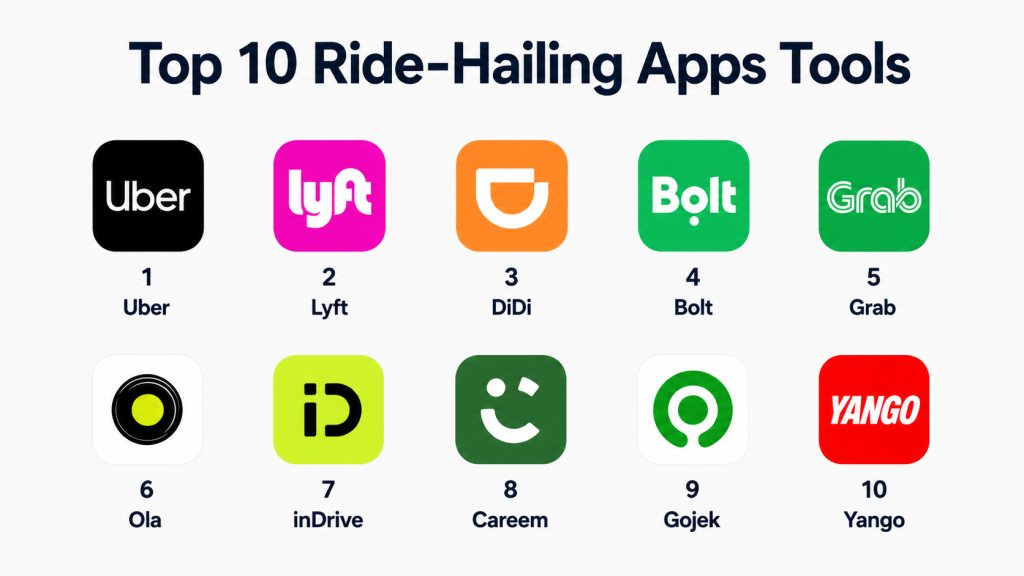
Top 10 Ride-Hailing Apps Tools
#1 — Uber
Short description: Uber is one of the most widely recognized ride-hailing apps globally. It connects riders with drivers for city rides, airport transfers, scheduled trips, business travel, and premium ride options in many regions. Uber is suitable for individuals, business travelers, enterprises, and frequent commuters. Its strong app experience, driver network, payment options, and corporate tools make it a practical choice in many cities. Availability and ride categories vary by country and city.
Key Features
- On-demand ride booking
- Multiple ride categories
- Driver and rider ratings
- Digital payments and receipts
- Scheduled rides in supported markets
- Trip sharing and safety tools
- Business travel account options
Pros
- Strong global brand and wide city coverage
- Mature app experience with reliable trip tracking
- Useful for both personal and business travel
Cons
- Pricing can change during peak demand
- Availability varies in smaller cities
- Driver experience and service quality may differ by market
Platforms / Deployment
iOS / Android / Web
Cloud
Security & Compliance
Encryption, account security, trip safety features, driver verification, and payment security are generally supported. SOC 2, ISO 27001, HIPAA, and detailed enterprise compliance status: Not publicly stated.
Integrations & Ecosystem
Uber has a broad ecosystem for mobility, delivery, payments, business travel, and travel-related workflows.
- Business travel tools
- Expense receipt support
- Maps and navigation ecosystem
- Digital payment support
- Enterprise mobility workflows
- API availability varies by region and program
Support & Community
Uber provides in-app help, rider support, driver support, business account assistance, and help-center documentation. Support quality can vary depending on country, issue type, and account category.
#2 — Lyft
Short description: Lyft is a major ride-hailing app best known in North America. It focuses on personal rides, scheduled rides, airport trips, business travel, bikes, scooters, and shared mobility in supported areas. Lyft is suitable for riders, companies, universities, healthcare-related transport programs, and local commuting needs. It has a strong consumer app experience and useful options for organizations that need managed transportation. Availability is more region-specific compared with some global platforms.
Key Features
- On-demand ride booking
- Scheduled ride options
- Business travel support
- Driver and rider ratings
- Digital payments and receipts
- Bikes and scooters in selected areas
- Safety and trip-sharing tools
Pros
- Strong presence in supported North American markets
- Good option for business and local commuting
- Clean user experience and multiple ride options
Cons
- Limited global availability
- Peak-time pricing can increase costs
- Coverage depends heavily on city and driver supply
Platforms / Deployment
iOS / Android / Web
Cloud
Security & Compliance
Account protection, digital payments, trip visibility, and safety features are supported. Detailed SOC 2, ISO 27001, HIPAA, or similar certifications: Not publicly stated.
Integrations & Ecosystem
Lyft supports consumer mobility and business transportation workflows.
- Business profile support
- Expense receipt workflows
- Travel and commute use cases
- Transit-related mobility options
- Healthcare and organization transportation programs where available
Support & Community
Lyft offers help-center documentation, in-app support, business support resources, and driver support channels. Community strength is high in markets where Lyft has strong adoption.
#3 — DiDi
Short description: DiDi is a major ride-hailing and mobility platform with strong recognition in China and selected international markets. It supports ride-hailing, taxi services, private car options, and other local mobility services depending on region. DiDi is useful for riders in markets where it has strong driver supply and localized payments. The platform is especially relevant for users and businesses operating in regions where DiDi has deep market penetration.
Key Features
- Ride-hailing and taxi booking
- Localized payment options
- Driver and rider ratings
- Route tracking
- Multiple mobility categories in supported markets
- Safety features
- Local language support in key regions
Pros
- Strong regional depth in core markets
- Localized app and payment experience
- Suitable for city mobility and frequent ride needs
Cons
- Global availability is not universal
- Features vary widely by country
- Business tools may differ by market
Platforms / Deployment
iOS / Android
Cloud
Security & Compliance
Basic account security, digital payment protection, safety features, and trip monitoring are generally expected. Detailed SOC 2, ISO 27001, GDPR, or HIPAA information: Not publicly stated.
Integrations & Ecosystem
DiDi’s ecosystem depends heavily on region and local mobility services.
- Taxi and private ride options
- Payment integrations
- Local maps and navigation
- City mobility services
- Business mobility options where available
Support & Community
Support is mainly available through app-based help channels and regional customer service. Documentation and onboarding vary by country and service category.
#4 — Bolt
Short description: Bolt is a fast-growing mobility platform known for ride-hailing, scooters, car-sharing, food delivery, and business travel services in supported markets. It is popular in many European and African cities and is often positioned as a cost-conscious alternative. Bolt is useful for riders, drivers, small businesses, and teams that need affordable mobility. Its app is simple, direct, and practical for day-to-day rides.
Key Features
- On-demand ride booking
- Affordable ride categories
- Driver and rider ratings
- Digital payment options
- Business travel support
- Scooters and mobility services in selected cities
- Food delivery ecosystem in supported markets
Pros
- Competitive pricing in many markets
- Simple app experience
- Strong regional growth in several cities
Cons
- Not available everywhere
- Service quality varies by driver network strength
- Premium business controls may vary by region
Platforms / Deployment
iOS / Android / Web
Cloud
Security & Compliance
Account security, in-app safety tools, trip tracking, and digital payment protection are supported. Detailed SOC 2, ISO 27001, HIPAA, or similar certifications: Not publicly stated.
Integrations & Ecosystem
Bolt has a growing mobility ecosystem beyond ride-hailing.
- Business travel features
- Digital payments
- Scooter mobility
- Food delivery services
- Car-sharing in selected markets
Support & Community
Bolt provides app-based support, help-center documentation, driver resources, and business support where available. Support depth depends on city and country maturity.
#5 — Grab
Short description: Grab is a major Southeast Asian super app offering ride-hailing, food delivery, payments, parcel delivery, and local services. It is especially useful in markets where users want one app for transport and daily services. Grab is suitable for riders, travelers, small businesses, delivery users, and corporate teams in supported regions. Its strength comes from local market depth and a broad service ecosystem.
Key Features
- Ride-hailing and taxi services
- Food and parcel delivery
- Digital wallet and payment options
- Rewards and loyalty ecosystem
- Business travel support in selected markets
- Safety tools and trip sharing
- Multiple vehicle categories
Pros
- Strong super-app ecosystem
- Deep regional relevance in Southeast Asia
- Useful for both travel and daily services
Cons
- Mostly region-focused
- Pricing and vehicle options vary by city
- Some features depend on local regulations
Platforms / Deployment
iOS / Android / Web
Cloud
Security & Compliance
Digital payment protection, account security, trip safety features, and verification tools are supported. Detailed SOC 2, ISO 27001, HIPAA, or similar certification status: Not publicly stated.
Integrations & Ecosystem
Grab’s ecosystem is one of its biggest strengths.
- Ride-hailing
- Food delivery
- Parcel delivery
- Digital payments
- Rewards
- Business services in supported markets
Support & Community
Grab provides in-app support, help-center resources, merchant support, driver support, and business assistance. Community strength is high in its key Southeast Asian markets.
#6 — Ola
Short description: Ola is a well-known ride-hailing app with strong recognition in India and selected markets. It supports app-based taxi booking, auto-rickshaw rides, bike rides, outstation rides, rentals, and airport travel in supported regions. Ola is suitable for daily commuters, local travelers, corporate users, and riders looking for multiple vehicle categories. Its market fit is strongest where local driver networks and regional ride options are active.
Key Features
- Cab booking
- Auto and bike ride options in supported areas
- Outstation rides
- Rental rides
- Digital payments
- Driver and rider ratings
- Localized ride categories
Pros
- Strong local relevance in India
- Multiple ride options for different budgets
- Useful for city and outstation travel
Cons
- Service quality can vary by city
- Business controls may not be uniform everywhere
- Availability outside core markets is limited
Platforms / Deployment
iOS / Android / Web
Cloud
Security & Compliance
Digital payments, ride tracking, driver details, and app-based safety options are supported. Detailed SOC 2, ISO 27001, GDPR, or HIPAA information: Not publicly stated.
Integrations & Ecosystem
Ola’s ecosystem is focused on local mobility and related services.
- Cab booking
- Auto-rickshaw rides
- Bike rides
- Rental and outstation rides
- Digital payments
- Local travel workflows
Support & Community
Ola provides in-app support, help-center resources, driver support, and rider issue management. Support quality can depend on region, ride type, and issue category.
#7 — inDrive
Short description: inDrive is a ride-hailing platform known for its fare negotiation model, where riders and drivers can agree on a price instead of relying only on automated pricing. It is popular in many emerging markets and is useful for riders who want more price control. The app supports city rides, intercity rides, and delivery in selected markets. inDrive is suitable for cost-conscious users, drivers seeking flexibility, and regions where negotiated pricing works well.
Key Features
- Fare negotiation between rider and driver
- City ride booking
- Intercity ride options in supported markets
- Delivery services in selected areas
- Driver choice before accepting rides
- Digital app-based trip tracking
- Localized market approach
Pros
- Transparent fare negotiation model
- Useful for price-sensitive riders
- Flexible approach for drivers and passengers
Cons
- Negotiation may not suit users wanting instant fixed pricing
- Coverage varies by city
- Enterprise features may be limited compared with larger platforms
Platforms / Deployment
iOS / Android
Cloud
Security & Compliance
App-based account controls, ride details, and safety-related features are available. Detailed SOC 2, ISO 27001, GDPR, HIPAA, or similar compliance information: Not publicly stated.
Integrations & Ecosystem
inDrive focuses on flexible mobility and selected local services.
- City rides
- Intercity rides
- Delivery in selected markets
- Driver and rider negotiation
- Local payment options where supported
Support & Community
Support is generally app-based, with regional help resources. Community strength is notable in markets where fare negotiation is popular and user adoption is strong.
#8 — Careem
Short description: Careem is a mobility and everyday services app with strong recognition in the Middle East and nearby regions. It offers ride-hailing and, in many markets, broader services such as delivery, payments, and daily convenience features. Careem is useful for riders, business travelers, local commuters, and users who prefer regionally localized mobility. Its value is strongest in countries where it has strong brand trust and local operating depth.
Key Features
- Ride-hailing services
- Localized vehicle categories
- Digital payments
- Delivery and everyday services in supported markets
- Business travel options where available
- Driver and rider ratings
- Trip tracking and support tools
Pros
- Strong regional relevance
- Good fit for Middle East mobility needs
- Broader everyday-services ecosystem in selected markets
Cons
- Availability varies by country
- Not a universal global ride-hailing solution
- Features may differ significantly by market
Platforms / Deployment
iOS / Android / Web
Cloud
Security & Compliance
Account security, digital payment support, ride tracking, and safety tools are generally available. Detailed SOC 2, ISO 27001, HIPAA, or similar certification information: Not publicly stated.
Integrations & Ecosystem
Careem’s ecosystem is built around regional mobility and daily services.
- Ride-hailing
- Delivery services
- Digital payments
- Business travel workflows
- Local service categories
- Regional customer support
Support & Community
Careem provides in-app help, regional support channels, driver assistance, and user support resources. Support depth depends on city and service category.
#9 — Gojek
Short description: Gojek is a Southeast Asian super app offering ride-hailing, delivery, payments, food delivery, and other on-demand services in supported markets. It is especially known for two-wheeler and local mobility use cases in dense urban areas. Gojek is useful for commuters, food delivery users, small businesses, and people who want one app for many daily needs. Its strength lies in regional relevance and service variety.
Key Features
- Ride-hailing services
- Two-wheeler mobility in supported markets
- Food delivery
- Parcel and local delivery
- Digital payments
- Merchant ecosystem
- Ratings and trip tracking
Pros
- Strong daily-use super-app model
- Useful for dense urban markets
- Good combination of mobility and delivery services
Cons
- Regional availability is limited
- Feature set depends heavily on market
- Not ideal for users needing broad global coverage
Platforms / Deployment
iOS / Android
Cloud
Security & Compliance
Digital payments, account controls, trip tracking, and safety-related features are supported. Detailed SOC 2, ISO 27001, GDPR, HIPAA, or similar certifications: Not publicly stated.
Integrations & Ecosystem
Gojek’s ecosystem covers mobility, delivery, merchants, and payments.
- Ride-hailing
- Food delivery
- Parcel delivery
- Merchant tools
- Digital payments
- Local daily services
Support & Community
Gojek provides app-based support, help resources, merchant assistance, driver support, and strong regional community presence in key markets.
#10 — Yango
Short description: Yango is a ride-hailing and mobility app active in selected international markets. It focuses on app-based ride booking, localized pricing, driver matching, and city transport needs. Yango is useful for riders in markets where it has strong availability and competitive pricing. It can be a practical alternative to larger ride-hailing platforms, especially in regions where local coverage and affordability matter.
Key Features
- On-demand ride booking
- Digital payments where supported
- Localized pricing
- Driver and rider app experience
- Route tracking
- Multiple ride categories in selected markets
- Regional market focus
Pros
- Competitive option in supported cities
- Simple app-based ride booking
- Useful regional alternative
Cons
- Limited availability compared with larger global platforms
- Business and enterprise features may vary
- Public compliance details are limited
Platforms / Deployment
iOS / Android
Cloud
Security & Compliance
Basic account protection, trip visibility, and digital ride records are supported. Detailed SOC 2, ISO 27001, GDPR, HIPAA, or similar compliance information: Not publicly stated.
Integrations & Ecosystem
Yango’s ecosystem depends on regional operations and available services.
- Ride booking
- Local payment methods
- Driver network
- Route and map support
- Regional mobility services
- Customer support channels
Support & Community
Support is mainly app-based and region-specific. Community strength varies depending on local adoption, city coverage, and driver supply.
Comparison Table
| Tool Name | Best For | Platform(s) Supported | Deployment | Standout Feature | Public Rating |
|---|---|---|---|---|---|
| Uber | Global riders, business travel, airport rides | iOS, Android, Web | Cloud | Wide coverage and mature ride experience | N/A |
| Lyft | North American riders and business travel | iOS, Android, Web | Cloud | Strong local mobility and business ride programs | N/A |
| DiDi | China and selected international markets | iOS, Android | Cloud | Strong regional mobility depth | N/A |
| Bolt | Cost-conscious riders in supported markets | iOS, Android, Web | Cloud | Affordable mobility and growing ecosystem | N/A |
| Grab | Southeast Asia super-app users | iOS, Android, Web | Cloud | Ride-hailing plus payments and delivery | N/A |
| Ola | India-focused riders and commuters | iOS, Android, Web | Cloud | Multiple local ride categories | N/A |
| inDrive | Price-sensitive riders and negotiated fares | iOS, Android | Cloud | Rider-driver fare negotiation | N/A |
| Careem | Middle East riders and local services | iOS, Android, Web | Cloud | Regional mobility and everyday services | N/A |
| Gojek | Southeast Asia daily-service users | iOS, Android | Cloud | Two-wheeler mobility plus super-app services | N/A |
| Yango | Regional ride-hailing users | iOS, Android | Cloud | Localized ride-hailing alternative | N/A |
Evaluation & Scoring of Ride-Hailing Apps
| Tool Name | Core (25%) | Ease (15%) | Integrations (15%) | Security (10%) | Performance (10%) | Support (10%) | Value (15%) | Weighted Total (0–10) |
|---|---|---|---|---|---|---|---|---|
| Uber | 9 | 9 | 9 | 8 | 9 | 8 | 7 | 8.45 |
| Lyft | 8 | 9 | 8 | 8 | 8 | 8 | 7 | 8.00 |
| DiDi | 8 | 8 | 7 | 7 | 8 | 7 | 8 | 7.65 |
| Bolt | 8 | 8 | 7 | 7 | 8 | 7 | 9 | 7.85 |
| Grab | 9 | 8 | 9 | 8 | 8 | 8 | 8 | 8.35 |
| Ola | 8 | 8 | 7 | 7 | 7 | 7 | 8 | 7.55 |
| inDrive | 7 | 8 | 6 | 7 | 7 | 7 | 9 | 7.35 |
| Careem | 8 | 8 | 8 | 7 | 8 | 8 | 8 | 7.85 |
| Gojek | 8 | 8 | 9 | 7 | 8 | 8 | 8 | 8.00 |
| Yango | 7 | 8 | 6 | 6 | 7 | 6 | 8 | 6.95 |
These scores are comparative, not absolute. A higher score does not mean the app is best for every country or every user. Ride-hailing depends heavily on local availability, driver supply, pricing, regulations, and payment habits. Buyers should use this table to shortlist apps, then test them in the actual operating city.
Which Ride-Hailing App Is Right for You?
Solo / Freelancer
Solo users should prioritize price, pickup speed, app simplicity, and payment flexibility. Uber, Bolt, Ola, inDrive, and Yango can be useful depending on location. If budget control matters most, inDrive and Bolt may be practical choices in supported cities.
SMB
Small businesses should look for invoice access, employee ride control, payment history, and reliable coverage. Uber, Lyft, Grab, Bolt, and Careem are strong options where business account features are available.
Mid-Market
Mid-market companies need better controls around employee travel, expense management, approval workflows, and ride visibility. Uber, Lyft, Grab, Careem, and Bolt are worth evaluating depending on country coverage.
Enterprise
Enterprises should prioritize compliance posture, business reporting, support quality, security controls, and travel-policy alignment. Uber for Business, Lyft Business, Grab for Business, and Careem business services may be suitable where supported.
Budget vs Premium
For budget-focused riders, Bolt, inDrive, Ola, and Yango may offer strong value in supported cities. For premium travel, Uber, Lyft, Grab, and Careem often provide higher-category ride options depending on market.
Feature Depth vs Ease of Use
Uber and Grab offer deeper ecosystems, while Bolt and Yango may feel simpler for basic rides. inDrive is easy to use but its negotiation model requires more rider involvement.
Integrations & Scalability
Businesses should choose apps with business profiles, digital receipts, reporting, and expense workflow support. Uber, Lyft, Grab, Bolt, and Careem are generally stronger for structured business mobility.
Security & Compliance Needs
For security-sensitive teams, check MFA options, business admin controls, invoice access, data handling, driver verification, audit logs, and regional compliance documentation. If compliance details are not public, request them directly from the vendor before rollout.
Frequently Asked Questions
1. What is a ride-hailing app?
A ride-hailing app connects passengers with nearby drivers through a mobile application. Users can book rides, track drivers, pay digitally, and rate the trip after completion.
2. How do ride-hailing apps make money?
Most ride-hailing apps earn through commissions, service fees, booking fees, subscriptions, advertising, or related services such as delivery and payments. The exact model varies by platform and country.
3. Are ride-hailing apps safe?
Most major platforms include safety features such as driver details, trip tracking, ratings, emergency support, and ride sharing. However, safety also depends on local driver verification, user behavior, and platform enforcement.
4. Which ride-hailing app is best for business travel?
Uber, Lyft, Grab, Bolt, and Careem are strong options for business travel where corporate account features are available. Companies should compare reporting, invoices, employee controls, and local availability.
5. What is the biggest mistake when choosing a ride-hailing app?
The biggest mistake is choosing based only on brand name. A better approach is to test pickup speed, driver availability, pricing, payment support, safety features, and support quality in the actual operating city.
6. Do ride-hailing apps support corporate billing?
Some platforms support business accounts, monthly billing, invoices, employee ride policies, and travel reporting. Availability depends on the app and region.
7. Can ride-hailing apps integrate with expense tools?
Some ride-hailing platforms support receipts, business profiles, and expense workflows. Direct integrations vary, so companies should validate supported expense platforms before choosing.
8. Are ride-hailing apps scalable for enterprises?
Yes, some platforms can support enterprise mobility needs, but scalability depends on city coverage, admin controls, reporting, data policies, and support quality. Large companies should run pilots before full rollout.
9. What alternatives exist to ride-hailing apps?
Alternatives include traditional taxis, employee shuttle services, car rentals, public transport, bike rentals, scooter sharing, corporate fleet services, and chauffeur providers.
10. How should a company switch from one ride-hailing platform to another?
Start with a small pilot, compare costs and service reliability, review invoices and reporting, test support response, and check employee feedback. Then migrate teams city by city instead of switching everything at once.
Conclusion
Ride-hailing apps have become an important part of modern mobility for individuals, businesses, and city travelers. However, there is no single best app for every user. Uber may be strong for global coverage, Lyft for North America, Grab and Gojek for Southeast Asia, Careem for the Middle East, Ola for India, Bolt for value-focused markets, and inDrive for negotiated pricing. The right choice depends on location, ride availability, safety expectations, pricing, business controls, and support quality.
