Upgrade & Secure Your Future with DevOps, SRE, DevSecOps, MLOps!
We spend hours scrolling social media and waste money on things we forget, but won’t spend 30 minutes a day earning certifications that can change our lives.
Master in DevOps, SRE, DevSecOps & MLOps by DevOps School!
Learn from Guru Rajesh Kumar and double your salary in just one year.
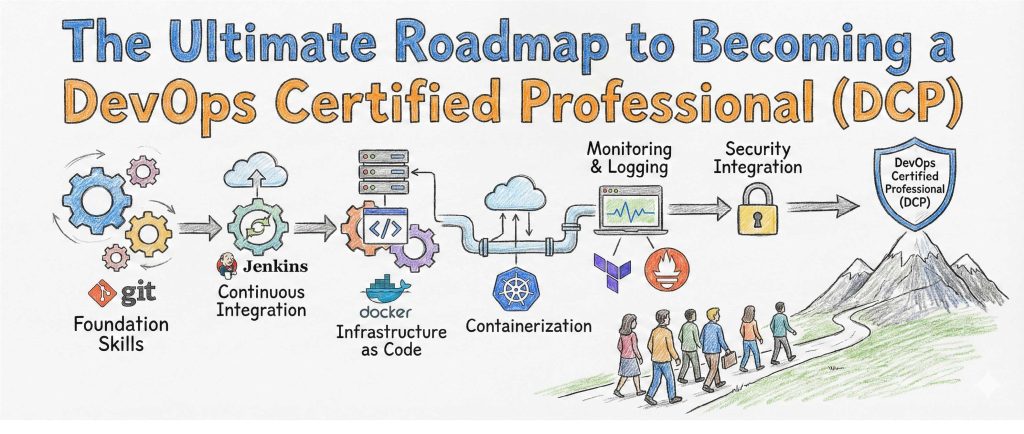
Introduction
The way we build and ship software has changed. In the past, developers wrote code and then handed it over to a different team to run it. This caused many delays and mistakes. Today, companies need people who can do both. They need people who understand how to write code and how to manage the systems that run it.
This is where the DevOps Certified Professional (DCP) comes in. This certification is not just a piece of paper. It is a sign that you understand how modern software works. Whether you are in India or working for a global company, this guide will help you understand why this program is important and how it can help your career grow.
DevOps Certified Professional (DCP)
What is Certified DevOps Professional (DCP)?
The DevOps Certified Professional (DCP) is a program that teaches you the skills to bridge the gap between development and operations. It focuses on automation, communication, and using the right tools to make software delivery fast and safe. It proves that you are not just a “tool user,” but an engineer who understands the whole process.
Why it Matters in Today’s Ecosystem
Most companies are moving to the cloud and using automation. They don’t want to do things manually anymore. If you can automate a task that used to take three hours and make it take three minutes, you are very valuable. The DCP program gives you the framework to do exactly that. It helps you stay relevant in a market that is changing very quickly.
The Importance of Certifications
For engineers and managers, a certification like DCP acts as a standard. It shows that you have reached a certain level of knowledge. In a competitive job market, it helps your resume stand out. It also gives you a clear path to learn, so you don’t waste time wondering what to study next.
Certification Overview Table
| Track | Level | Who it’s for | Prerequisites | Skills Covered | Recommended Order |
| Core Engineering | Professional | Engineers, Admins | Basic Linux/Git | CI/CD, Docker, Git, Monitoring | After Foundation |
Certification Deep-Dive: DevOps Certified Professional (DCP)
What it is
The DCP is a technical certification that covers the core tools and practices of DevOps. It is designed to take someone who knows the basics and turn them into a professional who can manage a full delivery pipeline. It focuses on practical, hands-on skills that you can use at work the very next day.
Who should take it
- Software Engineers who want to see their code go live faster.
- System Administrators who want to learn how to manage servers with code.
- Cloud Engineers who need to automate their infrastructure.
- Fresh Graduates who want to enter the industry with high-demand skills.
Skills you’ll gain
- Version Control: Mastering Git to manage code changes and collaborate with others.
- Continuous Integration (CI): Using tools like Jenkins to build and test code automatically.
- Containerization: Learning Docker to make sure your app runs the same everywhere.
- Configuration Management: Using tools to set up hundreds of servers with one script.
- Monitoring: Learning how to watch your systems so you know about problems before the customer does.
Real-world projects you should be able to do after it
- Automatic Web Deployment: Set up a system where every time you save your code, the website updates automatically.
- Infrastructure as Code: Write a script that creates a whole network of servers in the cloud.
- Log Management: Build a central place to see all the errors from all your apps at once.
- Container Orchestration: Manage multiple “containers” so they can talk to each other and stay running.
Preparation Plan
7–14 Days Plan
- Days 1-3: Focus on Linux commands and Git basics. You must be comfortable with the command line.
- Days 4-7: Learn about CI/CD concepts. Understand how code moves from a laptop to a server.
- Days 8-14: Practice setting up a basic build in a tool like Jenkins.
30 Days Plan
- Weeks 1-2: Deep dive into Docker. Learn how to create “images” and run “containers.”
- Week 3: Learn about configuration management. Understand how to manage settings across many servers.
- Week 4: Practice building a complete pipeline that includes testing and deployment.
60 Days Plan
- Month 1: Follow the 30-day plan but spend more time on troubleshooting errors.
- Month 2: Focus on monitoring and security. Learn how to keep your pipeline safe and how to watch for system crashes. Practice mock exams to get ready for the test.
Common mistakes to avoid
- Skipping the Basics: Don’t try to learn Docker if you don’t know Linux. The basics are the most important part.
- Only Watching Videos: You cannot learn DevOps by watching. You must type the commands and build the systems yourself.
- Ignoring the “Culture”: DevOps is about people working together. Don’t just focus on the tools; understand the “why” behind them.
Best next certification after this
Once you finish the DCP, you have a solid foundation. Depending on your interest, you should look at:
- Same Track: Certified DevOps Architect.
- Cross-Track: Certified DevSecOps Professional.
- Leadership: Certified DevOps Manager.
Choose Your Learning Path
1. DevOps Path
This is the main path. It is for people who want to be the bridge between dev and ops. You will learn the full loop of software delivery. It is great for engineers who like a bit of everything.
2. DevSecOps Path
This is for people who care about safety. You learn how to put security checks into the automation. It is a very high-paying path because every company is worried about hackers.
3. Site Reliability Engineering (SRE) Path
This path is for people who love stability. You focus on making sure the website stays up, even when millions of people are using it. It is heavily focused on programming and performance.
4. AIOps / MLOps Path
This is the future. It uses AI to manage systems and helps data scientists put their AI models into production. It is a great choice if you like data and automation.
5. DataOps Path
Data teams often have slow processes. This path teaches you how to use DevOps ideas to make data teams faster. It is perfect for data engineers and analysts.
6. FinOps Path
The cloud can be very expensive. This path focuses on the money. You learn how to keep the cloud bill low while keeping the performance high. Managers love this skill.
Role → Recommended Certifications Mapping
- DevOps Engineer: DCP + Kubernetes Specialist.
- Site Reliability Engineer (SRE): DCP + SRE Practitioner.
- Platform Engineer: DCP + Certified Cloud Architect.
- Cloud Engineer: DCP + AWS/Azure Certification.
- Security Engineer: DCP + Certified DevSecOps Professional.
- Data Engineer: DCP + Certified DataOps Professional.
- FinOps Practitioner: DCP + Certified FinOps Professional.
- Engineering Manager: DCP + Certified DevOps Manager.
Next Certifications to Take
Based on the data for DCP, here are the three best options for your next step:
- Same Track (Advanced Mastery): Certified DevOps Architect. This is for those who want to design large systems and lead the technical vision of a company.
- Cross-Track (Specialization): Certified DevSecOps Professional. Since security is a major concern now, adding “Sec” to your “DevOps” skills makes you very hard to replace.
- Leadership Focus (Management): Certified DevOps Manager. If you want to stop doing the hands-on work and start leading teams and strategy, this is the way to go.
Training & Certification Support Institutions
If you are looking for help with training for the DevOps Certified Professional (DCP), these institutions are well-known for their support:
They are the primary provider for DCP training. They offer deep, lab-based learning where you spend most of your time building real systems. Their community support is very strong for students.
Cotocus
This group focuses on helping corporate teams move to the cloud. They provide specialized training that is very practical and focuses on the challenges big companies face.
ScmGalaxy
A long-standing community for build and release engineers. They have a massive library of tutorials and help you understand the core foundation of DevOps tools.
BestDevOps
They focus on making complex tech simple. Their courses are designed for people who want to learn fast and get straight to the point without any fluff.
devsecopsschool.com
This is the place to go if you want to focus strictly on security within the DevOps world. They provide deep dives into automated security testing.
sreschool.com
This institution focuses entirely on Site Reliability Engineering. They teach the concepts used by giants like Google to keep their systems running 24/7.
aiopsschool.com
A great resource for the future of IT. They show you how to use Artificial Intelligence to automate the “watching” of your servers and apps.
dataopsschool.com
Dedicated to data professionals. They help you bring the speed of DevOps to your data pipelines and analytics projects.
finopsschool.com
This school focuses on the financial side. They help you master cloud cost optimization, which is a key skill for any senior role today.
General FAQs
- Is the DCP exam difficult?
It is a professional exam, so it is meant to be a challenge. However, if you do the hands-on labs, you will find it much easier. - How much time is required to prepare?
For most people, 1 to 2 months of consistent study is enough to be ready. - Are there any prerequisites?
You should know basic Linux and how to use Git. You don’t need to be a coding genius. - In what sequence should I take these?
Start with DCP to get the foundation, then choose a specialty like SRE or Security. - What is the career value?
Most engineers see a significant jump in salary and job offers once they add DCP to their profile. - Can I take these exams online?
Yes, most of these certifications are available as online proctored exams. - Do these certifications expire?
Yes, they usually last for 2 to 3 years. This is good because it keeps your skills up to date. - Will this help me move from Dev to DevOps?
Yes, it is specifically designed to help people make that transition. - Do employers in India value DCP?
Absolutely. Major IT hubs like Bangalore, Pune, and Hyderabad have a high demand for DCP-certified engineers. - What is the pass percentage?
It usually requires a score of 70% or higher to pass. - How do I verify the certificate?
You will receive a unique ID that can be checked on the official provider’s website. - Is training mandatory?
It’s not always mandatory, but it’s highly recommended because the labs are where the real learning happens.
DevOps Certified Professional (DCP) FAQs
- What is the main focus of the DCP?
The focus is on the engineering side—building pipelines, using containers, and automating deployments. - Does DCP cover cloud providers like AWS?
Yes, it teaches you how to use DevOps tools on major cloud platforms. - Is there a practical test?
The exam includes many scenario-based questions that test how you would solve a real problem. - Can I get a job just with DCP?
It is a huge help, but combine it with a few personal projects to show employers what you can build. - How often is the DCP syllabus updated?
It is updated regularly to make sure the tools mentioned are still what the industry is using. - Does it cover Kubernetes?
It covers the basics of container management which prepares you for advanced Kubernetes work. - Is it suitable for non-coders?
Yes, if you are willing to learn basic scripting and Linux. You don’t need to build apps, just manage them. - Why choose DCP over other certs?
DCP is built by industry practitioners who know what skills are actually needed in a real office.
Conclusion
The DevOps Certified Professional (DCP) is a powerful tool for your career. It gives you a clear structure to learn the most important skills in tech today. Whether you want to earn a higher salary, lead a team, or just make your daily work easier, this certification is a great investment. Don’t let the complexity of modern tech slow you down. Follow the plan, get your hands dirty with the labs, and get certified. The future of engineering is automated, and the DCP is your ticket to being a part of it.
