Upgrade & Secure Your Future with DevOps, SRE, DevSecOps, MLOps!
We spend hours scrolling social media and waste money on things we forget, but won’t spend 30 minutes a day earning certifications that can change our lives.
Master in DevOps, SRE, DevSecOps & MLOps by DevOps School!
Learn from Guru Rajesh Kumar and double your salary in just one year.
Introduction
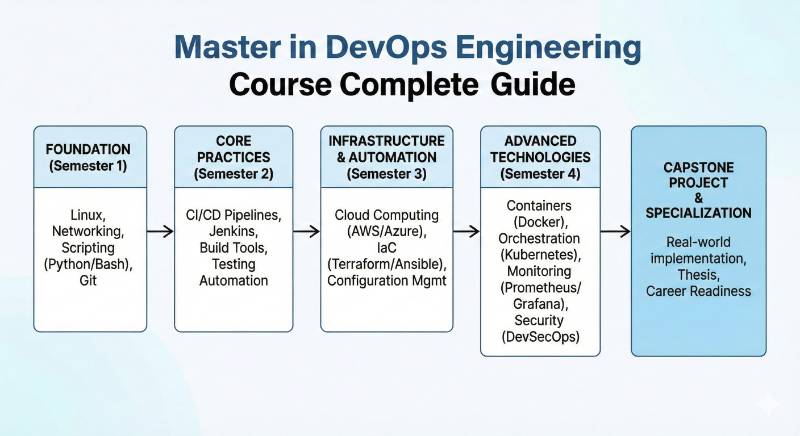
If you are already working in DevOps, cloud, SRE, platform engineering, or engineering management, Master in DevOps Engineering (MDE) is built to help you move from “using tools” to “designing and running reliable delivery systems.” This master guide explains what MDE is, who it is for, what skills you should gain, what projects you should be able to deliver, and how to prepare in 7–14 days, 30 days, or 60 days—using simple English and practical examples.
Official certification details
The official certification page for “Master in DevOps Engineering (MDE)” is here: Master in DevOps Engineering (MDE)
The provider website is: Devopsschool
Certification table
| Certification | Track | Level | Who it’s for | Prerequisites | Skills covered | Recommended order |
|---|---|---|---|---|---|---|
| Master in DevOps Engineering (MDE) | DevOps Engineering | Master | Working engineers, tech leads, architects, and managers who own delivery + reliability | Comfort with Linux, Git, CI/CD basics, and cloud basics; real project exposure is strongly helpful | CI/CD, automation, containers, Kubernetes basics to advanced usage, IaC, observability, reliability thinking, security-in-pipeline mindset | Build basics → practice on real project → take MDE and validate end-to-end capability |
What is MDE
Master in DevOps Engineering (MDE) is a certification program offered under DevOpsSchool that focuses on end-to-end DevOps engineering skills and practical capability.
It is meant for professionals who want to become strong in building, deploying, securing, and operating systems in a structured way, not in a “random tools” way.
Who should take MDE
MDE is a good fit if you relate to one or more of these situations:
- You are a DevOps/Platform engineer and want to design pipelines and platforms, not only run Jenkins jobs.
- You are an SRE and want stronger ownership of build/release workflows, not only monitoring and incident response.
- You are a Cloud engineer and want to connect infrastructure work with release automation and reliability outcomes.
- You are a tech lead or manager and you want a strong, real understanding of how delivery systems work so you can make better decisions.
- You are switching into DevOps and you want a structured master-level path (but you are ready to work hard and build projects, not only learn theory).
Skills you’ll gain
Below are the skill areas you should expect to strengthen after completing an MDE-style program. The key idea is not “know the tool name,” but “use the tool correctly in real situations.”
- CI/CD thinking (not only CI/CD tools): You learn how code should move from developer laptop to production with clear gates (build, test, scan, deploy) and clear ownership.
- Source control and collaboration: You learn how Git workflows, branching strategy, pull request rules, and tagging/releases connect to stable delivery.
- Build and packaging basics: You understand how artifacts are built (Maven/Gradle/npm, containers), versioned, stored, and promoted across environments.
- Containers and Kubernetes: You learn why containers reduce “works on my machine,” and how Kubernetes gives standard deployment patterns (deployments, services, config maps, secrets, ingress) for many teams.
- Infrastructure as Code (IaC): You learn how to create repeatable infrastructure (network, compute, cluster, databases) using code, so environments become consistent and reviewable.
- Configuration management and automation: You learn how to automate OS and application configuration, reduce manual steps, and prevent environment drift.
- Observability (logs, metrics, traces): You learn how to detect issues fast, measure performance and reliability, and avoid guessing during outages.
- Reliability practices (SRE mindset): You learn how to think in SLIs/SLOs, reduce alert noise, and make systems stable while still shipping frequently.
- DevSecOps basics (security as part of delivery): You learn how to shift security left with scanning, dependency checks, and policy rules in pipelines, instead of doing security only at the end.
- Release management and rollback planning: You learn safe deployment patterns (blue/green, canary, feature flags) and how to rollback fast without panic.
- Incident readiness: You learn how to create runbooks, do post-incident reviews, and prevent repeat incidents through real fixes (not only restarts).
- Documentation and communication: You learn how to document pipelines, platform standards, and operational processes so teams can move faster with less confusion.
Real-world projects you should be able to do after MDE
A master-level outcome should be measurable. Here are projects you should be able to deliver after you complete your preparation.
- Build a complete CI/CD pipeline for a microservice:
- Git repo → build → unit tests → code quality checks → container build → push image → deploy to staging → approval gate → deploy to production.
- Add rollback steps and basic notifications.
- Create an Infrastructure as Code setup for environments:
- Provision a VPC/network, compute, and Kubernetes cluster (or VM-based setup).
- Make dev/stage/prod look similar (same structure, different sizes).
- Implement a “secure-by-default” pipeline flow:
- Add dependency scanning, container scanning, and basic policy checks.
- Fail the build when high-risk issues are found (with clear reporting).
- Set up observability for an application:
- Collect metrics, logs, and alerts for key business endpoints (login, checkout, payment).
- Create a dashboard and alert rules that are not noisy.
- Improve reliability with SRE-style changes:
- Define a simple SLO (example: 99.9% successful requests for a key API).
- Reduce alert noise by removing low-value alerts.
- Create runbooks for top 5 common incidents.
- Create a standard deployment template for teams:
- Provide Kubernetes Helm charts (or similar templates) so new services can deploy with the same patterns.
- Include environment config, secrets handling, resource limits, and health checks.
- Build a “self-service platform” starter:
- A simple internal portal or scripts that allow teams to create a new service pipeline with minimum manual work.
- Focus on “guardrails” (standards) rather than total freedom.
Preparation plan (7–14 days / 30 days / 60 days)
Pick a plan based on your current level. The best plan is the one you can actually follow while working full-time.
7–14 days plan (fast track)
This is for people who already do DevOps daily and want to organize knowledge and fill gaps.
Day-by-day approach (example):
- Days 1–2: Refresh Linux + networking basics (ports, DNS, TLS basics), Git workflow, and basic scripting (shell).
- Days 3–4: CI/CD revision—create one pipeline end-to-end (build, test, package).
- Days 5–6: Containers and Kubernetes revision—deploy one app, add config, secrets, health checks.
- Days 7–8: IaC revision—create infra via code; focus on repeatability and clean variables.
- Days 9–10: Observability revision—dashboards + alerting + logs.
- Days 11–12: Security-in-pipeline basics—add scanning and quality gates.
- Days 13–14: Capstone revision—document what you built, prepare for scenario questions (why this approach, trade-offs).
What to focus on:
- Do fewer topics, but make sure you can explain decisions clearly.
30 days plan (balanced)
This is the best option for most working engineers.
Weekly approach:
- Week 1: Strong foundations
- Linux, Git, basic cloud, Docker fundamentals, scripting.
- Outcome: run a service locally and containerize it.
- Week 2: Delivery automation
- Build a CI/CD pipeline, add tests, artifact handling, promotions.
- Outcome: deployment to staging happens with one command or one click.
- Week 3: Platform + IaC
- Kubernetes deployment patterns, IaC provisioning, configuration management.
- Outcome: spin up an environment from scratch and deploy into it.
- Week 4: Reliability + security + final projects
- Observability, SRE practices, DevSecOps gates, release strategies.
- Outcome: one end-to-end “production-like” system with dashboards, alerts, and rollback.
What to focus on:
- Build at least 2 projects and document them like a real team would.
60 days plan (deep and career-focused)
This plan is for people switching roles, or people who want strong confidence through repeated practice.
Bi-weekly approach:
- Days 1–15: Foundations + one simple CI/CD pipeline.
- Days 16–30: Kubernetes + IaC + environment setup.
- Days 31–45: Observability + reliability improvements (SLO thinking, better alerts).
- Days 46–60: Security gates + advanced release patterns + capstone project and documentation.
What to focus on:
- Build a portfolio that you can show in interviews (architecture diagram, pipeline screenshots, runbooks, post-incident sample).
Common mistakes
These mistakes slow people down the most. Avoid them early.
- Learning tools without building a full system: You must build “code to production,” not only watch tutorials.
- Skipping fundamentals (Linux, networking, Git): Many pipeline and Kubernetes issues are actually basics issues.
- Copy-pasting YAML without understanding: It works until it doesn’t, and then you cannot debug.
- Ignoring security and compliance until the end: In real companies, security is not optional, and late security creates delays.
- Treating monitoring as a dashboard only: Monitoring must answer “Is the user impacted?” and “What should we do now?”
- Over-alerting: If everything is urgent, nothing is urgent; learn to reduce noise.
- No documentation: If only you understand the setup, your system will fail when you are not available.
- Not practicing failures: Real production includes failures; test rollback, test alerts, test incident response.
Best next certification after MDE
After MDE, your next step depends on what you want to become:
- If you want to go deeper in technical architecture: choose an architect-focused direction inside DevOps/platform engineering (focus on platform design, multi-team standards, governance).
- If you want to go deeper in security: go toward a DevSecOps-focused path and specialize in policy-as-code, threat modeling, and cloud security controls.
- If you want to go deeper in reliability: go toward an SRE-focused path and specialize in SLO design, capacity planning, and incident management at scale.
- If you want leadership: go toward a manager/leadership certification or program so you can scale processes and teams.
Note: Your prompt asks for “Next certifications” based on the official MDE page; if you paste that “Next certifications” section text here, I can convert it into a perfect same-track / cross-track / leadership list without adding any extra links.
Choose your path (6 learning paths)
MDE is a strong anchor, but your career can grow in different directions. Choose one path as primary, and keep the others as supporting skills.
1) DevOps path
This path is about delivery speed with stability.
- What you focus on: CI/CD, automation, environment consistency, deployment strategies, developer experience.
- What you build: reusable pipelines, self-service platforms, standard templates for teams.
- Good outcomes: faster releases, fewer deployment failures, smoother teamwork.
2) DevSecOps path
This path is about making security part of daily engineering.
- What you focus on: secure pipelines, scanning, secrets management, access controls, compliance checks.
- What you build: security gates in CI/CD, policy-as-code rules, audit-ready release evidence.
- Good outcomes: fewer vulnerabilities reaching production, safer releases, faster compliance.
3) SRE path
This path is about keeping systems reliable while still shipping changes.
- What you focus on: SLIs/SLOs, error budgets, incident response, capacity planning, performance.
- What you build: meaningful alerts, runbooks, automated remediation, better on-call experience.
- Good outcomes: lower downtime, faster recovery, less alert fatigue.
4) AIOps/MLOps path
This path is about scaling operations and model delivery using automation and intelligence.
- What you focus on: event correlation, anomaly detection basics, automated operations workflows; for MLOps, model training pipelines, model deployment, monitoring drift.
- What you build: automated triage, model CI/CD, operational dashboards with smarter signals.
- Good outcomes: faster detection and response, less manual work, better model reliability.
5) DataOps path
This path is about reliable and fast data pipelines.
- What you focus on: data pipeline automation, testing for data quality, orchestration, lineage basics.
- What you build: repeatable ETL/ELT deployments, data quality checks, pipeline observability.
- Good outcomes: fewer broken dashboards, trusted data, faster analytics delivery.
6) FinOps path
This path is about making cloud costs efficient without blocking delivery.
- What you focus on: cost visibility, tagging, budgets, unit economics, rightsizing basics, governance.
- What you build: cost dashboards, alerts for overspend, policies for resource usage.
- Good outcomes: lower cloud bill, smarter decisions, better ROI from cloud.
Role → Recommended certifications mapping
Below is a practical mapping. Use it as a guide, not a rule.
| Role | What you should prioritize now | How MDE helps |
|---|---|---|
| DevOps Engineer | Strong CI/CD + IaC + Kubernetes basics; one end-to-end project | Makes your skills complete from code to production operations |
| SRE | SLO thinking, observability, incident readiness; improve reliability | Adds stronger delivery automation and platform awareness |
| Platform Engineer | Standard platform templates, self-service, Kubernetes and governance | Helps you design platforms that teams can use safely |
| Cloud Engineer | IaC, networking basics, security basics, automation | Connects infra work to release automation and reliability outcomes |
| Security Engineer | Cloud security controls, secrets, policy-as-code, pipeline gates | Gives you the DevOps delivery context to integrate security correctly |
| Data Engineer | Pipeline automation, reliability of data jobs, quality checks | Helps apply DevOps practices to data delivery |
| FinOps Practitioner | Cost tracking, tagging, governance, cost optimization | Helps you influence engineering choices that reduce cost long-term |
| Engineering Manager | Delivery predictability, reliability, process improvement | Helps you guide teams with real technical understanding |
Top institutions that help with training + certification
Below are the institutions you listed, with a simple explanation of how they can help. (I’m not adding links because your rule says to avoid external links.)
DevOpsSchool
DevOpsSchool is the core brand behind the MDE certification and is the main place people look for official program details and certification flow.
It is usually the first choice if you want a single program that combines DevOps engineering with reliability and security thinking.
Cotocus
Cotocus is often positioned as an industry training and consulting brand. It can be helpful if you want training that feels closer to real company projects and delivery problems.
Scmgalaxy
Scmgalaxy is known for DevOps and SCM learning paths. It is useful if you want extra practice on release management, branching strategies, and automation habits.
BestDevOps
BestDevOps typically focuses on best practices and practical learning. It can be useful when you want clear “how to implement in real teams” guidance.
devsecopsschool
devsecopsschool is a strong option if your main gap is security. It can help you understand how to integrate scanning, compliance, and secure controls into pipelines.
sreschool
sreschool is useful if you want stronger reliability thinking. It can help you build deeper comfort in SLOs, incident response, observability, and stability patterns.
aiopsschool
aiopsschool is useful when your goal is modern operations at scale. It can help you connect monitoring data to automation and intelligent operations workflows.
dataopsschool
dataopsschool is helpful if your work involves data engineering and pipelines. It helps translate DevOps ideas into the data world (quality, orchestration, repeatability).
finopsschool
finopsschool is useful if cloud cost is a big pain point. It can help you build cost visibility, cost controls, and healthy governance without slowing teams down.
FAQs — difficulty, time, prerequisites, value
1) Is MDE hard?
It is challenging because it expects you to connect many parts (CI/CD, infrastructure, Kubernetes, reliability, and security). It becomes much easier when you build 2–3 complete projects instead of only reading.
2) How much time do I need as a working professional?
If you can give 1–2 hours on weekdays and more time on weekends, a 30–60 day plan is realistic. If you already do DevOps daily, 7–14 days can work as a revision plan.
3) Do I need coding knowledge?
You should be comfortable with basic scripting and reading logs. You do not need to be a full-time developer, but you must be able to automate repetitive tasks.
4) What are the prerequisites?
You should know Linux basics, Git basics, and at least one cloud platform at a basic level. Real project exposure helps more than theoretical knowledge.
5) Should I learn Kubernetes before starting?
It helps a lot. If you do not know Kubernetes, you can still start, but your learning curve will be steep, so choose the 60-day plan.
6) Is this useful for managers?
Yes, especially engineering managers who need to understand delivery bottlenecks, reliability risks, and how to plan improvements. You may not run commands daily, but you will make better decisions.
7) What is the best learning order?
Basics → CI/CD → containers → Kubernetes → IaC → observability → security gates → reliability practices → capstone projects. This order reduces confusion.
8) Can I switch from testing/support to DevOps using this?
Yes, but choose the 60-day plan and start with fundamentals. Your first goal should be: “I can deploy and operate one service end-to-end.”
9) What kind of jobs can this help with?
It supports roles like DevOps Engineer, Platform Engineer, SRE, Cloud/DevOps Engineer, and DevOps Lead. Your projects and explanations in interviews matter as much as the certification.
10) Is certification alone enough to get a job?
No. Certification is proof of learning, but hiring depends on what you can build and explain. Create 2–3 portfolio projects and write clear documentation.
11) What is the biggest benefit in real work?
You become faster and calmer under pressure because you understand the full system. You can debug issues across pipeline, infrastructure, and runtime instead of blaming one tool.
12) What if I feel overwhelmed by too many tools?
Reduce the tool list. Pick one CI tool, one IaC tool, one cloud, and one Kubernetes cluster type, then build projects. Depth beats wide tool lists.
FAQs on Master in DevOps Engineering (MDE)
1) What does “Master” mean in MDE?
It means the program aims for end-to-end capability. You should be able to design, implement, and operate delivery systems—not only follow steps.
2) What is the biggest difference between MDE and basic DevOps courses?
Basic courses teach tools separately. MDE-style learning is about connecting them into one working system and thinking in architecture + outcomes.
3) What should I build during MDE preparation?
At least one microservices-based deployment with CI/CD, Kubernetes deployment, IaC-created environments, and dashboards/alerts. If you build that, you are thinking like a master-level engineer.
4) How do I know I’m “ready”?
You are ready when you can answer scenario questions like: “How will you deploy safely?”, “How will you rollback?”, “How will you detect failure?”, and “How will you keep it secure?”
5) What should I focus on if I come from development?
Focus more on infrastructure basics, networking basics, Kubernetes operations, and incident thinking. Many developers already know Git and build steps.
6) What should I focus on if I come from system admin/support?
Focus more on CI/CD, release automation, and collaboration workflows with developers. Many admins already know Linux and troubleshooting.
7) What common gap do candidates have?
They can deploy, but they cannot operate reliably (alerts too noisy, no runbooks, no rollback plan). Fix this by practicing failures and incident readiness.
8) What is the smartest way to use MDE for career growth?
Use it as a story: “Here is the system I built, here is how I made it reliable and secure, and here are the measurable improvements.” That story wins interviews.
Conclusion
Becoming a master in DevOps is not just about collecting certificates; it is about building the confidence to lead. The Master in DevOps Engineering (MDE) program is designed to give you that confidence by connecting the dots between development, operations, security, and reliability.
By following the learning paths and projects outlined in this guide, you move beyond just “knowing tools” to solving real business problems. Whether you want to architect complex platforms, secure global pipelines, or ensure 99.99% uptime as an SRE, this certification provides the structured foundation you need.
