Upgrade & Secure Your Future with DevOps, SRE, DevSecOps, MLOps!
We spend hours scrolling social media and waste money on things we forget, but won’t spend 30 minutes a day earning certifications that can change our lives.
Master in DevOps, SRE, DevSecOps & MLOps by DevOps School!
Learn from Guru Rajesh Kumar and double your salary in just one year.
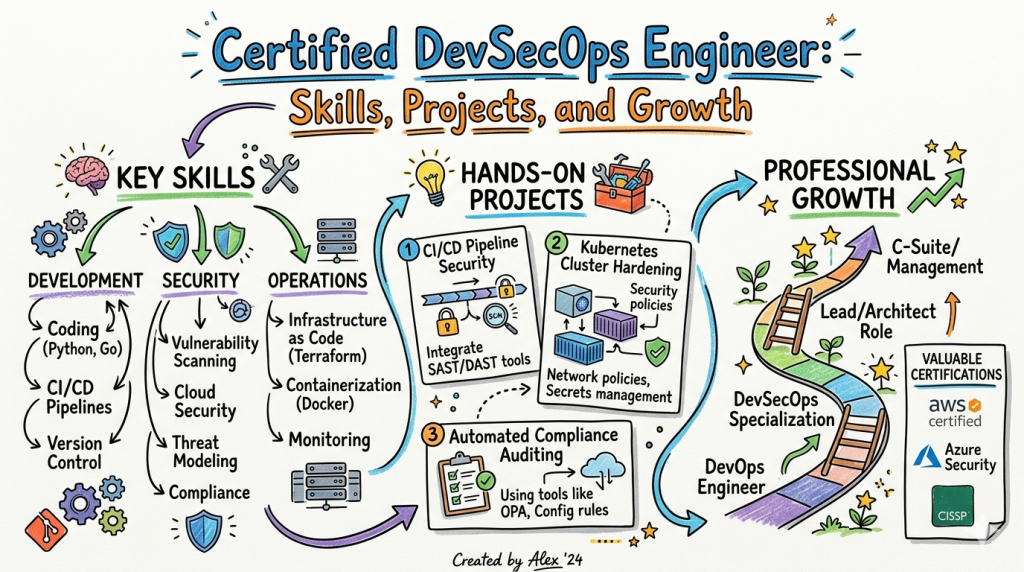
Modern software teams must ship fast and stay secure at the same time. Traditional security models cannot keep up with short release cycles, cloud-native architectures, and global user bases. This is why DevSecOps and the Certified DevSecOps Engineer certification are becoming so important for engineers and managers. This guide explains the Certified DevSecOps Engineer certification in simple language. You will learn what it is, who it is for, what skills you gain, how to prepare, how it fits into broader career paths, and what to do after completing it.
Why Certified DevSecOps Engineer Matters
DevSecOps is more than adding tools to a pipeline. It is a way of working where security is part of every decision, from architecture and coding to deployment and operations. Organizations are looking for people who understand this end-to-end view.
By earning Certified DevSecOps Engineer, you prove that you can design, implement, and improve secure delivery pipelines. This is valuable for engineers, architects, and managers in product companies, service firms, and startups.
Key Outcomes of Certified DevSecOps Engineer
After this certification, you should be able to:
- Explain DevSecOps concepts in clear, practical terms.
- Integrate security checks into CI/CD pipelines.
- Work with developers, operations, and security teams using common practices.
- Apply basic and intermediate application security, container security, and cloud security.
- Use automation to reduce manual security work and human error.
These outcomes make you more effective in real project environments.
Structured View of the Certification
What it is
Certified DevSecOps Engineer is a role-focused certification that proves you can embed security into the full software delivery lifecycle. It covers culture, processes, and tooling for secure CI/CD and modern application delivery.
The certification is hands-on and practical, with a strong focus on real-world use cases.
Who should take it
- Software engineers and developers working on web apps, APIs, or microservices
- DevOps, platform, and cloud engineers managing CI/CD and infrastructure
- Security engineers who want to shift left and automate security checks
- SREs and reliability engineers supporting critical production systems
- Engineering managers and tech leads responsible for secure delivery
Skills you’ll gain (bullets)
- Understanding DevSecOps principles and secure SDLC
- Designing secure CI/CD pipelines with integrated security controls
- Using SAST, DAST, and SCA tools in automated workflows
- Implementing secrets management, access control, and secure configuration
- Applying basic container and Kubernetes security practices
- Applying cloud security basics for identities, networks, and services
- Integrating security into monitoring, logging, and incident response
- Communicating security requirements and trade-offs with teams
Real-world projects you should be able to do
- Build or update a CI/CD pipeline that runs static and dependency scans on each commit
- Add dynamic security testing into staging or pre-production environments
- Implement secrets management for applications across multiple environments
- Harden container images and enforce scanning before deployment
- Create a basic threat model for an application and map security controls to pipeline steps
- Set up security-focused dashboards and alerts for key services
Preparation plan (7–14 / 30 / 60 days)
7–14 days (intensive plan)
- Best if you already work with CI/CD, containers, or security tools.
- Day blocks focus on: DevSecOps basics, secure SDLC, CI/CD security, SAST/DAST/SCA tools, container and cloud security, and a small end-to-end project.
- Spend extra time on hands-on labs, not just reading or watching videos.
30 days (balanced plan)
- Good for working professionals who can study 1–2 hours per day.
- Week 1: DevSecOps principles, culture, secure SDLC, and basic security concepts.
- Week 2: CI/CD security, static and dynamic analysis, and dependency security.
- Week 3: Container, Kubernetes, and cloud security basics.
- Week 4: Real-world projects, exam-style practice, and revision of weak areas.
60 days (foundations-first plan)
- Suitable if you are new to DevOps or security.
- Phase 1: Fundamentals of Linux, Git, CI/CD, containers, and basic networking.
- Phase 2: Application security basics, OWASP-style thinking, secure coding.
- Phase 3: DevSecOps practices, tools, project work, and exam preparation.
Common mistakes
- Treating DevSecOps as only tool knowledge, without understanding principles
- Ignoring secure coding and focusing only on infrastructure security
- Skipping hands-on practice and only reading theory or slides
- Memorizing commands and screenshots without understanding why they are used
- Not learning how to collaborate with developers, operations, and security teams
- Underestimating cloud, container, and identity security basics
Best next certification after this
- Same track: Advanced DevSecOps or specialized cloud security certifications to go deeper into secure architecture and compliance.
- Cross-track: SRE, AIOps/MLOps, or DataOps programs to broaden your platform and operations skills.
- Leadership: Architecture or security leadership programs to focus on strategy, governance, and large-scale security decisions.
Certification Table
Here is a table centered on the Certified DevSecOps Engineer certification, with all the details you asked for:
| Track | Level | Who it’s for | Prerequisites | Skills covered | Recommended order |
|---|---|---|---|---|---|
| DevSecOps | Intermediate | Developers, DevOps, SRE, Security, Cloud, Platform engineers | Basic DevOps, CI/CD, Linux, and programming basics | DevSecOps principles, secure SDLC, CI/CD security, SAST/DAST/SCA, secrets management, container and cloud security | Take after learning basic DevOps and CI/CD |
Choose Your Path: 6 Learning Paths
Certified DevSecOps Engineer can be the center of your learning map. Around it, you can choose one or more of these paths.
1. DevOps Path
Focus on automation, CI/CD, and reliable delivery pipelines.
- Build strong skills in CI/CD, infrastructure as code, and configuration management.
- Learn how to design pipelines that are fast, reliable, and maintainable.
- Combine DevOps with DevSecOps to deliver both speed and safety.
2. DevSecOps Path
Go deeper into security across applications, containers, and cloud.
- Specialize in secure coding, automated security testing, and policy as code.
- Learn how to design end-to-end secure delivery processes and governance.
- Become a go-to person for security inside engineering teams.
3. SRE Path
Concentrate on reliability and operations with a security-aware mindset.
- Learn Service Level Objectives (SLOs), error budgets, and incident management.
- Use observability and chaos engineering to test reliability and resilience.
- Combine SRE practices with DevSecOps for safe, stable, and secure systems.
4. AIOps / MLOps Path
Apply automation and intelligence to operations and machine learning.
- Use AIOps tools to detect anomalies and patterns in complex systems.
- Learn MLOps pipelines for model training, deployment, and monitoring.
- Combine DevSecOps with AIOps/MLOps to secure ML services and automated operations.
5. DataOps Path
Focus on data pipelines, analytics, and secure data handling.
- Build and automate reliable data pipelines and orchestration workflows.
- Ensure data quality, lineage, and controlled data access.
- Integrate DevSecOps thinking so that data pipelines are secure and compliant.
6. FinOps Path
Align cloud costs with engineering decisions and security.
- Learn cloud cost optimization, budgeting, and financial accountability.
- Understand how architecture choices impact both cost and security.
- Combine FinOps and DevSecOps to build solutions that are secure and cost-effective.
Role → Recommended Certifications Mapping
| Role | Recommended certifications focus |
|---|---|
| DevOps Engineer | Core DevOps, Certified DevSecOps Engineer, container/Kubernetes certifications |
| SRE | SRE-focused programs, Certified DevSecOps Engineer, observability and incident management certifications |
| Platform Engineer | Kubernetes/platform engineering, Certified DevSecOps Engineer, cloud architecture certifications |
| Cloud Engineer | Cloud provider associate/professional tracks, Certified DevSecOps Engineer, cloud security certifications |
| Security Engineer | Application security, Certified DevSecOps Engineer, cloud and container security certifications |
| Data Engineer | Data engineering and DataOps, Certified DevSecOps Engineer (for pipeline and platform security) |
| FinOps Practitioner | FinOps certifications, cloud provider cost management, Certified DevSecOps Engineer (for secure designs) |
| Engineering Manager | Leadership and architecture programs, Certified DevSecOps Engineer, governance and risk-related courses |
Training and Certification Institutions
Here is a short overview of institutions that can support training and certification for Certified DevSecOps Engineer and related skills. Each one is described in a few lines.
- DevOpsSchool
DevOpsSchool provides structured programs on DevOps, DevSecOps, SRE, and cloud. Their trainings often include hands-on labs, projects, and guidance for applying concepts in real work environments. - Cotocus
Cotocus focuses on professional training and consulting for DevOps, DevSecOps, and cloud-native technologies. They support learners with practical examples, use cases, and project-style exercises. - ScmGalaxy
ScmGalaxy offers workshops and courses in DevOps, source control, build and release engineering, and DevSecOps. Their programs are known for tool-focused sessions and practical demonstration. - BestDevOps
BestDevOps acts as a resource hub for DevOps and DevSecOps, offering curated knowledge, training options, and learning paths. It helps professionals discover and navigate suitable training programs. - devsecopsschool.com
devsecopsschool.com specializes in DevSecOps training and certifications, including Certified DevSecOps Engineer. Their focus is on security integrated into DevOps and CI/CD across tools and platforms. - sreschool.com
sreschool.com is centered on Site Reliability Engineering education. It complements DevSecOps training by teaching how to design and operate reliable, observable, and secure systems in production. - aiopsschool.com
aiopsschool.com focuses on AIOps, automation, and intelligent operations. Learners explore how to use data, monitoring, and automation to manage modern, complex systems. - dataopsschool.com
dataopsschool.com offers training on DataOps and data engineering workflows. It helps professionals build robust, secure data pipelines and manage data platforms effectively. - finopsschool.com
finopsschool.com is dedicated to FinOps and cloud cost management practices. It helps engineers and managers align cloud usage and spending with business and technical goals.
General FAQs
1. What is the goal of Certified DevSecOps Engineer?
The goal is to validate that you can integrate security into every stage of the software delivery lifecycle. It confirms both your practical skills and your understanding of DevSecOps principles.
2. How hard is this certification?
The difficulty is moderate for someone with DevOps or security experience. For beginners, the concepts are manageable if you follow a structured plan and spend time on labs and practice projects.
3. How much time does preparation usually take?
Many working professionals need 30 to 60 days of focused study and practice. If you are already strong in DevOps and security, a shorter 7–14 day intensive sprint can also work.
4. Do I need to know coding?
Basic coding and scripting skills are very helpful. You do not need to be a deep programmer, but you should be comfortable reading code, writing simple scripts, and understanding application behavior.
5. What are the prerequisites for this certification?
You should know basic DevOps concepts, CI/CD, Git, Linux, and at least one programming language. Knowledge of containers, cloud basics, and application security gives you a smoother learning experience.
6. In what sequence should I learn DevSecOps topics?
Start with DevOps fundamentals, then study secure SDLC and basic security principles. Next, move into CI/CD security, scanning tools, container security, and cloud security. Finish with projects and exam practice.
7. What is the value of this certification for my career?
It shows that you can bring security into modern delivery practices. This makes you more attractive for roles like DevSecOps Engineer, security-focused DevOps Engineer, SRE, and platform roles with security responsibilities.
8. How does this certification help engineers in India and global markets?
Companies in India and worldwide are looking for people who can make security part of everyday engineering. This certification signals that you have these skills and can work in global, cloud-based environments.
9. Does this certification help managers as well?
Yes. Engineering managers and leads can use this knowledge to design secure delivery processes, make better tool and architecture decisions, and guide their teams toward secure, high-velocity delivery.
10. Can freshers attempt Certified DevSecOps Engineer?
Freshers can attempt it, but it is easier if they first build a base in Linux, Git, CI/CD, and basic programming. A longer 60-day plan with strong fundamentals is recommended for early-career learners.
11. What career outcomes can I expect?
You can move into roles such as DevSecOps Engineer, Security Engineer in DevOps teams, SRE with security focus, or platform engineer working on secure cloud platforms. Over time, you can grow into architecture or security leadership roles.
12. Is this certification tool-specific?
The certification highlights common tool categories and practices but is not limited to one tool vendor. You learn approaches that apply across multiple stacks, which protects your skills when tools change.
FAQs on Certified DevSecOps Engineer (8 Q&A)
1. Is Certified DevSecOps Engineer suitable for pure developers?
Yes. It helps developers write safer code, understand how security checks run in pipelines, and collaborate better with security and operations teams.
2. Does this certification cover cloud security?
It covers cloud security basics such as identity, access control, secure configuration, and integration of cloud-related security checks into pipelines. It prepares you to go deeper into cloud security later.
3. Do I need hands-on experience with CI/CD tools?
Hands-on experience is strongly recommended. You should be comfortable with at least one CI/CD tool so you can apply DevSecOps concepts in a real pipeline.
4. Does it include container and Kubernetes security?
Yes. It introduces container image scanning, hardening practices, and the basics of securing Kubernetes workloads, all from a DevSecOps perspective.
5. How much theory versus practice is involved?
There is a mix of concepts and practice, but the focus is on real usage. You are expected to understand ideas and then show you can apply them in labs, projects, or exam scenarios.
6. Can this certification help me move from security to DevSecOps?
Yes. If you come from a security background, it helps you understand CI/CD, automation, and how developers work. This makes your security work more aligned with modern engineering practices.
7. Will it help with compliance and audits?
It does not replace compliance certifications, but it helps you design pipelines and processes that make compliance checks easier, more visible, and more automated.
8. Is Certified DevSecOps Engineer useful for remote or global teams?
Yes. DevSecOps practices are highly suitable for distributed teams because they rely on shared code, pipelines, and automated checks, which work across time zones and locations.
Conclusion
Certified DevSecOps Engineer is a practical way to build and prove your ability to blend security with modern software delivery. It takes you beyond basic DevOps into a space where secure coding, automated testing, container and cloud security, and continuous monitoring all work together. For engineers, it opens paths into DevSecOps, SRE, platform, and security roles. For managers, it offers a clear framework to guide teams toward safe, fast, and reliable delivery. With a focused preparation plan, hands-on projects, and the right training support, this certification can become a strong pillar in your long-term career.
