Upgrade & Secure Your Future with DevOps, SRE, DevSecOps, MLOps!
We spend hours scrolling social media and waste money on things we forget, but won’t spend 30 minutes a day earning certifications that can change our lives.
Master in DevOps, SRE, DevSecOps & MLOps by DevOps School!
Learn from Guru Rajesh Kumar and double your salary in just one year.
Introduction
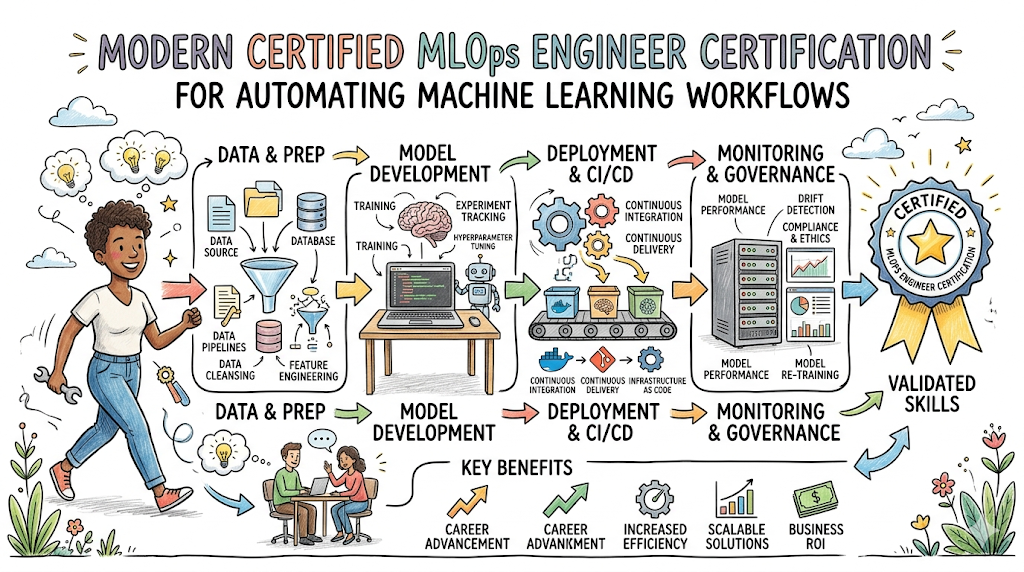
The transition from experimental machine learning to production-ready systems is facilitated by the Certified MLOps Engineer program. This career guide is intended for professionals who seek to master the lifecycle of machine learning models. Knowledge is provided on how to bridge the gap between data science and operational excellence. This path is hosted by aiopsschool.com to ensure that industry standards are met. This guide is designed to help engineers and managers make informed decisions regarding their career progression. Professional goals are aligned with current enterprise requirements through this specialized training.
What is the Certified MLOps Engineer?
The Certified MLOps Engineer represents a specialized professional designation for those managing the intersection of machine learning, DevOps, and data engineering. It exists because many machine learning models fail to reach production due to a lack of operational rigor. Real-world, production-focused learning is prioritized over pure academic theory. Modern engineering workflows are aligned with enterprise practices to ensure models are scalable and reliable.
The lifecycle of a model, from data ingestion to monitoring, is covered extensively. Emphasis is placed on the automation of repetitive tasks and the creation of reproducible environments. This certification serves as a validation of an engineer’s ability to handle complex AI infrastructures. It is recognized as a standard for operational excellence in the field of machine learning.
Who Should Pursue Certified MLOps Engineer?
This path is ideally suited for DevOps engineers who wish to transition into the artificial intelligence space. Site Reliability Engineers and cloud professionals will find the operational aspects highly beneficial. Security and data roles are also targeted to ensure that data integrity and safety are maintained in AI systems. Both beginners and experienced leads are encouraged to participate.
Engineering managers who oversee data science teams will gain insights into the technical challenges of model deployment. It is recommended for professionals who are looking to increase their value within the global technology market. Relevance is maintained for both the Indian market and the international technology landscape. Individuals seeking a structured learning path for machine learning operations will find this program indispensable.
Why Certified MLOps Engineer is Valuable and Beyond
High demand is observed for engineers who can automate machine learning pipelines. Longevity is ensured as enterprises continue to adopt AI-driven solutions across all sectors. Professionals are helped to stay relevant even when specific software tools change over time. A strong return on time and career investment is provided by this specialization.
Reliability in AI systems is viewed as a competitive advantage for modern organizations. The ability to deploy models quickly and safely reduces the time to market for new products. Long-term career growth is supported by a curriculum that focuses on core principles rather than fleeting trends. It prepares candidates for the future of automated enterprise environments.
Certified MLOps Engineer Certification Overview
The program is delivered via the official training portal and is hosted on the primary platform. Certification levels are structured to accommodate different stages of professional growth. A practical assessment approach is utilized to validate the skills of the candidates. Ownership of the learning process is placed on the student through hands-on labs and simulations.
The structure is designed to be applicable to real-world enterprise environments. Core modules include model versioning, data management, and continuous deployment for AI. Assessment is based on the ability to solve practical problems rather than simple memorization. The program is updated regularly to reflect changes in the industry landscape.
Certified MLOps Engineer Certification Tracks & Levels
A foundation level is provided for those who are new to the concepts of machine learning operations. A professional level is offered for engineers who are responsible for deploying models into production. Advanced levels are reserved for architects who design complex AI infrastructures and orchestrate large-scale systems.
Specialization tracks are available to align with DevOps, SRE, or FinOps backgrounds. Clear career progression is mapped through these various levels of expertise. Each level builds upon the previous one to ensure a comprehensive understanding of the domain. This tiered approach allows professionals to learn at a pace that suits their current career stage.
Complete Certified MLOps Engineer Certification Table
| Track | Level | Who it’s for | Prerequisites | Skills Covered | Recommended Order |
| Foundation | Associate | Beginners | Basic Linux | ML Lifecycle | 1st |
| Professional | Professional | Engineers | DevOps Basics | CI/CD for ML | 2nd |
| Specialist | Expert | Architects | 3+ Years Exp | Scaling Models | 3rd |
| Operations | Manager | Leads | Management | Cost & Governance | 4th |
Detailed Guide for Each Certified MLOps Engineer Certification
Certified MLOps Engineer – Foundation Level
What it is
This certification validates a fundamental understanding of machine learning operations. Core concepts regarding the model lifecycle and basic automation are tested at this level.
Who should take it
Suitable roles include junior DevOps engineers and recent graduates entering the IT field. It is intended for those who want a solid entry point into the AI operations space.
Skills you’ll gain
- Basic understanding of ML pipelines.
- Version control for data and models.
- Introduction to containerization for AI.
- Familiarity with cloud-native AI tools.
Real-world projects you should be able to do
- A basic automated data ingestion script can be created.
- A simple machine learning model can be deployed using a container.
Preparation plan
A 7-day plan is recommended for those with prior IT experience. A 14-day strategy is advised for complete beginners to cover all theoretical and practical aspects.
Common mistakes
- The importance of data versioning is often overlooked.
- Too much time is spent on model math instead of operations.
Best next certification after this
- Same-track option: Certified MLOps Engineer – Professional.
- Cross-track option: Certified DevOps Associate.
- Leadership option: Project Management Professional.
Certified MLOps Engineer – Professional Level
What it is
The ability to deploy and manage production-grade machine learning models is validated. Advanced CI/CD techniques for machine learning are emphasized in this program.
Who should take it
Mid-level engineers and SREs are the primary target audience. It is intended for professionals who are managing live production environments on a daily basis.
Skills you’ll gain
- Automated testing for ML models.
- Model monitoring and drift detection.
- Scalable model serving techniques.
- Infrastructure as Code for AI environments.
Real-world projects you should be able to do
- A fully automated CI/CD pipeline for a deep learning model can be built.
- Monitoring dashboards for model performance can be implemented and maintained.
Preparation plan
A 30-day intensive study plan is suggested for most candidates. Practical lab work should be prioritized during this period to ensure technical proficiency.
Common mistakes
- Monitoring for model drift is frequently ignored during the deployment phase.
- Security protocols for data access are not sufficiently implemented in the pipeline.
Best next certification after this
- Same-track option: Certified MLOps Engineer – Expert.
- Cross-track option: Certified Kubernetes Security Specialist.
- Leadership option: Technical Program Manager.
Choose Your Learning Path
DevOps Path
The focus is placed on the integration of machine learning into existing CI/CD workflows. Traditional DevOps tools are extended to handle the unique requirements of AI models and large datasets. Automation is applied to the testing and deployment phases to ensure consistent delivery. Reliability and speed of delivery are treated as the primary objectives in this learning path.
DevSecOps Path
Security is integrated into every stage of the machine learning lifecycle. Data privacy and model integrity are protected against potential threats and unauthorized access. Compliance standards are enforced through automated checks within the delivery pipeline. Vulnerabilities in AI libraries and containers are actively identified and mitigated before they reach production.
SRE Path
Stability and uptime of machine learning services are prioritized above all else. Error budgets and service level objectives are defined for AI platforms to maintain performance. Automated recovery and scaling mechanisms are implemented to handle traffic spikes. The focus is maintained on the operational health and observability of models in high-traffic environments.
AIOps Path
Artificial intelligence is utilized to improve traditional IT operations and system management. Patterns in system logs and performance metrics are identified using machine learning algorithms. Faster incident response and root cause analysis are achieved through intelligent automation. Operational efficiency is enhanced by reducing manual intervention in daily maintenance tasks.
MLOps Path
The entire lifecycle of a machine learning model is managed from data collection to final retirement. Continuous training and continuous deployment of models are established as core practices. Feedback loops are used to improve model accuracy and performance over time. Collaboration between data scientists and operations engineers is facilitated through standardized processes.
DataOps Path
The flow of data from various sources to end consumers is optimized for speed and quality. Data pipelines are treated as code to ensure repeatability and ease of maintenance. Data quality checks are automated to prevent errors from affecting downstream models. Orchestration of complex data workflows is managed through the use of modern tooling.
FinOps Path
Cloud spending associated with machine learning workloads is monitored and controlled. Resource utilization is optimized to reduce unnecessary costs and improve the bottom line. Financial accountability is promoted among engineering teams through transparent reporting. Strategic decisions are made based on the cost-efficiency of various AI models and infrastructures.
Role → Recommended Certified MLOps Engineer Certifications
| Role | Recommended Certifications |
| DevOps Engineer | Professional MLOps Level |
| SRE | Specialist MLOps & Monitoring |
| Platform Engineer | Infrastructure & Scaling Track |
| Cloud Engineer | Cloud-Specific MLOps Tracks |
| Security Engineer | DevSecOps for AI Specialist |
| Data Engineer | DataOps & Foundation MLOps |
| FinOps Practitioner | Cloud Cost Management for AI |
| Engineering Manager | Executive MLOps Strategy |
Next Certifications to Take After Certified MLOps Engineer
Same Track Progression
A deep specialization in model governance and advanced orchestration is recommended for continued growth. Expertise in specific frameworks like Kubeflow or MLflow is developed through advanced coursework. Architectural mastery of large-scale AI systems is pursued to lead complex enterprise projects. Continuous learning is encouraged to keep pace with the rapid evolution of the field.
Cross-Track Expansion
Broadening of skills into Kubernetes security or advanced data engineering is encouraged to create a versatile profile. Knowledge of cloud-native architecture is enhanced by exploring different provider platforms. Understanding of the underlying infrastructure is deepened to support complex and demanding workloads. Skills are gained that allow for a more holistic view of the technology stack.
Leadership & Management Track
A transition into technical leadership or engineering management is facilitated by focusing on strategic goals. Strategic planning and team building for AI organizations are learned in this track. The focus is shifted from individual technical tasks to high-level business impact and organizational growth. Leaders are prepared to manage the intersection of business needs and technical capabilities.
Training & Certification Support Providers for Certified MLOps Engineer
DevOpsSchool
A comprehensive ecosystem for learning is provided by DevOpsSchool, which has become a leader in technical education. A wide range of technical courses is offered to help professionals upskill in modern technologies and methodologies. Instructors with deep industry experience, including the expertise of Rajesh Kumar, are utilized to deliver practical training sessions. Community support is viewed as a vital part of the learning journey for every student. Resources are updated frequently to reflect the latest changes in the IT landscape and toolsets. Career guidance is offered to students to help them navigate the competitive job market successfully. A strong emphasis is placed on hands-on labs and real-world scenarios to ensure practical readiness. Certification preparation is made easier through a structured curriculum and realistic mock exams. Long-term learning goals are supported through various membership programs and networking events. Professional excellence is nurtured through constant engagement and high-quality study materials.
Cotocus
Technical consulting and high-end training services are delivered by Cotocus to organizations worldwide. Specialized knowledge in cloud-native technologies and automation is shared with clients to drive digital transformation. Engineering teams are helped to adopt modern practices through expert guidance and specialized workshops. Customized training programs are developed to meet specific corporate needs and technical challenges. The focus is maintained on delivering measurable results and improving operational efficiency for organizations. Deep technical expertise is applied to solve complex infrastructure and deployment challenges. Practical workshops are conducted to ensure that skills are transferred effectively to the workforce. The gap between theoretical knowledge and practical application is bridged through senior-level mentorship. Strategic advice is provided to leaders who are planning large-scale technological transitions. Professional growth is fostered through high-quality educational content and expert-led sessions.
Scmgalaxy
A vast repository of technical resources and tutorials is maintained by Scmgalaxy for the benefit of the global community. Information regarding software configuration management and DevOps is shared extensively through multiple channels. Knowledge is provided to thousands of engineers through detailed blog posts and instructional videos. Practical solutions for common engineering problems are documented clearly for easy reference. Community engagement is encouraged through active forums and specialized discussion groups. The latest trends in the software industry are tracked and analyzed to keep the community informed. Free resources are offered to help beginners start their technical careers with a strong foundation. Expert insights are provided on various tools and frameworks used in the modern development lifecycle. Collaboration among professionals is promoted to share best practices and innovative solutions. A strong foundation for learning modern engineering disciplines is established through decades of community service.
BestDevOps
Top-tier training programs for DevOps professionals are curated by BestDevOps to ensure the highest quality of education. A focus is placed on identifying the most effective tools and practices in the current industry. High-quality content is developed to ensure that students achieve their certification goals on the first attempt. Industry standards are followed strictly to maintain the relevance and authority of the training material. Mentorship is provided by experts who have succeeded in high-stakes production environments. Practical skills are prioritized over theoretical concepts to ensure workplace readiness. A structured approach to learning is offered to maximize time efficiency for busy professionals. Success stories from past students are used to inspire and guide new learners. Continuous improvement of the curriculum is observed through regular feedback loops. Professional excellence is promoted within the global DevOps community through high standards of instruction.
devsecopsschool.com
The integration of security into the DevOps lifecycle is the primary focus of devsecopsschool.com. Specialized training in automated security testing and vulnerability scanning is provided to modern engineers. Knowledge on how to protect cloud-native applications from emerging threats is shared. Vulnerability management and compliance are treated as core subjects in every course. Practical labs are utilized to simulate real-world security threats and response scenarios. Professionals are taught how to build secure pipelines from the ground up without sacrificing speed. The importance of a “security first” mindset is emphasized throughout the curriculum. Expert instructors guide students through complex security frameworks and regulatory requirements. Resources are offered to help candidates pass global security certifications with confidence. The safety of modern software systems is championed through specialized education and technical advocacy.
sreschool.com
The principles of Site Reliability Engineering are taught at sreschool.com with a focus on practical application. Expertise in system availability, performance, and scalability is developed through structured courses. Students are taught how to manage large-scale distributed systems with precision. Reliability is treated as a core feature of software products rather than an afterthought. Automation of operational tasks is emphasized to reduce manual toil and increase efficiency. Real-world incident management and root cause analysis are practiced in simulated environments. Service level objectives and error budgets are explained in detail to align technical work with business goals. Technical leadership skills are fostered in senior engineers to prepare them for architect roles. Practical advice on building resilient infrastructure is provided by seasoned professionals. The standards of global SRE practices are followed closely in the curriculum design.
aiopsschool.com
Advanced training in artificial intelligence for IT operations is offered by aiopsschool.com to bridge the gap in skills. Professionals are helped to master the use of machine learning in system monitoring and anomaly detection. Automation of incident response is taught using modern AI tools and predictive analytics. Data-driven decision making is promoted for IT leaders to improve service quality. Practical experience with AIOps platforms is provided through intensive labs and case studies. The curriculum is designed to meet the growing demand for AI skills in the infrastructure space. Expert guidance is offered on how to implement AI solutions in complex enterprise environments. The future of IT operations is explored through innovative teaching methods and research. Certification programs are tailored to various professional levels from associate to expert. A community of AI enthusiasts and professionals is supported through ongoing education.
dataopsschool.com
The management of data pipelines and workflows is the focus of dataopsschool.com. Knowledge on how to improve data quality and delivery speed is shared with data professionals. Data engineering practices are integrated with operational rigor to ensure reliable data flows. Students are taught how to treat data as code for better versioning and testing. Orchestration of complex data environments is mastered through practical training on modern tools. Collaboration between data teams and operations is encouraged to break down silos. Automated testing for data pipelines is emphasized to maintain high standards of quality. The strategic value of data within organizations is highlighted through business-focused modules. Modern tools for data management and governance are explored in depth. Professionals are prepared for roles in the evolving data landscape through expert-led instruction and labs.
finopsschool.com
The practice of cloud financial management is taught at finopsschool.com to help organizations control costs. Professionals are helped to optimize cloud spending and maximize the business value of cloud investments. Accountability for cloud costs is promoted among engineering teams through education. Strategies for resource optimization and rightsizing are shared in detail. The cultural shift required for successful FinOps implementation is explained thoroughly. Practical tools for monitoring and reporting cloud expenses are utilized in training sessions. Financial goals are aligned with technical objectives to ensure sustainable growth. Expert instructors provide insights into global cloud billing practices and discount models. Students are prepared to lead cost-saving initiatives within their companies effectively. The intersection of finance and engineering is explored through specialized education and practical frameworks.
Frequently Asked Questions (General)
- Is the Certified MLOps Engineer exam difficult?
The exam is considered moderately difficult because it requires a combination of coding, data science, and operational knowledge. Thorough preparation is essential to succeed. - How much time is needed for preparation?
Approximately 30 to 60 days are required for most candidates to fully grasp the material and complete the mandatory practical labs. - What are the prerequisites for this certification?
A basic understanding of Linux and Python is recommended. Familiarity with DevOps concepts is viewed as a significant advantage during the course. - Is there a high return on investment for this cert?
Yes, a high return on investment is expected as the demand for MLOps skills currently exceeds the supply of qualified engineers in the market. - In what order should the levels be taken?
The foundation level should be taken first, followed by the professional and expert levels to ensure a logical and structured progression of skills. - Can a data scientist take this certification?
Yes, data scientists are encouraged to take this certification to learn how to deploy their models into production environments efficiently and reliably. - Are hands-on labs included in the training?
Yes, hands-on labs are a mandatory part of the training to ensure that practical skills are developed by the students before the exam. - Is the certification recognized globally?
The certification is recognized by major technology firms and enterprises across the world, including in the Indian and international markets. - How long does the certification remain valid?
The certification is typically valid for two years, after which renewal through continuing education or a higher-level exam is required. - Does this help in getting a remote job?
Yes, MLOps skills are in high demand for remote engineering roles within global technology companies that prioritize operational excellence. - What programming languages are used in the exam?
Python is the primary language used for model management, although some knowledge of shell scripting is also beneficial for automation tasks. - Is cloud experience necessary?
Basic experience with cloud platforms like AWS, Azure, or GCP is helpful and is often covered as part of the specialized training process.
FAQs on Certified MLOps Engineer
- What specific tools are covered in the Certified MLOps Engineer course?
Tools such as Docker, Kubernetes, MLflow, and Kubeflow are extensively covered throughout the program. Automation of pipelines is taught using these industry-standard technologies. - How is the model monitoring portion of the exam structured?
Practical scenarios regarding data drift and performance degradation are presented to the candidate. Candidates are required to identify and resolve these issues in a simulated production environment. - Is CI/CD for machine learning different from traditional CI/CD?
Yes, the inclusion of data versioning and model validation makes it more complex than traditional software. These unique requirements are addressed throughout the certification program. - Are there any coding requirements for the exam?
A functional knowledge of Python is required to complete the automated pipeline tasks effectively. High-level architecture and logic are also tested alongside coding skills. - How does this certification impact salary expectations?
Professionals with this certification often see a significant increase in salary due to the highly specialized nature of the skills involved. - Is the exam proctored online?
Yes, the exam is conducted through a secure online proctoring system to ensure integrity and global accessibility for all candidates. - What is the passing score for the certification?
A minimum score of 70% is usually required to pass the exam and earn the designation of a certified professional. - Can the training be completed at my own pace?
Yes, the training is designed to be flexible so that working professionals can complete the modules according to their own personal schedules.
Final Thoughts: Is Certified MLOps Engineer Worth It?
The decision to pursue the Certified MLOps Engineer designation should be based on long-term career goals and the desire for technical mastery. In a market where artificial intelligence is becoming the standard for enterprise software, operational skills are highly valued by top employers. This path provides a structured and reliable way to move from experimental work to scalable production systems. No unnecessary hype is needed to see the practical benefits of being able to automate complex machine learning lifecycles.
Honest advice is given to focus on the practical labs and the real-world application of the tools provided. The ability to bridge the gap between data science and operations is a rare and valuable skill set. For those committed to the future of engineering and AI, the investment is viewed as a strategic move for professional growth. Success in this field requires a dedication to continuous improvement and a deep understanding of operational principles.
