Upgrade & Secure Your Future with DevOps, SRE, DevSecOps, MLOps!
We spend hours scrolling social media and waste money on things we forget, but won’t spend 30 minutes a day earning certifications that can change our lives.
Master in DevOps, SRE, DevSecOps & MLOps by DevOps School!
Learn from Guru Rajesh Kumar and double your salary in just one year.
Introduction
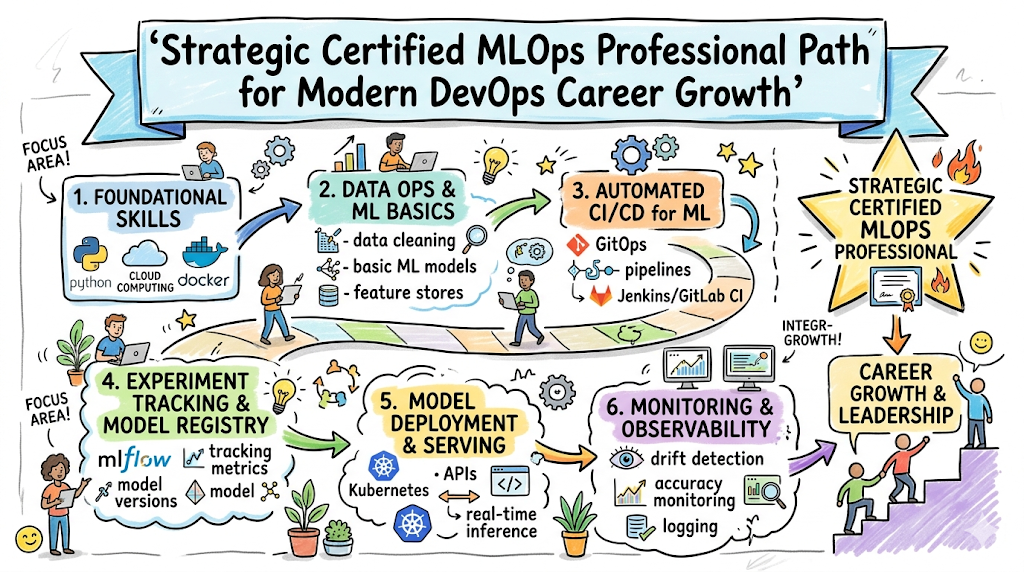
In the current landscape of enterprise technology, the bridge between data science and production engineering has become a critical focal point for scaling innovation. This comprehensive guide to the Certified MLOps Professional is designed for engineers and architects who need to move beyond experimental notebooks into robust, automated production environments. As organizations integrate artificial intelligence into their core services, the need for a standardized approach to model deployment, monitoring, and retraining has never been higher.
By pursuing this path through aiopsschool, professionals can gain the technical depth required to manage the entire machine learning lifecycle using cloud-native and DevOps principles. This guide provides an unbiased look at how this certification maps to real-world roles such as Site Reliability Engineering and Platform Engineering. Whether you are looking to pivot your career or solidify your existing expertise, understanding this framework will help you make informed decisions about your professional development and long-term career trajectory.
What is the Certified MLOps Professional?
The Certified MLOps Professional is a specialized credential designed to validate an engineer’s ability to operationalize machine learning workflows at scale. Unlike theoretical data science courses that focus heavily on algorithmic design, this program emphasizes the “Ops” component, focusing on continuous integration, continuous delivery, and continuous training (CT). It represents a shift toward treating machine learning models as software artifacts that require the same level of rigor as any other production code.
The curriculum is built around the practical challenges of managing data drift, model decay, and resource-intensive infrastructure. It exists to bridge the gap between the experimental phase of model development and the reality of enterprise-grade deployment. By aligning with modern engineering workflows, the program ensures that practitioners can work effectively within Kubernetes environments, use CI/CD pipelines for model updates, and implement sophisticated monitoring systems that track both system health and model accuracy.
Who Should Pursue Certified MLOps Professional?
This certification is ideal for software engineers and DevOps practitioners who are increasingly tasked with supporting data science teams. Systems administrators and SREs who want to transition into high-growth AI roles will find the curriculum particularly relevant to their daily operations. Additionally, data scientists who want to take more ownership of their production deployments can use this track to understand the underlying infrastructure and automation patterns.
From a managerial perspective, technical leaders and engineering managers can benefit from this certification to better understand the lifecycle of ML products and how to structure their teams for success. The relevance of this track is global, catering to the massive demand for AI infrastructure talent in North America, Europe, and India. Professionals at various seniority levels can find value in this path as it provides a structured approach to a domain that is often fragmented by too many tools and competing methodologies.
Why Certified MLOps Professional is Valuable and Beyond
The demand for MLOps expertise is driven by the reality that most AI initiatives fail at the deployment stage due to a lack of operational maturity. Professionals who hold this certification demonstrate that they possess the skills to ensure models remain reliable and cost-effective over time, which is a major concern for enterprise leadership. As tools and frameworks evolve rapidly, having a certification that focuses on core principles and architectural patterns ensures long-term career longevity and relevance.
Investing time in this certification provides a significant return by positioning an engineer as a specialist in a niche but highly critical field. Enterprise adoption of AI is no longer optional, and the engineers who can manage the underlying complexity of these systems are in high demand across finance, healthcare, and retail sectors. By mastering these competencies, you are not just learning a specific tool but are adopting a mindset that integrates data management, software engineering, and infrastructure automation into a cohesive career path.
Certified MLOps Professional Certification Overview
The program is delivered via the official course portal and hosted on the primary provider platform. It is structured to provide a logical progression from foundational concepts to advanced architectural patterns, ensuring that learners are not overwhelmed by the complexity of the domain. The assessment approach is designed to be practical, often involving hands-on scenarios that mimic real-world production issues that engineers face in their daily work.
The certification is maintained by industry experts who understand the nuances of the cloud-native ecosystem. It covers a wide range of topics, including data versioning, model registries, feature stores, and automated testing for machine learning. The ownership structure ensures that the content is updated frequently to reflect the latest changes in the industry, making it a reliable benchmark for technical competence in the competitive job market without focusing on fleeting trends.
Certified MLOps Professional Certification Tracks & Levels
The certification is divided into three primary levels to accommodate different stages of a professional’s career journey. The Foundation level introduces the core vocabulary and concepts of MLOps, making it suitable for those new to the field or for managers who need a high-level overview. This level ensures that everyone on a cross-functional team is speaking the same language and understands the basic mechanics of the model lifecycle.
The Professional level dives deep into the implementation of pipelines and automation strategies, focusing on the tools and techniques used by practitioners. For those seeking the highest level of expertise, the Advanced level covers complex topics like multi-cloud deployments, advanced security for ML models, and high-performance computing clusters. These levels are designed to align with career progression, allowing an engineer to grow from a contributor to a technical lead or architect.
Complete Certified MLOps Professional Certification Table
| Track | Level | Who it’s for | Prerequisites | Skills Covered | Recommended Order |
| Core MLOps | Foundation | Beginners & Managers | Basic Linux knowledge | ML Lifecycle, DevOps Basics | 1st |
| Implementation | Professional | DevOps & Data Engineers | Coding & Cloud experience | CI/CD for ML, Kubernetes | 2nd |
| Architecture | Advanced | Senior Engineers & Architects | 5+ years experience | Scaling, Security, FinOps | 3rd |
| Data Operations | Specialist | Data Engineers | SQL & Pipeline knowledge | Feature Stores, Data Governance | Optional |
| Security | Specialist | Security Professionals | IAM & Network security | Model Robustness, Compliance | Optional |
Detailed Guide for Each Certified MLOps Professional Certification
Certified MLOps Professional – Foundation
What it is
This certification validates a foundational understanding of the machine learning operations lifecycle and the integration of DevOps practices into data science workflows. It serves as an entry point for those looking to understand how models move from development to production.
Who should take it
It is suitable for entry-level engineers, project managers, and business analysts who need to understand the technical requirements of ML projects. It is also a great starting point for traditional IT professionals pivoting to AI roles who need a baseline for further study.
Skills you’ll gain
- Understanding the ML lifecycle stages from research to production
- Knowledge of basic DevOps and SRE principles for ML workloads
- Familiarity with common MLOps tools and cloud-native terminology
- Basics of model versioning, tracking, and experimentation management
Real-world projects you should be able to do
- Documenting an MLOps workflow for a small cross-functional team
- Identifying bottlenecks in a manual model deployment process
- Assisting in the setup of a basic model registry and metadata store
Preparation plan
- 7-14 days: Review the official glossary and core lifecycle documentation provided by the school.
- 30 days: Complete all foundational modules and take practice quizzes to solidify basic terminology.
- 60 days: Not usually required for this level if the candidate has a technical background or prior IT experience.
Common mistakes
- Overcomplicating the technical requirements before understanding the fundamental workflow.
- Neglecting the cultural shift required between data scientists and infrastructure engineers.
Best next certification after this
- Same-track option: Certified MLOps Professional – Professional Level
- Cross-track option: Certified SRE Professional
- Leadership option: Certified Engineering Manager
Certified MLOps Professional – Professional
What it is
This level validates the technical ability to design, build, and maintain automated machine learning pipelines in a production environment. It focuses on the practical application of automation tools to ensure model reliability and consistency.
Who should take it
This is designed for practicing DevOps engineers, data engineers, and software developers who are responsible for the hands-on implementation of ML infrastructure. It requires a solid grasp of containerization and CI/CD concepts.
Skills you’ll gain
- Building automated CI/CD pipelines for ML models and data
- Managing Kubernetes clusters specifically for high-performance ML workloads
- Implementing model monitoring and intelligent alerting systems
- Versioning code, models, and large-scale datasets efficiently
Real-world projects you should be able to do
- Deploying a model to a production Kubernetes cluster with horizontal auto-scaling.
- Setting up an automated retraining pipeline triggered by data drift or accuracy decay.
- Implementing a centralized logging system for ML model performance and system metrics.
Preparation plan
- 7-14 days: Focus on hands-on lab exercises for container orchestration and pipeline automation.
- 30 days: Build three end-to-end pipelines using different toolsets to understand platform variations.
- 60 days: Perform deep dives into monitoring and troubleshooting real-world failures in distributed systems.
Common mistakes
- Focusing too much on a single tool rather than the underlying principles of the lifecycle.
- Underestimating the complexity of managing large-scale data pipelines compared to standard code.
Best next certification after this
- Same-track option: Certified MLOps Professional – Advanced Level
- Cross-track option: Certified DevSecOps Professional
- Leadership option: Certified Technical Architect
Certified MLOps Professional – Advanced
What it is
This certification validates expert-level knowledge in designing resilient, secure, and cost-effective ML architectures at an enterprise scale. It covers high-level strategy and complex technical problem-solving for global organizations.
Who should take it
It is intended for senior engineers, technical leads, and architects with several years of experience in distributed systems and large-scale infrastructure. Candidates should have experience managing multi-team environments and complex deployments.
Skills you’ll gain
- Designing multi-cloud and hybrid ML architectures for disaster recovery
- Implementing advanced security and compliance for AI models in regulated industries
- Optimizing cloud costs for large-scale ML training and real-time inference
- Leading the technical strategy for enterprise MLOps adoption across departments
Real-world projects you should be able to do
- Designing a global model deployment strategy with low-latency requirements for millions of users.
- Implementing a governance framework for data privacy and security in ML pipelines.
- Conducting a full FinOps audit of an organization’s machine learning infrastructure spending.
Preparation plan
- 7-14 days: Review case studies of large-scale ML failures and industry-leading success stories.
- 30 days: Design complex architectures on paper and validate them through peer review or simulation.
- 60 days: Execute a comprehensive project that spans multiple cloud providers or hybrid environments.
Common mistakes
- Ignoring the long-term cost implications of high-performance computing resources.
- Failing to account for complex regulatory requirements in different international regions.
Best next certification after this
- Same-track option: Industry-specific AI specialty certifications
- Cross-track option: Certified FinOps Professional
- Leadership option: CTO or VP of Engineering tracks
Choose Your Learning Path
DevOps Path
The DevOps path focuses on the integration of machine learning into existing continuous delivery frameworks. Engineers on this path prioritize the automation of testing and deployment processes to ensure that ML models can be released as frequently and safely as standard software. This path is essential for organizations looking to break down the silos between data science and operations and move toward a more agile methodology.
DevSecOps Path
The DevSecOps path emphasizes the security and integrity of the machine learning pipeline from data ingestion to model inference. Practitioners learn how to scan models for vulnerabilities, secure data access, and ensure that the entire automated process meets enterprise compliance standards. This is critical for industries like finance and healthcare where data privacy and model robustness are paramount to the business mission.
SRE Path
The SRE path focuses on the reliability, availability, and performance of ML systems in production environments. Engineers learn to define Service Level Objectives (SLOs) for machine learning models and implement the monitoring necessary to detect and resolve issues before they impact end-users. This path ensures that ML services are as stable and predictable as any other mission-critical application within the enterprise.
AIOps Path
The AIOps path is distinct from MLOps as it focuses on using machine learning and analytics to improve traditional IT operations. Professionals on this path learn how to implement automated incident response, predictive maintenance for infrastructure, and intelligent alerting systems. It is about applying AI to the infrastructure itself to reduce manual toil and improve uptime across the entire technological stack.
MLOps Path
The MLOps path is specifically focused on the lifecycle management of machine learning models as distinct and complex artifacts. This includes versioning the datasets, tracking the experiments, managing the model registry, and ensuring that the models are served efficiently to end-users. It is the core path for anyone looking to specialize in the intersection of data science and production engineering at a deep technical level.
DataOps Path
The DataOps path focuses on the delivery and quality of data pipelines that feed machine learning models. Practitioners learn how to automate data ingestion, cleaning, and transformation while maintaining high levels of data integrity and accessibility. Without a strong DataOps foundation, MLOps cannot function effectively at scale, making this a vital specialization for modern cloud-native organizations.
FinOps Path
The FinOps path addresses the financial management of machine learning infrastructure in the cloud. Because ML training and inference can be extremely expensive, this path focuses on cost transparency, resource optimization, and budget accountability. It ensures that the organization gets the maximum value from its investment in AI without overspending, providing a clear map between engineering activity and business value.
Role → Recommended Certified MLOps Professional Certifications
| Role | Recommended Certifications |
| DevOps Engineer | Professional Level, Security Specialist |
| SRE | Professional Level, SRE Specialist |
| Platform Engineer | Advanced Level, DataOps Specialist |
| Cloud Engineer | Professional Level, FinOps Specialist |
| Security Engineer | Security Specialist, Advanced Level |
| Data Engineer | DataOps Specialist, Professional Level |
| FinOps Practitioner | FinOps Specialist, Foundation Level |
| Engineering Manager | Foundation Level, Advanced Level |
Next Certifications to Take After Certified MLOps Professional
Same Track Progression
Once you have mastered the Certified MLOps Professional track, you should look toward deep specialization in specific areas of the lifecycle. This might involve diving deeper into specialized hardware acceleration, such as TPU or GPU optimization for massive-scale training. The goal is to move from a generalist practitioner to a subject matter expert who can solve the most difficult technical challenges in the field, specifically focusing on large-scale model performance.
Cross-Track Expansion
Broadening your skills into adjacent domains like security or reliability engineering can make you a more versatile professional. For example, moving from MLOps into DevSecOps allows you to take a lead role in securing the increasingly complex AI supply chain. This cross-pollination of skills is highly valued by large organizations that need individuals who can think across traditional departmental boundaries and provide holistic architectural solutions.
Leadership & Management Track
For those looking to move into management, certifications in technical leadership and engineering management are the logical next step. These programs help you transition from individual technical contribution to strategic planning, team building, and resource management. Understanding the technical depth of MLOps while possessing the skills to lead a team is a powerful combination for reaching executive levels in modern technology-driven companies.
Training & Certification Support Providers for Certified MLOps Professional
DevOpsSchool
DevOpsSchool has established itself as a premier destination for those seeking comprehensive training in the DevOps and MLOps domains. With a vast library of resources and a deep bench of experienced instructors, they provide a structured learning environment that caters to both individuals and corporate teams. Their approach emphasizes hands-on experience, ensuring that students do not just learn the theory but can actually implement the solutions in real-world scenarios. The platform is known for its strong community support and its ability to stay current with the rapidly changing landscape of enterprise technology, making it a reliable choice for long-term career growth.
Cotocus
Cotocus is a specialized training and consulting organization that focuses on high-end technical skills required by modern enterprises. They provide bespoke training solutions that are often tailored to the specific needs of a company’s technology stack. Their instructors are typically working professionals who bring real-world experience into the classroom, making the training highly practical and immediately applicable to daily engineering challenges. Cotocus is particularly valued for its focus on cloud-native technologies and its ability to help organizations transition to more automated and efficient workflows through targeted skill development and expert-led workshops.
Scmgalaxy
Scmgalaxy is a comprehensive community and resource hub for professionals involved in software configuration management, DevOps, and now MLOps. It provides a wealth of free tutorials, articles, and discussion forums that help engineers stay updated on the latest tools and best practices. In addition to community resources, they offer structured training programs that are designed to help professionals earn industry-recognized certifications. The focus here is on peer-to-peer learning and the sharing of practical knowledge, making it a valuable destination for anyone looking to grow their career in technical operations while staying connected to global industry trends.
BestDevOps
BestDevOps focuses on delivering high-quality, interactive training that is designed to help engineers master the complexities of modern software delivery. Their programs are built around the concept of immersive learning, where students spend a significant amount of time working on labs and projects that simulate production environments. They offer a range of certifications and training tracks that cover the entire spectrum of DevOps, from foundational concepts to advanced architectural patterns. The goal of BestDevOps is to bridge the skill gap in the industry by producing practitioners who are ready to contribute on day one in any enterprise environment.
devsecopsschool.com
As security becomes an integral part of every stage of the software lifecycle, devsecopsschool.com provides the specialized training needed to integrate security into automated pipelines. Their curriculum covers everything from secret management and vulnerability scanning to compliance as code. They are a critical resource for organizations looking to move away from traditional security models toward a more proactive, integrated approach. The training is designed to be highly technical, appealing to both developers who need to write more secure code and security professionals who need to understand the nuances of automation and orchestration.
sreschool.com
Sreschool.com is dedicated to the discipline of Site Reliability Engineering, focusing on the principles of reliability, scalability, and performance. Their training programs are designed to teach engineers how to manage large-scale distributed systems using data-driven decision-making. They cover essential SRE topics such as error budgets, service level objectives, and incident response automation. For professionals looking to move into high-reliability roles at major tech companies, the resources and certifications offered here are essential for building the necessary technical and cultural competencies to maintain complex, multi-cloud systems with high uptime requirements.
Aiopsschool.com stands at the forefront of the intersection between artificial intelligence and IT operations. They specialize in teaching engineers how to leverage machine learning to automate and optimize traditional operational tasks. Their curriculum is unique in its focus on the application of AI to solve infrastructure problems, rather than just the deployment of ML models. This makes it an ideal destination for those who want to lead the next wave of automation in the enterprise, where systems are increasingly self-healing and self-optimizing through intelligent analytics and automated remediation.
dataopsschool.com
Dataopsschool.com addresses the critical need for better data management and orchestration in the era of big data and AI. They provide training on how to build robust, automated data pipelines that ensure data quality and accessibility. Their programs cover a wide range of topics, including data versioning, automated testing for data, and the management of large-scale data warehouses. By focusing on the “Ops” side of data, they help organizations overcome the data bottlenecks that often stall machine learning and analytics initiatives, ensuring a steady flow of high-quality information to stakeholders.
finopsschool.com
With cloud costs continuing to rise, finopsschool.com provides the essential training needed to manage the economics of cloud computing. Their curriculum is based on the FinOps framework, which emphasizes the collaboration between engineering, finance, and business teams. They teach professionals how to track spending, optimize resource usage, and make data-driven decisions about cloud investments. This training is vital for any organization looking to scale its cloud or ML initiatives without losing control of its budget, making it a highly relevant track for modern technical leaders who need to balance performance with cost.
Frequently Asked Questions (General)
- How long does it take to get certified?
Most professionals find that they can complete the foundational levels within a month of dedicated study. For the professional and advanced levels, it may take three to six months depending on your prior experience with cloud-native tools and coding. - What are the prerequisites for the professional level?
You should have a strong grasp of Linux systems, basic Python programming, and a solid understanding of containerization and CI/CD concepts. Previous experience as a DevOps or software engineer is highly recommended. - Is this certification recognized globally?
Yes, the certification is designed to meet international industry standards and is recognized by major technology companies and enterprises across the globe, including in major tech hubs in India and North America. - Does the certification expire?
The certification typically remains valid for two to three years, after which you may need to renew it or move to a higher level to demonstrate that your skills remain current with the latest technology. - Is there a practical exam component?
The program focuses heavily on practical assessments, requiring you to complete labs and projects that demonstrate your ability to solve real-world technical problems in a simulated production environment. - Can managers benefit from this training?
Absolutely, as the foundational level provides the necessary vocabulary and conceptual understanding to manage cross-functional teams and make strategic technology decisions regarding AI investments. - What is the ROI for an individual?
Professionals often see significant salary increases and access to higher-level job opportunities in the growing field of AI and machine learning operations due to the specialized nature of the skill set. - Are there any discounts for corporate groups?
Most training providers offer bulk discounts for teams and organizations looking to upskill multiple employees at once to ensure standardized knowledge across the entire engineering department. - What tools are covered in the curriculum?
The program covers a wide range of cloud-native tools, including Kubernetes, Docker, various CI/CD platforms, and specialized ML tools like Kubeflow or MLflow for model lifecycle management. - How does this differ from a data science certification?
While data science focuses on model design and statistics, this certification focuses on the engineering and operational aspects of maintaining those models in production reliably. - Is the exam available online?
Yes, the exams are typically delivered through an online platform that can be accessed from anywhere in the world, providing flexibility for working professionals. - What kind of support is available during training?
Most providers offer a combination of instructor support, community forums, and comprehensive documentation to help you succeed in your learning journey and troubleshoot lab exercises.
FAQs on Certified MLOps Professional
- Does this cover generative AI deployment?
The curriculum includes patterns for scaling large language models and other generative architectures in production environments. - How do I start if I have no ML background?
Start with the Foundation level to build your vocabulary and understanding of the lifecycle before moving to technical implementation. - Is Kubernetes mandatory for MLOps?
While not strictly mandatory for every small project, it is the industry standard for orchestration and a major focus of this certification. - How does this help with data drift?
You will learn to build automated monitoring systems that detect data drift and trigger retraining or manual review processes. - What is the pass rate?
The pass rate is high for those who complete all recommended labs and practice assignments provided in the training modules. - Are there real-world labs?
Yes, the professional track is primarily built around hands-on lab exercises that simulate production-grade infrastructure issues and model deployments. - Is Python required?
Yes, a basic to intermediate knowledge of Python is necessary for most implementation tasks within the machine learning pipeline. - Can I take the exam without training?
While possible for experienced practitioners, the training is highly recommended due to the practical nature of the assessment and specific framework requirements.
Final Thoughts
As a mentor who has seen the industry evolve over two decades, I can say that the shift toward MLOps is one of the most significant changes in the landscape of enterprise engineering. The Certified MLOps Professional is not just another badge; it is a validation of the specific engineering rigor required to make artificial intelligence a reliable part of any business. If you are looking to future-proof your career, moving into the operational side of AI is one of the most strategic moves you can make. The real value of this certification lies in its focus on production-grade outcomes. It moves you away from the “it works on my machine” mentality and into a mindset of building resilient, self-healing systems that can handle the unpredictability of real-world data. For anyone serious about a career in DevOps, SRE, or data engineering, this path provides the structure and authority needed to lead in a field that is still defining itself. It is a worthwhile investment for those who are ready to put in the work to master the complexity of modern machine learning systems.
