Upgrade & Secure Your Future with DevOps, SRE, DevSecOps, MLOps!
We spend hours scrolling social media and waste money on things we forget, but won’t spend 30 minutes a day earning certifications that can change our lives.
Master in DevOps, SRE, DevSecOps & MLOps by DevOps School!
Learn from Guru Rajesh Kumar and double your salary in just one year.
Introduction
Digital Experience Platforms (DXP) help organizations create, manage, personalize, deliver, and optimize digital experiences across websites, mobile apps, portals, ecommerce channels, customer communities, and other digital touchpoints. In simple words, a DXP brings together content management, customer data, personalization, analytics, integrations, digital assets, and workflow tools so teams can deliver connected customer experiences.
DXP matters because customers now expect fast, personalized, consistent, and secure experiences across every digital channel. A basic CMS may publish content, but a DXP helps connect content with customer journeys, marketing campaigns, commerce, support portals, and analytics.
Common use cases include enterprise websites, customer portals, ecommerce experiences, personalized campaigns, intranets, mobile content delivery, multilingual publishing, and partner communities.
Buyers should evaluate content management, personalization, analytics, integrations, scalability, developer experience, security, workflow governance, AI capabilities, localization, commerce support, and total cost.
Best for: enterprises, mid-market companies, ecommerce brands, banks, insurers, healthcare organizations, education institutions, SaaS companies, government teams, and global marketing teams managing complex digital experiences.
Not ideal for: very small teams that only need a simple website, basic blog, single landing page, or lightweight CMS without personalization, workflow, analytics, or integration needs.
Key Trends in Digital Experience Platforms (DXP)
Composable DXP architecture: More organizations are moving from all-in-one suites to modular stacks using headless CMS, search, commerce, CDP, analytics, and personalization tools.
- AI-driven personalization: DXP platforms are adding AI features for content recommendations, audience segmentation, campaign optimization, and customer journey support.
- Headless and hybrid content delivery: Teams want content delivered across websites, mobile apps, portals, digital kiosks, ecommerce stores, and connected devices.
- Customer data integration: DXP tools increasingly connect with CDPs, CRMs, analytics systems, and marketing automation platforms.
- Omnichannel experience management: Brands want one platform or connected stack to manage content across multiple customer touchpoints.
- Enterprise governance: Approval workflows, roles, localization, audit trails, versioning, and publishing controls are now critical.
- Performance and scalability focus: Fast page speed, global CDN delivery, API performance, and uptime are major buying factors.
- Security-first experience delivery: SSO, MFA, RBAC, encryption, secure APIs, audit logs, and compliance controls are expected in enterprise DXP projects.
- Low-code experience creation: Marketing teams want visual editing, reusable components, templates, and campaign workflows without full developer dependency.
- Commerce and content convergence: Ecommerce brands increasingly need content, product data, personalization, and checkout journeys connected.
How We Selected These Tools
The tools below were selected using practical enterprise software evaluation logic:
- Strong recognition in DXP, CMS, personalization, enterprise web experience, or composable digital experience markets.
- Feature completeness across content, personalization, workflow, analytics, integrations, and digital experience delivery.
- Suitability for enterprise, mid-market, ecommerce, public sector, and global digital teams.
- Security posture signals such as SSO, RBAC, permissions, encryption, and audit controls where known.
- Integration ecosystem across CRM, CDP, commerce, analytics, DAM, search, marketing automation, and developer tools.
- Ability to support multilingual, multisite, and omnichannel content delivery.
- Developer experience, API support, and composable architecture readiness.
- Business user experience for marketers, editors, and content managers.
- Scalability and reliability for large digital properties.
- Support resources, documentation, partner ecosystem, and implementation maturity.
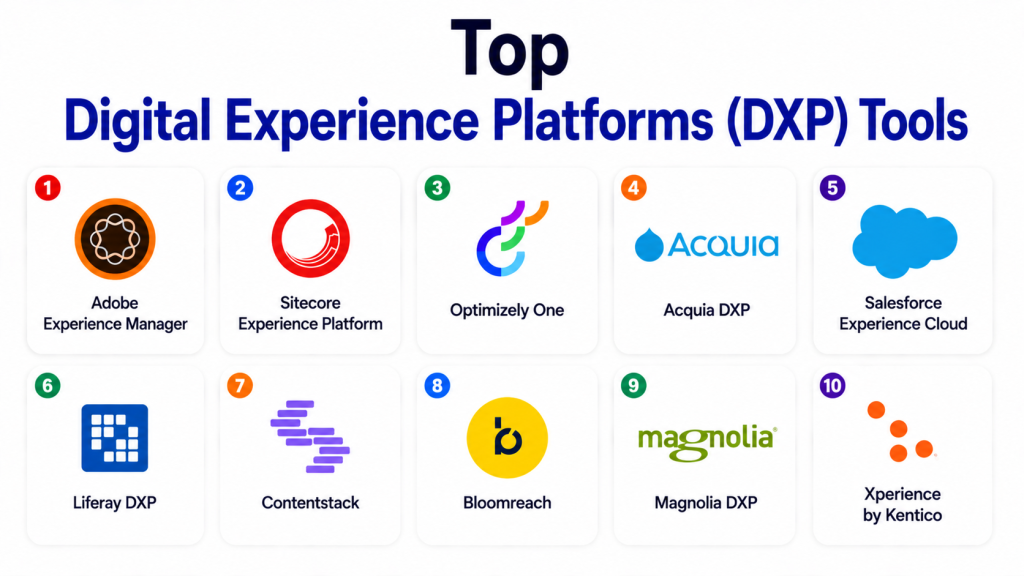
Top Digital Experience Platforms (DXP) Tools
#1 — Adobe Experience Manager
Short description: Adobe Experience Manager is an enterprise DXP and content management platform for building, managing, and optimizing digital experiences. It is best suited for large organizations with complex websites, digital assets, personalization, and marketing operations.
Key Features
- Enterprise web content management.
- Digital asset management integration.
- Personalization and experience delivery.
- Workflow and approval controls.
- Multisite and multilingual support.
- Integration with Adobe Experience Cloud.
- Enterprise content governance.
Pros
- Strong fit for large enterprise digital experience programs.
- Good integration with Adobe marketing, analytics, and asset tools.
- Suitable for global brands with complex content operations.
Cons
- Implementation can be complex and costly.
- Requires skilled administrators, developers, and partners.
- Not ideal for small teams or simple websites.
Platforms / Deployment
Web
Cloud / Hybrid options vary
Security & Compliance
SSO, permissions, encryption, workflow controls, audit-related features, and enterprise security options are available. Specific compliance details vary by deployment, configuration, and plan.
Integrations & Ecosystem
Adobe Experience Manager works best in mature enterprise marketing and content ecosystems.
- Adobe Experience Cloud
- Digital asset management
- Analytics platforms
- Personalization tools
- Commerce systems
- Enterprise identity systems
Support & Community
Adobe provides enterprise documentation, implementation partners, training resources, customer support, and a large ecosystem of agencies and certified professionals.
#2 — Sitecore Experience Platform
Short description: Sitecore Experience Platform is a DXP focused on content management, personalization, analytics, and customer experience delivery. It is suitable for enterprises and mid-market organizations that need personalized digital journeys across websites and channels.
Key Features
- Web content management.
- Personalization and customer journey tools.
- Analytics and experience tracking.
- Marketing automation capabilities.
- Multisite and multilingual support.
- Headless and composable options.
- Integration with commerce and customer data tools.
Pros
- Strong for personalized customer experiences.
- Good fit for marketing-led enterprises.
- Flexible digital experience architecture.
Cons
- Implementation may require specialist Sitecore expertise.
- Can be complex for smaller teams.
- Cost and architecture should be carefully planned.
Platforms / Deployment
Web
Cloud / Self-hosted / Hybrid
Security & Compliance
SSO, access controls, permissions, encryption, and enterprise security features are available depending on product configuration. Specific compliance details vary by deployment and plan.
Integrations & Ecosystem
Sitecore supports enterprise digital marketing and experience workflows.
- CRM systems
- Commerce platforms
- Analytics tools
- Customer data platforms
- Marketing automation
- APIs and headless delivery
Support & Community
Sitecore provides documentation, enterprise support, partner implementation services, training resources, and a mature professional community.
#3 — Optimizely One
Short description: Optimizely One is a digital experience platform that combines content management, experimentation, personalization, commerce, and marketing workflow capabilities. It is useful for organizations focused on testing, optimization, and content-led growth.
Key Features
- Content management.
- Experimentation and A/B testing.
- Personalization.
- Digital commerce support.
- Marketing planning and workflow tools.
- Analytics and optimization.
- Integration ecosystem.
Pros
- Strong experimentation and optimization capabilities.
- Good fit for growth, ecommerce, and marketing teams.
- Useful for improving digital experience performance.
Cons
- Full platform value depends on adopting multiple modules.
- Implementation may require strategy and technical planning.
- Pricing and packaging can vary by need.
Platforms / Deployment
Web
Cloud
Security & Compliance
SSO, permissions, encryption, admin controls, and enterprise security features are available. Specific compliance details vary by plan and configuration.
Integrations & Ecosystem
Optimizely fits content, commerce, experimentation, and digital optimization workflows.
- Analytics tools
- Commerce platforms
- CRM systems
- Marketing tools
- Data platforms
- Developer APIs
Support & Community
Optimizely provides documentation, customer support, partner services, training, and optimization-focused resources.
#4 — Acquia DXP
Short description: Acquia DXP is a digital experience platform built around Drupal-based content management, personalization, customer data, digital asset management, and marketing tools. It is useful for enterprises, government, education, healthcare, and content-heavy organizations.
Key Features
- Drupal-based content management.
- Cloud hosting and platform operations.
- Personalization capabilities.
- Digital asset management.
- Customer data and marketing tools.
- Multisite and multilingual support.
- Developer and API workflows.
Pros
- Strong fit for Drupal and open-source-oriented enterprises.
- Good for content-heavy and complex web experiences.
- Supports composable digital experience strategies.
Cons
- Requires Drupal knowledge for best results.
- Implementation can be complex.
- Smaller teams may find the platform too broad.
Platforms / Deployment
Web
Cloud / Hybrid options vary
Security & Compliance
Access controls, permissions, encryption, cloud security controls, and governance features are available. Specific compliance details vary by product, plan, and configuration.
Integrations & Ecosystem
Acquia connects Drupal-based content with broader digital experience workflows.
- Drupal ecosystem
- Marketing automation
- Customer data tools
- Analytics platforms
- Digital asset systems
- APIs and developer tools
Support & Community
Acquia provides documentation, enterprise support, professional services, partner support, and access to the broader Drupal community.
#5 — Salesforce Experience Cloud
Short description: Salesforce Experience Cloud helps organizations build customer portals, partner portals, communities, and connected digital experiences using Salesforce data. It is best for CRM-centric organizations that want digital experiences tied to sales, service, and customer data.
Key Features
- Customer and partner portals.
- CRM-connected experiences.
- Templates and site building.
- Personalization based on Salesforce data.
- User access and permissions.
- Integration with Salesforce ecosystem.
- Community and self-service support.
Pros
- Strong fit for Salesforce-based organizations.
- Useful for customer, partner, and service portals.
- Connects digital experiences with CRM data.
Cons
- Best value depends on Salesforce ecosystem adoption.
- Customization may require Salesforce expertise.
- Not ideal for teams that only need a general CMS.
Platforms / Deployment
Web / Mobile access varies
Cloud
Security & Compliance
SSO, MFA, role-based access, sharing rules, encryption options, audit-related controls, and Salesforce security features are available. Specific capabilities vary by plan and configuration.
Integrations & Ecosystem
Salesforce Experience Cloud is strongest when connected with Salesforce data and workflows.
- Salesforce CRM
- Service Cloud
- Sales Cloud
- Marketing tools
- Partner workflows
- AppExchange ecosystem
Support & Community
Salesforce provides documentation, Trailhead learning resources, enterprise support, partner services, and a large professional community.
#6 — Liferay DXP
Short description: Liferay DXP is a digital experience platform for portals, intranets, customer experiences, partner portals, and enterprise applications. It is useful for organizations that need secure, role-based, integrated experiences across users and business systems.
Key Features
- Portal and intranet management.
- Web content management.
- User roles and permissions.
- Workflow and forms.
- Integration with enterprise systems.
- Personalization and segmentation.
- Self-service digital experiences.
Pros
- Strong for portals and role-based experiences.
- Good fit for B2B, intranet, and customer self-service use cases.
- Flexible deployment options.
Cons
- May require technical implementation.
- Less focused on simple marketing websites.
- User experience depends on configuration and design quality.
Platforms / Deployment
Web
Cloud / Self-hosted / Hybrid
Security & Compliance
SSO, RBAC, permissions, encryption, audit-related controls, and enterprise security features are available. Specific compliance details vary by deployment and plan.
Integrations & Ecosystem
Liferay works well for enterprise portals and integrated digital services.
- ERP systems
- CRM systems
- Identity providers
- APIs
- Workflow systems
- Business applications
Support & Community
Liferay provides documentation, customer support, enterprise services, developer resources, and a professional community.
#7 — Contentstack
Short description: Contentstack is a composable DXP and headless CMS platform for structured content, API delivery, omnichannel publishing, and enterprise content operations. It is useful for developer-led and enterprise teams building flexible digital experiences.
Key Features
- Headless content management.
- Structured content models.
- API-first delivery.
- Workflow and approvals.
- Localization support.
- Composable integrations.
- Enterprise governance controls.
Pros
- Strong for composable and headless architectures.
- Good developer experience.
- Useful for omnichannel content delivery.
Cons
- Requires technical implementation.
- Non-technical users may need onboarding.
- Full DXP outcomes require connected ecosystem tools.
Platforms / Deployment
Web
Cloud
Security & Compliance
SSO, roles, permissions, encryption, audit-related controls, and enterprise security features are available on business-oriented plans. Specific compliance details vary by plan.
Integrations & Ecosystem
Contentstack supports composable digital experience architecture.
- Front-end frameworks
- Commerce platforms
- Search tools
- Marketing systems
- APIs
- Custom applications
Support & Community
Contentstack provides documentation, developer resources, customer support, onboarding, and partner services.
#8 — Bloomreach
Short description: Bloomreach is a digital experience and commerce-focused platform that combines content, search, merchandising, personalization, and customer engagement capabilities. It is especially useful for ecommerce, retail, and digital commerce teams.
Key Features
- Content management.
- Site search and discovery.
- Personalization.
- Merchandising tools.
- Customer engagement capabilities.
- Commerce integrations.
- Analytics and optimization.
Pros
- Strong fit for ecommerce and retail experiences.
- Useful for search, discovery, and personalization.
- Helps connect content with customer behavior.
Cons
- Best suited for commerce-heavy use cases.
- Full value may require multiple modules.
- Implementation may need data and integration planning.
Platforms / Deployment
Web
Cloud
Security & Compliance
Access controls, encryption, admin controls, and enterprise security options are available. Specific compliance details vary by product and plan.
Integrations & Ecosystem
Bloomreach supports commerce, content, and customer engagement workflows.
- Ecommerce platforms
- Product catalogs
- Customer data tools
- Marketing automation
- Search and merchandising
- Analytics systems
Support & Community
Bloomreach provides documentation, customer support, implementation resources, partner support, and commerce-focused guidance.
#9 — Magnolia DXP
Short description: Magnolia DXP is a composable digital experience platform that combines content management, personalization, integrations, and experience delivery. It is suitable for enterprises that want marketer-friendly content tools with developer flexibility.
Key Features
- Content management.
- Headless and hybrid delivery.
- Personalization support.
- Workflow and publishing controls.
- Integration framework.
- Multisite and multilingual support.
- Digital experience orchestration.
Pros
- Good balance of marketer usability and developer flexibility.
- Strong for composable enterprise architectures.
- Supports hybrid content delivery needs.
Cons
- Requires implementation planning.
- Smaller teams may find it too advanced.
- Ecosystem may be smaller than larger DXP vendors.
Platforms / Deployment
Web
Cloud / Self-hosted / Hybrid
Security & Compliance
Access controls, permissions, encryption, and enterprise security features are available. Specific compliance details vary by deployment and plan.
Integrations & Ecosystem
Magnolia supports flexible digital experience and integration workflows.
- Front-end frameworks
- Commerce platforms
- CRM systems
- Marketing tools
- APIs
- Enterprise applications
Support & Community
Magnolia provides documentation, support resources, partner services, and implementation guidance.
#10 — Xperience by Kentico
Short description: Xperience by Kentico is a digital experience platform that combines content management, digital marketing, personalization, and multichannel content delivery. It is useful for mid-market and enterprise teams that want a balanced CMS and marketing platform.
Key Features
- Web content management.
- Digital marketing features.
- Personalization.
- Email and campaign support.
- Headless and multichannel delivery options.
- Content workflows.
- .NET-based development model.
Pros
- Good balance of CMS and marketing features.
- Useful for mid-market digital experience projects.
- Strong fit for .NET-oriented teams.
Cons
- May not match the depth of large enterprise suites.
- Best results require implementation expertise.
- Ecosystem may be smaller than broader platforms.
Platforms / Deployment
Web
Cloud / Self-hosted / Hybrid options vary
Security & Compliance
Roles, permissions, authentication controls, encryption, and admin features are available. Specific compliance details vary by deployment and plan.
Integrations & Ecosystem
Xperience by Kentico supports content, marketing, and digital experience workflows.
- .NET ecosystem
- Marketing tools
- Analytics
- Email workflows
- APIs
- Commerce and business integrations
Support & Community
Kentico provides documentation, partner support, developer resources, customer support, and a professional community.
Comparison Table
| Tool Name | Best For | Platform(s) Supported | Deployment | Standout Feature | Public Rating |
|---|---|---|---|---|---|
| Adobe Experience Manager | Large enterprise digital experiences | Web | Cloud / Hybrid options vary | Enterprise content and asset experience suite | N/A |
| Sitecore Experience Platform | Personalized customer journeys | Web | Cloud / Self-hosted / Hybrid | Content, personalization, and analytics | N/A |
| Optimizely One | Experimentation and optimization-led teams | Web | Cloud | Content plus testing and personalization | N/A |
| Acquia DXP | Drupal-based enterprise experiences | Web | Cloud / Hybrid options vary | Open-source Drupal-powered DXP | N/A |
| Salesforce Experience Cloud | CRM-connected portals | Web, mobile access varies | Cloud | Salesforce data-driven experiences | N/A |
| Liferay DXP | Portals, intranets, and self-service | Web | Cloud / Self-hosted / Hybrid | Role-based portal experiences | N/A |
| Contentstack | Composable headless experiences | Web | Cloud | API-first omnichannel content | N/A |
| Bloomreach | Ecommerce and retail personalization | Web | Cloud | Search, merchandising, and commerce experience | N/A |
| Magnolia DXP | Hybrid and composable enterprise content | Web | Cloud / Self-hosted / Hybrid | Marketer-friendly composable DXP | N/A |
| Xperience by Kentico | Mid-market CMS and marketing experiences | Web | Cloud / Self-hosted / Hybrid options vary | CMS plus digital marketing tools | N/A |
Evaluation & Scoring of Digital Experience Platforms (DXP)
| Tool Name | Core (25%) | Ease (15%) | Integrations (15%) | Security (10%) | Performance (10%) | Support (10%) | Value (15%) | Weighted Total |
|---|---|---|---|---|---|---|---|---|
| Adobe Experience Manager | 10 | 6 | 10 | 9 | 9 | 9 | 6 | 8.40 |
| Sitecore Experience Platform | 9 | 6 | 9 | 8 | 8 | 8 | 6 | 7.75 |
| Optimizely One | 9 | 8 | 9 | 8 | 8 | 8 | 7 | 8.20 |
| Acquia DXP | 8 | 6 | 9 | 8 | 8 | 8 | 7 | 7.75 |
| Salesforce Experience Cloud | 8 | 8 | 10 | 9 | 8 | 9 | 7 | 8.45 |
| Liferay DXP | 8 | 7 | 8 | 8 | 8 | 8 | 8 | 7.85 |
| Contentstack | 9 | 7 | 9 | 8 | 9 | 8 | 7 | 8.15 |
| Bloomreach | 9 | 7 | 9 | 8 | 8 | 8 | 7 | 8.05 |
| Magnolia DXP | 8 | 7 | 8 | 8 | 8 | 7 | 7 | 7.60 |
| Xperience by Kentico | 8 | 8 | 8 | 7 | 8 | 8 | 8 | 7.90 |
These scores are comparative and should be interpreted by use case. A global brand may rate Adobe Experience Manager higher because enterprise governance matters. A CRM-heavy business may prefer Salesforce Experience Cloud. A composable architecture team may prefer Contentstack or Magnolia. Ecommerce teams may value Bloomreach or Optimizely more because personalization and optimization matter.
Which Digital Experience Platform (DXP) Tool Is Right for You?
Solo / Freelancer
Solo users usually do not need a full DXP. A standard CMS, website builder, or ecommerce platform is often enough. A DXP becomes useful only when the user manages multiple digital touchpoints, customer journeys, personalization, analytics, or content workflows at scale.
SMB
Most SMBs should avoid overly complex enterprise DXP suites unless they have strong digital maturity. Xperience by Kentico, Optimizely, Web CMS alternatives, or lighter composable options may be more practical. SMBs should focus on ease of use, content publishing, SEO, analytics, and affordable integrations.
Mid-Market
Mid-market companies often need personalization, content workflows, localization, CRM integration, analytics, and ecommerce support. Optimizely One, Contentstack, Bloomreach, Magnolia DXP, Xperience by Kentico, and Salesforce Experience Cloud are strong options depending on digital strategy.
Enterprise
Large enterprises should evaluate Adobe Experience Manager, Sitecore, Salesforce Experience Cloud, Acquia DXP, Liferay DXP, Optimizely One, and Bloomreach. Enterprise buyers should focus on governance, security, multisite support, personalization, scalability, integrations, and partner availability.
Budget vs Premium
Budget-focused teams should consider whether they truly need a DXP or whether a CMS plus selected integrations is enough. Premium DXP platforms are better when digital experience is business-critical, content operations are complex, and personalization or customer journey orchestration directly impacts revenue or service quality.
Feature Depth vs Ease of Use
Adobe Experience Manager, Sitecore, and Acquia offer deep enterprise capabilities but require stronger implementation resources. Optimizely, Salesforce Experience Cloud, and Xperience by Kentico may feel more practical for teams needing faster business adoption. Contentstack and Magnolia are better for teams that want composable flexibility.
Integrations & Scalability
Salesforce Experience Cloud is strong for CRM-driven experiences. Adobe Experience Manager fits Adobe-centered marketing stacks. Acquia fits Drupal-based enterprises. Contentstack supports headless and composable architectures. Bloomreach is strong for commerce and customer engagement. Liferay is strong for portals and integrated self-service environments.
Security & Compliance Needs
Security-focused buyers should review SSO, MFA, RBAC, encryption, audit logs, workflow permissions, API security, data residency, admin controls, and compliance requirements. Enterprise teams should also evaluate vendor support, implementation partner quality, and governance features before rollout.
Frequently Asked Questions (FAQs)
What is a Digital Experience Platform?
A Digital Experience Platform helps businesses create, manage, personalize, deliver, and optimize digital experiences across websites, apps, portals, ecommerce, and other channels.
How is a DXP different from a CMS?
A CMS mainly manages and publishes content. A DXP goes further by adding personalization, customer data integration, analytics, workflow, commerce, portals, and omnichannel experience delivery.
Which DXP is best for large enterprises?
Adobe Experience Manager, Sitecore, Salesforce Experience Cloud, Acquia DXP, Liferay DXP, and Optimizely One are strong enterprise options. The right choice depends on architecture and business goals.
Which DXP is best for ecommerce?
Bloomreach and Optimizely are strong for commerce-focused digital experiences. Adobe Experience Manager and Salesforce Experience Cloud may also fit ecommerce ecosystems depending on the stack.
What is a composable DXP?
A composable DXP is built from connected best-fit tools such as CMS, search, personalization, commerce, analytics, and customer data platforms instead of one single suite.
Do DXPs support AI?
Many DXP platforms are adding AI for personalization, content recommendations, campaign optimization, search, content creation, and customer journey insights. Features vary by platform and plan.
Are DXPs expensive?
DXPs can be expensive because they often include enterprise features, integrations, hosting, support, and implementation services. Smaller teams should confirm whether they need a full DXP.
What are common DXP implementation mistakes?
Common mistakes include buying too much platform too early, ignoring content governance, underestimating integration work, skipping user training, and not defining customer journey goals.
Can a DXP replace marketing automation software?
Sometimes a DXP includes marketing features, but it may not fully replace dedicated marketing automation tools. Many organizations integrate both.
How long does DXP implementation take?
Implementation can vary widely. A simple setup may be faster, while enterprise DXP projects often require discovery, architecture, migration, integrations, personalization planning, and training.
Is headless CMS the same as DXP?
No. A headless CMS manages and delivers content through APIs. A DXP is broader and may include content, personalization, analytics, commerce, portals, and customer journey tools.
What are alternatives to DXP platforms?
Alternatives include traditional CMS platforms, headless CMS tools, ecommerce platforms, digital asset management systems, customer data platforms, marketing automation tools, and custom digital stacks.
Conclusion
Digital Experience Platforms help organizations deliver connected, personalized, and scalable digital experiences across many channels. The best DXP depends on your business model, customer journeys, content needs, technical architecture, budget, and existing software ecosystem. Adobe Experience Manager is strong for large enterprise experience management. Sitecore is useful for personalization-driven marketing teams. Optimizely is strong for experimentation and optimization. Acquia works well for Drupal-based enterprises. Salesforce Experience Cloud is best for CRM-connected portals. Liferay is strong for intranets and self-service portals. Contentstack and Magnolia support composable strategies. Bloomreach is strong for commerce experiences, while Xperience by Kentico is practical for balanced CMS and marketing use cases.
