Upgrade & Secure Your Future with DevOps, SRE, DevSecOps, MLOps!
We spend hours scrolling social media and waste money on things we forget, but won’t spend 30 minutes a day earning certifications that can change our lives.
Master in DevOps, SRE, DevSecOps & MLOps by DevOps School!
Learn from Guru Rajesh Kumar and double your salary in just one year.
Introduction
Document Automation Tools help businesses create, approve, generate, send, store, and manage documents with less manual work. Instead of copying text into templates again and again, teams can use automation to generate contracts, proposals, invoices, HR letters, policy documents, reports, onboarding files, legal documents, and customer forms.
Document automation matters because teams now need faster turnaround, fewer errors, stronger compliance, and better collaboration. Manual document work can create delays, version confusion, missing approvals, and inconsistent formatting. Modern document automation tools solve this with templates, conditional logic, workflow routing, e-signature support, AI drafting, data integrations, and audit trails.
Common use cases include contract generation, sales proposals, employee letters, invoice processing, customer onboarding, legal document assembly, compliance forms, and finance approvals.
Buyers should evaluate template flexibility, workflow automation, integrations, data mapping, approval routing, e-signature support, AI features, security controls, reporting, scalability, pricing, and ease of use.
Best for: legal teams, sales teams, HR teams, finance teams, operations teams, insurance firms, healthcare organizations, real estate teams, consultancies, and enterprises that create repeated business documents.
Not ideal for: individuals who only create occasional documents, teams that only need simple word processing, or organizations without repeatable document workflows.
Key Trends in Document Automation Tools
- AI-assisted drafting: Tools are adding AI to help draft clauses, summarize documents, suggest language, and improve templates.
- No-code automation: Business users want to build document workflows without heavy developer support.
- Contract lifecycle integration: Document automation is becoming more connected with CLM, CRM, ERP, HR, and e-signature tools.
- Template governance: Teams need approved templates, controlled clauses, version history, and brand consistency.
- Data-driven document generation: More tools can pull data from forms, CRMs, spreadsheets, databases, and business systems.
- Compliance-ready workflows: Legal, finance, and regulated industries need audit logs, role-based access, retention, and approval history.
- E-signature as a standard expectation: Document generation often connects directly to signing and storage workflows.
- Better collaboration: Comments, approval routing, redlining, and shared review spaces are becoming more important.
- Cloud-first deployment: Most modern document automation tools are cloud-based, while some enterprise buyers still need hybrid or controlled deployment options.
- Reusable document intelligence: Teams want automation that learns from past documents, templates, clauses, and approval patterns.
How We Selected These Tools
The tools below were selected using practical SaaS evaluation logic:
- Strong recognition in document automation, document generation, proposal automation, contract automation, or workflow automation.
- Template creation and document generation capabilities.
- Workflow support for approvals, reviews, routing, and signatures.
- Integration ecosystem with CRM, ERP, HR, finance, storage, and e-signature tools.
- Ease of use for business users and non-technical teams.
- Security posture signals such as access control, encryption, SSO, and audit logs.
- Fit for different segments, including SMB, mid-market, and enterprise.
- Scalability for repeated document workflows.
- Support and onboarding quality.
- Practical value for reducing manual document work.
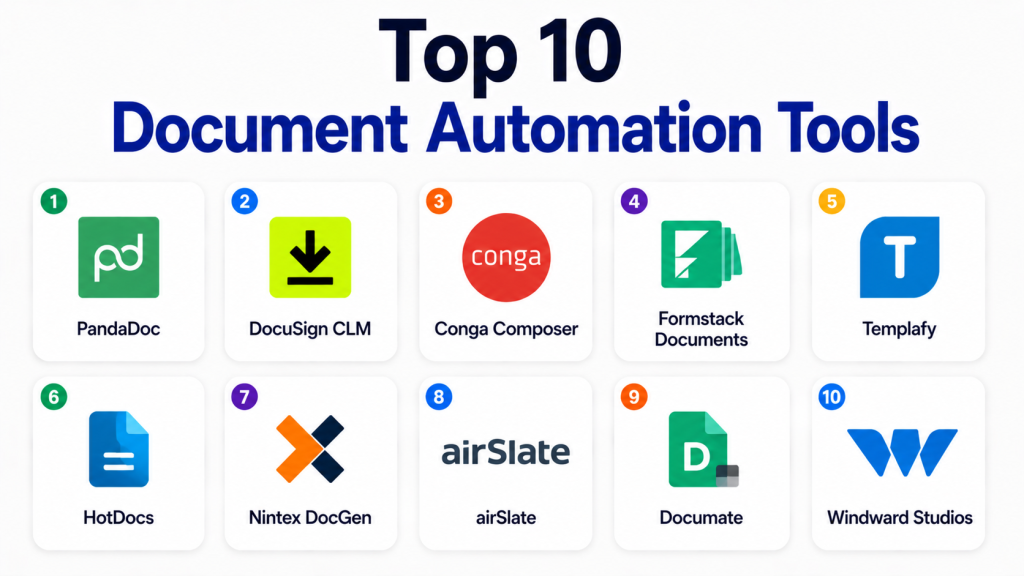
Top Document Automation Tools
#1 — PandaDoc
Short description: PandaDoc is a document automation and proposal management platform used for creating, sending, tracking, and signing business documents. It is especially useful for sales teams, agencies, SMBs, and customer-facing teams.
Key Features
- Proposal and document templates.
- Drag-and-drop document builder.
- E-signature support.
- CRM integrations.
- Document analytics and tracking.
- Content library.
- Approval workflows.
Pros
- Strong for sales proposals and customer documents.
- Easy to use for non-technical teams.
- Combines document creation, sending, and signing.
Cons
- May not fit deep legal document assembly needs.
- Advanced workflow and governance may require higher plans.
- Best suited for revenue and customer-facing documents.
Platforms / Deployment
Web / iOS / Android
Cloud
Security & Compliance
SSO, permissions, encryption, audit trail, and admin controls are available on business-oriented plans. Specific compliance details vary by plan.
Integrations & Ecosystem
PandaDoc works well for sales and customer document workflows.
- CRM tools
- Payment tools
- E-signature workflows
- Cloud storage
- Productivity tools
- API support
Support & Community
PandaDoc provides documentation, onboarding resources, customer support, templates, and learning content. Support options vary by plan.
#2 — DocuSign CLM
Short description: DocuSign CLM supports contract generation, approval, negotiation, signing, and storage workflows. It is useful for legal, procurement, sales, and enterprise teams that need stronger contract automation.
Key Features
- Contract generation.
- Clause and template management.
- Approval workflows.
- Contract review and negotiation support.
- E-signature integration.
- Repository and search.
- Workflow automation.
Pros
- Strong contract lifecycle automation.
- Good fit for legal and enterprise teams.
- Connects document workflows with signing processes.
Cons
- May be too advanced for simple document generation.
- Implementation can require planning.
- Pricing and packaging may vary by organization.
Platforms / Deployment
Web / iOS / Android
Cloud
Security & Compliance
SSO, encryption, audit trails, access controls, and enterprise security features are available. Specific compliance details vary by plan and deployment.
Integrations & Ecosystem
DocuSign CLM integrates with common enterprise and sales workflows.
- CRM systems
- E-signature workflows
- Cloud storage
- ERP systems
- Legal operations tools
- API options
Support & Community
DocuSign provides documentation, implementation resources, enterprise support, training, and partner services.
#3 — Conga Composer
Short description: Conga Composer is a document generation tool commonly used with Salesforce to create proposals, quotes, contracts, invoices, and business documents from CRM data. It is suitable for sales, finance, operations, and revenue teams.
Key Features
- Data-driven document generation.
- Salesforce integration.
- Template-based output.
- Batch document creation.
- Document delivery workflows.
- Support for multiple output formats.
- Automation rules.
Pros
- Strong for Salesforce-based document generation.
- Reduces manual copy-paste work.
- Useful for repeatable sales and operations documents.
Cons
- Best value is for Salesforce-heavy teams.
- Template setup may require admin knowledge.
- May not be ideal outside CRM-driven workflows.
Platforms / Deployment
Web
Cloud
Security & Compliance
Security depends on product configuration and connected platforms. Enterprise access controls and admin options are available. Specific compliance details are Not publicly stated.
Integrations & Ecosystem
Conga Composer is strongest in CRM-centered document generation.
- Salesforce
- CRM workflows
- Document templates
- E-signature tools
- Quote and proposal processes
- Automation workflows
Support & Community
Conga provides documentation, customer support, training, and implementation resources. Support options vary by plan.
#4 — Formstack Documents
Short description: Formstack Documents helps teams generate documents automatically from forms, databases, CRMs, and other business systems. It is useful for HR, operations, legal, education, healthcare, and administrative teams.
Key Features
- Automated document generation.
- Data merge from forms and systems.
- Template creation.
- Workflow routing.
- E-signature integrations.
- Delivery automation.
- Support for PDFs and business documents.
Pros
- Strong for form-to-document workflows.
- Useful for teams automating repetitive document creation.
- Works across many business functions.
Cons
- Advanced setup may require workflow planning.
- Document design flexibility depends on templates.
- Best results require clean input data.
Platforms / Deployment
Web
Cloud
Security & Compliance
Access controls, encryption, and business security features are available. Specific compliance details vary by plan and should be validated directly.
Integrations & Ecosystem
Formstack Documents connects well with data capture and business automation tools.
- Online forms
- CRM systems
- Cloud storage
- E-signature tools
- Payment workflows
- Automation platforms
Support & Community
Formstack provides documentation, onboarding resources, customer support, and learning materials. Support varies by plan.
#5 — Templafy
Short description: Templafy is an enterprise document automation and content governance platform focused on brand consistency, approved templates, business documents, and enterprise content control. It is useful for large organizations that need standardized document creation.
Key Features
- Centralized template management.
- Brand and content governance.
- Document generation.
- Dynamic content insertion.
- Enterprise admin controls.
- Integration with office productivity tools.
- Compliance-friendly document workflows.
Pros
- Strong for enterprise template governance.
- Helps maintain brand and content consistency.
- Useful for large distributed teams.
Cons
- May be too advanced for small teams.
- Implementation requires planning and governance.
- Best suited for organizations with high document volume.
Platforms / Deployment
Web / Windows / macOS
Cloud
Security & Compliance
SSO, access controls, encryption, admin controls, and enterprise security features are available. Specific compliance details vary by plan.
Integrations & Ecosystem
Templafy works well in enterprise productivity and brand governance environments.
- Microsoft Office
- Google Workspace
- Document templates
- Digital asset systems
- CRM workflows
- Enterprise identity systems
Support & Community
Templafy provides enterprise onboarding, documentation, customer success support, and implementation assistance.
#6 — HotDocs
Short description: HotDocs is a document automation platform often used for legal, government, insurance, banking, and complex document assembly workflows. It is suitable for teams that need rule-based document generation and conditional logic.
Key Features
- Complex document assembly.
- Conditional logic.
- Interview-style data collection.
- Template automation.
- Legal and business document workflows.
- Centralized document generation.
- Integration options.
Pros
- Strong for complex legal and regulated documents.
- Good rule-based automation capabilities.
- Useful for high-value repeatable document workflows.
Cons
- Setup may require specialist knowledge.
- Interface may feel complex for simple users.
- Not ideal for basic proposal generation.
Platforms / Deployment
Web / Windows
Cloud / Self-hosted / Hybrid
Security & Compliance
Access controls, audit-related features, and enterprise security options are available. Specific compliance details vary by deployment and plan.
Integrations & Ecosystem
HotDocs is built for complex document assembly and business process integration.
- Legal systems
- Case management tools
- CRM systems
- Workflow platforms
- Data sources
- Enterprise repositories
Support & Community
HotDocs provides documentation, implementation support, training resources, and customer support options.
#7 — Nintex DocGen
Short description: Nintex DocGen helps teams generate documents automatically using business data and workflow automation. It is useful for organizations that already use Nintex automation or need document generation connected to process workflows.
Key Features
- Document generation from business data.
- Workflow automation.
- Template management.
- Salesforce and business system support.
- Approval routing.
- Delivery automation.
- Process integration.
Pros
- Strong when paired with workflow automation.
- Useful for business process document generation.
- Good fit for teams automating approvals and outputs.
Cons
- Best value is inside Nintex or process automation environments.
- Setup may require workflow design.
- May be more than needed for simple templates.
Platforms / Deployment
Web
Cloud
Security & Compliance
Access controls, encryption, admin controls, and audit-related features are available. Specific compliance details vary by plan.
Integrations & Ecosystem
Nintex DocGen fits document automation inside broader process automation.
- Salesforce
- Workflow automation
- Business systems
- E-signature tools
- Cloud storage
- Forms and process tools
Support & Community
Nintex provides documentation, customer support, training resources, partner support, and implementation guidance.
#8 — airSlate
Short description: airSlate is a workflow automation platform that includes document generation, forms, approvals, e-signatures, and business process automation. It is suitable for teams that want no-code document workflows.
Key Features
- No-code workflow automation.
- Document generation.
- E-signature support.
- Form creation.
- Approval routing.
- Data collection and routing.
- Automation bots.
Pros
- Good for no-code business workflows.
- Combines documents, forms, and signatures.
- Useful for operations-heavy teams.
Cons
- Workflow design may require planning.
- Can feel broad if users only need document templates.
- Advanced automation may need training.
Platforms / Deployment
Web
Cloud
Security & Compliance
Access controls, encryption, audit trails, and admin features are available. Specific compliance details vary by plan.
Integrations & Ecosystem
airSlate connects document workflows with broader business automation.
- Cloud storage
- CRM tools
- E-signature workflows
- Forms
- Business apps
- Automation bots
Support & Community
airSlate provides documentation, learning resources, customer support, and onboarding materials. Support varies by plan.
#9 — Documate
Short description: Documate is a document automation platform designed for legal and professional document workflows. It helps teams create guided interviews, generate documents, and automate repeatable drafting processes.
Key Features
- Guided interview workflows.
- Legal document automation.
- Template-based generation.
- Conditional logic.
- Client intake support.
- Workflow automation.
- Document assembly.
Pros
- Strong for legal document automation.
- Useful for client-facing intake and drafting workflows.
- Helps standardize repeatable legal documents.
Cons
- Best suited for legal and professional services workflows.
- May not fit broad enterprise content automation.
- Advanced templates require careful design.
Platforms / Deployment
Web
Cloud
Security & Compliance
Not publicly stated.
Integrations & Ecosystem
Documate is focused on legal and professional document workflows.
- Legal intake workflows
- Document templates
- Conditional logic
- Client-facing forms
- Practice workflows
- Document assembly processes
Support & Community
Support and onboarding resources are available. Broader community strength is Varies / Not publicly stated.
#10 — Windward Studios
Short description: Windward Studios provides document generation and reporting automation for teams that need to create documents from structured data sources. It is useful for technical, finance, operations, and software teams that need automated reports, contracts, and statements.
Key Features
- Data-driven document generation.
- Template design in familiar document formats.
- Report automation.
- Integration with databases and applications.
- Support for multiple output formats.
- API and developer-friendly options.
- Batch document creation.
Pros
- Strong for data-heavy document generation.
- Useful for developers and operations teams.
- Good for automated reporting and high-volume outputs.
Cons
- May require technical setup.
- Less focused on sales proposal workflows.
- Business users may need support from technical teams.
Platforms / Deployment
Web / Windows
Cloud / Self-hosted / Hybrid
Security & Compliance
Security depends on deployment, data sources, and configuration. Specific compliance details are Not publicly stated.
Integrations & Ecosystem
Windward Studios fits technical document generation and reporting workflows.
- Databases
- Business applications
- APIs
- Reporting workflows
- CRM and ERP data
- Batch generation processes
Support & Community
Windward Studios provides documentation, technical support, developer resources, and implementation guidance.
Comparison Table
| Tool Name | Best For | Platform(s) Supported | Deployment | Standout Feature | Public Rating |
|---|---|---|---|---|---|
| PandaDoc | Sales proposals and customer documents | Web, iOS, Android | Cloud | Proposal creation with e-signature | N/A |
| DocuSign CLM | Contract lifecycle automation | Web, iOS, Android | Cloud | Contract generation and approval workflows | N/A |
| Conga Composer | Salesforce document generation | Web | Cloud | CRM data-driven documents | N/A |
| Formstack Documents | Form-to-document automation | Web | Cloud | Automated document generation from data | N/A |
| Templafy | Enterprise template governance | Web, Windows, macOS | Cloud | Brand-controlled document templates | N/A |
| HotDocs | Legal and complex document assembly | Web, Windows | Cloud / Self-hosted / Hybrid | Rule-based document automation | N/A |
| Nintex DocGen | Workflow-based document generation | Web | Cloud | Document generation inside process automation | N/A |
| airSlate | No-code document workflows | Web | Cloud | Forms, documents, approvals, and signatures | N/A |
| Documate | Legal document automation | Web | Cloud | Guided legal document interviews | N/A |
| Windward Studios | Data-driven document generation | Web, Windows | Cloud / Self-hosted / Hybrid | Automated reports from structured data | N/A |
Evaluation & Scoring of Document Automation Tools
| Tool Name | Core (25%) | Ease (15%) | Integrations (15%) | Security (10%) | Performance (10%) | Support (10%) | Value (15%) | Weighted Total |
|---|---|---|---|---|---|---|---|---|
| PandaDoc | 8 | 9 | 8 | 8 | 8 | 8 | 8 | 8.20 |
| DocuSign CLM | 9 | 7 | 9 | 9 | 8 | 9 | 7 | 8.30 |
| Conga Composer | 8 | 7 | 9 | 8 | 8 | 8 | 7 | 7.85 |
| Formstack Documents | 8 | 8 | 8 | 7 | 8 | 8 | 8 | 7.90 |
| Templafy | 9 | 7 | 9 | 9 | 8 | 8 | 7 | 8.10 |
| HotDocs | 9 | 6 | 7 | 8 | 8 | 8 | 7 | 7.60 |
| Nintex DocGen | 8 | 7 | 8 | 8 | 8 | 8 | 7 | 7.70 |
| airSlate | 8 | 8 | 8 | 8 | 8 | 8 | 8 | 8.00 |
| Documate | 7 | 8 | 6 | 6 | 7 | 7 | 8 | 7.05 |
| Windward Studios | 8 | 6 | 8 | 7 | 8 | 7 | 8 | 7.45 |
These scores are comparative and should be used as a starting point. A sales team may rank PandaDoc higher because of proposal workflows, while a legal team may prefer DocuSign CLM, HotDocs, or Documate. Technical teams may value Windward Studios for data-driven generation. Enterprises should weigh security, template governance, integrations, and support more heavily than price alone.
Which Document Automation Tool Is Right for You?
Solo / Freelancer
Solo users usually need simple templates, fast document creation, and easy signing. PandaDoc, Formstack Documents, Documate, and airSlate can be useful depending on the workflow. Freelancers creating proposals may prefer PandaDoc, while legal freelancers may prefer Documate for guided document generation.
SMB
SMBs should focus on ease of use, pricing, template management, and e-signature support. PandaDoc, Formstack Documents, airSlate, and Nintex DocGen are practical options. If the SMB uses Salesforce heavily, Conga Composer may be worth evaluating.
Mid-Market
Mid-market teams often need approval workflows, CRM integrations, permissions, document consistency, and automation across departments. Conga Composer, DocuSign CLM, Templafy, airSlate, and Nintex DocGen are strong choices depending on the main use case.
Enterprise
Enterprises should focus on template governance, security, audit trails, integrations, clause control, legal review, and global document consistency. DocuSign CLM, Templafy, HotDocs, Conga Composer, Nintex DocGen, and Windward Studios are useful options to evaluate.
Budget vs Premium
Budget-focused teams may prefer tools with simple document generation and signing features. Premium tools are better when the organization needs complex workflows, legal clause control, enterprise template governance, deep integrations, or high-volume document generation.
Feature Depth vs Ease of Use
PandaDoc, Formstack Documents, and airSlate are easier for business users. DocuSign CLM, HotDocs, Templafy, and Windward Studios offer deeper workflow or generation capabilities but may need more setup. Conga Composer is strong when document generation is tightly connected to Salesforce.
Integrations & Scalability
Conga Composer is strong for Salesforce-driven workflows. DocuSign CLM integrates well with contract and signing workflows. Templafy fits enterprise productivity environments. Windward Studios is useful when documents need to be generated from databases, applications, and structured systems.
Security & Compliance Needs
Security-focused buyers should review SSO, MFA, encryption, RBAC, audit trails, template permissions, document access logs, data retention, and e-signature compliance needs. Legal, finance, healthcare, and regulated teams should run a security review before standardizing any document automation platform.
Frequently Asked Questions (FAQs)
What is a Document Automation Tool?
A Document Automation Tool helps users create documents automatically using templates, business data, rules, and workflows. It reduces manual drafting, copying, formatting, and approval delays.
How is document automation different from document management?
Document automation focuses on creating and routing documents. Document management focuses on storing, organizing, searching, securing, and retaining documents after they are created.
Which document automation tool is best for sales teams?
PandaDoc and Conga Composer are strong options for sales teams. PandaDoc is useful for proposals and signatures, while Conga Composer is strong for Salesforce-based document generation.
Which tool is best for legal document automation?
DocuSign CLM, HotDocs, and Documate are strong options for legal workflows. The right choice depends on contract complexity, clause control, client intake, and approval requirements.
Do document automation tools support e-signatures?
Many document automation tools support built-in e-signatures or integrate with e-signature platforms. Buyers should confirm the exact signing workflow before purchase.
Can document automation tools pull data from CRM systems?
Yes, many tools can pull data from CRM platforms, forms, databases, spreadsheets, or business applications. This helps generate accurate documents without manual copy-paste work.
What are common mistakes when choosing document automation software?
Common mistakes include ignoring template governance, underestimating setup effort, using poor data sources, skipping approval workflows, and choosing a tool without required integrations.
Are document automation tools secure?
Many business-grade tools include encryption, access controls, SSO, audit trails, and admin features. Security depends on the product, plan, configuration, and how documents are shared.
How long does implementation take?
Simple document automation can be started quickly, but enterprise workflows may take longer due to templates, approvals, integrations, data mapping, and user training.
Can small businesses use document automation tools?
Yes. Small businesses can use document automation to create proposals, invoices, contracts, HR letters, and customer documents faster. They should choose easy tools that do not require complex setup.
What are alternatives to document automation tools?
Alternatives include word processors, document management systems, CRM templates, e-signature platforms, workflow automation tools, contract lifecycle management platforms, and custom scripts.
Do document automation tools use AI?
Many modern tools are adding AI for drafting, summarization, template suggestions, clause review, and workflow assistance. AI capabilities vary by tool and plan.
Conclusion
Document Automation Tools help teams save time, reduce manual errors, improve consistency, and move documents through approval and signing workflows faster. The best tool depends on your document type, team size, industry, compliance needs, and business systems. PandaDoc is strong for proposals and sales documents. DocuSign CLM is better for contract lifecycle workflows. Conga Composer is powerful for Salesforce-driven documents. Formstack Documents and airSlate are practical for form-based and no-code automation. Templafy is strong for enterprise template governance, while HotDocs and Documate are useful for legal document assembly. Windward Studios is a strong choice for data-driven document generation.
