Upgrade & Secure Your Future with DevOps, SRE, DevSecOps, MLOps!
We spend hours scrolling social media and waste money on things we forget, but won’t spend 30 minutes a day earning certifications that can change our lives.
Master in DevOps, SRE, DevSecOps & MLOps by DevOps School!
Learn from Guru Rajesh Kumar and double your salary in just one year.
Introduction
GRC (Governance, Risk & Compliance) NoSQL Database Platforms are specialized tools that help organizations manage and secure non-relational databases, such as MongoDB, Cassandra, Couchbase, and DynamoDB, while ensuring regulatory compliance and governance. These platforms enable administrators to monitor access, enforce policies, optimize performance, and mitigate risks in increasingly complex database environments.
In +, the growth of cloud-native applications, microservices, and real-time data analytics has made managing NoSQL databases more critical. Enterprises need robust tools to maintain data integrity, ensure security, and comply with frameworks like GDPR, SOC 2, and HIPAA.
Use Cases:
- Centralized monitoring and auditing of NoSQL databases.
- Policy enforcement across multiple database clusters.
- Performance tracking and optimization for high-availability systems.
- Backup, replication, and disaster recovery management.
- Mitigation of insider threats and misconfigurations.
Evaluation Criteria:
- Support for multiple NoSQL engines (MongoDB, Cassandra, DynamoDB, Couchbase).
- Role-based access control (RBAC) and detailed auditing.
- Compliance reporting and policy enforcement.
- Real-time monitoring and alerting.
- Encryption and security features.
- Backup and disaster recovery options.
- Cloud-native, hybrid, and on-premises deployment.
- Integration with IAM, SIEM, and DevOps pipelines.
- Ease of administration and automation.
- Scalability to handle distributed workloads.
Best for: Database administrators, IT operations teams, compliance officers, and enterprise architects managing large or complex NoSQL environments.
Not ideal for: Small businesses with minimal database infrastructure or teams relying on single-vendor solutions with low compliance requirements.
Key Trends in NoSQL Database Platforms
- AI-Driven Monitoring: Predictive analytics to identify query inefficiencies and database anomalies.
- Automated Compliance: Built-in auditing, logging, and reporting for GDPR, SOC 2, and HIPAA.
- Multi-Cloud and Hybrid Support: Seamless administration across AWS, Azure, GCP, and on-premises environments.
- Real-Time Observability: Continuous performance tracking for latency, throughput, and system health.
- Policy-Driven Governance: Automated enforcement of data access, retention, and operational policies.
- DevOps Pipeline Integration: APIs and connectors for CI/CD workflows and database schema management.
- High Availability and Disaster Recovery: Automated replication, failover, and backup capabilities.
- Advanced Security: Encryption, key management, RBAC, and audit logs.
- Predictive Maintenance: AI-enabled alerts for system failures and self-healing operations.
- Cost Optimization: Intelligent resource management to reduce cloud spend and improve efficiency.
How We Selected These Tools (Methodology)
- Evaluated market adoption and enterprise usage across industries.
- Assessed feature completeness, including monitoring, governance, and compliance.
- Reviewed reliability, scalability, and performance indicators.
- Examined security posture, including RBAC, encryption, and audit capabilities.
- Verified integration potential with IAM, SIEM, and DevOps tools.
- Considered suitability for SMB, mid-market, and enterprise organizations.
- Checked multi-cloud and hybrid deployment support.
- Evaluated ease of administration, dashboards, and automation.
- Reviewed vendor support services and active community engagement.
- Assessed compliance readiness for GDPR, SOC 2, HIPAA, and industry-specific standards.
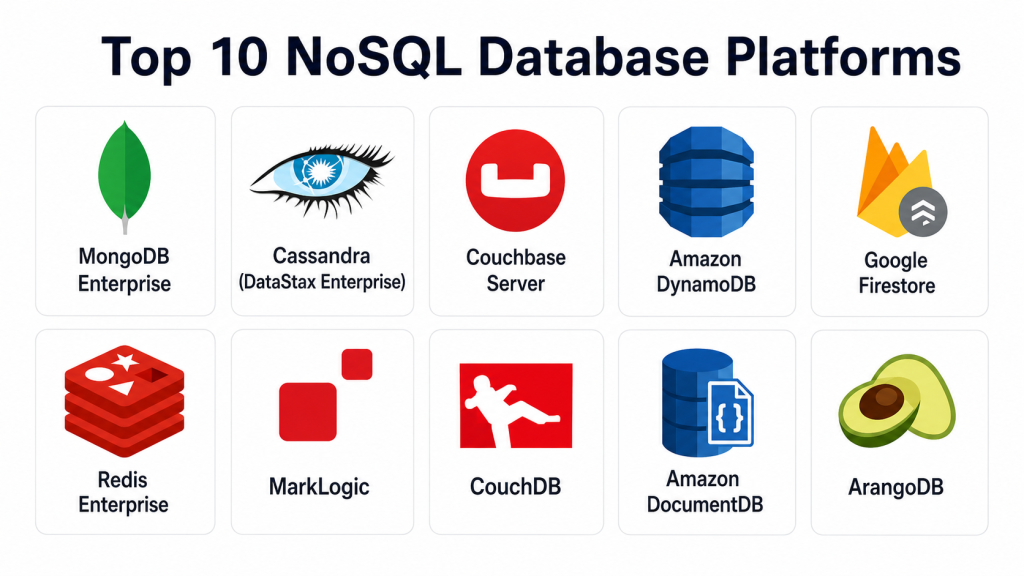
Top 10 NoSQL Database Platforms
#1 — MongoDB Enterprise
Short description: MongoDB Enterprise provides a comprehensive document-based NoSQL database platform with strong governance, risk management, and compliance features. Designed for enterprises managing large distributed environments, it combines scalability with robust security and auditing.
Key Features
- Role-based access control and auditing
- Real-time monitoring via Ops Manager
- Automated backup and disaster recovery
- Encryption at rest and in transit
- Multi-cloud and hybrid deployment support
- Compliance-ready for GDPR, SOC 2, HIPAA
Pros
- Highly scalable and reliable
- Strong governance and security features
Cons
- Enterprise features can be costly
- Steep learning curve for large deployments
Platforms / Deployment
- Windows / macOS / Linux
- Cloud / On-premises / Hybrid
Security & Compliance
- RBAC, audit logs, encryption
- SOC 2, ISO 27001, GDPR, HIPAA
Integrations & Ecosystem
- AWS, Azure, GCP
- SIEM integration
- APIs for DevOps automation
Support & Community
- Professional enterprise support
- Active developer community
#2 — Cassandra (DataStax Enterprise)
Short description: DataStax Enterprise enhances Apache Cassandra with enterprise features, offering governance, risk management, and compliance tools for large-scale, distributed NoSQL deployments.
Key Features
- Continuous monitoring and alerting
- Automated backup and recovery
- Fine-grained access control and auditing
- Multi-data center replication
- Compliance reporting capabilities
- Analytics and search integration
Pros
- Highly scalable and fault-tolerant
- Advanced security and compliance options
Cons
- Complex setup for beginners
- Requires dedicated expertise
Platforms / Deployment
- Linux / Cloud / On-premises
Security & Compliance
- RBAC, audit logs
- GDPR, SOC 2
Integrations & Ecosystem
- Spark, Hadoop, Kafka
- Cloud provider connectors
- APIs for DevOps automation
Support & Community
- Enterprise support from DataStax
- Large open-source Cassandra community
#3 — Couchbase Server
Short description: Couchbase Server is a high-performance document-oriented NoSQL platform with integrated security, governance, and monitoring for enterprise applications.
Key Features
- Multi-cluster management
- Role-based security and auditing
- Automated backup and recovery
- Real-time monitoring and alerting
- Query and indexing optimization
- Cloud and hybrid deployment
Pros
- Fast, scalable, and reliable
- Comprehensive enterprise features
Cons
- Enterprise license required for full features
- Can be complex for multi-cluster setups
Platforms / Deployment
- Linux / Windows / macOS
- Cloud / Hybrid
Security & Compliance
- RBAC, encryption, audit logs
- GDPR, SOC 2
Integrations & Ecosystem
- Cloud connectors (AWS, Azure, GCP)
- DevOps CI/CD pipelines
- Monitoring tools
Support & Community
- Enterprise support
- Community forums
#4 — Amazon DynamoDB
Short description: DynamoDB is AWS’s fully managed NoSQL database platform, offering scalability, security, and compliance features suitable for high-throughput, low-latency applications.
Key Features
- Fully managed replication and backups
- Encryption at rest and in transit
- Role-based access control
- Real-time performance monitoring via CloudWatch
- Serverless auto-scaling
- Compliance-ready for HIPAA, GDPR, SOC 2
Pros
- Managed service with high availability
- Seamless integration with AWS ecosystem
Cons
- Limited to AWS
- Pricing scales with high throughput
Platforms / Deployment
- Cloud (AWS)
Security & Compliance
- IAM, RBAC, audit logs, encryption
- GDPR, HIPAA, SOC 2
Integrations & Ecosystem
- AWS Lambda, CloudFormation, CloudWatch
- APIs for DevOps automation
Support & Community
- AWS enterprise support
- Active developer forums
#5 — Google Firestore
Short description: Firestore is a cloud-native NoSQL database with real-time synchronization, multi-region replication, and governance features for regulated enterprise applications.
Key Features
- Role-based access control
- Real-time data synchronization
- Automated backups
- Audit logging for compliance
- Serverless architecture
- Multi-region replication
Pros
- Fully managed and scalable
- Real-time support for applications
Cons
- Limited to Google Cloud
- Advanced compliance requires configuration
Platforms / Deployment
- Cloud (GCP)
Security & Compliance
- IAM, audit logs, encryption
- GDPR, SOC 2
Integrations & Ecosystem
- Firebase suite
- Google Cloud analytics
- DevOps API integration
Support & Community
- GCP enterprise support
- Active developer community
#6 — Redis Enterprise
Short description: Redis Enterprise is a high-performance key-value store with advanced monitoring, backup, and GRC features for enterprise applications.
Key Features
- RBAC and auditing
- High-availability clustering
- Backup and restore automation
- Real-time performance monitoring
- Multi-cloud support
- Compliance reporting
Pros
- Fast in-memory database
- Strong enterprise governance
Cons
- Enterprise features require premium license
- Limited document model support
Platforms / Deployment
- Linux / Windows / Cloud / On-premises
Security & Compliance
- RBAC, audit logs, encryption
- SOC 2, GDPR
Integrations & Ecosystem
- Cloud connectors (AWS, Azure, GCP)
- DevOps and monitoring tool integration
- APIs for automation
Support & Community
- Enterprise support
- Active Redis community
#7 — MarkLogic
Short description: MarkLogic is a multi-model NoSQL database with integrated search, governance, and compliance features for sensitive enterprise data.
Key Features
- Multi-model support (JSON, XML, RDF)
- Role-based access control
- Automated backup and high availability
- Real-time monitoring and alerts
- Integrated search capabilities
- Compliance-ready features
Pros
- Flexible data model support
- Strong enterprise security
Cons
- High licensing costs
- Complexity for beginners
Platforms / Deployment
- Linux / Windows / Cloud / On-premises
Security & Compliance
- RBAC, audit logs, encryption
- SOC 2, GDPR, HIPAA
Integrations & Ecosystem
- APIs for DevOps
- Analytics and reporting tools
- Cloud services integration
Support & Community
- Enterprise support
- Knowledge base and forums
#8 — CouchDB
Short description: CouchDB is an open-source, document-oriented NoSQL database with built-in replication, monitoring, and basic governance features.
Key Features
- Multi-node replication
- Role-based access control
- Backup and restore
- Monitoring dashboards
- JSON-based data model
- Open-source extensibility
Pros
- Free and flexible
- Easy replication and scaling
Cons
- Limited enterprise compliance features
- Monitoring requires additional tools
Platforms / Deployment
- Linux / Windows / macOS / Cloud
Security & Compliance
- RBAC, audit logs
- Not publicly stated
Integrations & Ecosystem
- APIs for DevOps automation
- Cloud deployment support
- Community-built connectors
Support & Community
- Community support
- Extensive online documentation
#9 — Amazon DocumentDB
Short description: Amazon DocumentDB is AWS’s managed MongoDB-compatible NoSQL database, providing scalable, secure, and compliance-ready database services.
Key Features
- Managed replication and backups
- Encryption at rest and in transit
- RBAC and IAM integration
- Performance monitoring with CloudWatch
- Compliance-ready for HIPAA, GDPR, SOC 2
- Auto-scaling storage
Pros
- Managed service with high availability
- Seamless AWS integration
Cons
- Limited to AWS ecosystem
- Costs scale with usage
Platforms / Deployment
- Cloud (AWS)
Security & Compliance
- IAM, RBAC, encryption
- GDPR, HIPAA, SOC 2
Integrations & Ecosystem
- AWS Lambda, CloudWatch, APIs
- DevOps CI/CD integration
Support & Community
- AWS enterprise support
- Active developer forums
#10 — ArangoDB
Short description: ArangoDB is a multi-model NoSQL database supporting graph, document, and key-value data, offering monitoring, governance, and compliance features.
Key Features
- Multi-model support (graph, document, key-value)
- RBAC and auditing
- Backup and restore
- Real-time monitoring and alerts
- Multi-cloud deployment support
- Compliance-ready features
Pros
- Flexible multi-model database
- Strong enterprise security
Cons
- Enterprise features require license
- Complexity for beginners
Platforms / Deployment
- Linux / Windows / macOS / Cloud
Security & Compliance
- RBAC, audit logs, encryption
- SOC 2, GDPR
Integrations & Ecosystem
- APIs for DevOps automation
- Cloud connectors
- Monitoring tools
Support & Community
- Enterprise support available
- Active community forums
Comparison Table (Top 10)
| Tool Name | Best For | Platform(s) Supported | Deployment | Standout Feature | Public Rating |
|---|---|---|---|---|---|
| MongoDB Enterprise | Document DB enterprises | Windows/macOS/Linux/Web | Cloud/On-prem/Hybrid | Centralized monitoring & GRC | N/A |
| Cassandra (DataStax) | Distributed DBs | Linux/Cloud | On-prem/Cloud | Multi-node replication | N/A |
| Couchbase Server | Enterprise document DBs | Linux/Windows/macOS | Cloud/Hybrid | Multi-cluster management | N/A |
| Amazon DynamoDB | Cloud-native apps | Cloud (AWS) | Cloud | Fully managed serverless scaling | N/A |
| Google Firestore | Real-time applications | Cloud (GCP) | Cloud | Real-time synchronization | N/A |
| Redis Enterprise | High-performance key-value DBs | Linux/Windows/Cloud | Cloud/On-prem | In-memory speed & clustering | N/A |
| MarkLogic | Multi-model enterprise DBs | Linux/Windows/Cloud | Cloud/On-prem | Integrated search & GRC | N/A |
| CouchDB | Open-source document DBs | Linux/Windows/macOS/Web | On-prem/Cloud | Replication & distributed model | N/A |
| Amazon DocumentDB | Managed MongoDB-compatible DBs | Cloud (AWS) | Cloud | Managed service with compliance | N/A |
| ArangoDB | Multi-model flexible DBs | Linux/Windows/macOS/Cloud | Cloud/On-prem | Graph/document/key-value support | N/A |
Evaluation & Scoring of NoSQL Database Platforms
| Tool Name | Core (25%) | Ease (15%) | Integrations (15%) | Security (10%) | Performance (10%) | Support (10%) | Value (15%) | Weighted Total |
|---|---|---|---|---|---|---|---|---|
| MongoDB Enterprise | 9 | 8 | 8 | 9 | 9 | 8 | 7 | 8.3 |
| Cassandra (DataStax) | 9 | 7 | 8 | 8 | 9 | 7 | 7 | 8.0 |
| Couchbase Server | 8 | 8 | 8 | 8 | 8 | 7 | 7 | 7.8 |
| Amazon DynamoDB | 8 | 8 | 8 | 8 | 8 | 7 | 7 | 7.8 |
| Google Firestore | 8 | 8 | 8 | 8 | 8 | 7 | 7 | 7.8 |
| Redis Enterprise | 9 | 8 | 7 | 9 | 9 | 7 | 7 | 8.2 |
| MarkLogic | 9 | 7 | 8 | 9 | 8 | 7 | 6 | 7.9 |
| CouchDB | 7 | 8 | 7 | 7 | 7 | 6 | 7 | 7.1 |
| Amazon DocumentDB | 8 | 8 | 8 | 8 | 8 | 7 | 7 | 7.8 |
| ArangoDB | 8 | 8 | 8 | 8 | 8 | 7 | 7 | 7.8 |
Interpretation: Weighted totals reflect comparative strength in features, ease of use, integrations, security, performance, support, and overall value.
Which NoSQL Database Platform Is Right for You?
Solo / Freelancer
- CouchDB or ArangoDB for lightweight, open-source solutions.
SMB
- Redis Enterprise or Couchbase Server for moderate-scale deployments with security.
Mid-Market
- MongoDB Enterprise, MarkLogic, Amazon DocumentDB for enhanced governance and multi-cloud support.
Enterprise
- Cassandra (DataStax), MongoDB Enterprise, Couchbase Server for large-scale, compliant operations.
Budget vs Premium
- Open-source solutions (CouchDB, ArangoDB) are cost-effective.
- Premium platforms provide automation, compliance, and monitoring for enterprise workloads.
Feature Depth vs Ease of Use
- Enterprise platforms offer advanced features at the cost of complexity.
- Developer-focused tools prioritize usability and rapid development.
Integrations & Scalability
- Check API support for DevOps, SIEM, and IAM.
- Multi-cloud and hybrid options enhance flexibility.
Security & Compliance Needs
- RBAC, encryption, and audit trails are essential for enterprise compliance.
- Built-in reporting helps streamline GDPR, HIPAA, and SOC 2 adherence.
Frequently Asked Questions (FAQs)
What is a NoSQL Database Platform?
A database platform designed for non-relational data, including document, key-value, columnar, and graph databases.
Can these tools manage multiple NoSQL types?
Enterprise platforms often support multiple NoSQL engines like MongoDB, Cassandra, Redis, Couchbase, and DocumentDB.
Do these platforms support compliance reporting?
Yes, audit logs, RBAC, and compliance dashboards are common features.
Are open-source NoSQL tools suitable for small teams?
Yes, CouchDB and ArangoDB offer lightweight solutions for SMB and solo developers.
Do these platforms automate backups?
Enterprise platforms provide automated backup, replication, and disaster recovery.
Can I monitor database performance in real-time?
Yes, monitoring dashboards and alerting are standard features in most enterprise solutions.
Do these tools integrate with DevOps pipelines?
Yes, APIs and connectors support CI/CD workflows and schema management.
Are these platforms cloud-compatible?
Most platforms support cloud, on-premises, and hybrid deployments.
Can they detect security threats?
Some platforms offer anomaly detection, auditing, and alerting for security breaches.
How frequently should databases be audited?
Continuous monitoring is recommended, supplemented by periodic compliance audits.
Conclusion
GRC NoSQL database platforms are essential for enterprises to manage performance, governance, and compliance across distributed, high-volume databases. SMBs may opt for open-source solutions like CouchDB or ArangoDB, while mid-market and enterprise teams benefit from MongoDB Enterprise, Cassandra, and Couchbase for comprehensive management. Evaluate your environment, compliance requirements, and scalability needs, shortlist 2–3 platforms, and pilot them to optimize operations, security, and governance.
