Upgrade & Secure Your Future with DevOps, SRE, DevSecOps, MLOps!
We spend hours scrolling social media and waste money on things we forget, but won’t spend 30 minutes a day earning certifications that can change our lives.
Master in DevOps, SRE, DevSecOps & MLOps by DevOps School!
Learn from Guru Rajesh Kumar and double your salary in just one year.
Introduction
Modern software delivery has changed dramatically. Businesses no longer release applications once in a while. They now build, test, deploy, monitor, and improve software continuously. DevOps helped organizations bring development and operations teams together, automate CI/CD pipelines, and deliver software faster. But as systems became more complex, DevOps teams started facing new challenges. Cloud platforms, microservices, containers, Kubernetes, hybrid infrastructure, APIs, and distributed applications generate massive operational data. Logs, metrics, traces, alerts, events, and deployment signals are difficult to manage manually. This is where AIOps becomes important. AIOps adds artificial intelligence, machine learning, big data analytics, and intelligent automation to IT operations. It helps teams detect incidents faster, reduce alert noise, understand root causes, and automate repetitive actions. TheAIOps.com can be understood as an educational learning resource for professionals who want to understand AIOps, DevOps, automation, observability, and intelligent IT operations in a practical way.
What Is DevOps?
DevOps is a software delivery approach that connects development, operations, quality, security, and business teams. Its main goal is to deliver reliable software faster through collaboration, automation, continuous testing, and continuous feedback.
In simple words, DevOps reduces the gap between people who build software and people who run software.
Core Principles of DevOps
DevOps is based on practical principles that improve both speed and stability:
- Collaboration between development and operations teams
- Automation of build, test, deployment, and infrastructure tasks
- Continuous integration and continuous delivery
- Monitoring and feedback after deployment
- Shared ownership of application reliability
- Faster recovery from failures
- Continuous improvement of tools and processes
CI/CD Overview
CI/CD stands for Continuous Integration and Continuous Delivery or Continuous Deployment.
Continuous Integration means developers frequently merge code changes into a shared repository. Automated tests validate whether the code works correctly.
Continuous Delivery means the application is always kept ready for release. Continuous Deployment goes one step further and automatically releases approved changes to production.
A typical CI/CD workflow includes:
- Code commit
- Automated build
- Unit testing
- Security scanning
- Integration testing
- Artifact creation
- Deployment approval
- Release to staging or production
- Monitoring after deployment
Collaboration Culture
DevOps is not only about tools. It is also about culture.
In traditional IT, developers may write code and hand it over to operations teams. If something fails, teams may blame each other. DevOps changes this mindset by encouraging shared responsibility.
Developers care about production stability. Operations teams participate earlier in the software lifecycle. Security and quality teams become part of the delivery process. Everyone works toward one goal: delivering reliable digital services.
What Is AIOps?
AIOps stands for Artificial Intelligence for IT Operations. It uses AI, machine learning, analytics, and automation to improve how IT teams monitor, detect, analyze, and resolve operational issues.
AIOps helps teams move from reactive operations to intelligent, predictive, and automated operations.
Definition
AIOps is an approach that collects operational data from different IT systems and uses AI-driven analysis to identify patterns, detect anomalies, correlate events, reduce alert noise, and trigger automated responses.
In simple terms, AIOps helps IT teams understand what is happening across complex systems before small issues become major outages.
Machine Learning
Machine learning allows AIOps platforms to learn from historical and real-time data.
For example, if an application normally uses 40% CPU during business hours but suddenly jumps to 90% after a deployment, machine learning can detect this unusual pattern. It does not depend only on fixed rules. It learns what “normal” behavior looks like.
Big Data Analytics
Modern IT systems generate huge volumes of data. This includes application logs, infrastructure metrics, network events, cloud usage data, security alerts, and user experience signals.
Big data analytics helps AIOps platforms process this information at scale. Instead of engineers manually checking multiple dashboards, AIOps can analyze large data streams and highlight meaningful insights.
Intelligent Automation
Intelligent automation means using AI-supported decisions to trigger operational actions.
For example, if a service becomes unhealthy because of memory pressure, an AIOps workflow may restart the service, scale the container, create an incident ticket, notify the right team, and attach diagnostic logs.
This reduces manual effort and improves response time.
Observability
Observability helps teams understand the internal health of a system by analyzing external outputs such as logs, metrics, and traces.
AIOps improves observability by connecting signals across applications, infrastructure, databases, cloud services, and user journeys. It helps teams see not only that something is wrong, but also why it may be happening.
Event Correlation
Event correlation is the process of connecting related alerts and events.
For example, one database slowdown may create hundreds of alerts across application servers, APIs, payment services, and customer dashboards. AIOps can correlate these events and show that the database issue is the likely root cause.
This helps teams avoid alert overload and focus on the real problem.
Why DevOps and AIOps Work Better Together
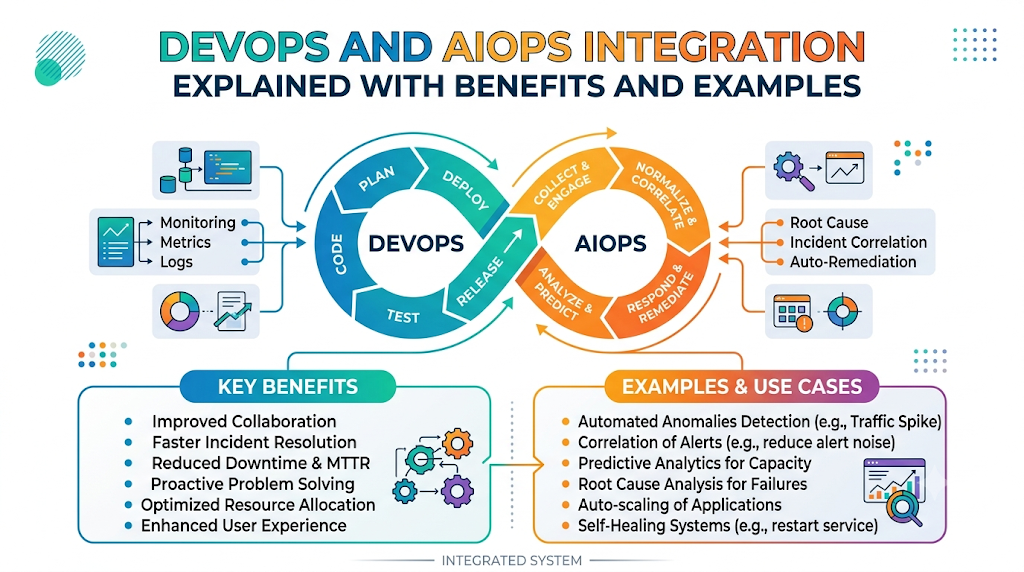
DevOps improves software delivery. AIOps improves operational intelligence. When both are combined, organizations can build, deploy, monitor, and recover from issues more effectively.
DevOps and AIOps Integration means adding AI-driven monitoring, analytics, automation, and predictive insights into DevOps workflows.
Continuous Monitoring
DevOps teams need continuous monitoring after every deployment. AIOps makes monitoring smarter by analyzing logs, metrics, traces, events, and user experience data together.
For example, after a new release, an e-commerce company may monitor checkout speed, payment success rate, API latency, database load, and error rates. AIOps can detect whether a new deployment is causing abnormal behavior.
Intelligent Incident Detection
Traditional monitoring often depends on fixed thresholds. For example, alert when CPU usage crosses 80%.
But modern systems are dynamic. A CPU spike may be normal during peak traffic and dangerous during low traffic. AIOps detects incidents based on patterns, baselines, and anomalies.
For example, a banking application may experience unusual login failures from one region. AIOps can detect the abnormal pattern and alert the team before customers start reporting the issue.
Faster Root Cause Analysis
Root cause analysis is one of the most time-consuming parts of incident management.
DevOps teams may need to check deployment logs, infrastructure metrics, container events, database status, network latency, and application traces. AIOps shortens this process by correlating signals.
For example, if a release causes API failures, AIOps may connect the issue to a specific deployment, configuration change, or service dependency.
Automated Remediation
AIOps can automate common incident response actions.
Examples include:
- Restarting a failed service
- Scaling cloud resources
- Rolling back a bad deployment
- Clearing temporary storage
- Creating an incident ticket
- Assigning the right support team
- Triggering a runbook
This does not mean humans lose control. Good AIOps implementation uses controlled automation, approvals, and safe rollback options.
Predictive Operations
DevOps teams often focus on current issues. AIOps adds predictive capability.
For example, an AIOps system may predict that disk usage will cross a critical limit soon based on current growth trends. The team can take action before the application fails.
Predictive operations help enterprises prevent incidents instead of only reacting to them.
Improved Software Reliability
When DevOps and AIOps work together, teams can release faster without ignoring reliability.
AIOps provides intelligence around service health, deployment impact, user experience, infrastructure behavior, and incident trends. This helps teams make better release decisions.
TheAIOps.com Guide to DevOps and AIOps Integration
TheAIOps.com explains DevOps and AIOps Integration as a practical way to make IT operations more intelligent, automated, and reliable. The idea is not to replace DevOps but to strengthen it with AI-driven insights.
Connecting CI/CD Pipelines with AIOps
AIOps can be connected with CI/CD pipelines to monitor deployment quality.
For example, when a new version is deployed, AIOps can compare system behavior before and after release. It can check error rates, latency, resource usage, and user transaction failures.
If the release creates abnormal behavior, the pipeline can trigger alerts, pause further rollout, or start rollback procedures.
Improving Observability
DevOps teams need visibility across applications, infrastructure, cloud platforms, containers, and customer journeys.
AIOps improves observability by combining different signals into one intelligent view. It helps engineers understand how one change affects the full system.
For example, if a new microservice version increases database queries, AIOps can connect application latency with database load and deployment history.
Reducing Alert Fatigue
Alert fatigue happens when teams receive too many alerts, many of which are duplicate, low priority, or unclear.
AIOps reduces alert fatigue by grouping related events, removing noise, prioritizing critical alerts, and identifying likely root causes.
Instead of seeing hundreds of alerts, engineers can focus on a smaller number of meaningful incidents.
Automating Incident Response
AIOps can support incident response by triggering runbooks and workflows.
For example, if application latency increases after traffic growth, automation may scale the service. If a pod crashes repeatedly, automation may restart it and collect logs for review.
This helps teams save time and handle incidents consistently.
Building Resilient IT Operations
Resilient operations mean systems can absorb failures, recover quickly, and continue serving users.
DevOps provides automation and delivery discipline. AIOps adds intelligence, prediction, and operational learning. Together, they help enterprises build systems that are faster, safer, and easier to manage.
DevOps Lifecycle Enhanced by AIOps
AIOps can support every stage of the DevOps lifecycle.
Planning
During planning, teams decide what to build and how to improve systems.
AIOps helps by showing historical incident data, service reliability trends, capacity issues, and recurring failure patterns. This helps teams prioritize work based on real operational risk.
Development
During development, AIOps insights can guide better design decisions.
For example, if past incidents show that a service fails under high database load, developers can improve caching, optimize queries, or redesign service communication.
Continuous Integration
In continuous integration, AIOps can analyze build failures, test patterns, and code quality signals.
If certain modules repeatedly fail after changes, teams can identify unstable areas and improve testing strategy.
Continuous Testing
AIOps can improve testing by using production insights.
For example, if real users frequently use a specific transaction path, teams can prioritize test coverage for that journey. This makes testing more aligned with business impact.
Continuous Deployment
During deployment, AIOps can watch system behavior in real time.
If a canary release creates abnormal errors or latency, AIOps can recommend stopping the rollout or rolling back to the previous stable version.
Monitoring
Monitoring becomes more intelligent with AIOps.
Instead of manually checking multiple dashboards, teams receive correlated insights, anomaly alerts, and service health summaries.
Feedback and Continuous Improvement
AIOps supports continuous improvement by analyzing past incidents, alert patterns, deployment failures, and recovery times.
This helps teams improve runbooks, refine automation, adjust alerts, and strengthen reliability practices.
Benefits of DevOps and AIOps Integration
Faster Software Delivery
AIOps helps DevOps teams release faster by reducing manual investigation and improving deployment confidence.
When teams can detect release issues quickly, they can move faster without increasing risk.
Reduced Downtime
AIOps detects anomalies early and supports faster incident response.
This reduces downtime because teams can identify problems before they spread across the system.
Better Infrastructure Visibility
Modern infrastructure includes cloud instances, containers, databases, APIs, networks, and third-party services.
AIOps gives teams better visibility by connecting data across these layers.
Improved Resource Utilization
AIOps can identify underused or overloaded resources.
For example, it can recommend scaling down unused cloud resources or scaling up services before performance issues occur.
Enhanced Customer Experience
Customers care about speed, availability, and smooth digital experiences.
AIOps helps teams detect problems that affect users, such as slow checkout, failed login, delayed reports, or payment errors.
Stronger Operational Resilience
AIOps improves resilience by supporting prediction, automation, correlation, and faster recovery.
This allows teams to handle complexity without depending only on manual effort.
Real-World Enterprise Use Cases
Cloud-Native Applications
Cloud-native applications often use microservices, containers, Kubernetes, APIs, and service meshes.
AIOps helps DevOps teams monitor service dependencies, detect container failures, analyze latency, and respond to scaling issues.
Financial Services
Banks and payment companies need high reliability.
DevOps and AIOps Integration can help detect transaction failures, unusual traffic patterns, API delays, and infrastructure risks before they affect customers.
Healthcare Systems
Healthcare platforms must remain available for patient records, appointments, billing, and clinical workflows.
AIOps can help detect application slowdowns, database issues, and integration failures across hospital systems.
E-Commerce Platforms
E-commerce platforms face traffic spikes during sales, campaigns, and seasonal demand.
AIOps can predict capacity needs, detect checkout failures, monitor payment gateways, and support automated scaling.
Telecommunications
Telecom environments generate huge volumes of network and service events.
AIOps can correlate network alerts, customer impact, service degradation, and infrastructure events to improve operational response.
Traditional DevOps vs DevOps with AIOps
| Capability | Traditional DevOps | DevOps with AIOps |
|---|---|---|
| Monitoring | Manual dashboards | AI-driven observability |
| Incident Detection | Rule-based alerts | Intelligent anomaly detection |
| Root Cause Analysis | Manual investigation | Automated correlation |
| Operations | Reactive | Predictive |
| Automation | CI/CD focused | End-to-end operational automation |
| Alert Management | High alert volume | Noise reduction and prioritization |
| Deployment Validation | Manual review and basic checks | AI-assisted release health analysis |
| Feedback Loop | Delayed operational learning | Continuous data-driven improvement |
Common Challenges
Data Silos
Many enterprises store logs, metrics, traces, deployment data, and incident records in separate tools.
Recommendation: Standardize data collection and build a centralized observability layer. Use common naming, tagging, and service ownership practices.
Tool Integration
DevOps teams often use many tools for CI/CD, monitoring, ticketing, cloud management, and collaboration.
Recommendation: Start with key integrations first. Connect CI/CD pipelines, monitoring tools, incident systems, and cloud platforms before expanding to advanced automation.
Alert Overload
Too many alerts can overwhelm teams and hide real incidents.
Recommendation: Use event correlation, alert grouping, severity mapping, and service impact analysis. Remove duplicate and low-value alerts.
Skill Gaps
DevOps engineers may not have deep knowledge of AI models, while data teams may not understand IT operations.
Recommendation: Build cross-functional learning. Train teams on observability, incident response, automation, data quality, and AIOps best practices.
Organizational Change
Teams may resist automation if they fear loss of control.
Recommendation: Start with human-approved automation. Show measurable improvements in alert reduction, MTTR, and service availability before moving to deeper automation.
Best Practices for Successful Integration
Successful DevOps AIOps integration requires planning, clean data, team collaboration, and gradual automation.
Important best practices include:
- Standardize operational data across teams and tools
- Centralize observability for logs, metrics, traces, and events
- Automate repetitive operational tasks safely
- Continuously refine AI models using real incident feedback
- Foster collaboration between DevOps and operations teams
- Connect deployment data with monitoring data
- Define service ownership clearly
- Start with high-impact use cases such as alert reduction and incident response
- Review automation workflows regularly
- Track performance metrics before and after implementation
Key Performance Metrics
Deployment Frequency
Deployment frequency measures how often teams release software.
AIOps helps improve this by increasing confidence in release monitoring and reducing manual checks.
Change Failure Rate
Change failure rate measures how many deployments cause incidents or require rollback.
AIOps can reduce this by detecting risky deployment behavior early.
Mean Time to Detect (MTTD)
MTTD measures how long it takes to detect a problem.
AIOps reduces MTTD through anomaly detection, event correlation, and intelligent alerting.
Mean Time to Resolve (MTTR)
MTTR measures how long it takes to fix an incident.
AIOps improves MTTR by helping teams identify root causes faster and automate common remediation actions.
Alert Reduction Rate
Alert reduction rate shows how much alert noise has been reduced.
This is an important metric because fewer, better alerts improve engineer focus and reduce burnout.
Service Availability
Service availability measures how reliably applications remain accessible to users.
DevOps and AIOps Integration improves availability through predictive monitoring, faster response, and automation.
Career Opportunities
DevOps and AIOps skills are becoming valuable for professionals working in modern IT operations, cloud platforms, and enterprise automation.
Important roles include:
- DevOps Engineer: Builds CI/CD pipelines, automates infrastructure, and improves delivery workflows.
- AIOps Engineer: Implements AI-driven monitoring, event correlation, automation, and operational analytics.
- Site Reliability Engineer: Focuses on service reliability, incident response, performance, and automation.
- Platform Engineer: Builds internal platforms that help development teams deploy and operate applications efficiently.
- Cloud Operations Engineer: Manages cloud infrastructure, performance, cost, security, and availability.
- Observability Engineer: Designs monitoring, logging, tracing, alerting, and service visibility practices.
Professionals who understand both DevOps and AIOps can work across automation, reliability, platform engineering, and intelligent operations.
Future of DevOps and AIOps
Autonomous Operations
Autonomous operations will allow systems to detect, analyze, and fix common issues with minimal manual intervention.
Human engineers will still guide strategy, governance, safety, and improvement.
AI-Driven CI/CD
AI-driven CI/CD will help teams evaluate release risk, detect failed patterns, recommend rollback, and improve deployment quality.
Self-Healing Infrastructure
Self-healing infrastructure can automatically restart services, scale resources, reroute traffic, or apply known fixes.
This makes systems more resilient and reduces repetitive manual work.
Predictive Incident Management
Predictive incident management helps teams act before service failure.
For example, AIOps may detect growing memory leaks, traffic pressure, or database saturation before downtime occurs.
Intelligent Platform Engineering
Platform engineering teams can use AIOps to build smarter internal developer platforms.
These platforms can provide deployment insights, service health views, automated troubleshooting, and reliability recommendations.
Common Misconceptions About DevOps and AIOps
AIOps Replaces DevOps
AIOps does not replace DevOps. It improves DevOps by adding intelligence to monitoring, incident response, and automation.
DevOps remains important for collaboration, CI/CD, infrastructure automation, and delivery culture.
AI Eliminates Human Engineers
AI does not remove the need for engineers.
Human experts are needed to design systems, review automation, improve reliability, handle complex incidents, and make business decisions.
AIOps Is Only for Large Enterprises
Large enterprises benefit strongly from AIOps, but smaller teams can also use AIOps practices.
Any team facing alert noise, deployment risk, monitoring complexity, or cloud operational challenges can benefit.
Automation Removes the Need for Monitoring
Automation does not remove monitoring. In fact, automation needs strong monitoring to work safely.
Without reliable observability, automation may act on incomplete or wrong signals.
FAQ Section
- What is DevOps and AIOps Integration?
DevOps and AIOps Integration means combining DevOps practices with AI-driven IT operations. It helps teams automate delivery, monitor systems intelligently, detect incidents faster, and improve reliability. - Why is AIOps important for DevOps teams?
AIOps is important because modern DevOps environments generate huge amounts of operational data. AIOps helps teams analyze this data, reduce alert noise, and find root causes faster. - Does AIOps replace DevOps engineers?
No. AIOps supports DevOps engineers by reducing repetitive work and improving decision-making. Engineers are still needed for architecture, automation design, incident review, and continuous improvement. - How does AIOps improve CI/CD pipelines?
AIOps improves CI/CD by monitoring deployment impact, detecting abnormal behavior after releases, identifying risky changes, and supporting automated rollback decisions. - What data does AIOps use?
AIOps uses logs, metrics, traces, alerts, events, deployment records, incident tickets, infrastructure data, and user experience signals. - How does AIOps reduce alert fatigue?
AIOps reduces alert fatigue by grouping related alerts, removing duplicates, prioritizing high-impact issues, and identifying likely root causes. - Can small teams use AIOps?
Yes. Small teams can start with simple use cases such as centralized observability, anomaly detection, alert correlation, and automated incident notifications. - What is the role of observability in AIOps?
Observability provides the data needed for AIOps analysis. Logs, metrics, and traces help AIOps understand system health and detect abnormal patterns. - What skills are needed for DevOps and AIOps careers?
Useful skills include CI/CD, cloud platforms, Linux, Kubernetes, monitoring, scripting, incident response, automation, machine learning basics, and observability tools. - What is the best way to start DevOps AIOps integration?
Start with one practical problem, such as alert noise or slow incident response. Centralize data, connect key tools, define metrics, and gradually automate safe tasks.
Final Summary
DevOps and AIOps Integration helps organizations combine fast software delivery with intelligent IT operations. DevOps brings collaboration, automation, CI/CD, and shared ownership. AIOps adds machine learning, big data analytics, observability, event correlation, prediction, and intelligent automation. Together, they help teams release software faster, detect incidents earlier, reduce downtime, improve infrastructure visibility, and build stronger operational resilience. The main goal is not to replace engineers. The goal is to help engineers make better decisions, reduce manual effort, and manage complex systems with more confidence.
