Upgrade & Secure Your Future with DevOps, SRE, DevSecOps, MLOps!
We spend hours scrolling social media and waste money on things we forget, but won’t spend 30 minutes a day earning certifications that can change our lives.
Master in DevOps, SRE, DevSecOps & MLOps by DevOps School!
Learn from Guru Rajesh Kumar and double your salary in just one year.
Introduction
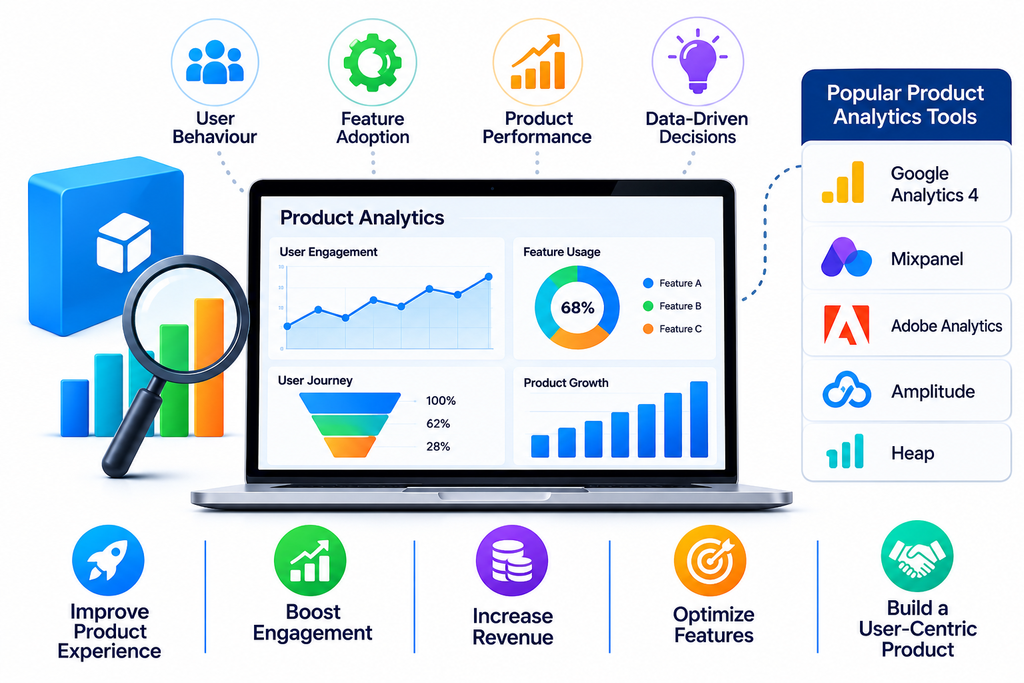
Understanding how users interact with a digital product is essential for building successful software and online services. Businesses need more than information about website visits or downloads. They need to understand which features customers use, how people navigate applications, where users experience difficulties, and what encourages them to continue using a product.
Product analytics tools help organizations collect and analyze this information. They provide insights into user behaviour, feature adoption, engagement, retention, and product performance.
By transforming user activity into actionable insights, product analytics enables businesses to improve their products, make informed decisions, and deliver better customer experiences.
What Are Product Analytics Tools?
Product analytics tools are software solutions that track, measure, and analyze how users interact with digital products such as websites, mobile applications, SaaS platforms, and software services.
These tools collect behavioural data through events, user properties, sessions, and interaction tracking.
Common product analytics measurements include:
- Daily and monthly active users
- Feature adoption rates
- User engagement
- Customer retention
- User journey analysis
- Conversion funnels
- Session activity
- Product usage frequency
- Churn rates
- Customer lifecycle behaviour
These insights help product teams understand how their products perform and identify areas that require improvement.
How Do Product Analytics Tools Work?
Product analytics platforms collect information about user interactions and organize it into reports and visualizations.
1. Event Tracking
The platform records specific activities, such as button clicks, account registrations, purchases, searches, and feature usage.
2. User Identification
Analytics systems associate permitted interactions with anonymous or identified user profiles, depending on the tracking configuration.
3. Data Processing
Collected events are organized into meaningful datasets that help teams understand user activity.
4. Behavioural Analysis
Product teams analyze user journeys, engagement patterns, conversion funnels, and retention trends.
5. Product Optimization
The findings help organizations improve features, simplify navigation, and prioritize product development.
Popular Product Analytics Tools
1. Mixpanel
Mixpanel is a product analytics platform designed to help businesses understand user behaviour and product engagement.
Key features include:
- Event-based analytics
- Funnel analysis
- Retention reporting
- User segmentation
- Behavioural insights
It is useful for product teams that want to understand how customers interact with digital products.
2. Amplitude
Amplitude provides product analytics capabilities focused on user journeys, engagement, retention, and product performance.
Its features help organizations understand how different user groups interact with product features.
3. Google Analytics 4
Google Analytics 4 offers event-based tracking for websites and applications.
Although commonly used for web analytics, it can also support product usage measurement through custom events and conversion tracking.
4. Heap
Heap provides digital experience analytics with capabilities for understanding user interactions, analysing journeys, and identifying behavioural patterns.
Its approach to interaction data can help teams investigate product usage without relying exclusively on manually planned event tracking.
5. Adobe Analytics
Adobe Analytics provides advanced digital analytics capabilities for organizations requiring detailed customer journey and experience analysis.
It is particularly relevant for businesses managing complex digital products and customer experiences.
6. PostHog
PostHog is a product analytics platform that offers event tracking, funnels, retention analysis, session replay, and feature flags.
It can support development and product teams that want analytics and experimentation capabilities within a connected workflow.
Key Benefits of Product Analytics Tools
1. Better Understanding of User Behaviour
Product analytics helps businesses understand how customers interact with different product features.
This information can reveal popular functionality, frequently used workflows, and areas where users experience difficulties.
2. Improved Feature Adoption
Businesses can measure whether customers discover and use newly introduced features.
If adoption is low, product teams can investigate whether the feature needs better onboarding, improved visibility, or usability enhancements.
3. Higher Customer Retention
Retention reports help businesses understand how frequently users return to a product.
By identifying patterns associated with long-term engagement, organizations can develop strategies to improve customer loyalty.
4. Better Product Development Decisions
Analytics insights help product managers prioritize improvements based on actual user behaviour rather than assumptions.
5. Improved Conversion Rates
Funnel analysis helps organizations identify where users abandon important processes, such as account registration, onboarding, or checkout.
6. Reduced Customer Churn
By identifying declining engagement and other behavioural patterns, businesses can investigate potential customer dissatisfaction and improve product experiences.
Important Product Analytics Metrics
Choosing the right metrics is essential for understanding product performance.
| Metric | Description |
|---|---|
| DAU | Daily active users |
| MAU | Monthly active users |
| Retention Rate | Percentage of users returning over a defined period |
| Churn Rate | Percentage of customers who stop using a product |
| Feature Adoption | Percentage of users adopting a particular feature |
| Session Duration | Time spent during a session |
| Conversion Rate | Percentage completing a desired action |
| Stickiness | Relationship between daily and monthly active users |
Businesses should select metrics that reflect their product goals rather than tracking every available measurement.
Product Analytics vs Web Analytics
Although both disciplines involve collecting digital interaction data, their primary objectives are different.
| Feature | Product Analytics | Web Analytics |
|---|---|---|
| Main focus | Product usage | Website performance |
| Primary objective | Improve digital products | Understand website traffic |
| Data | User events and interactions | Visits, sessions, and page views |
| Metrics | Retention and feature adoption | Traffic and engagement |
| Users | Product and development teams | Marketing and website teams |
| Analysis | Product journeys | Website journeys |
Both approaches can complement each other when organizations want a complete understanding of their digital performance.
How to Choose the Right Product Analytics Tool
Selecting a product analytics platform requires evaluating business objectives and technical requirements.
Consider the following factors:
- Event Tracking: Check whether the platform supports the events and interactions your product needs to measure.
- Ease of Use: Choose dashboards that product managers and analysts can understand.
- User Segmentation: Look for capabilities to compare different user groups.
- Funnel Analysis: Evaluate tools for identifying conversion barriers.
- Retention Reporting: Check whether the platform supports cohort and retention analysis.
- Integration: Review compatibility with development tools, data warehouses, and CRM systems.
- Scalability: Ensure the platform can support increasing user activity.
- Pricing: Compare event limits, subscription costs, and additional usage charges.
- Privacy and Security: Review data governance, access controls, and consent requirements.
Best Practices for Product Analytics
To generate meaningful insights, businesses should establish a structured product analytics strategy.
- Define clear product objectives.
- Identify important user journeys.
- Create a consistent event-tracking plan.
- Monitor feature adoption regularly.
- Analyze user retention and churn.
- Compare behavioural patterns across user segments.
- Review conversion funnels.
- Avoid collecting unnecessary personal information.
- Validate event-tracking accuracy.
- Use analytics findings to guide product experiments.
Product teams should also avoid relying on vanity metrics. High download numbers or registrations do not necessarily indicate that users find a product valuable.
Common Challenges in Product Analytics
Data Quality Issues
Incorrect event tracking can produce incomplete or misleading reports.
Too Much Data
Collecting excessive information without clear objectives can make analysis difficult.
Privacy Concerns
Organizations must handle user information responsibly and follow applicable privacy requirements.
Integration Complexity
Connecting analytics platforms with existing software systems can require technical planning.
Misinterpreting User Behaviour
A correlation between two user actions does not automatically establish that one action causes another.
Future Trends in Product Analytics
Product analytics continues to evolve as businesses adopt artificial intelligence, automation, and advanced data technologies.
Emerging trends include:
- AI-powered behavioural analysis
- Predictive customer retention
- Automated anomaly detection
- Real-time product insights
- Advanced user journey analysis
- Privacy-conscious analytics
- Automated experimentation
- Deeper integration with product development tools
These developments are helping product teams make faster and more informed decisions.
Conclusion
Product analytics tools have become essential for organizations that want to understand how customers interact with their digital products. They provide valuable insights into feature adoption, user engagement, retention, conversion journeys, and product performance.
By selecting appropriate analytics solutions and monitoring meaningful metrics, businesses can identify product weaknesses, improve customer experiences, and make more effective development decisions.
A well-planned product analytics strategy helps organizations build digital products that better match customer needs and support long-term business growth.
