Upgrade & Secure Your Future with DevOps, SRE, DevSecOps, MLOps!
We spend hours scrolling social media and waste money on things we forget, but won’t spend 30 minutes a day earning certifications that can change our lives.
Master in DevOps, SRE, DevSecOps & MLOps by DevOps School!
Learn from Guru Rajesh Kumar and double your salary in just one year.
Content Delivery Networks (CDN): A Complete Guide to Faster Website Performance
INTRODUCTION
Website speed and performance are essential for creating successful digital experiences. Today’s internet users expect websites to load quickly, display images smoothly, and provide uninterrupted access to information. A slow website can frustrate visitors, reduce engagement, and negatively affect business performance.
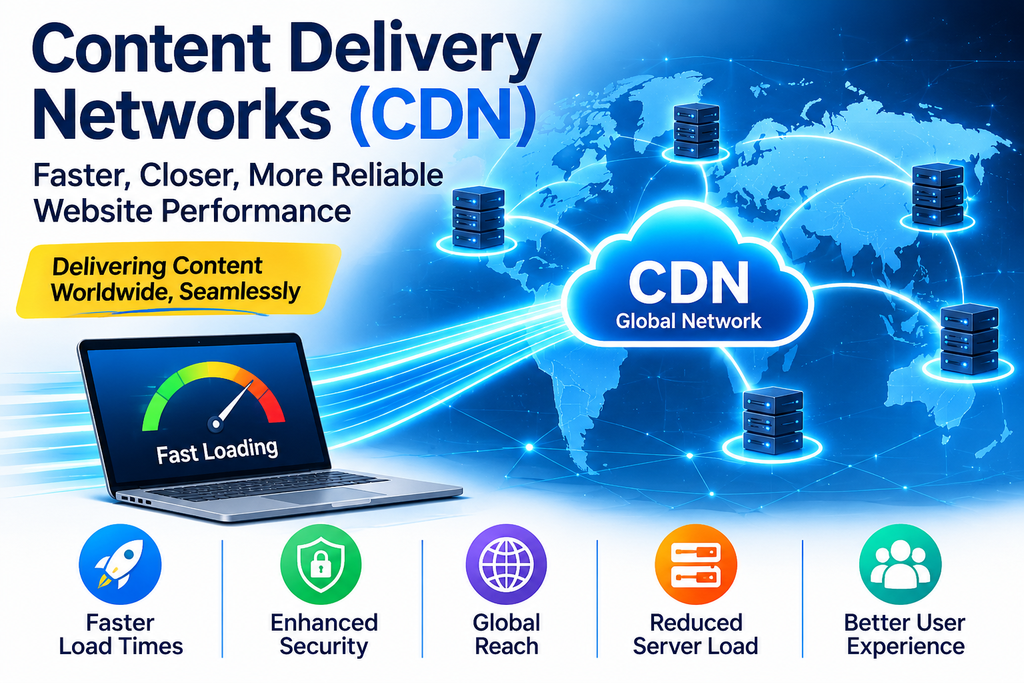
Content Delivery Networks (CDNs) help solve these challenges by distributing website content across multiple servers located in different geographical regions. Instead of delivering every resource from a single hosting server, a CDN allows visitors to access cached content from a nearby server.
From small business websites to large e-commerce platforms and streaming services, CDNs have become an important part of modern internet infrastructure.
WHAT IS A CONTENT DELIVERY NETWORK?
A Content Delivery Network is a geographically distributed network of servers that delivers web content efficiently to users.
CDNs store copies of frequently requested website resources across multiple locations. When someone visits a website, the CDN can deliver the requested content from an appropriate server rather than retrieving everything directly from the original hosting server.
Common CDN resources include:
- Website images and graphics
- Videos and multimedia files
- JavaScript and CSS files
- Fonts and downloadable resources
- Static web pages
- Software updates and application assets
HOW DOES A CDN WORK?
A CDN uses caching, intelligent routing, and distributed infrastructure to improve content delivery.
- Content Distribution: Website resources are copied to geographically distributed CDN servers.
- User Request: A visitor opens a website and requests its content.
- Intelligent Routing: The CDN selects an appropriate server based on network conditions and availability.
- Cache Delivery: If the requested resource is cached, the CDN delivers it directly.
- Origin Retrieval: If the resource is unavailable or expired, the CDN retrieves it from the original server.
This process reduces repeated requests to the origin infrastructure and can improve website responsiveness.
BENEFITS OF CONTENT DELIVERY NETWORKS
- Faster Website Loading
CDNs reduce the distance data travels by delivering cached content from distributed servers. This can improve page loading performance and user experience.
- Better Traffic Management
Distributed content delivery helps reduce the workload on the original hosting server, particularly when websites receive large numbers of simultaneous visitors.
- Improved Availability
CDNs can provide alternative delivery locations when individual servers or network routes experience problems.
- Enhanced Security
Many CDN providers offer security features such as DDoS protection, web application firewalls, bot management, and traffic filtering.
- Reduced Bandwidth Consumption
Caching frequently accessed resources reduces repeated communication with the origin server and can lower bandwidth requirements.
- Global Content Delivery
Businesses serving international audiences can use CDN infrastructure to deliver content more efficiently across different geographical regions.
POPULAR CDN PROVIDERS
Cloudflare
Cloudflare provides content delivery, website security, DDoS protection, DNS services, and edge computing capabilities.
Amazon CloudFront
Amazon CloudFront is a content delivery service integrated with Amazon Web Services. It supports websites, applications, APIs, and video distribution.
Akamai
Akamai provides global content delivery, cybersecurity, and edge computing solutions for businesses with demanding infrastructure requirements.
Google Cloud CDN
Google Cloud CDN uses Google’s global infrastructure to distribute content and integrates with Google Cloud services.
Fastly
Fastly provides configurable content delivery and edge computing services with advanced caching capabilities.
TYPES OF CDN SERVICES
- Traditional CDN: Distributes static website resources such as images, scripts, and stylesheets.
- Dynamic Content Acceleration: Optimizes the delivery of dynamic website content.
- Video CDN: Supports efficient video streaming and multimedia delivery.
- Security CDN: Combines content delivery with security and threat protection.
- Cloud CDN: Provides content distribution through cloud infrastructure.
CDN VS TRADITIONAL WEB HOSTING
Feature | Traditional Hosting | CDN
Infrastructure | Central hosting server | Distributed servers
Content delivery | From hosting infrastructure | From suitable CDN locations
Caching | Depends on configuration | Distributed caching
Global performance | Depends on hosting location | Can improve geographic delivery
Security | Depends on hosting provider | May include additional protection
A CDN generally complements traditional web hosting rather than replacing it.
IMPORTANT CDN TECHNOLOGIES
Edge Computing: Processes selected operations closer to users.
Intelligent Routing: Directs requests through suitable network paths.
Caching: Stores frequently requested content for faster delivery.
HTTP/2 and HTTP/3: Modern communication protocols that can improve network efficiency.
SSL/TLS Encryption: Helps protect information transferred between websites and visitors.
HOW TO CHOOSE THE RIGHT CDN
Before selecting a CDN provider, businesses should evaluate:
- Global server coverage.
- Website loading performance.
- Security and DDoS protection.
- Pricing and bandwidth costs.
- Compatibility with existing hosting infrastructure.
- Scalability and traffic management.
- Analytics and monitoring features.
- Technical support and documentation.
The right choice depends on website traffic, audience location, technical requirements, and available budget.
CDN IMPLEMENTATION BEST PRACTICES
- Identify resources suitable for caching.
- Configure appropriate cache-control headers.
- Optimize images and videos.
- Enable HTTPS delivery.
- Monitor cache-hit ratios.
- Configure cache invalidation.
- Test website performance regularly.
- Avoid caching sensitive or personalized information.
- Review security and access settings.
Businesses should take particular care with dynamic information such as customer accounts, shopping carts, payment sessions, and personalized content.
COMMON CDN CHALLENGES
Despite their benefits, CDNs can introduce certain challenges.
Configuration Complexity: Incorrect caching rules may display outdated information.
Additional Costs: Bandwidth usage and premium features can increase expenses.
Cache Invalidation: Updated resources may require deliberate cache refresh procedures.
Integration Issues: Some applications require specialized routing and configuration.
Security Risks: Incorrect configurations can expose origin infrastructure or sensitive information.
Proper implementation and continuous monitoring help reduce these challenges.
FUTURE OF CDN TECHNOLOGY
CDN technology continues to evolve with developments in artificial intelligence, cloud computing, and edge infrastructure.
Important trends include:
- AI-powered traffic optimization
- Advanced edge computing
- Faster video delivery
- Automated threat detection
- Serverless edge applications
- Improved caching technologies
- Real-time content distribution
These developments will continue to influence how websites and applications deliver digital content.
CONCLUSION
Content Delivery Networks are an essential component of modern website infrastructure. They help businesses improve loading performance, distribute traffic, reduce origin-server workload, and strengthen website security.
Whether operating an e-commerce store, business website, media platform, or enterprise application, choosing the right CDN can support better scalability and more reliable digital experiences.
Understanding CDN architecture, providers, caching technologies, and implementation practices allows businesses to build faster and more efficient online platforms.
