Upgrade & Secure Your Future with DevOps, SRE, DevSecOps, MLOps!
We spend hours scrolling social media and waste money on things we forget, but won’t spend 30 minutes a day earning certifications that can change our lives.
Master in DevOps, SRE, DevSecOps & MLOps by DevOps School!
Learn from Guru Rajesh Kumar and double your salary in just one year.
Introduction
In today’s digital environment, customers expect businesses to understand their interests, preferences, and needs. Generic marketing messages and identical website experiences may not always capture customer attention. Businesses increasingly use personalization technologies to deliver relevant content, product suggestions, and experiences to individual users.
Personalization engines help organizations analyze customer information and create tailored digital experiences across websites, mobile applications, email campaigns, and other digital channels.
By combining customer data, behavioural insights, artificial intelligence, and automation, these platforms help businesses improve engagement, increase conversions, and build stronger customer relationships.
What Are Personalization Engines?
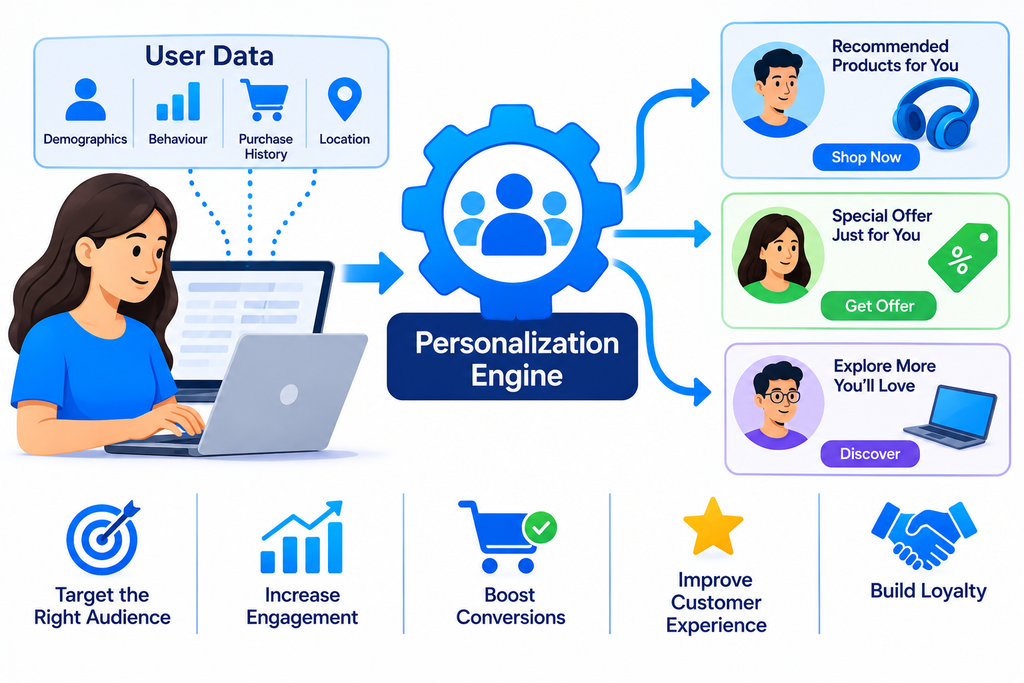
Personalization engines are software platforms that use customer data, behavioural patterns, and business rules to deliver customized content, recommendations, offers, and experiences.
They analyze information such as browsing activity, purchase history, demographics, location, and customer preferences to determine what content or experience may be most relevant to a particular user.
Common personalization capabilities include:
- Personalized product recommendations
- Customized website content
- Behaviour-based marketing messages
- Individualized promotional offers
- Dynamic landing pages
- Personalized email campaigns
- Customer segmentation
- Real-time content customization
- AI-powered recommendations
- Cross-channel personalization
These technologies help businesses provide more relevant experiences throughout the customer journey.
How Do Personalization Engines Work?
Personalization engines follow a process that combines data collection, analysis, decision-making, and content delivery.
1. Customer Data Collection
The platform gathers permitted customer information from websites, mobile applications, CRM systems, purchase records, and marketing channels.
2. Customer Segmentation
Users are grouped according to relevant characteristics, such as interests, browsing behaviour, purchase history, and engagement patterns.
3. Behavioural Analysis
The system analyzes customer interactions to identify preferences, interests, and potential purchasing intentions.
4. Personalization Decisions
The engine determines which content, products, offers, or experiences should be presented to different users.
5. Content Delivery
Personalized experiences are delivered through websites, applications, emails, advertisements, or other connected channels.
6. Performance Measurement
Businesses evaluate engagement, conversions, customer retention, and other performance indicators to improve personalization strategies.
Popular Personalization Engines
1. Dynamic Yield
Dynamic Yield provides personalization and experience optimization capabilities for digital businesses.
Key features include:
- Website personalization
- Product recommendations
- Audience segmentation
- Experience optimization
- Personalized promotions
- Cross-channel experiences
It helps organizations deliver tailored digital experiences based on customer behaviour and preferences.
2. Optimizely
Optimizely provides digital experience optimization, experimentation, and personalization solutions.
Its capabilities support content targeting, audience segmentation, experimentation, and personalized digital experiences.
3. Insider
Insider is a customer experience and personalization platform that helps businesses connect with customers across multiple marketing channels.
Its capabilities include customer segmentation, predictive personalization, campaign automation, and cross-channel engagement.
4. Adobe Target
Adobe Target provides experimentation and personalization capabilities for digital experiences.
Businesses can use it to test different experiences, target specific audiences, and deliver relevant content across digital channels.
5. Bloomreach
Bloomreach offers commerce-focused personalization and digital experience solutions.
Its capabilities include personalized product discovery, search, merchandising, and customer experience management.
6. Salesforce Personalization
Salesforce provides personalization capabilities that help businesses tailor customer experiences using customer data and connected marketing systems.
It supports personalized content, recommendations, and customer engagement across digital touchpoints.
7. Kameleoon
Kameleoon provides personalization and experimentation capabilities that help organizations create targeted digital experiences.
Its features support audience segmentation, behavioural targeting, testing, and experience optimization.
Key Benefits of Personalization Engines
1. Improved Customer Engagement
Personalized content and recommendations can make digital experiences more relevant to individual users.
When visitors see information that matches their interests, they may be more likely to interact with a website or application.
2. Higher Conversion Rates
Relevant product recommendations, customized offers, and personalized landing pages can help customers discover suitable products and services.
3. Better Customer Experience
Personalization reduces irrelevant content and helps customers find information that matches their preferences.
4. Increased Customer Retention
Businesses can use personalization to maintain meaningful engagement through relevant recommendations, offers, and communication.
5. Improved Marketing Efficiency
Personalization engines help marketing teams deliver targeted messages instead of relying entirely on broad campaigns.
6. Better Customer Insights
Analyzing customer interactions helps organizations understand audience preferences and identify emerging behaviour patterns.
7. Increased Revenue Opportunities
Relevant product suggestions, cross-selling, and upselling opportunities can contribute to higher revenue when implemented effectively.
Types of Personalization
Personalization can take different forms depending on the business model and customer experience requirements.
Behavioural Personalization
Content and recommendations are adjusted according to browsing activity, previous interactions, and product engagement.
Demographic Personalization
Experiences are tailored using permitted demographic information, such as age range or customer segment.
Location-Based Personalization
Businesses provide relevant content or offers based on a user’s approximate location, where appropriate and permitted.
Contextual Personalization
Content is adjusted according to factors such as device type, current browsing session, or referral source.
Predictive Personalization
Artificial intelligence and machine learning models estimate customer interests and potential future actions.
Product-Based Personalization
E-commerce platforms recommend products based on browsing history, purchasing behaviour, and related product interests.
Important Features to Look for in Personalization Software
| Feature | Description |
|---|---|
| Customer Segmentation | Group customers based on relevant characteristics |
| AI Recommendations | Generate personalized suggestions |
| Behavioural Tracking | Analyze customer interactions |
| Dynamic Content | Display customized website content |
| Real-Time Personalization | Adjust experiences using current interactions |
| A/B Testing | Compare different personalized experiences |
| Cross-Channel Support | Personalize multiple communication channels |
| Analytics and Reporting | Measure personalization performance |
| Integration | Connect with CRM and marketing platforms |
| Privacy Controls | Manage customer data and consent |
Personalization Engines vs Recommendation Engines
Personalization engines and recommendation engines are closely related, but they have different primary purposes.
| Feature | Personalization Engines | Recommendation Engines |
|---|---|---|
| Main purpose | Customize overall experiences | Suggest relevant items |
| Content | Websites, offers, messages, layouts | Products, services, and content |
| Data | Behaviour, preferences, context | Preferences, interactions, item relationships |
| Applications | Websites and marketing channels | E-commerce, streaming, and content platforms |
| Main objective | Improve customer experience | Help users discover relevant options |
Recommendation engines can be an important component of a broader personalization strategy.
How to Choose the Right Personalization Engine
Selecting a personalization platform requires understanding business goals and technical requirements.
- Business Objectives: Identify whether the priority is engagement, conversions, retention, or revenue growth.
- Data Integration: Check compatibility with CRM systems, analytics platforms, and customer databases.
- AI Capabilities: Evaluate recommendation models and predictive personalization features.
- Real-Time Processing: Determine whether the platform supports immediate experience customization.
- Audience Segmentation: Review available targeting and customer grouping options.
- Channel Support: Check compatibility with websites, mobile applications, email, and other channels.
- Scalability: Ensure the platform can support growing customer data and traffic.
- Analytics: Evaluate performance reporting and experimentation capabilities.
- Privacy and Security: Review consent management, access controls, and data protection.
- Pricing: Compare subscriptions, usage limits, and implementation costs.
Best Practices for Personalization
Businesses should follow a structured approach when implementing personalization technologies.
- Define clear personalization objectives.
- Understand customer preferences and journeys.
- Collect only necessary and appropriately permitted data.
- Create meaningful customer segments.
- Start with high-impact personalization opportunities.
- Test personalized experiences before large-scale implementation.
- Monitor engagement and conversion performance.
- Avoid excessive personalization that may feel intrusive.
- Maintain consistent experiences across channels.
- Review privacy and consent requirements regularly.
Personalization should improve customer experiences rather than simply increase the amount of customer data collected.
Common Challenges in Personalization
Data Quality Issues
Incomplete, outdated, or inconsistent customer information can produce irrelevant recommendations and experiences.
Integration Complexity
Connecting personalization engines with existing CRM, analytics, and marketing systems may require technical resources.
Privacy Concerns
Businesses must handle customer information responsibly and comply with applicable privacy regulations.
Implementation Costs
Advanced personalization platforms may require significant investment in software, infrastructure, and specialist resources.
Over-Personalization
Excessive targeting can make customers uncomfortable and reduce trust.
Measuring Effectiveness
Businesses need reliable measurement strategies to distinguish genuine improvements from normal variations in customer behaviour.
Future Trends in Personalization Engines
Personalization technology continues to develop with advances in artificial intelligence, machine learning, and customer data platforms.
Important trends include:
- AI-driven personalization
- Predictive customer experiences
- Real-time content customization
- Generative AI-powered recommendations
- Privacy-conscious personalization
- Omnichannel customer experiences
- Automated audience segmentation
- Context-aware recommendations
- Advanced customer journey optimization
These developments are helping businesses deliver increasingly relevant digital experiences while improving marketing efficiency.
Conclusion
Personalization engines have become important technologies for businesses seeking to deliver relevant and engaging digital experiences. They help organizations understand customer behaviour, customize content, recommend products, and improve interactions across multiple channels.
From e-commerce websites and SaaS platforms to financial services and digital media businesses, personalization can support stronger engagement, improved customer experiences, and sustainable business growth.
By selecting the right personalization platform, maintaining reliable data practices, and continuously measuring results, organizations can create more meaningful customer experiences and build lasting relationships.
