Upgrade & Secure Your Future with DevOps, SRE, DevSecOps, MLOps!
We spend hours scrolling social media and waste money on things we forget, but won’t spend 30 minutes a day earning certifications that can change our lives.
Master in DevOps, SRE, DevSecOps & MLOps by DevOps School!
Learn from Guru Rajesh Kumar and double your salary in just one year.
Introduction
Businesses constantly look for ways to improve their websites, applications, and digital experiences. Small changes to a headline, button, image, page layout, or registration form can influence how visitors interact with a product.
However, making changes based only on assumptions can lead to disappointing results. Businesses need reliable ways to determine which design or experience performs better.
A/B testing tools make this possible by allowing organizations to compare different versions of a webpage, application, or digital experience. By measuring user responses, businesses can identify improvements that support higher conversions, better engagement, and stronger customer experiences.
What Are A/B Testing Tools?
A/B testing tools are software solutions that help businesses conduct controlled experiments by comparing two or more versions of a digital experience.
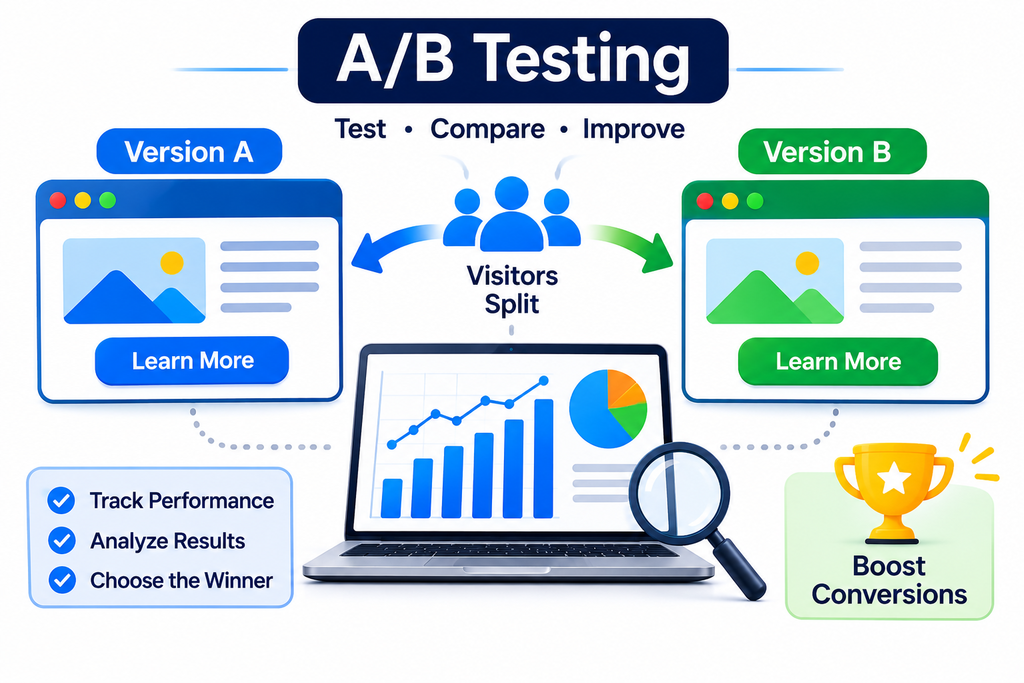
In a traditional A/B test, visitors are divided into groups and shown different versions of a webpage or application.
- Version A: The original experience, commonly called the control.
- Version B: The modified experience, commonly called the variation.
The testing platform measures predefined outcomes, such as clicks, registrations, purchases, or other conversions.
Businesses analyze the results to determine whether the variation performs better than the original experience.
How Does A/B Testing Work?
- Identify an Objective: Identify an area to improve, such as conversions or engagement.
- Develop a Hypothesis: Explain what change is expected to improve performance and why.
- Create Variations: Prepare different versions of the selected experience.
- Divide the Audience: Randomly assign visitors to different variations.
- Collect Performance Data: Measure clicks, purchases, form submissions, and engagement.
- Analyze Results: Evaluate results using appropriate statistical methods.
- Implement Improvements: Apply changes when there is reliable evidence of improvement.
Popular A/B Testing Tools
1. Optimizely
Optimizely provides digital experimentation and personalization capabilities, including web experimentation, feature experimentation, audience targeting, experiment management, and performance reporting.
2. VWO (Visual Website Optimizer)
VWO provides A/B testing, split URL testing, multivariate testing, heatmaps, session recordings, and conversion tracking.
3. AB Tasty
AB Tasty provides experimentation, personalization, and customer experience optimization solutions.
4. Convert
Convert is an experimentation platform offering A/B testing, multivariate testing, and personalization capabilities.
5. Adobe Target
Adobe Target supports A/B testing, automated personalization, audience targeting, and experience optimization.
6. Kameleoon
Kameleoon offers web experimentation, feature experimentation, audience segmentation, and optimization workflows.
Key Benefits of A/B Testing Tools
1. Improved Conversion Rates
Identify website elements that encourage visitors to complete desired actions.
2. Better User Experience
Test layouts, navigation structures, and content presentations to discover easier user experiences.
3. Data-Driven Decisions
Use experimental evidence instead of relying entirely on opinions or assumptions.
4. Reduced Business Risk
Test proposed changes with a portion of the audience before implementing them broadly.
5. Improved Marketing Performance
Experiment with headlines, landing pages, advertisements, and calls to action.
6. Continuous Product Improvement
Discover opportunities to improve product features and digital experiences.
Common Elements Businesses Can A/B Test
- Headlines and titles
- Call-to-action buttons
- Landing pages
- Images and graphics
- Forms and submission processes
- Navigation menus
- Pricing page presentations
- Email subject lines and content
Important A/B Testing Metrics
| Metric | Description |
| Conversion Rate | Percentage completing a desired action |
| Click-Through Rate | Percentage clicking a particular element |
| Bounce Rate | Percentage of sessions that are not engaged, depending on the analytics definition |
| Engagement Rate | Measure of meaningful user interaction |
| Revenue per Visitor | Revenue relative to visitor numbers |
| Average Order Value | Average value of completed purchases |
| Form Completion Rate | Percentage completing a form |
| Retention Rate | Percentage returning over a defined period |
Businesses should select a primary metric before launching an experiment and monitor secondary metrics to identify unexpected effects.
A/B Testing vs Multivariate Testing
| Feature | A/B Testing | Multivariate Testing |
| Main purpose | Compare alternative versions | Compare combinations of multiple elements |
| Complexity | Relatively simple | More complex |
| Variations | Usually two or more versions | Multiple element combinations |
| Traffic requirements | Depends on expected effect | Often requires more traffic |
| Best suited for | Testing specific changes | Understanding combined element effects |
A/B testing is generally a practical starting point for businesses developing an experimentation strategy.
How to Choose the Right A/B Testing Tool
- Testing Capabilities: Check support for A/B, split URL, and multivariate testing.
- Ease of Use: Choose an interface marketing and product teams can operate.
- Analytics Integration: Ensure compatibility with existing reporting systems.
- Audience Segmentation: Look for options to target specific visitor groups.
- Statistical Reporting: Review how experimental results are calculated.
- Personalization: Consider tailored digital experience capabilities.
- Scalability: Support increasing traffic and experimentation needs.
- Pricing: Compare subscription costs and visitor limits.
- Privacy and Security: Review data collection and privacy controls.
Best Practices for Successful A/B Testing
- Establish a clear testing objective.
- Develop a measurable hypothesis.
- Test one primary change at a time when practical.
- Define the primary success metric before starting.
- Randomly assign visitors to variations.
- Ensure experiments run long enough to collect sufficient data.
- Avoid repeatedly checking results and stopping tests prematurely.
- Consider seasonality and external factors.
- Monitor secondary metrics and potential negative effects.
- Document experiment findings.
- Repeat successful experimentation across relevant areas.
Statistical significance alone does not guarantee business importance. Organizations should also consider the size of the improvement, implementation costs, and potential impact on other user outcomes.
Common A/B Testing Mistakes
Testing Without a Clear Hypothesis: Experiments without a specific objective can produce results that are difficult to interpret.
Ending Tests Too Early: Stopping an experiment before collecting sufficient data can lead to unreliable conclusions.
Testing Too Many Changes Simultaneously: Changing several unrelated elements can make it difficult to identify which modification influenced the result.
Ignoring Audience Differences: Different customer groups may respond differently to the same experience.
Focusing Only on Conversion Rates: Improving one metric may negatively affect satisfaction, retention, or revenue quality.
Future Trends in A/B Testing
- AI-assisted experiment recommendations
- Automated variation generation
- Advanced audience segmentation
- Real-time experimentation analytics
- Cross-platform testing
- Personalization-driven experimentation
- Improved statistical analysis
- Integration with product analytics platforms
Conclusion
A/B testing tools help businesses make informed decisions by comparing different versions of websites, applications, and digital experiences. They provide a structured way to understand user preferences, improve conversions, and identify opportunities for continuous optimization.
From small businesses to enterprise organizations, experimentation can support better marketing performance, stronger product experiences, and more effective digital strategies.
By selecting the right testing platform, defining clear objectives, and following reliable experimentation practices, businesses can use A/B testing to achieve measurable and sustainable improvements.
