Upgrade & Secure Your Future with DevOps, SRE, DevSecOps, MLOps!
We spend hours scrolling social media and waste money on things we forget, but won’t spend 30 minutes a day earning certifications that can change our lives.
Master in DevOps, SRE, DevSecOps & MLOps by DevOps School!
Learn from Guru Rajesh Kumar and double your salary in just one year.
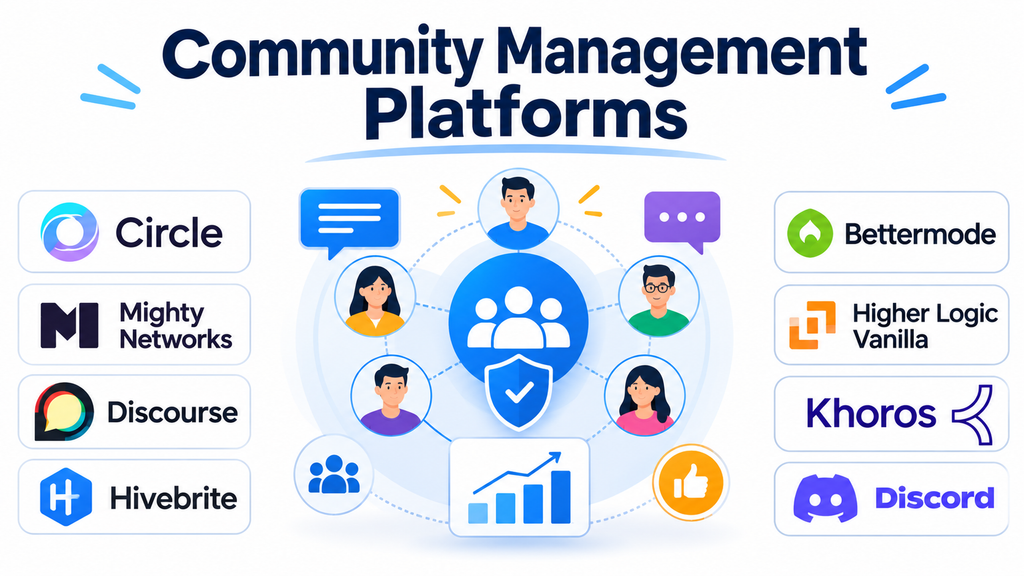
An online community can attract thousands of members and still struggle to create meaningful participation. Conversations become fragmented, useful questions go unanswered, moderators become overwhelmed, and members gradually lose interest. The challenge is not simply attracting people. It is creating an environment where they have a reason to return and contribute.
Community management platforms help organizations address this challenge by providing dedicated spaces for discussions, member interaction, events, knowledge sharing, moderation, and engagement tracking. They are used by businesses, educational institutions, professional associations, nonprofits, creators, and brands that want to develop lasting relationships with their audiences.
However, not every platform serves the same purpose. A creator selling educational memberships has different requirements from a software company building a customer support community or an association managing thousands of professional members.
Understanding these differences is essential before investing in community management software.
What Community Management Platforms Actually Do
Community management software provides the infrastructure for organizing and maintaining digital communities. Depending on the product, it can include member profiles, discussion forums, private groups, messaging, events, moderation tools, content libraries, and engagement analytics.
These platforms generally fall into several categories:
- Branded community platforms: Allow organizations to create dedicated online spaces with their own identity and membership structure.
- Customer community platforms: Help businesses connect customers, provide peer support, collect product feedback, and build searchable knowledge bases.
- Professional and association platforms: Support member directories, networking, chapters, events, and membership administration.
- Discussion and forum software: Organizes conversations into searchable topics and discussions.
- Real-time community platforms: Prioritize chat, voice communication, channels, and immediate interaction.
The distinction matters because a tool optimized for instant messaging may not provide the structured knowledge management needed for a customer support community.
Community Management Platforms to Consider
1. Circle
Circle is designed for organizations, creators, and businesses that want a branded community with organized spaces for discussions and member interaction.
Its approach brings community conversations together with features such as events, courses, live interactions, and membership experiences. This makes it relevant to educational businesses, professional groups, and paid membership communities.
One useful aspect is its space-based organization. Administrators can separate discussions, learning resources, events, and different member groups instead of placing every interaction into a single feed.
Circle also provides moderation capabilities, including member reporting, moderator roles, and configurable automated moderation options. Availability of advanced controls depends on the subscription plan.
It is worth evaluating when an organization wants a dedicated community destination without developing its own platform infrastructure.
2. Mighty Networks
Mighty Networks combines online community features with courses, memberships, events, and member interaction.
Its structure is particularly relevant to creators, educators, coaches, and businesses that want community participation to become part of a broader learning or membership experience.
For example, an educational organization could create learning spaces, connect students through discussions, organize events, and manage access to paid programs within a connected environment.
Its main consideration is the relationship between community and content delivery. Organizations primarily interested in traditional customer support forums may find dedicated forum software more appropriate.
Mighty Networks is worth considering when the community itself is part of a membership or educational product.
3. Discourse
Discourse takes a discussion-first approach to online community management.
It organizes conversations into topics and replies, making it particularly useful for technical communities, open-source projects, product discussions, and knowledge-sharing environments.
One of its important strengths is the structure of its discussions. Rather than relying entirely on rapidly moving chat messages, conversations remain organized and searchable.
Discourse is open-source software and can be self-hosted, while hosted deployment options are also available. This provides flexibility for organizations that want more control over their infrastructure.
The trade-off is operational responsibility. Self-hosted deployments require appropriate server management, maintenance, backups, and security administration.
It is especially relevant when searchable conversations and long-term knowledge retention matter more than a highly visual social feed.
4. Hivebrite
Hivebrite focuses on managing professional networks, alumni communities, associations, and other membership-based organizations.
Its capabilities extend beyond discussion feeds. The platform includes member directories, profiles, groups, events, networking features, and organizational management capabilities.
This makes it useful for institutions that need to connect members across different locations, professional interests, or organizational chapters.
Its member-management orientation is an important distinction. A university alumni network, for instance, may need searchable graduate profiles, professional networking opportunities, and events rather than simply a general discussion forum.
Organizations considering Hivebrite should examine implementation requirements, customization, integration needs, and the overall administrative model.
5. Bettermode
Bettermode is focused on branded customer and product communities.
It is relevant to software companies and businesses that want to bring customer discussions, questions, product feedback, and support resources into a dedicated online environment.
Its flexible community spaces can help organizations structure different areas around customer interests, product topics, and support requirements.
This approach can be useful when a business wants customers to help one another rather than relying entirely on individual support conversations.
Before selecting it, organizations should examine customization requirements, integration options, member permissions, and how community content connects with their existing website and customer systems.
6. Higher Logic Vanilla
Higher Logic Vanilla focuses on customer communities and structured online discussions.
It is particularly relevant to businesses that want to establish customer-to-customer support, product discussion areas, and knowledge-sharing environments.
For organizations with established customer service operations, a community can complement traditional support channels by allowing customers to find answers from existing discussions.
Its relevance is strongest when community management is connected to broader customer experience and support processes.
Organizations should assess how its integration capabilities fit their CRM, support systems, authentication requirements, and existing customer workflows.
7. Khoros
Khoros serves organizations with substantial digital engagement and community management requirements.
Its community capabilities are relevant to large businesses managing customer discussions, peer support, product feedback, and branded digital experiences.
Enterprise buyers should consider the broader operational environment, including moderation workflows, administrator permissions, integrations, reporting, and governance.
Khoros is a different proposition from lightweight community products intended for individual creators. Its relevance increases when community operations involve multiple teams, large audiences, and established customer experience processes.
Organizations should evaluate deployment scope, implementation requirements, and commercial terms directly with the vendor.
8. Discord
Discord is built around real-time communication through servers, channels, voice conversations, and community interaction.
It is widely relevant to gaming groups, developer communities, hobby groups, educational communities, and digital organizations that prioritize frequent interaction.
Its channel-based structure allows administrators to separate conversations by topic, create dedicated spaces, and manage member permissions.
However, Discord is fundamentally different from a conventional searchable knowledge forum. Fast-moving conversations can make valuable information difficult to locate later, especially when members generate large volumes of messages.
It is a strong candidate when immediate communication and member interaction are central requirements, but less suitable when the primary objective is building a structured public knowledge repository.
9. WildApricot
WildApricot focuses on membership management for associations, clubs, and nonprofit organizations.
Its capabilities include member databases, membership administration, event management, website creation, and payment-related workflows.
This makes it particularly relevant to organizations where community participation is closely connected to formal membership.
For example, an association may need to maintain member records, organize events, manage renewals, and communicate with different membership groups.
WildApricot should be evaluated as a membership-management solution with community-related capabilities rather than as a direct substitute for every discussion-focused platform.
How These Platforms Differ
| Platform | Main orientation | Most relevant use case |
|---|---|---|
| Circle | Branded community and memberships | Creator and business communities |
| Mighty Networks | Community, learning, and memberships | Educational and paid communities |
| Discourse | Structured discussion forums | Technical and knowledge-sharing communities |
| Hivebrite | Professional member networks | Alumni and associations |
| Bettermode | Customer community experiences | Product and customer communities |
| Higher Logic Vanilla | Customer discussion and support | Business support communities |
| Khoros | Enterprise digital engagement | Large customer communities |
| Discord | Real-time communication | Gaming and interactive groups |
| WildApricot | Membership administration | Associations and nonprofits |
These products should not be compared solely by the number of features they advertise. Their underlying community models are different, and that difference can determine whether members actually use the platform.
Choosing the Right Platform for Your Community Model
For customer support and product feedback
A software company building a customer community should prioritize searchable discussions, product feedback, moderation, and connections with customer support systems.
Bettermode, Higher Logic Vanilla, Khoros, and Discourse are worth examining for different versions of this requirement.
The important question is whether customers can find useful answers independently and whether internal teams can identify recurring problems from community conversations.
For creators and paid memberships
Creators, coaches, and educators generally need a combination of member interaction, content delivery, events, and access management.
Circle and Mighty Networks are relevant options because they bring several of these activities into a connected environment.
The buying decision should consider how memberships, learning content, events, and member communication work together.
For alumni and professional associations
Associations need more than a discussion feed. Member directories, profile management, networking, events, chapter administration, and membership records may be central requirements.
Hivebrite and WildApricot are useful platforms to evaluate, depending on the complexity of the organization and its membership operations.
For technical and open-source communities
Technical communities often need durable discussions, searchable documentation, clear topic organization, and member moderation.
Discourse is particularly relevant to this model.
Discord can complement it when developers also need real-time conversations, but chat and searchable long-form discussions serve different purposes.
Features That Matter More Than a Large Feature List
Member organization and permissions
Community administrators need control over who can access different areas and what members can do.
Check whether the platform supports private groups, member roles, moderator permissions, restricted content, and different membership levels.
Moderation and community safety
Moderation is essential as participation increases.
Useful capabilities include reporting, content review, user restrictions, moderation roles, spam controls, and configurable community guidelines.
Automated moderation can reduce administrative work, but it should not replace human review for difficult or context-sensitive situations.
Searchable knowledge and content organization
A community becomes more valuable when useful conversations remain accessible.
Look for topic organization, search functionality, pinned resources, content categorization, and the ability to identify unanswered questions.
Analytics and engagement reporting
Member counts alone do not explain community health.
Organizations should examine participation frequency, active members, returning visitors, discussion activity, unanswered questions, and event participation.
The most useful analytics depend on the community’s purpose. A customer support community may prioritize questions resolved through existing content, while a professional network may focus on member connections and event participation.
Integration and data portability
Community software rarely operates independently.
Potential integration requirements include CRM systems, customer support software, payment platforms, email services, identity providers, and analytics applications.
Organizations should also examine export capabilities, API availability, data ownership, and what happens when they decide to migrate to another provider.
Common Mistakes When Managing Online Communities
Choosing software before defining the community’s purpose: A platform cannot solve the problem of an unclear community strategy.
Treating registrations as engagement: A large membership count does not necessarily indicate meaningful participation.
Ignoring moderation capacity: Community growth creates additional responsibilities for reviewing reports, resolving conflicts, and maintaining guidelines.
Creating too many channels: Excessive categories can fragment discussions and make the community difficult to navigate.
Failing to provide useful content: Members need a reason to participate, whether that means answers, networking, learning opportunities, or exclusive resources.
Neglecting inactive members: Organizations should understand why members stop participating and whether the community continues to provide practical value.
Security, Privacy, and Governance Considerations
Community platforms can process personal profiles, private messages, professional information, customer discussions, and other sensitive content.
Before deployment, organizations should examine access controls, administrator privileges, authentication options, data retention, deletion procedures, backup arrangements, and vendor security documentation.
For enterprise deployments, single sign-on, auditability, and integration security may be important procurement requirements.
Public communities also require clear rules regarding acceptable content, member conduct, personal information, and reporting procedures.
An organization should never assume that selecting a platform automatically makes its community compliant with applicable privacy requirements. Configuration, operational practices, integrations, and organizational responsibilities all matter.
Questions to Ask Before Purchasing
A realistic product demonstration should cover the actual work administrators and members will perform.
Consider asking vendors:
- Can members create subgroups or access restricted spaces?
- How are inappropriate posts and reported content handled?
- Can administrators export member information and community discussions?
- Which integrations are available without custom development?
- Can the platform support our expected membership structure?
- What analytics are available for engagement and participation?
- Are branded mobile applications included or separately licensed?
- What happens to community data if we leave the platform?
- Which features require higher subscription plans?
- What administrative work remains our responsibility?
A pilot involving real members can reveal usability and workflow problems that are difficult to identify from a feature comparison.
Frequently Asked Questions
What is a community management platform?
It is software used to create, organize, and maintain online communities. Common capabilities include discussions, member profiles, groups, events, moderation, content sharing, and engagement reporting.
Are community management platforms the same as social media management tools?
No. Social media management tools generally help organizations publish, schedule, monitor, and analyze content across external social networks. Community platforms focus more directly on member relationships, discussions, participation, and dedicated community spaces. Some products support both types of activity.
Can small businesses use community management software?
Yes. Smaller businesses can use lightweight hosted platforms to build customer groups, membership communities, educational spaces, and professional networks. The appropriate choice depends on the size of the community and the level of administration required.
Is open-source community software available?
Yes. Discourse is a prominent example. Its open-source model offers flexibility and self-hosting options, although organizations operating their own infrastructure must manage maintenance, security, and backups.
How can organizations measure community success?
Useful measurements include active participation, returning members, unanswered questions, discussion quality, event attendance, member retention, and the community’s contribution to business or organizational objectives.
Building a Community That Members Want to Return To
The strongest community platform is not necessarily the one with the largest feature set. It is the one that supports the relationships, conversations, and activities that make a particular community valuable.
Circle and Mighty Networks suit different forms of membership and learning communities. Discourse prioritizes structured conversations. Hivebrite and WildApricot address membership-oriented organizations, while Bettermode, Higher Logic Vanilla, and Khoros serve different customer community requirements. Discord offers a more immediate, chat-centered experience.
Before choosing, define the purpose of the community, identify how members will interact, and determine what administrators must manage every day. Test the complete member journey, from registration to participation and returning engagement.
A successful community is built through consistent value, thoughtful moderation, and meaningful relationships. The software should make those activities easier rather than becoming another complicated system that members rarely use.
