Upgrade & Secure Your Future with DevOps, SRE, DevSecOps, MLOps!
We spend hours scrolling social media and waste money on things we forget, but won’t spend 30 minutes a day earning certifications that can change our lives.
Master in DevOps, SRE, DevSecOps & MLOps by DevOps School!
Learn from Guru Rajesh Kumar and double your salary in just one year.
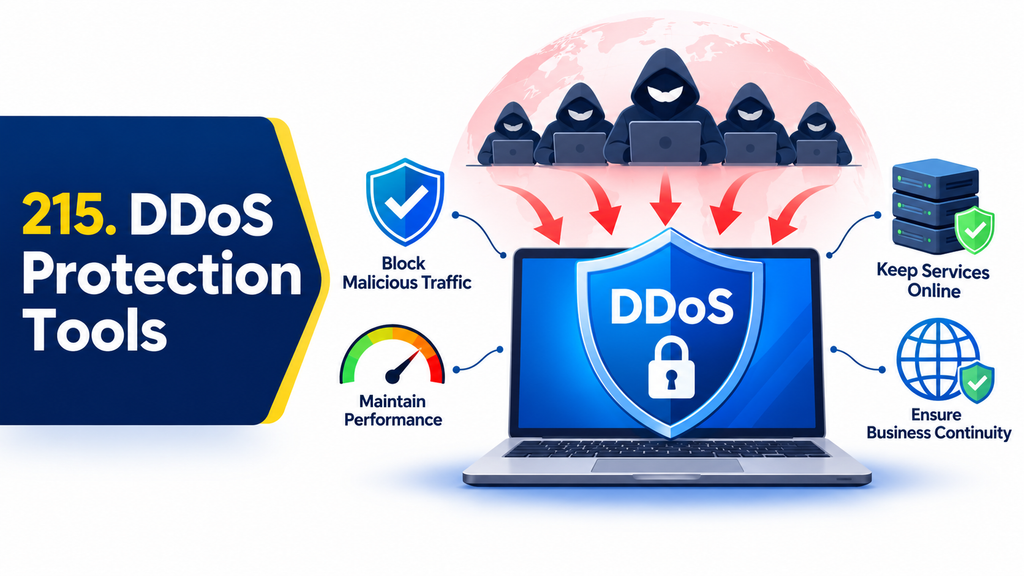
Distributed Denial-of-Service (DDoS) attacks are among the most disruptive cybersecurity threats facing modern businesses. These attacks overwhelm websites, applications, servers, or network infrastructure with massive volumes of malicious traffic, making legitimate services unavailable to users. As organizations increasingly depend on digital platforms, protecting online infrastructure against these attacks has become essential.
DDoS Protection Tools help businesses detect, filter, and mitigate malicious traffic before it can disrupt critical services. These solutions use traffic analysis, intelligent filtering, behavioral monitoring, and automated mitigation techniques to maintain service availability and protect digital infrastructure.
How DDoS Protection Tools Work
DDoS protection solutions continuously monitor incoming network traffic to identify unusual activity and potential attack patterns. When suspicious traffic is detected, the platform analyzes its source, volume, behavior, and characteristics to distinguish legitimate visitors from malicious requests.
Depending on the solution, mitigation techniques may include traffic filtering, rate limiting, IP reputation analysis, traffic rerouting, and web application firewall integration. Some platforms also use machine learning to identify emerging attack patterns and respond automatically.
Popular DDoS Protection Tools
Several established cybersecurity providers offer solutions for defending against distributed denial-of-service attacks:
- Cloudflare: Provides network-layer and application-layer DDoS protection, traffic filtering, and global content delivery infrastructure.
- AWS Shield: Offers managed DDoS protection for applications running on Amazon Web Services, including standard and advanced protection options.
- Akamai Prolexic: Provides large-scale DDoS mitigation designed to protect enterprise networks and critical applications.
- Google Cloud Armor: Helps protect applications hosted on Google Cloud against DDoS attacks and malicious web traffic.
- NETSCOUT Arbor: Offers network visibility, threat detection, and DDoS attack mitigation for service providers and enterprises.
- Radware DefensePro: Provides automated protection against network and application-layer DDoS attacks.
- Imperva DDoS Protection: Protects websites, applications, and network infrastructure against high-volume and sophisticated attacks.
Key Features to Consider
When evaluating DDoS protection software, organizations should consider attack detection accuracy, mitigation speed, network capacity, automated response capabilities, and protection across different network layers.
Scalability is particularly important because attacks can vary significantly in size and complexity. Businesses should also evaluate integration with existing security infrastructure, real-time reporting, centralized management, and service-level commitments.
Benefits of DDoS Protection Tools
Implementing DDoS protection helps organizations maintain website availability, minimize downtime, protect customer experiences, and reduce the financial impact of cyberattacks. These tools also support business continuity by ensuring that essential online services remain accessible during security incidents.
For organizations operating e-commerce platforms, financial services, SaaS applications, or public-facing websites, effective DDoS protection is an important part of a broader cybersecurity strategy.
How to Choose the Right Solution
The right solution depends on an organization’s infrastructure, traffic volume, security requirements, and available budget. Small businesses may benefit from cloud-based protection services, while large enterprises and service providers may require advanced mitigation capabilities with dedicated network-level protection.
Organizations should assess their exposure to different attack types, compare mitigation capabilities, review provider support, and test how effectively a solution integrates with their existing environment.
Conclusion
DDoS Protection Tools play a critical role in protecting digital infrastructure against traffic-based cyberattacks. Solutions from Cloudflare, AWS Shield, Akamai, Google Cloud Armor, NETSCOUT, Radware, and Imperva offer different approaches to detecting and mitigating malicious traffic. Choosing the right platform helps businesses strengthen security, maintain availability, and build a more resilient digital environment.
