Upgrade & Secure Your Future with DevOps, SRE, DevSecOps, MLOps!
We spend hours scrolling social media and waste money on things we forget, but won’t spend 30 minutes a day earning certifications that can change our lives.
Master in DevOps, SRE, DevSecOps & MLOps by DevOps School!
Learn from Guru Rajesh Kumar and double your salary in just one year.
Introduction
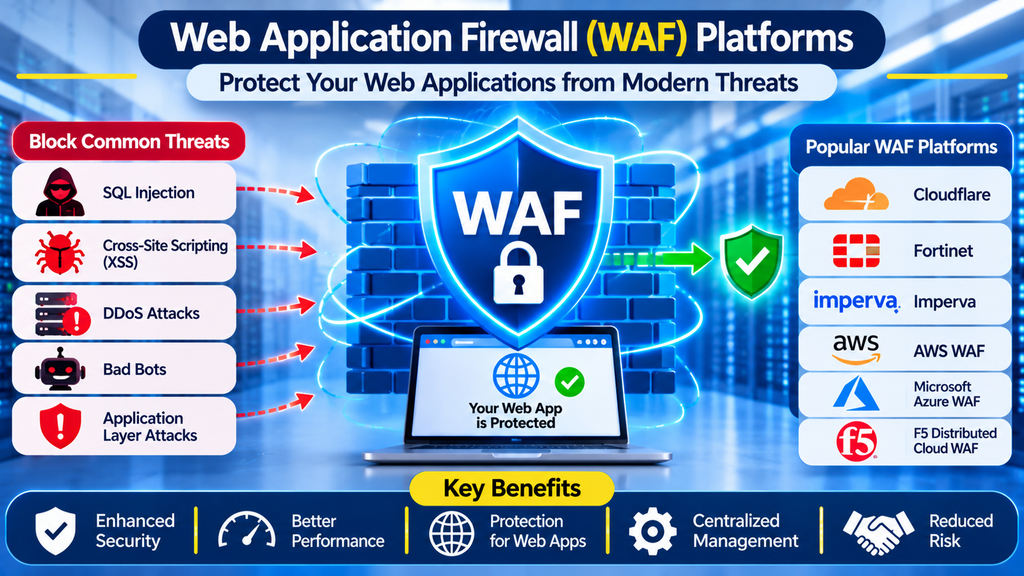
Web applications and APIs are essential to modern businesses, supporting online shopping, customer portals, banking services, SaaS products, and internal business systems. However, applications exposed to the internet can also become targets for attacks such as SQL injection, cross-site scripting, malicious bots, and attempts to exploit application vulnerabilities.
Traditional network firewalls primarily control traffic based on network-level information. Web Application Firewalls (WAFs) add a layer of protection by inspecting HTTP and HTTPS requests and applying rules designed to identify and block suspicious application-layer traffic.
WAF platforms help organizations protect websites, web applications, and supported APIs while maintaining visibility into incoming requests. This guide explores WAF technology, popular platforms, essential features, selection criteria, and best practices.
What Are Web Application Firewall (WAF) Platforms?
A Web Application Firewall is a security control that monitors and filters HTTP and HTTPS traffic between clients and web applications. It applies security rules to help detect and block malicious requests before they reach protected applications.
WAF platforms may be delivered as cloud services, software, virtual appliances, or hardware appliances. Some are integrated with content delivery networks (CDNs), application delivery controllers, API security services, or broader web application and API protection platforms.
Common capabilities include:
- Detecting common web application attack patterns.
- Applying managed and custom security rules.
- Filtering malicious requests and suspicious payloads.
- Providing virtual patching for certain known vulnerabilities.
- Monitoring application traffic and security events.
- Applying rate limits and other traffic controls where supported.
- Protecting supported APIs and application endpoints.
A WAF is not a replacement for secure application development, patching, authentication, or a network firewall. It is one layer in a broader application security strategy.
Why Are WAF Platforms Important?
1. Protection Against Common Web Attacks
WAFs can help detect and block attacks such as SQL injection and cross-site scripting when those attacks match the configured security rules.
2. Application-Layer Visibility
WAF logs can provide information about suspicious requests, targeted endpoints, rule matches, and traffic patterns that may not be apparent from network-level monitoring alone.
3. Virtual Patching
When an application cannot be patched immediately, a carefully tested WAF rule may help reduce exposure to a specific attack pattern. This is a temporary mitigation, not a substitute for fixing the underlying vulnerability.
4. API Protection
Many applications rely on APIs to exchange data. WAF platforms with appropriate API capabilities can help inspect requests, enforce rules, and control suspicious traffic.
5. Traffic and Abuse Controls
Some platforms provide rate limiting, bot controls, and application-layer denial-of-service protections to help reduce abusive or excessive requests.
6. Centralized Security Management
Organizations can use WAF dashboards, policies, alerts, and reports to coordinate protection across multiple websites and applications.
Popular WAF Platforms
1. Cloudflare WAF
Cloudflare WAF provides web application security capabilities through Cloudflare’s edge network.
Key features:
- Managed and custom WAF rules
- Protection against common application attacks
- Integration with Cloudflare CDN and related security services
- Traffic filtering and rule analytics
- Additional traffic-control capabilities depending on the plan
Best suited for: Businesses that want edge-based application protection and centralized management for internet-facing websites and supported applications.
2. AWS WAF
AWS WAF is a web application firewall service that can protect supported AWS resources and certain integrated application endpoints.
Key features:
- Web access control lists and configurable rules
- Managed rule groups and custom rules
- Rate-based rules
- Integration with supported AWS services
- Logging and monitoring integrations
Best suited for: Organizations hosting applications on AWS or using supported AWS-integrated services.
3. Azure Web Application Firewall
Azure Web Application Firewall provides application-layer protection through supported Azure networking and application delivery services, including compatible Application Gateway and Front Door deployments.
Key features:
- Managed and custom security rules
- Detection and prevention modes, depending on the deployment
- Protection against common web attack patterns
- Integration with Azure monitoring services
- Centralized policy management for supported resources
Best suited for: Businesses running web applications in Microsoft Azure that need integrated application security controls.
4. Google Cloud Armor
Google Cloud Armor provides security policies for supported Google Cloud application delivery resources, including protection against certain web attacks and distributed denial-of-service threats.
Key features:
- Security policies and configurable rules
- Application-layer traffic filtering
- Integration with supported Google Cloud load-balancing services
- Rate limiting and adaptive protection capabilities where supported
- Logging and security visibility
Best suited for: Organizations operating applications on Google Cloud and compatible application delivery infrastructure.
5. F5 Distributed Cloud WAAP
F5 offers application security capabilities through its Distributed Cloud platform, including web application and API protection features. Exact functionality depends on the selected service and deployment.
Key features:
- Web application and API protection capabilities
- Security policy management
- Traffic inspection and threat mitigation
- Integration with supported application delivery environments
- Centralized visibility for supported services
Best suited for: Organizations that need managed application security across distributed or hybrid environments.
6. Imperva WAF
Imperva provides web application security products and services designed to protect websites, applications, and APIs.
Key features:
- Application-layer attack protection
- Managed security rules
- Website and API protection capabilities
- Security event monitoring and reporting
- Deployment options depending on the product
Best suited for: Businesses that need dedicated application security and managed protection for internet-facing services.
7. Fortinet FortiWeb
FortiWeb is Fortinet’s web application firewall offering, designed to protect web applications and APIs in supported deployment environments.
Key features:
- Web application attack detection and mitigation
- Security policies and traffic inspection
- Application and API protection capabilities
- Integration with supported Fortinet security infrastructure
- Logging and monitoring
Best suited for: Organizations that want a dedicated WAF and may benefit from integration with their broader Fortinet security environment.
Comparison of WAF Platforms
| Platform | Main strength | Common use case |
|---|---|---|
| Cloudflare WAF | Edge-based web protection | Public websites and internet-facing applications |
| AWS WAF | AWS service integration | Applications on supported AWS resources |
| Azure WAF | Microsoft Azure integration | Azure-hosted applications |
| Google Cloud Armor | Google Cloud integration | Google Cloud application delivery |
| F5 Distributed Cloud WAAP | Distributed application security | Hybrid and distributed applications |
| Imperva WAF | Dedicated application protection | Websites and APIs requiring managed security |
| Fortinet FortiWeb | Dedicated WAF with Fortinet integration | Enterprise web application security |
Capabilities, pricing, supported integrations, and deployment models vary. Confirm current product documentation and service limits before making a decision.
Essential Features to Look For
Managed Security Rules
Managed rule sets can provide protection against common web attacks. Check how frequently rules are updated, how exceptions are configured, and whether the rules fit your application.
Custom Rule Creation
Organizations need the flexibility to define rules for their own endpoints, request patterns, trusted sources, and business requirements.
Detection and Blocking Modes
Some platforms allow policies to run in a monitoring or detection mode before blocking requests. This helps teams identify false positives before enforcing a policy in production.
API Security Capabilities
If the application exposes APIs, examine support for API discovery, schema validation, request inspection, authentication-related controls, and abuse detection. These features vary considerably between WAF products.
Bot and Rate-Limiting Controls
Rate limits and bot-management integrations can help reduce automated abuse, credential attacks, scraping, and excessive request volumes.
Logging and Alerting
Look for searchable logs, rule-match details, dashboards, alerting, and integration with security information and event management (SIEM) systems.
High Availability and Scalability
The platform should accommodate normal traffic, expected growth, and traffic spikes while meeting your application’s availability requirements.
Automation and Integration
APIs, infrastructure-as-code support, and integration with deployment pipelines can help maintain consistent policies across environments.
Compliance and Data Handling
Review logging retention, data residency, encryption, access controls, and the organization’s applicable regulatory obligations.
How to Choose the Right WAF Platform
1. Map Your Applications
List websites, APIs, hosting environments, domains, load balancers, and public endpoints that require protection.
2. Identify Your Threats
Assess risks such as injection attacks, malicious automation, API abuse, application-layer denial of service, and exposure of sensitive endpoints.
3. Match the Deployment Model
Choose a cloud-managed, integrated cloud service, software-based, or appliance-based solution according to your infrastructure and operational needs.
4. Evaluate Application Compatibility
Test how the WAF handles legitimate traffic, cookies, authentication flows, file uploads, API requests, and application-specific behavior.
5. Measure False Positives
Review how easily security rules can be tuned without creating excessive exceptions or blocking legitimate users.
6. Assess Operational Requirements
Consider monitoring, incident response, policy deployment, automation, access controls, and the expertise required to maintain the platform.
7. Compare Total Cost of Ownership
Evaluate subscriptions, traffic or request limits, additional security modules, support, implementation, logging costs, and ongoing administration.
8. Run a Proof of Concept
Test the platform using representative application traffic. Verify detection, blocking, logging, rate limiting, exception handling, and rollback procedures before broad deployment.
WAF Deployment Best Practices
- Inventory exposed applications: Ensure all relevant websites and APIs are covered.
- Start in monitoring mode when appropriate: Review alerts and false positives before enabling aggressive blocking.
- Use managed rules carefully: Understand the rules you enable and test their effect on legitimate application behavior.
- Create narrow exceptions: Avoid broad exclusions that unintentionally weaken protection.
- Keep applications patched: Use the WAF as an additional security layer, not as a substitute for fixing vulnerabilities.
- Protect origin servers: Where architecture permits, restrict direct access to origins so traffic cannot simply bypass the WAF.
- Monitor security events: Review rule matches, unusual traffic, and repeated attacks against sensitive endpoints.
- Tune rate limits: Base thresholds on normal application behavior to avoid blocking legitimate users.
- Integrate with incident response: Send relevant logs and alerts to the team’s monitoring and response workflows.
- Test changes before production: Validate rules with representative requests and document rollback procedures.
- Review API coverage: Confirm that important endpoints, methods, and request types are included in the protection policy.
- Reassess regularly: Application changes, new endpoints, and evolving threats require ongoing policy reviews.
Common WAF Challenges
False Positives
A WAF may block legitimate requests when security rules conflict with normal application behavior. Testing, careful tuning, and narrow exceptions help reduce disruption.
Encrypted Traffic and Inspection
HTTPS traffic must be inspected at an appropriate termination point for a WAF to evaluate its application-layer content. Deployment architecture and certificate management therefore matter.
Complex Applications
Applications with dynamic request patterns, custom protocols over HTTP, or specialized integrations may require additional policy tuning and testing.
Incomplete API Visibility
New or undocumented API endpoints may not receive the intended protection if they are not discovered, included in policy scope, or monitored properly.
Overreliance on the WAF
A WAF cannot eliminate all application vulnerabilities or replace secure coding, identity controls, dependency management, and patching.
Performance and Availability
Inspection, routing changes, or incorrect policies can affect latency and availability. Monitor performance and test failover behavior according to business requirements.
Conclusion
WAF platforms help organizations protect websites and supported APIs by inspecting application traffic, enforcing security rules, and providing visibility into suspicious requests. They can reduce exposure to common web attacks, support virtual patching, and strengthen application security when deployed correctly.
The best platform depends on hosting infrastructure, application architecture, traffic patterns, API requirements, operational expertise, and budget. Combining a well-configured WAF with secure development, timely patching, strong identity controls, and continuous monitoring creates a more resilient application security strategy.
