Upgrade & Secure Your Future with DevOps, SRE, DevSecOps, MLOps!
We spend hours scrolling social media and waste money on things we forget, but won’t spend 30 minutes a day earning certifications that can change our lives.
Master in DevOps, SRE, DevSecOps & MLOps by DevOps School!
Learn from Guru Rajesh Kumar and double your salary in just one year.
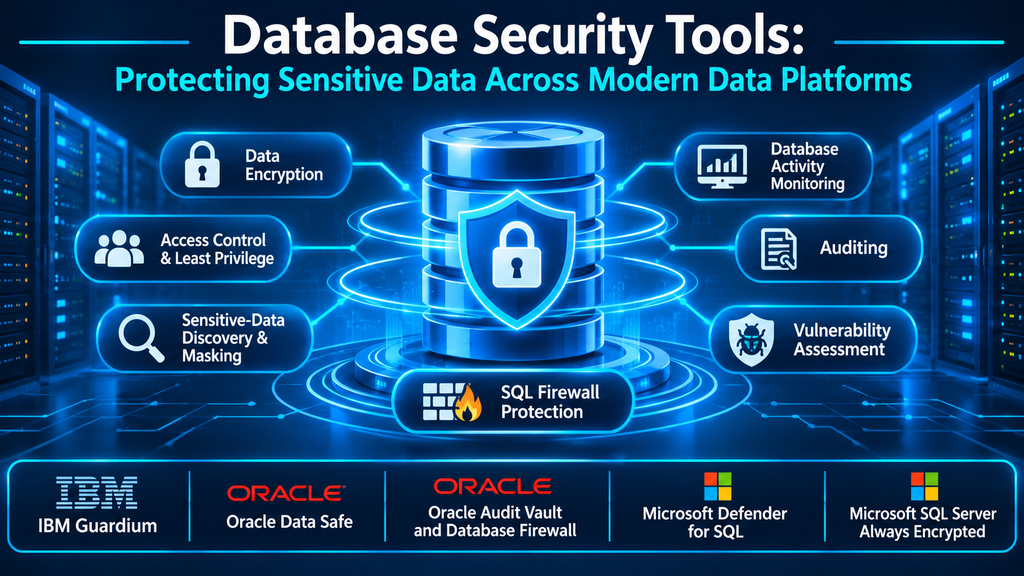
Database Security Tools: Protecting Sensitive Data Across Modern Data Platforms
Databases hold some of an organization’s most valuable information: customer records, financial transactions, employee details, credentials, intellectual property, and operational data. They are also attractive targets for attackers and insiders because a successful compromise can expose large volumes of sensitive information at once. Database security tools help organizations reduce that risk through access controls, encryption, monitoring, auditing, vulnerability assessment, data discovery, and masking.
The category is broader than a single product type. Some tools protect data inside a particular database engine; others monitor activity across heterogeneous database estates, identify sensitive records, or help enforce security policies. Choosing the right approach starts with understanding what needs protection and where existing controls leave gaps.
What database security tools are designed to protect
A database can be exposed through weak credentials, excessive privileges, unpatched software, insecure application queries, misconfigured network access, compromised service accounts, or inappropriate access by privileged administrators. A comprehensive strategy addresses these risks at several layers.
- Identity and access management: Authenticate users and applications, enforce least privilege, and control administrative access.
- Encryption: Protect data at rest and in transit, and where appropriate protect sensitive values while applications process them.
- Activity monitoring and auditing: Record database actions, identify suspicious behavior, and preserve evidence for investigations.
- Vulnerability and configuration assessment: Find insecure settings, missing patches, excessive permissions, and known weaknesses.
- Sensitive data discovery and classification: Locate personal, financial, health, and other regulated or confidential information.
- Masking and tokenization: Reduce exposure in development, testing, analytics, and other environments where real values are unnecessary.
- Database firewall and query controls: Detect or restrict suspicious database requests and unexpected SQL behavior.
No single control covers every threat. Encryption does not prevent an authorized account from reading data, while auditing does not automatically block a malicious query. Effective database security combines preventive, detective, and recovery-oriented measures.
Database security platforms and tools to evaluate
| Tool or platform | Main focus | Where it may fit |
|---|---|---|
| IBM Guardium | Data discovery, activity monitoring, risk assessment, and compliance | Heterogeneous enterprise database environments |
| Oracle Data Safe | Oracle database security assessment, user assessment, auditing, discovery, and masking | Oracle database estates, including supported cloud and on-premises deployments |
| Oracle Audit Vault and Database Firewall | Database audit collection, monitoring, alerting, and SQL firewall capabilities | Centralized monitoring across supported database platforms |
| Microsoft Defender for SQL | Threat detection and vulnerability assessment for SQL environments | Azure SQL and supported SQL Server deployments |
| SQL Server security features | Encryption, access control, auditing, and data masking | Organizations operating Microsoft SQL Server and Azure SQL |
These products are not identical substitutes. Some provide centralized security management, while others are native database controls or cloud-integrated protection services. Validate supported database versions, deployment models, and licensing before comparing feature lists.
IBM Guardium
IBM Guardium is a family of data security capabilities covering areas such as database discovery, sensitive data classification, vulnerability assessment, activity monitoring, access controls, and compliance reporting.
IBM’s documentation describes monitoring database activity at a granular level, including actions performed through enterprise applications. This is important because database access does not always appear under a human user’s direct account: applications and service identities can perform queries on behalf of many end users. A monitoring system needs enough context to make those actions meaningful.
Guardium is worth evaluating for organizations that need centralized visibility across large or heterogeneous database estates. Buyers should examine the exact Guardium components and modules required, supported data sources, deployment architecture, collection methods, performance impact, and integration with their SIEM and incident response processes.
Official documentation: IBM Guardium overview and IBM Guardium data security.
Oracle Data Safe
Oracle Data Safe provides database security assessment, user assessment, activity auditing, sensitive data discovery, and data masking capabilities for supported Oracle databases. Its unified console helps teams review security posture and manage relevant database security activities.
Data Safe can help identify risky user privileges, assess configuration settings, discover sensitive information, and collect audit activity. Its masking capabilities are useful when teams need safer nonproduction data while preserving relationships required by testing or development workflows.
Oracle also documents SQL Firewall capabilities in its database security portfolio. Buyers should distinguish features delivered by Data Safe from features built into particular Oracle Database releases and verify the availability and configuration requirements for their target version.
Data Safe is a natural candidate for organizations with Oracle database estates, including supported on-premises and cloud deployments. It is less appropriate to assume it provides one uniform control plane for every non-Oracle database in a mixed estate.
Official documentation: Oracle Data Safe features and Oracle AI Database security.
Oracle Audit Vault and Database Firewall
Oracle Audit Vault and Database Firewall (AVDF) focuses on collecting and analyzing database audit information, monitoring database activity, and supporting alerts and reports. Oracle describes heterogeneous monitoring capabilities for supported platforms, including Oracle Database, MySQL, Microsoft SQL Server, PostgreSQL, MongoDB, IBM Db2, and SAP Sybase.
The Database Firewall component adds a layer for monitoring and controlling database traffic according to supported policies. This is useful when organizations need insight into SQL activity beyond what application logs or network monitoring can provide. It can help identify suspicious query patterns and policy violations, but it should complement—not replace—secure application development, database permissions, and patch management.
AVDF is worth investigating when centralized database auditing and activity monitoring are priorities, particularly in mixed database environments. Check the current supported platforms and versions, collection approach, policy capabilities, and expected operational overhead.
Official resource: Oracle Database Security.
Microsoft Defender for SQL
Microsoft Defender for SQL provides security capabilities for supported SQL environments through Microsoft’s cloud security ecosystem. Microsoft documents threat protection and vulnerability assessment features that can help identify suspicious database activity and security weaknesses.
For Azure SQL, protection and monitoring can be integrated with broader Azure security and logging services. For SQL Server, the available experience depends on deployment and onboarding configuration. Organizations should check the exact service scope rather than assume that every SQL Server instance receives the same capabilities automatically.
Defender for SQL is relevant to teams already using Azure and Microsoft security operations. Its value is strongest when alerts are connected to a defined triage process, owners are assigned to remediation, and findings are correlated with identity, infrastructure, and application telemetry.
Official documentation: Microsoft Defender for SQL and Secure Azure SQL Database.
Microsoft SQL Server security features
Microsoft SQL Server includes database security controls that can be used without treating a separate monitoring product as the first line of defense. These include Transparent Data Encryption (TDE), Always Encrypted, SQL Server Audit, row-level security, and dynamic data masking.
TDE protects database files and related data at rest. Always Encrypted is designed to protect selected sensitive data so that the database engine does not necessarily see plaintext values, depending on configuration and the cryptographic operation. Row-level security restricts which rows a user can access, while dynamic data masking changes how selected values are presented to users who lack the relevant permissions. SQL Server Audit records configured database and server events.
These features solve different problems. Dynamic data masking, for example, is not a substitute for encryption or strong authorization; privileged users and appropriately authorized queries may still access underlying values. Always Encrypted also introduces application and query compatibility considerations that must be tested.
Official resource: Microsoft SQL Server data security.
Choosing controls by security objective
A practical database security architecture maps each risk to a control that can address it.
| Security objective | Controls to consider | Important limitation |
|---|---|---|
| Prevent unauthorized logins | Strong authentication, managed identities, MFA where supported, network restrictions | Valid credentials can still be abused if privileges are excessive |
| Limit data access | Least privilege, role-based access, row-level security, privileged access controls | Permissions require regular review and ownership |
| Protect stored data | TDE, file or volume encryption, managed keys | Encryption at rest does not stop authorized queries from returning data |
| Protect sensitive fields | Always Encrypted, application-level encryption, tokenization | Application compatibility and key custody must be planned |
| Detect suspicious queries | Activity monitoring, audit policies, database firewall controls | Detection quality depends on coverage, context, and tuning |
| Reduce nonproduction exposure | Static or dynamic masking, data subsetting, synthetic data | Masking must preserve required relationships without leaking original values |
| Find weaknesses | Vulnerability assessment, configuration baselines, patch management | Findings need owners, prioritization, and remediation follow-through |
Database encryption: at rest, in transit, and in use
Encryption is a foundational part of database security, but the phrase “database encryption” can describe several different protections.
Encryption at rest protects database files, logs, backups, or storage media when they are not actively being used. Transparent Data Encryption is one common implementation. It reduces the value of stolen storage media or copied database files, but it does not prevent an authorized database session from reading records.
Encryption in transit protects connections between applications, database clients, and servers, commonly using TLS. This helps prevent interception or modification of network traffic. It should be configured with appropriate certificate validation and modern cryptographic settings.
Protection of data in use is more complex. Techniques such as client-side encryption, Always Encrypted, confidential computing, and application-level cryptography can reduce exposure during processing, but each has different compatibility and operational tradeoffs. Organizations should define exactly which actors must be prevented from seeing plaintext and test whether the selected technology meets that requirement.
Key management is inseparable from encryption. Teams need clear ownership of key generation, storage, rotation, backup, recovery, and revocation. A database encrypted with a key that cannot be recovered may be unavailable permanently; a key accessible to too many administrators may weaken the intended protection.
Sensitive data discovery and masking
Organizations cannot apply proportionate controls if they do not know where sensitive information resides. Database discovery and classification tools scan supported data sources to identify records and fields that may contain personal identifiers, payment information, health data, credentials, or other confidential content.
Classification helps teams prioritize access controls, retention rules, encryption, monitoring, and compliance reviews. It is not a security control by itself: identifying a sensitive column does not prevent someone from reading it.
Masking reduces exposure by replacing or obscuring sensitive values. Static masking changes data in a copy or nonproduction dataset. Dynamic masking changes what a user sees at query time according to configured rules. Data subsetting creates smaller datasets containing only selected records or relationships.
For realistic testing, masking must preserve referential integrity and application behavior. It must also avoid predictable transformations that allow the original values to be reconstructed. Teams should verify that backups, exports, logs, and downstream analytics do not reintroduce unmasked data.
Database activity monitoring and auditing
Database activity monitoring provides visibility into queries, logins, administrative actions, schema changes, and access to sensitive objects. Auditing records selected events for accountability, investigation, and compliance evidence.
A useful monitoring program establishes a baseline of expected activity and identifies events that deserve investigation. Examples include unusual access to sensitive tables, repeated failed logins, unexpected privilege changes, queries from unfamiliar hosts, bulk exports, and database activity outside normal application patterns.
Monitoring should cover more than interactive administrator sessions. Service accounts, application identities, batch jobs, data pipelines, and cloud-managed database services can all access sensitive information. Without identity and application context, alerts may be difficult to interpret.
Audit collection also creates operational responsibilities. Logs need secure storage, appropriate retention, access restrictions, time synchronization, and review processes. Excessive logging can increase cost and make important events harder to find, so policies should focus on useful evidence and risk.
How to select database security tools
Before evaluating vendors, build an inventory of database platforms, versions, locations, owners, applications, and data classifications. Then use the following criteria to compare solutions:
- Database coverage: Confirm support for the database engines, versions, cloud services, and deployment models actually in use.
- Protection depth: Separate capabilities for access control, encryption, masking, auditing, monitoring, firewalling, and vulnerability assessment.
- Collection architecture: Understand whether monitoring uses agents, native audit interfaces, network inspection, APIs, or a combination.
- Performance impact: Test query latency, resource use, connection handling, and behavior under production-like load.
- Identity context: Check whether the tool can distinguish individual users, application identities, service accounts, and privileged sessions.
- Policy quality: Evaluate how rules are created, tuned, tested, and maintained as applications change.
- Integration: Verify connections to SIEM, SOAR, identity providers, ticketing systems, cloud monitoring, and incident response workflows.
- Key custody: Review HSM support, external key management, separation of duties, and recovery processes where encryption is involved.
- Audit and compliance: Confirm retention, reporting, evidence export, and access restrictions for audit data.
- Total operating cost: Include licensing, database coverage, infrastructure, storage, professional services, tuning, and ongoing administration.
A proof of concept should test realistic database traffic, sensitive-data queries, privilege escalation attempts, bulk extraction patterns, and alert handling. It should also measure the effect of monitoring on database performance and test what happens if a monitoring component becomes unavailable.
Common database security mistakes
- Relying only on perimeter security: Network controls cannot replace database-level identity, authorization, and auditing.
- Using shared or overprivileged accounts: Shared credentials make accountability difficult and increase the impact of compromise.
- Assuming encryption solves access problems: Encryption at rest does not prevent an authorized but malicious query.
- Ignoring nonproduction environments: Test and analytics databases often contain copied production records and may have weaker controls.
- Leaving default or stale accounts active: Unused accounts and excessive privileges create avoidable attack paths.
- Failing to monitor service identities: Application accounts can access large amounts of data without obvious human activity.
- Collecting logs without reviewing them: Audit data has limited value if alerts are not triaged and evidence is not retained properly.
- Treating vulnerability findings as completed work: Assessment must lead to patching, configuration changes, or documented risk acceptance.
Final perspective: build layered protection around the data
Database security is not a product purchase; it is a coordinated set of controls around the information an organization stores and processes. IBM Guardium can be relevant for centralized visibility and monitoring across heterogeneous environments. Oracle Data Safe and Audit Vault address important parts of Oracle’s database security ecosystem, while Microsoft Defender for SQL and SQL Server’s native controls are relevant to Microsoft database deployments.
The strongest approach combines identity governance, least privilege, encryption, sensitive-data discovery, masking, monitoring, auditing, patching, and tested recovery. Organizations should choose tools based on actual database coverage and operational requirements—not on a feature checklist alone. When controls are mapped to the data, continuously reviewed, and connected to incident response, databases become much harder to misuse and easier to defend.
