Upgrade & Secure Your Future with DevOps, SRE, DevSecOps, MLOps!
We spend hours scrolling social media and waste money on things we forget, but won’t spend 30 minutes a day earning certifications that can change our lives.
Master in DevOps, SRE, DevSecOps & MLOps by DevOps School!
Learn from Guru Rajesh Kumar and double your salary in just one year.
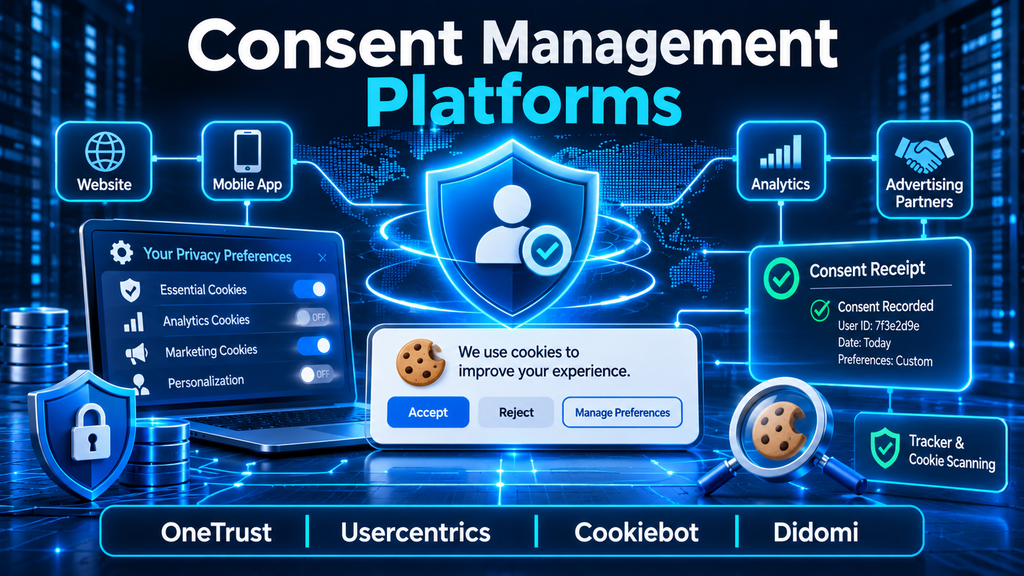
Consent Management Platforms: Managing User Preferences, Privacy Choices, and Regulatory Compliance
Introduction
Every time someone visits a website, opens a mobile application, or interacts with a digital service, technologies may collect information about their activity. Cookies, analytics scripts, advertising pixels, software development kits (SDKs), and embedded third-party services can all process data.
Organizations need a reliable way to explain these activities, collect appropriate user choices, and ensure that those choices are respected. This is the role of a Consent Management Platform (CMP).
A CMP provides the technology to present consent experiences, record user preferences, control applicable tracking technologies, and communicate consent signals to connected systems. It helps organizations operationalize privacy requirements while giving users greater transparency and control.
However, displaying a cookie banner is only one part of the process. Effective consent management requires accurate technology discovery, appropriate configuration, reliable integrations, and continuous verification.
What Is a Consent Management Platform?
A Consent Management Platform is software that helps organizations collect, store, manage, and communicate individuals’ consent and privacy preferences.
A typical CMP provides a consent interface through which visitors can accept, reject, or customize optional data-processing activities. It then records the selected preferences and communicates relevant signals to websites, applications, advertising partners, analytics services, and other connected technologies.
Core capabilities commonly include:
- Consent banners: Displaying privacy notices and choice options to visitors.
- Preference centers: Allowing users to manage granular choices by purpose or category.
- Cookie and tracker discovery: Identifying cookies, scripts, pixels, SDKs, and third-party services.
- Consent enforcement: Preventing applicable technologies from running before the required permission is obtained.
- Consent records: Maintaining evidence of the user’s choices and subsequent changes.
- Geolocation-based configuration: Presenting different consent experiences according to applicable regional requirements.
- Consent signal management: Communicating preferences to advertising and analytics ecosystems.
- Reporting and monitoring: Providing visibility into consent activity, banner performance, and configuration changes.
A CMP is not a substitute for a complete privacy program or legal assessment. It provides technical and operational capabilities that support an organization’s consent strategy.
Why Organizations Need Consent Management Platforms
1. Digital properties use many tracking technologies
Modern websites can load technologies from analytics providers, advertising networks, customer engagement platforms, video services, social media integrations, and other external vendors.
These technologies may change as marketing teams add campaigns or developers update applications. A CMP helps maintain an inventory and makes it easier to identify technologies that require consent controls.
2. Privacy requirements differ across regions
Organizations serving international audiences may need to support different rules concerning consent, opt-outs, transparency, and tracking.
A CMP can help configure location-aware experiences and communicate appropriate preferences. However, the organization must still determine which legal requirements apply to each processing activity.
3. User preferences must be respected after collection
A consent choice is useful only if connected systems act on it. If a visitor rejects optional advertising cookies but an advertising script still executes, the consent interface and actual website behavior are inconsistent.
A CMP should therefore connect the choice interface with tag managers, scripts, SDKs, and relevant downstream platforms.
4. Consent records support accountability
Organizations may need to demonstrate what a user was told, what choices were available, what they selected, and whether the choice subsequently changed.
Reliable records help privacy, legal, and compliance teams investigate questions and respond to audits.
5. Manual consent management becomes difficult to maintain
Managing separate banners, spreadsheets, tracking inventories, and preference records across multiple websites creates operational complexity.
A centralized CMP can standardize configurations and provide a consistent management process across digital properties.
Essential Features of a Modern CMP
Consent banners and preference centers
The banner is often the first interaction between a visitor and an organization’s consent system. It should communicate relevant information clearly and make the available choices understandable.
A preference center provides more detailed control over categories or purposes, such as analytics, personalization, and advertising.
When evaluating this feature, consider:
- Clear and understandable language.
- Accessible design and keyboard navigation.
- Mobile responsiveness.
- Multiple language support.
- Custom branding and layout.
- Equally usable acceptance and rejection paths where required.
- An easy way to revisit and change preferences.
A visually attractive banner is not necessarily a well-designed consent experience. The choices must be meaningful and technically enforceable.
Cookie and tracker scanning
Automated scanning helps identify technologies operating across a website or application.
A useful scanner should detect more than familiar browser cookies. Depending on the product and environment, it may identify scripts, tracking pixels, embedded services, and other technologies that process visitor information.
Scanning should be repeated after website changes, marketing deployments, and application updates. Automated discovery does not eliminate the need for manual verification, especially for dynamically loaded technologies and authenticated user journeys.
Consent enforcement and script blocking
Consent enforcement is one of the most important CMP capabilities.
The platform should help prevent technologies that require permission from loading before the applicable choice has been received. It should also ensure that preference changes are reflected in subsequent processing.
Organizations should test:
- Whether scripts execute before consent.
- Whether rejected categories remain blocked.
- Whether consent withdrawal changes website behavior.
- Whether tag managers respect consent signals.
- Whether embedded third-party services are controlled.
- Whether the behavior remains consistent across pages and subdomains.
A banner that records choices without controlling the associated technologies offers only part of the required protection.
Consent records and audit trails
A consent record should provide enough information to reconstruct the relevant event.
Depending on the use case, useful evidence may include:
- A timestamp for the consent event.
- The applicable notice or banner version.
- The categories and purposes presented.
- The user’s recorded preferences.
- Relevant configuration or policy changes.
- The consent identifier or associated identity information, where appropriate.
- Subsequent updates or withdrawals.
The organization should also define how long records are retained and who can access them.
Geolocation and regulatory configuration
A CMP may provide different banner configurations based on visitor location, jurisdiction, or other contextual rules.
This is useful for organizations operating multiple websites across regions. However, geolocation is not a complete legal decision engine. Location signals may be inaccurate, and the organization must determine the appropriate treatment of each activity.
Integration with advertising and analytics systems
Consent signals often need to reach systems such as tag managers, analytics platforms, customer data platforms, advertising technology, and marketing automation tools.
Relevant standards and mechanisms may include:
- Google Consent Mode.
- IAB Transparency and Consent Framework (TCF).
- IAB Global Privacy Platform (GPP).
- Global Privacy Control (GPC), where applicable.
- Vendor-specific consent APIs and preference signals.
Support for a standard does not automatically mean every connected vendor is configured correctly. Integration testing remains essential.
Leading Consent Management Platforms
The following platforms illustrate different approaches to consent collection, preference management, and enforcement. Product capabilities, integrations, and available features can vary by package and deployment.
1. OneTrust Consent Management Platform
<text weight=”medium”>Vendor:</text> <Entity value=”OneTrust” category=”company” disambig=”Privacy, security, and governance software provider”/>
OneTrust offers consent management capabilities for websites, mobile applications, and connected digital environments. Its platform includes cookie and tracker discovery, customizable consent experiences, preference management, and consent records.
It is worth evaluating for organizations that need to coordinate consent across multiple digital properties and connect user choices with broader privacy and data governance workflows.
Key evaluation areas:
- Automated cookie and tracker discovery.
- Geolocation-aware and multilingual banners.
- Consent receipts and change history.
- Script blocking and consent enforcement.
- Integration with advertising, analytics, and customer data systems.
Official product information: https://www.onetrust.com/products/consent-management/
2. Usercentrics CMP
<text weight=”medium”>Vendor:</text> <Entity value=”Usercentrics” category=”company” disambig=”Consent and privacy management software provider”/>
Usercentrics provides consent management for web, mobile, and other digital environments. Its offerings include customizable consent banners, preference management, consent documentation, and mechanisms for managing data-processing services.
The platform is relevant to organizations that want configurable consent experiences and support for different digital channels.
Key evaluation areas:
- Website and mobile consent capabilities.
- Service-based consent configuration.
- Customizable banner experiences.
- Cross-domain consent sharing where supported.
- Integration with tag management and advertising ecosystems.
Official documentation: https://usercentrics.com/docs/
3. Cookiebot CMP
<text weight=”medium”>Vendor:</text> <Entity value=”Cookiebot” category=”software” disambig=”Website cookie consent management platform”/>
Cookiebot CMP focuses on website cookie consent and related tracking controls. Its capabilities include cookie scanning, consent banners, category-based preferences, and mechanisms for blocking non-essential services before consent.
It may be suitable for organizations looking for a website-focused solution with a relatively straightforward implementation model.
Key evaluation areas:
- Automated website scanning.
- Cookie categorization and monitoring.
- Consent banners and privacy triggers.
- Consent records and preference updates.
- Integration with website platforms and tag management.
Official product information: https://www.cookiebot.com/
4. Didomi Consent Management Platform
<text weight=”medium”>Vendor:</text> <Entity value=”Didomi” category=”company” disambig=”Consent and preference management technology provider”/>
Didomi provides consent and preference management across websites, applications, and connected digital environments. Its platform emphasizes centralized consent experiences, regional configuration, consent records, and analytics.
It is relevant to organizations managing multiple domains, markets, and digital channels.
Key evaluation areas:
- Multi-domain and multi-channel consent.
- Customizable consent interfaces.
- Consent event history and evidence.
- Analytics and banner performance monitoring.
- Integration with advertising and data platforms.
Official product information: https://www.didomi.io/consent-management-platform
CMP Comparison
| Platform | General approach | Key areas to evaluate | Potential fit |
|---|---|---|---|
| OneTrust | Enterprise consent and preference management | Discovery, enforcement, consent records, integrations | Organizations managing multiple digital properties |
| Usercentrics | Configurable web and app consent | Banner customization, service control, cross-domain support | Businesses with varied digital channels |
| Cookiebot | Website-focused cookie consent | Scanning, categorization, blocking, consent records | Websites seeking structured cookie management |
| Didomi | Multi-channel consent and preference management | Regional configuration, analytics, cross-domain management | Organizations operating across multiple markets |
This is a product-positioning comparison, not an independent performance ranking. Buyers should verify specific features, technical limits, certification status, and package availability with vendors.
Understanding Consent Standards and Signals
Consent management becomes more complicated when organizations work with advertising and analytics ecosystems. Standardized signals help communicate user preferences between publishers, platforms, and technology providers.
Google Consent Mode
Google Consent Mode allows supported Google tags and services to adjust their behavior according to consent signals.
A CMP can communicate the relevant consent state, but implementation must be tested to ensure that tags receive the correct signals at the correct time.
IAB Transparency and Consent Framework
The IAB Transparency and Consent Framework provides a standardized mechanism for communicating consent and related preferences between publishers and participating advertising technology vendors.
Organizations operating in the relevant advertising ecosystem should verify that their CMP meets the applicable framework requirements and that their vendor configurations are correct.
Global Privacy Platform
The IAB Global Privacy Platform provides a framework for transmitting privacy and consent signals across supported jurisdictions and regulatory environments.
It can help organizations communicate applicable privacy choices to participating advertising partners.
Global Privacy Control
Global Privacy Control is a browser-level signal that can communicate a user’s privacy preference, including an opt-out preference where applicable.
Organizations should evaluate how their CMP detects and processes GPC signals and whether downstream systems honor the resulting preference.
Standards evolve, and support for a particular version should be confirmed during procurement and implementation.
How to Choose the Right CMP
Start with the digital environment
Identify every website, mobile application, domain, subdomain, and connected service that requires consent management.
Include marketing landing pages, embedded services, authenticated areas, and regional websites. A solution that works on the main website may not cover every digital property.
Define the applicable consent requirements
Work with privacy and legal teams to determine the relevant jurisdictions, processing activities, and consent or opt-out requirements.
Do not assume that one banner configuration will be appropriate for every visitor or every type of data processing.
Validate tracker discovery
Ask vendors to scan representative websites and applications. Compare the results with independent browser inspection, developer tools, and tag manager configurations.
The evaluation should include dynamically loaded scripts, embedded content, and technologies that appear only after particular user actions.
Test enforcement, not just presentation
A CMP demonstration should show what happens before consent, after acceptance, after rejection, and after withdrawal.
Verify that the platform actually controls the technologies involved rather than simply recording a preference.
Review integrations
Confirm that the CMP works with the organization’s existing tag manager, analytics services, advertising partners, mobile SDKs, and customer data systems.
Review API capabilities, integration ownership, error handling, and the process for maintaining connections after software updates.
Examine consent evidence
Determine whether the platform can produce reliable records of consent events and configuration changes.
Ask how the records can be exported, retained, searched, and presented during an audit or investigation.
Evaluate usability and performance
Consent interfaces affect the visitor experience. Test banner loading time, accessibility, mobile behavior, language quality, and how the interface performs on slower connections.
The CMP should not introduce unnecessary delays or create confusing interactions.
Common CMP Implementation Challenges
Incomplete cookie and tracker discovery
Automated scanners may miss technologies that load conditionally, after user interaction, or through complex application flows.
Recommendation: Combine automated scanning with manual testing across important pages and user journeys.
Incorrect consent categorization
A technology may be assigned to the wrong category, or its purpose may change after an application update.
Recommendation: Establish clear ownership for technology classification and periodically review categories with privacy and technical teams.
Scripts firing before consent
Poor tag manager configuration can allow optional tracking scripts to execute before the CMP has initialized or communicated the relevant consent state.
Recommendation: Test script execution at page load and verify the order in which the CMP and dependent technologies initialize.
Inconsistent consent across domains
Visitors may be asked repeatedly for the same preferences when moving between related websites or subdomains.
Recommendation: Evaluate cross-domain consent capabilities, identity boundaries, and the legal appropriateness of sharing consent records.
Treating acceptance rates as the primary success measure
A banner that encourages acceptance through confusing design may increase opt-ins without providing a meaningful or trustworthy experience.
Recommendation: Measure clarity, accessibility, preference changes, enforcement accuracy, and compliance evidence alongside interaction rates.
Failing to maintain configurations
New marketing tags, analytics tools, and embedded services can be introduced after the CMP has been deployed.
Recommendation: Integrate CMP reviews into website release processes and perform recurring scans.
A Practical CMP Deployment Roadmap
Phase 1: Discover digital properties
Create an inventory of websites, applications, domains, subdomains, trackers, and third-party services.
Phase 2: Define consent requirements
Work with privacy, legal, marketing, and engineering teams to document relevant purposes, categories, jurisdictions, and consent rules.
Phase 3: Select and configure the platform
Choose a CMP based on coverage, integration requirements, usability, evidence capabilities, and total cost. Configure banners, preference centers, categories, and regional rules.
Phase 4: Integrate and enforce
Connect the CMP with tag managers, analytics tools, advertising platforms, and relevant application SDKs. Configure blocking and consent signal propagation.
Phase 5: Test real user journeys
Test first-time visits, returning visitors, acceptance, rejection, preference changes, withdrawal, regional experiences, and mobile interactions.
Phase 6: Monitor and improve
Schedule recurring scans, review new trackers, monitor integration failures, validate consent records, and update configurations as the digital environment changes.
Questions to Ask CMP Vendors
- Which websites, mobile platforms, and digital channels are supported?
- How frequently are cookies, trackers, and third-party services discovered?
- Can the platform block technologies before consent is obtained?
- How does it handle consent withdrawal and preference updates?
- Which versions of relevant industry frameworks are supported?
- Does it support Google Consent Mode and applicable IAB signals?
- Can consent records be exported with their associated evidence?
- How does cross-domain or cross-device consent work?
- What happens when an integration fails or a consent signal is unavailable?
- Which capabilities require additional licensing?
- How does the solution affect website performance and accessibility?
- What tools are available for ongoing monitoring and configuration changes?
A proof of concept should test actual website behavior rather than relying exclusively on a vendor’s demonstration environment.
The Future of Consent Management
Consent management is expanding beyond traditional cookie banners.
Organizations increasingly need to coordinate preferences across websites, mobile applications, customer data platforms, connected devices, and AI-enabled services. This creates a need for consent information that can be understood and enforced across multiple systems.
Several developments are shaping this evolution:
- Unified preference management: Connecting consent choices with broader communication and personalization preferences.
- Server-side tracking governance: Applying consent controls to data flows that do not rely exclusively on browser-side scripts.
- Mobile and connected-device consent: Extending preference management to applications, games, and connected television environments.
- Automated technology discovery: Improving visibility into newly introduced trackers and data-processing services.
- AI-related consent governance: Understanding how user permissions apply to data used by AI systems and connected services.
- Continuous compliance monitoring: Detecting configuration changes that may cause actual website behavior to diverge from documented preferences.
The direction is clear: consent management is becoming an ongoing data governance function rather than a one-time website implementation.
Conclusion
Consent Management Platforms help organizations translate privacy choices into operational controls. They provide the infrastructure to discover tracking technologies, present transparent consent experiences, record preferences, control applicable scripts, and communicate signals to connected systems.
Selecting the right CMP requires more than comparing banner designs. Organizations should evaluate tracker discovery, enforcement accuracy, integrations, consent evidence, accessibility, and ongoing maintenance.
Most importantly, consent must remain meaningful after the visitor makes a choice. A platform is successful when the organization’s actual data-processing behavior reflects the preferences it has collected.
As digital ecosystems expand across websites, applications, advertising platforms, and AI services, reliable consent management will remain an important foundation for responsible data use and customer trust.
