Upgrade & Secure Your Future with DevOps, SRE, DevSecOps, MLOps!
We spend hours scrolling social media and waste money on things we forget, but won’t spend 30 minutes a day earning certifications that can change our lives.
Master in DevOps, SRE, DevSecOps & MLOps by DevOps School!
Learn from Guru Rajesh Kumar and double your salary in just one year.
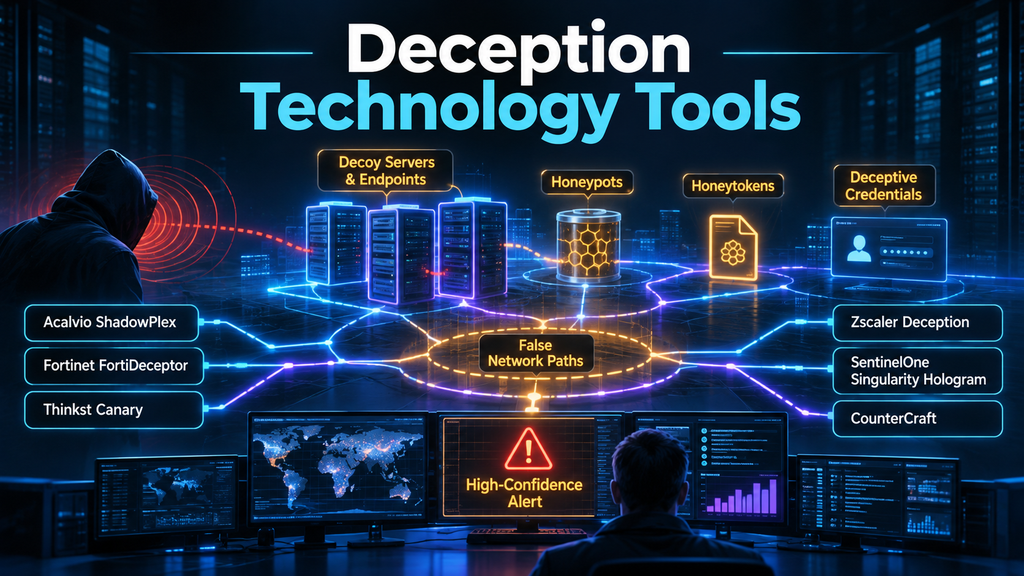
Deception Technology Tools: Turning Attacker Curiosity into High-Confidence Security Alerts
Cybersecurity teams have invested heavily in firewalls, endpoint detection, identity protection, vulnerability management, and security monitoring. Yet attackers can still enter enterprise environments, steal credentials, explore internal systems, and move toward valuable assets without immediately triggering a clear alert.
One reason is that many traditional security controls focus on identifying malicious behavior within legitimate systems. Deception technology takes a different approach: it introduces carefully designed fake assets into the environment and monitors whether anyone interacts with them.
These assets can include decoy servers, fake databases, deceptive credentials, honeytokens, simulated applications, and misleading network paths. Legitimate employees and systems should have no reason to access them. When an unauthorized actor does, the interaction can provide a strong indication of suspicious activity.
Modern deception platforms extend beyond standalone honeypots. They can distribute deceptive assets across endpoints, networks, cloud infrastructure, identity systems, and operational technology environments.
For security teams, the goal is not simply to catch attackers in a trap. It is to detect their intentions earlier, understand their techniques, and provide actionable information for containment and investigation.
What Is Deception Technology in Cybersecurity?
Deception technology is a proactive security approach that uses fabricated digital assets to attract, identify, and monitor unauthorized activity.
These assets are designed to resemble legitimate enterprise resources. Attackers conducting reconnaissance or moving through a compromised environment may discover and interact with them.
Examples include:
- Decoy servers: Simulated systems that resemble production servers or infrastructure.
- Honeypots: Controlled systems designed to attract and observe suspicious activity.
- Honeytokens: Fake credentials, files, API keys, database records, or other digital artifacts that trigger alerts when accessed.
- Deceptive credentials: Fabricated usernames, passwords, or access tokens intended to reveal credential misuse.
- Decoy applications: Fake business applications or services that expose unauthorized access attempts.
- Breadcrumbs: Misleading information planted in an environment to encourage attackers to follow a monitored path.
- Decoy network shares: Fake file shares and directories that help identify unauthorized exploration.
The effectiveness of deception depends on making these assets believable without allowing them to expose real business information or create unnecessary operational risk.
Why Organizations Are Adopting Deception Technology
Traditional security controls remain essential, but they do not always provide immediate evidence that an attacker is exploring an environment.
Deception adds another detection layer that can help reveal activity earlier in an intrusion.
1. Detecting lateral movement
After gaining an initial foothold, attackers often attempt to discover other systems, identify privileged accounts, and move between network segments.
Deception tools can place decoy systems and credentials in locations that attract this activity.
An attempt to use a deceptive credential or connect to a decoy server can provide an early warning that an attacker is moving beyond the initial access point.
2. Identifying compromised credentials
Stolen credentials are frequently used to access enterprise applications, directories, and infrastructure.
Organizations can distribute fake credentials or honeytokens in controlled locations. If an attacker collects and uses them, the resulting event can help identify unauthorized credential activity.
These mechanisms are particularly useful when combined with identity monitoring and incident response workflows.
3. Reducing alert investigation overhead
Security operations centers receive alerts from endpoint agents, firewalls, identity systems, cloud services, and network monitoring tools.
Many alerts require correlation and investigation before analysts can determine whether an incident is genuine.
A properly configured deception alert can be more actionable because legitimate users should not normally interact with the decoy. However, poor placement, accidental discovery, and incorrect assumptions can still create misleading alerts.
4. Detecting insider threats
Not every threat originates outside the organization.
An employee, contractor, or compromised internal account may attempt to access sensitive information without authorization.
Decoy documents, credentials, and file shares can help expose unusual internal access patterns that conventional monitoring might not immediately identify.
5. Improving threat intelligence
Deception platforms can capture information about how an attacker interacts with decoys.
Depending on the product and deployment, this may include attempted connections, commands, credential usage, reconnaissance activity, and other indicators of attacker techniques.
Security teams can use this information to improve detection rules, investigate incidents, and refine defensive controls.
How Deception Technology Works
Although implementations differ, most deception platforms follow a common process.
Step 1: Identify valuable assets and attack paths
Security teams identify the systems, identities, applications, and network areas that need additional monitoring.
These may include Active Directory, file servers, cloud workloads, administrative systems, databases, and critical operational technology.
Step 2: Design realistic decoys
The platform creates deceptive assets that resemble legitimate infrastructure.
Examples include fake file shares, simulated servers, database credentials, cloud resources, and decoy user accounts.
The decoys should be convincing enough to attract unauthorized activity without being confused with production assets by legitimate administrators.
Step 3: Distribute lures and breadcrumbs
Deceptive artifacts are placed at selected locations where attackers may encounter them during reconnaissance or lateral movement.
Examples include fabricated credentials, fake configuration files, misleading network references, and decoy documents.
Step 4: Monitor interactions
The deception platform monitors access attempts and interactions with its assets.
When a decoy is accessed, the platform records relevant information and generates an alert.
Step 5: Analyze attacker activity
Security teams review the event to understand what was accessed, which account or system was involved, and whether the activity suggests a broader intrusion.
Some platforms provide additional context, attack reconstruction, or integration with security analytics tools.
Step 6: Respond and contain
Depending on the organization’s response policy, the platform may notify analysts, forward events to a SIEM, or initiate automated actions through EDR, SOAR, identity, or firewall integrations.
Automatic isolation or credential revocation should be implemented carefully and tested to avoid disrupting legitimate business operations.
Leading Deception Technology Tools
Deception products vary considerably in their architecture and intended use. Some focus on enterprise-scale distributed deception, while others emphasize lightweight canary systems or integration with an existing security platform.
The following tools illustrate several approaches to the category.
1. Acalvio ShadowPlex
Acalvio ShadowPlex is an enterprise deception platform designed to detect threats through deceptive assets across multiple environments.
Its portfolio includes deception capabilities for advanced threat defense, identity protection, and cloud security. The platform uses decoys, honeytokens, deceptive credentials, and deceptive attack paths to expose suspicious activity.
Relevant capabilities include:
- Deception across IT, cloud, identity, and operational technology environments.
- Honeytokens and deceptive credentials.
- Detection of credential misuse and lateral movement.
- Cloud deception capabilities for supported environments.
- Threat investigation and intelligence.
- Integration with security operations workflows.
Where it fits: ShadowPlex is worth evaluating when an organization needs a broader deception program spanning multiple infrastructure and identity environments.
What to assess: Examine deployment architecture, supported asset types, decoy management, integration with existing security tools, and the operational effort required to maintain realistic deceptive assets.
Official product information: https://www.acalvio.com/products/
2. Fortinet FortiDeceptor
FortiDeceptor is Fortinet’s deception-based breach detection platform. It is designed to expose in-network threats, including credential misuse, reconnaissance, lateral movement, and ransomware-related activity.
The product uses deception assets to attract suspicious interactions and provide security teams with information about attacker behavior.
Relevant capabilities include:
- Deception assets across IT, OT, and IoT environments.
- Detection of lateral movement and suspicious credential use.
- Active Directory deception.
- Ransomware detection using decoy files.
- Attack activity analysis and forensic information.
- Integration with Fortinet Security Fabric and third-party security tools.
- Deployment options that include hardware, virtual, and cloud-based models.
Where it fits: FortiDeceptor is worth considering for organizations seeking deception capabilities across enterprise networks and operational technology environments, particularly those already using Fortinet security products.
What to assess: Evaluate supported decoy types, network segmentation requirements, response integrations, hardware or virtual deployment needs, and compatibility with existing security operations workflows.
Official product information: https://www.fortinet.com/products/fortideceptor
3. Thinkst Canary
Thinkst Canary focuses on deploying canary systems and tokens that alert defenders when someone interacts with them.
Thinkst Canary can present decoy services and systems that resemble parts of an organization’s infrastructure. Canarytokens provide another approach, allowing defenders to create deceptive artifacts such as documents, links, or credentials that notify them when accessed.
Relevant capabilities include:
- Canary systems that emulate network services.
- Detection of interactions with deceptive assets.
- Canarytokens for files, links, credentials, and other artifacts.
- Alerting through supported notification and integration mechanisms.
- Lightweight deployment options.
- OpenCanary, an open-source daemon maintained by Thinkst.
Where it fits: Thinkst Canary is worth evaluating when an organization wants straightforward, focused detection through decoy systems and canary tokens.
What to assess: Review the available deployment models, supported integrations, alert routing, token coverage, and the amount of manual work needed to distribute and maintain canaries.
Official product information: https://thinkst.com/
4. Zscaler Deception
Zscaler Deception extends deception capabilities through the Zscaler Zero Trust Exchange architecture.
It uses decoys and deceptive assets to expose suspicious activity across enterprise environments, including network, endpoint, cloud, and identity-related attack paths.
Relevant capabilities include:
- Decoy servers and applications.
- Deceptive credentials and endpoint lures.
- Detection of reconnaissance and lateral movement.
- Active Directory deception.
- Cloud and network deception use cases.
- Threat investigation and activity analysis.
- Integration with the broader Zscaler platform and supported security workflows.
Where it fits: Zscaler Deception is worth considering for organizations that want to incorporate deception into a broader Zscaler security and zero-trust architecture.
What to assess: Examine supported deployment models, decoy coverage, integration requirements, event handling, and how deception alerts connect to the organization’s incident response processes.
Official product information: https://www.zscaler.com/products-and-solutions/deception-technology
Deception Technology Platform Comparison
| Platform | Main approach | Notable evaluation areas |
|---|---|---|
| Acalvio ShadowPlex | Distributed enterprise deception | Cloud, identity, IT, and OT coverage |
| Fortinet FortiDeceptor | Network and infrastructure deception | IT/OT decoys and Fortinet integrations |
| Thinkst Canary | Canary systems and tokens | Simplicity, token coverage, and alerting |
| Zscaler Deception | Deception integrated with zero-trust services | Enterprise decoys and platform integration |
This is a functional comparison rather than a universal ranking. Product capabilities, licensing, deployment options, and integration depth should be confirmed against the organization’s specific requirements.
Deception Technology vs. Traditional Honeypots
The terms honeypot and deception technology are related, but they do not always describe the same level of capability.
A honeypot is generally a controlled decoy system designed to attract suspicious activity. It may imitate a server, service, or application and record interactions.
Modern deception platforms can coordinate many types of deceptive assets across a larger environment. They may include fake credentials, endpoint breadcrumbs, cloud resources, identity decoys, and automated response integrations.
| Area | Traditional honeypot | Modern deception platform |
|---|---|---|
| Deployment | Often a standalone decoy | Can distribute multiple deceptive assets |
| Coverage | Usually focused on selected systems | May span endpoints, networks, cloud, and identity |
| Credential deception | May be limited | Can include deceptive credentials and tokens |
| Management | May require manual administration | Often provides centralized management |
| Threat intelligence | Captures activity on the honeypot | Can correlate interactions across multiple decoys |
| Response | Often depends on manual investigation | May integrate with SIEM, SOAR, and EDR |
| Scalability | Depends on the implementation | Designed to support broader environments |
A traditional honeypot can still be valuable, especially for research, controlled testing, or a focused detection use case. The choice depends on whether the organization needs a small number of decoys or a coordinated enterprise deception layer.
Important Use Cases for Deception Technology
1. Active Directory protection
Active Directory environments contain user accounts, groups, credentials, and privileged access relationships that attackers frequently investigate after gaining access.
Deceptive accounts and credentials can help reveal unauthorized enumeration and credential misuse.
2. Ransomware detection
Ransomware operators may explore file systems and attempt to identify valuable data before encrypting files.
Decoy files and directories can provide early signals when suspicious processes interact with them.
Organizations should ensure that the decoys are isolated from real business data and that alerts are connected to appropriate containment procedures.
3. Cloud security
Cloud environments introduce additional attack paths involving identities, storage, workloads, and exposed services.
Deceptive cloud resources and credentials can help identify unauthorized exploration and access attempts.
4. Insider threat monitoring
Deception can help detect employees or compromised internal accounts that access sensitive resources without a legitimate business reason.
The placement of decoys must be carefully governed to respect employee privacy, internal policies, and applicable regulations.
5. Operational technology security
Manufacturing, energy, utilities, and other industrial environments may contain legacy systems that cannot easily support conventional endpoint monitoring.
Specialized deception capabilities can provide additional visibility into suspicious activity targeting industrial assets.
OT deployments require particular care because decoy interactions, network changes, or response automation must not interfere with safety-critical operations.
6. Threat hunting and incident investigation
During an investigation, deception events can help security teams understand whether an attacker has explored specific systems or attempted to use particular credentials.
This information can support threat hunting and help prioritize investigation activities.
Key Features to Evaluate Before Choosing a Deception Tool
Selecting a deception platform requires more than comparing the number of available decoy types.
Coverage across environments
Check whether the platform supports the organization’s actual infrastructure, including:
- Windows and Linux systems.
- Active Directory and identity services.
- Network infrastructure.
- Cloud workloads and storage.
- SaaS applications, where supported.
- Containers and Kubernetes environments, where relevant.
- Operational technology and IoT devices.
Realistic decoy creation
Decoys should resemble legitimate resources without exposing real credentials, production data, or sensitive information.
Ask how the platform creates and updates deceptive assets and how it avoids conflicts with legitimate systems.
Centralized management
Large organizations need a manageable way to deploy, update, monitor, and retire deceptive assets.
Evaluate whether administrators can manage decoys centrally and understand their status across different locations.
Alert quality and investigation context
A useful deception alert should provide enough information for analysts to understand what happened.
Review the available event details, timestamps, source systems, account information, and activity history.
SIEM and SOAR integration
Deception alerts should fit into existing security operations workflows.
Check support for the organization’s SIEM, SOAR, EDR, identity, and incident management tools.
Automated response
Some deployments may use deception events to trigger actions such as endpoint isolation, access revocation, or firewall blocking.
Automation should be configurable, auditable, and tested against realistic scenarios.
Deployment and maintenance
Evaluate whether the platform requires virtual appliances, agents, network changes, cloud permissions, or dedicated infrastructure.
Also consider how much ongoing work is required to keep decoys realistic as the production environment changes.
Common Challenges When Deploying Deception Technology
Deception can provide valuable detection signals, but poorly designed deployments may create operational problems.
1. Unrealistic decoys
If decoys are easy to identify, experienced attackers may ignore them.
Organizations should consider how deceptive assets fit into real network naming conventions, service configurations, and environment layouts.
2. Accidental interaction by legitimate users
Administrators, automated scripts, vulnerability scanners, and monitoring systems may interact with decoys.
These events can create confusion unless the organization documents expected behavior and configures appropriate exclusions or context.
3. Poor placement
A decoy that is never discovered or accessed may provide little detection value.
Placement should be guided by likely attacker paths, high-value assets, identity exposure, and realistic access patterns.
4. Unclear incident ownership
A high-confidence alert still requires a defined response process.
Security teams should know who investigates, who approves containment, and how deception events are escalated.
5. Overreliance on deception
Deception is not a replacement for endpoint protection, identity security, network segmentation, vulnerability management, or secure configuration.
It is an additional detection and threat intelligence layer.
6. Operational and safety risks
Deception deployments in production networks and OT environments require careful testing.
Decoys should not expose real data, create unexpected routes, interfere with safety systems, or disrupt business-critical applications.
How to Implement a Deception Technology Program
A phased implementation helps organizations introduce deception without creating unnecessary complexity.
Phase 1: Identify objectives
Define the main use cases. These might include detecting lateral movement, identifying compromised credentials, monitoring sensitive file shares, or improving visibility across cloud environments.
Phase 2: Map the environment
Identify important network segments, identities, servers, applications, and cloud resources. Understand which areas are most likely to be targeted.
Phase 3: Select appropriate decoys
Choose deceptive assets that match the intended use cases. A credential-focused deployment will require different assets from an OT deception deployment.
Phase 4: Define placement and ownership
Determine where each decoy should be placed, which team owns it, and how it will be maintained.
Phase 5: Integrate security monitoring
Connect alerts to the appropriate SIEM, SOAR, ticketing, or incident response systems. Ensure analysts receive sufficient context.
Phase 6: Test detection and response
Run controlled simulations to confirm that decoys trigger the expected alerts and that response workflows operate correctly.
Phase 7: Expand coverage gradually
Start with a focused deployment and expand to additional systems and environments after validating operational effectiveness.
Phase 8: Review and improve
Measure alert usefulness, investigation time, decoy coverage, response effectiveness, and maintenance effort. Update the deception strategy as the environment changes.
Questions to Ask Vendors During a Proof of Concept
A structured proof of concept can help determine whether a deception platform is suitable for the organization’s environment.
- Which decoy types are supported?
- Can deceptive assets be deployed across endpoints, networks, cloud, and identity systems?
- How are decoys kept realistic as infrastructure changes?
- Does the platform support automated deployment and centralized management?
- How does it distinguish legitimate administrative activity from suspicious interaction?
- What event information is available when a decoy is accessed?
- Which SIEM, SOAR, EDR, and identity integrations are supported?
- Can response actions be automated or require analyst approval?
- What infrastructure, agents, permissions, or network changes are required?
- How does the product support cloud and OT environments?
- How are decoys protected from accidental access or misuse?
- What are the licensing and ongoing maintenance requirements?
The proof of concept should measure detection quality, operational effort, integration reliability, and the usefulness of the resulting security intelligence.
The Future of Deception Technology
Deception technology is evolving alongside cloud adoption, identity-centric attacks, automation, and AI-assisted threat activity.
As attackers automate reconnaissance and explore more systems in parallel, security teams need detection mechanisms that can expose malicious intent without relying exclusively on lengthy behavioral analysis.
Several developments are shaping the category.
AI-assisted deception management
Automation can help security teams recommend, create, and maintain decoys as environments change. The objective is to reduce manual administration while keeping deceptive assets relevant.
Cloud and identity deception
Cloud identities, service accounts, API keys, and workload permissions create additional opportunities for deceptive credentials and resources.
Organizations are likely to place greater emphasis on detecting unauthorized access across these environments.
Deception for AI infrastructure
As businesses deploy AI applications, agents, and model services, deception may extend to decoy APIs, fake credentials, simulated AI services, and misleading data resources.
These techniques can help identify suspicious exploration of AI infrastructure, although their effectiveness depends on implementation and the attack scenario.
Deeper security operations integration
Deception alerts can become more useful when connected to endpoint, identity, network, and cloud telemetry.
Combining these signals can help analysts understand an incident and decide whether automated containment is appropriate.
Final Thoughts
Deception technology gives organizations another way to detect attackers by changing what they encounter inside an enterprise environment. Instead of relying only on indicators of suspicious behavior, it introduces decoys and deceptive assets that provide useful signals when accessed without authorization.
Platforms such as Acalvio ShadowPlex, Fortinet FortiDeceptor, Thinkst Canary, and Zscaler Deception illustrate different approaches to this category, from distributed enterprise deception to focused canary systems and security-platform integration.
The right solution depends on the organization’s infrastructure, threat model, deployment requirements, and security operations maturity.
A successful deception program requires realistic decoys, thoughtful placement, reliable alerting, and a clear response process. When combined with established security controls, deception can improve visibility into attacker activity and help defenders identify threats earlier in the intrusion lifecycle.
