Upgrade & Secure Your Future with DevOps, SRE, DevSecOps, MLOps!
We spend hours scrolling social media and waste money on things we forget, but won’t spend 30 minutes a day earning certifications that can change our lives.
Master in DevOps, SRE, DevSecOps & MLOps by DevOps School!
Learn from Guru Rajesh Kumar and double your salary in just one year.
SASE Platforms: Bringing Networking and Cloud Security Together for the Distributed Enterprise
Secure Access Service Edge (SASE) has become an important architectural approach for organizations supporting remote employees, branch offices, cloud applications, and distributed infrastructure. As business operations move beyond traditional corporate networks, organizations need networking and security services that can protect users wherever they connect.
Historically, networking and security were managed through separate technologies. SD-WAN optimized connectivity, while firewalls, web gateways, VPNs, and other security products enforced protection policies. This separation often created complex architectures, inconsistent controls, and operational overhead.
SASE addresses this challenge by converging networking and security capabilities into a cloud-delivered architecture. It aims to provide consistent access, threat protection, and policy enforcement across users, devices, branches, and applications.
However, not all SASE platforms are architecturally identical. Some vendors deliver networking and security through a single integrated service, while others combine separate networking and security products. Understanding these differences is essential when evaluating a SASE investment.
What Is Secure Access Service Edge (SASE)?
Secure Access Service Edge is an architecture that brings together network connectivity and security services, typically delivered through cloud-based infrastructure.
A SASE platform helps organizations connect users and locations to applications while applying security policies close to the point of access.
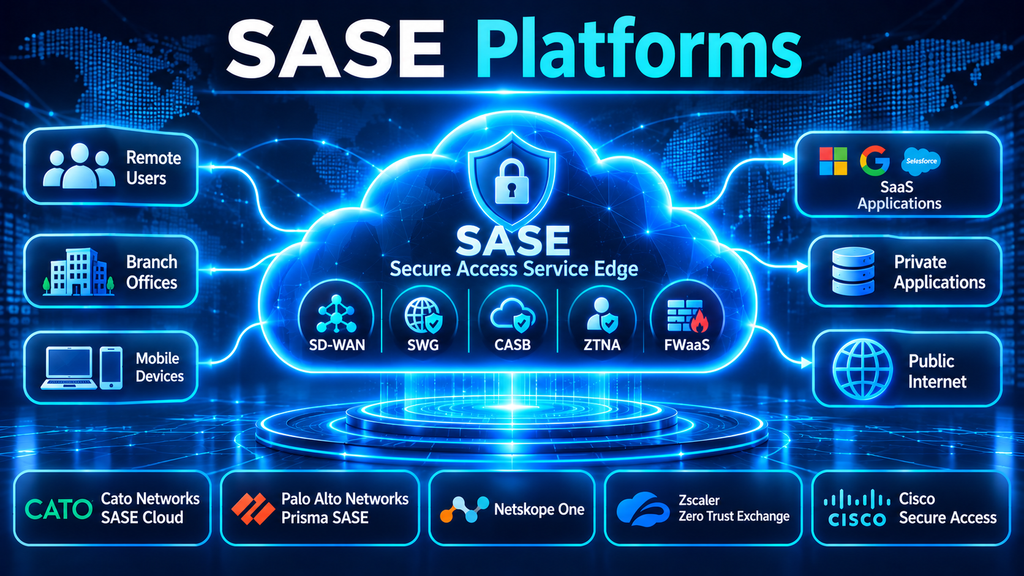
A typical SASE architecture combines:
- Software-Defined Wide Area Networking (SD-WAN): Optimizes connectivity between branch offices, data centers, cloud environments, and users.
- Secure Web Gateway (SWG): Protects users from malicious websites, unsafe downloads, and web-based threats.
- Cloud Access Security Broker (CASB): Provides visibility and controls for SaaS application usage and cloud data.
- Zero Trust Network Access (ZTNA): Grants identity- and context-based access to private applications.
- Firewall as a Service (FWaaS): Delivers cloud-based firewall and traffic inspection capabilities.
- Data Loss Prevention (DLP): Helps identify and control sensitive information across supported channels.
These capabilities may be delivered through one integrated service or assembled from multiple products. The distinction matters because a platform marketed as SASE does not necessarily provide identical depth across every component.
Why Organizations Are Moving Toward SASE
Traditional enterprise networks were built around corporate offices, data centers, and centralized security gateways. Modern organizations operate differently.
Employees connect from homes, branch offices, hotels, and mobile networks. Applications run across SaaS platforms, public cloud environments, private data centers, and hybrid infrastructure.
This creates several challenges.
1. Fragmented networking and security tools
Organizations may operate separate products for SD-WAN, VPN, firewall protection, web filtering, cloud security, and remote access.
Each product can introduce its own management interface, policy structure, reporting system, and support requirements.
SASE aims to reduce this fragmentation by bringing important networking and security functions into a more unified architecture.
2. Inconsistent security policies
A user working from a corporate office may receive different security treatment from someone accessing the same application remotely.
When traffic follows different network paths, enforcing consistent policies becomes difficult.
Cloud-delivered SASE services can help apply common security policies across distributed access locations.
3. Poor application experience
Centralizing traffic through a distant data center can increase latency, especially when users access cloud applications hosted in other regions.
SASE platforms can route traffic through geographically distributed points of presence and optimize connectivity to improve application performance.
The actual benefit depends on provider coverage, routing design, application location, and network conditions.
4. Increasing remote-work requirements
Remote and hybrid work have made traditional network boundaries less relevant.
Organizations need secure access for employees, contractors, partners, and other users without requiring every connection to pass through a corporate office.
SASE combines remote access, identity-aware security, and networking capabilities to support this model.
5. Growing cloud and data security requirements
Organizations use multiple SaaS applications and cloud environments to store and process business information.
SASE can integrate CASB, DLP, web security, and other controls to help protect information as it moves between users and cloud services.
How a SASE Architecture Works
Although implementations vary, most SASE platforms follow a common operating model.
Step 1: Connect users and locations
Users, branch offices, mobile devices, and remote sites connect to the SASE service through supported clients, tunnels, network appliances, or other access mechanisms.
SD-WAN capabilities can help establish connectivity between branches and cloud-delivered services.
Step 2: Identify the user and device
The platform uses identity and available device information to understand who is connecting and from which endpoint.
Identity providers, endpoint security platforms, and device management systems can supply additional context.
Step 3: Evaluate access policies
The platform evaluates the requested application, user identity, device posture, location, and other available risk signals.
Policies determine whether traffic should be allowed, blocked, inspected, or restricted.
Step 4: Inspect and secure traffic
Depending on the destination and configured policies, traffic may pass through web security, firewall, DLP, CASB, malware inspection, and other security services.
The objective is to enforce appropriate controls without unnecessarily disrupting application performance.
Step 5: Optimize connectivity
SD-WAN and the provider’s network infrastructure help select appropriate traffic paths between users, branches, cloud services, and private applications.
Some platforms provide integrated connectivity over their own global backbones, while others support third-party SD-WAN integrations.
Step 6: Monitor activity and improve policies
Centralized reporting and logging help administrators review security events, troubleshoot performance issues, and refine policies.
Integration with SIEM, SOAR, endpoint security, and identity platforms can support broader security operations.
Core Capabilities to Evaluate in SASE Platforms
A strong SASE evaluation should consider both security depth and networking performance.
| Capability | What it does | Why it matters |
|---|---|---|
| SD-WAN | Manages and optimizes wide-area connectivity | Supports distributed offices and cloud access |
| SWG | Inspects and filters internet traffic | Helps block web-based threats |
| CASB | Controls cloud application usage | Improves SaaS visibility and data protection |
| ZTNA | Provides application-specific access | Reduces unnecessary network exposure |
| FWaaS | Delivers cloud-based firewall inspection | Extends network security across locations |
| DLP | Identifies and controls sensitive data | Reduces data leakage risks |
| Identity integration | Connects policies to user identities | Supports consistent access decisions |
| Threat prevention | Detects malicious content and activity | Helps reduce exposure to cyber threats |
| Digital experience monitoring | Measures application and connection performance | Helps identify user experience problems |
| Centralized management | Unifies policy and reporting workflows | Reduces operational complexity |
Leading SASE Platforms
The following platforms represent different approaches to SASE. Their networking models, security capabilities, licensing structures, and deployment requirements should be evaluated against the organization’s existing environment.
1. Cato SASE Cloud
Cato Networks provides a cloud-native SASE platform designed to converge networking and security services within a unified architecture.
Its platform brings together networking, access, and security functions through a global service infrastructure.
Relevant capabilities include:
- SD-WAN and branch connectivity.
- Secure web gateway and firewall services.
- Cloud access security controls.
- Zero Trust Network Access.
- Data protection capabilities.
- Centralized management and monitoring.
- Integration across distributed users and locations.
Cato is worth evaluating when an organization wants a single-vendor SASE service with integrated networking and security. Buyers should assess global point-of-presence coverage, application performance, migration requirements, and the flexibility needed to coexist with existing network infrastructure.
Official product information: Cato SASE Platform.
2. Palo Alto Networks Prisma SASE
Palo Alto Networks delivers SASE capabilities through its Prisma SASE portfolio, combining Prisma Access with Prisma SD-WAN and related security technologies.
Its architecture connects distributed users and locations to cloud-delivered security services.
Relevant capabilities include:
- Cloud-delivered firewall and threat prevention.
- Secure web gateway functionality.
- Zero Trust Network Access.
- SaaS security and CASB capabilities.
- Data protection and DLP.
- SD-WAN integration.
- Centralized policy and security management.
Prisma SASE is worth evaluating for organizations already using Palo Alto Networks firewalls or planning a security-led SASE transformation. Buyers should examine product packaging, licensing dependencies, SD-WAN integration, traffic routing, and the operational requirements of managing the platform.
Official product information: Palo Alto Networks Prisma SASE.
3. Netskope One
Netskope One combines security services and networking capabilities to support distributed users, branches, and cloud applications.
Its architecture emphasizes cloud application visibility, data protection, secure access, and integration across the broader Netskope platform.
Relevant capabilities include:
- Secure web gateway.
- Cloud access security broker.
- Zero Trust Network Access.
- Data loss prevention.
- Cloud and SaaS security.
- Branch networking and SD-WAN capabilities.
- Digital experience monitoring and operational visibility.
Netskope is worth considering when data protection and cloud application security are major priorities. Buyers should evaluate the integration between security and networking components, application coverage, branch requirements, and the level of platform unification included in their chosen package.
Official product information: Netskope One.
4. Zscaler Zero Trust Exchange
Zscaler’s Zero Trust Exchange is a cloud-delivered security platform built around zero-trust access and inspection.
Its architecture connects users and applications through cloud security services rather than relying exclusively on traditional network perimeter controls.
Relevant capabilities include:
- Zscaler Internet Access for internet and SaaS security.
- Zscaler Private Access for private application connectivity.
- Cloud-delivered firewall services.
- Data protection and DLP.
- Cloud application visibility and controls.
- Zero-trust access policies.
- Branch and workload security options.
Zscaler is worth evaluating for organizations prioritizing cloud-delivered security and application-centric access. Buyers should carefully assess the networking components, branch connectivity requirements, third-party integrations, and whether the chosen architecture meets their definition of single-vendor SASE.
Official product information: Zscaler Zero Trust Exchange.
5. Cisco Secure Access and Cisco SASE
Cisco provides SASE capabilities through its Secure Access and networking portfolio, including SD-WAN technologies and cloud-delivered security services.
Cisco Secure Access provides Security Service Edge capabilities that can form part of a wider Cisco SASE architecture.
Relevant capabilities include:
- Secure web gateway.
- Zero Trust Network Access.
- CASB and data protection capabilities.
- Firewall and DNS security services.
- Identity integration.
- Cloud-delivered policy enforcement.
- Integration with Cisco SD-WAN and networking products.
Cisco is worth evaluating for organizations with significant Cisco or Meraki networking investments. Buyers should assess how Secure Access integrates with the selected SD-WAN architecture, which capabilities require additional subscriptions, and how policy management works across the complete environment.
Official product information: Cisco Secure Access.
SASE Platform Comparison
| Platform | Architectural emphasis | Important evaluation area |
|---|---|---|
| Cato SASE Cloud | Integrated cloud-native networking and security service | Global coverage, migration, and single-platform operations |
| Palo Alto Networks Prisma SASE | Security-led SASE with Prisma Access and SD-WAN | Product packaging, integration, and policy management |
| Netskope One | Cloud security and data protection with networking capabilities | DLP depth, application coverage, and networking integration |
| Zscaler Zero Trust Exchange | Cloud-delivered zero-trust security and access | Branch networking, third-party integrations, and SASE scope |
| Cisco Secure Access and Cisco SASE | SSE integrated with Cisco networking technologies | SD-WAN integration, licensing, and operational consistency |
This comparison is not a universal ranking. Each platform has different strengths, and the right choice depends on existing infrastructure, network architecture, security priorities, and operational requirements.
SASE vs. SSE: Understanding the Difference
SASE and Security Service Edge (SSE) are closely related, but they are not interchangeable.
SASE combines networking and security capabilities. It generally includes SD-WAN alongside security services such as SWG, CASB, ZTNA, and FWaaS.
SSE focuses on the security side of this architecture. It typically includes SWG, CASB, ZTNA, and related cloud-delivered security services without requiring the same integrated SD-WAN component.
In practical terms:
- An organization focused on cloud-delivered security may begin with SSE.
- An organization modernizing both branch networking and security may pursue a broader SASE architecture.
- An organization with an existing SD-WAN investment may integrate it with an SSE platform rather than replace everything immediately.
The distinction is important when evaluating vendor claims. Buyers should identify which components are native, which are integrated from separate products, and which require third-party services.
SASE vs. Traditional Network Security
| Area | Traditional architecture | SASE architecture |
|---|---|---|
| Network design | Often centered on data centers and corporate offices | Supports distributed users, branches, and cloud services |
| Security enforcement | Multiple perimeter and endpoint controls | Cloud-delivered security policy enforcement |
| Remote access | Commonly relies on VPN gateways | Can use ZTNA and other identity-aware access methods |
| Web protection | Separate proxy or secure web gateway | SWG integrated into the wider architecture |
| SaaS security | Often managed through separate tools | CASB and DLP can be integrated |
| Branch connectivity | Routers, MPLS, VPNs, and separate firewalls | SD-WAN integrated with cloud-delivered security |
| Management | Multiple consoles and policy systems | More centralized management, depending on platform |
| User experience | May depend on centralized traffic paths | Can use distributed points of presence and optimized routing |
SASE does not automatically eliminate every traditional network component. Data centers, private circuits, firewalls, and local infrastructure may remain necessary. The architecture should evolve according to actual application and business requirements.
Common SASE Deployment Challenges
SASE can simplify long-term architecture, but migration introduces important technical and organizational considerations.
1. Complex migration from legacy infrastructure
Organizations may have years of firewall rules, VPN configurations, routing policies, and network dependencies.
Replacing these components without understanding their purpose can interrupt critical applications.
Build an inventory of network paths, applications, user groups, branch connections, and security rules before migration.
2. Incomplete integration between components
A vendor may offer several SASE products without delivering a fully unified operating experience.
Policy sharing, reporting, identity context, and logging may vary across modules.
Evaluate how the components work together rather than treating a combined product catalog as proof of complete integration.
3. Network performance and latency
Cloud-delivered inspection introduces additional routing considerations.
Traffic may travel through a service point of presence before reaching its destination. If that point is poorly positioned or overloaded, user experience may suffer.
Test latency, throughput, application responsiveness, and failover behavior from representative locations.
4. Policy complexity
Converging networking and security services can create a large number of policies.
Poorly designed rules may produce conflicts, inconsistent enforcement, or excessive exceptions.
Establish policy ownership, naming conventions, change management, and review procedures.
5. Licensing and commercial complexity
SASE platforms may package SD-WAN, ZTNA, DLP, CASB, firewall services, and monitoring in different subscription tiers.
Some features may require additional licenses or separate products.
Request a complete bill of materials and validate the cost of the actual deployment architecture, not just the advertised entry-level package.
6. Resilience and dependency management
A cloud-delivered architecture depends on provider infrastructure, connectivity, regional availability, and local network conditions.
Review service-level commitments, regional coverage, failover design, and procedures for operating during outages.
How to Implement SASE Successfully
A phased approach can help organizations modernize networking and security without disrupting business operations.
Phase 1: Assess the existing environment
Document current SD-WAN, firewall, VPN, web gateway, CASB, and remote-access technologies. Identify applications, locations, users, and existing security policies.
Phase 2: Define business and security objectives
Determine whether the primary objective is branch modernization, remote-access transformation, cloud security, data protection, or consolidation of networking and security tools.
Phase 3: Select the architecture
Decide whether a single-vendor SASE platform, an integrated SSE and SD-WAN architecture, or a hybrid approach best meets the requirements.
Phase 4: Prioritize use cases
Begin with a manageable scope, such as remote-user access, selected branch offices, or secure internet access. Avoid migrating every network and security function simultaneously.
Phase 5: Design identity and security policies
Define user authentication, device requirements, application access, web filtering, DLP rules, and firewall policies. Establish how these controls will be managed centrally.
Phase 6: Run a representative pilot
Include users from different locations, branch offices, application types, and device categories. Test business-critical workflows and security enforcement.
Phase 7: Measure performance and security outcomes
Monitor application latency, connection reliability, policy enforcement, false positives, support tickets, and incident response workflows.
Phase 8: Expand and optimize
Gradually migrate additional locations and users. Retire legacy services only after validating that their business and technical functions are covered.
Questions to Ask Before Buying a SASE Platform
A practical proof of concept should examine both the networking and security sides of the service.
- Does the platform provide native SD-WAN, or does it rely on third-party integration?
- Which SWG, CASB, ZTNA, FWaaS, and DLP capabilities are included?
- Are security policies shared across networking and access components?
- Where are the provider’s points of presence located?
- How does traffic routing work for SaaS and private applications?
- Can the platform support existing data centers and hybrid cloud environments?
- What integrations are available for identity and endpoint security?
- How does it handle encrypted traffic inspection?
- Can it provide centralized logs and reporting?
- How does it integrate with existing SIEM and SOAR platforms?
- What happens during a provider outage or loss of connectivity?
- Which capabilities require separate subscriptions?
- Can the platform coexist with existing SD-WAN and firewall investments?
The best proof of concept should validate real application performance, policy consistency, deployment effort, and the total operational impact.
The Future of SASE: AI, Automation, and Adaptive Security
SASE is evolving as organizations adopt more cloud services, AI applications, connected devices, and distributed workloads.
AI-enabled tools are creating new security questions. Organizations need visibility into which AI services employees use, what information they share, and whether automated agents can access sensitive applications.
SASE platforms are increasingly incorporating AI-related security controls, data governance, behavioral analytics, and automated policy recommendations.
Network operations are also becoming more automated. Telemetry from users, devices, applications, and network paths can help identify performance problems and guide traffic decisions.
However, automation must be governed carefully. Security teams should understand what data is collected, how automated recommendations are generated, and which policy changes require human approval.
The long-term direction is toward more adaptive networking and security: connectivity and access decisions that respond to identity, application requirements, device health, and changing risk.
Final Thoughts
SASE represents a significant change in how organizations design enterprise networking and security. By bringing SD-WAN and cloud-delivered security services together, it can reduce architectural fragmentation and support consistent protection across remote users, branch offices, and cloud applications.
The best platform is not necessarily the one with the longest feature list. Organizations should examine the depth of each security component, the maturity of networking integration, global performance, licensing, and the practical effort required to operate the service.
A successful SASE transformation begins with a clear understanding of the existing environment and a phased migration strategy. When implemented thoughtfully, SASE can provide a more consistent, scalable foundation for secure connectivity across the distributed enterprise.
