Upgrade & Secure Your Future with DevOps, SRE, DevSecOps, MLOps!
We spend hours scrolling social media and waste money on things we forget, but won’t spend 30 minutes a day earning certifications that can change our lives.
Master in DevOps, SRE, DevSecOps & MLOps by DevOps School!
Learn from Guru Rajesh Kumar and double your salary in just one year.
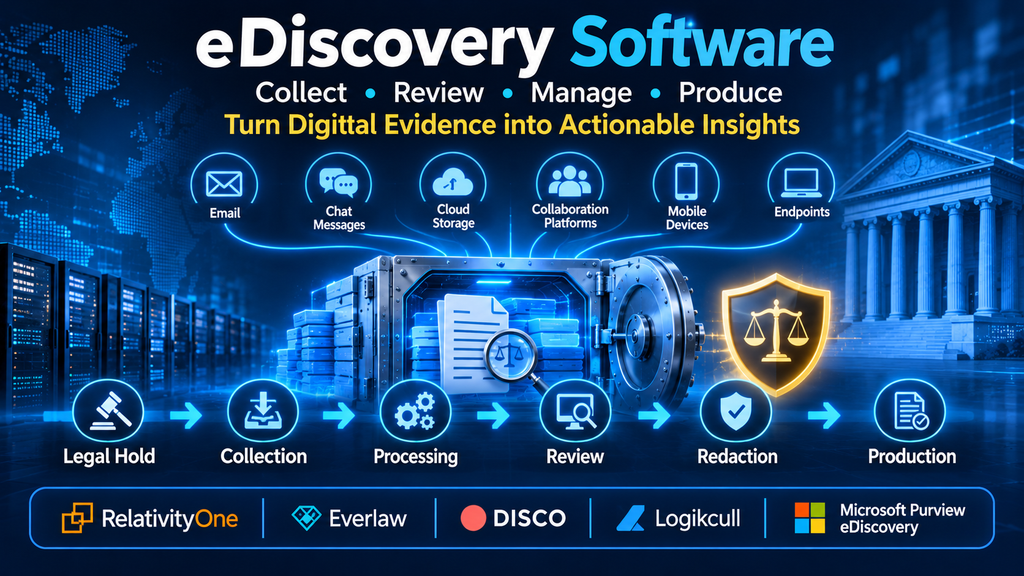
eDiscovery Software: Managing Digital Evidence from Legal Hold to Production
Legal disputes, regulatory investigations, internal inquiries, and data breach investigations increasingly depend on information stored in digital systems. Relevant evidence may be scattered across email accounts, collaboration platforms, cloud storage, mobile devices, business applications, shared drives, and employee endpoints.
Finding that information is only the beginning. Organizations must preserve potentially relevant records, collect them in a defensible manner, process large volumes of material, identify responsive documents, protect privileged information, redact sensitive content, and produce evidence in the required format.
Electronic discovery software, commonly called eDiscovery software, supports this lifecycle. It helps legal departments, law firms, compliance teams, and investigation professionals manage electronically stored information (ESI) from initial identification through review and production.
Modern platforms increasingly use analytics, machine learning, and generative AI to accelerate document review and help investigators identify important facts. Yet automation does not remove the need for defensible processes, human oversight, and careful validation.
The right eDiscovery platform is therefore not simply the one with the most search features. It is the one that can manage relevant data sources, preserve evidence reliably, support the required legal workflow, and make its decisions traceable.
What Is eDiscovery Software?
eDiscovery software is a technology platform used to identify, preserve, collect, process, search, review, analyze, and produce electronically stored information for legal or investigative purposes.
The information involved can include:
- Emails and attachments.
- Documents, spreadsheets, and presentations.
- Chat messages and collaboration records.
- Mobile device and application data.
- Cloud storage and file-sharing content.
- Database records and business application data.
- Social media and other digital communications.
- System logs and other relevant electronic records.
A typical eDiscovery matter may involve thousands or millions of records. The platform helps organize these records, reduce irrelevant material, identify potentially responsive information, and prepare the evidence for legal review or production.
eDiscovery software is used in litigation, regulatory requests, internal investigations, employment disputes, competition matters, data breach response, and other situations where electronic records must be examined systematically.
Understanding the eDiscovery Lifecycle
Many eDiscovery programs use the Electronic Discovery Reference Model (EDRM) as a framework for organizing the process. The stages are connected, but each has distinct operational and legal considerations.
1. Information Governance
Information governance establishes how an organization creates, stores, classifies, retains, and disposes of information.
Good governance makes future discovery more manageable. Clear retention schedules, data ownership, records management, and defensible deletion practices can reduce unnecessary data accumulation.
2. Identification
The legal or investigation team determines which people, systems, applications, devices, and repositories may contain relevant information.
This stage requires collaboration between legal, IT, compliance, security, and business teams. The objective is to understand where potentially relevant records exist before collection begins.
3. Preservation and Legal Hold
When litigation or an investigation creates a preservation obligation, relevant information must be protected from routine deletion or alteration.
Legal hold workflows help notify custodians, track acknowledgements, record preservation actions, and manage hold releases when appropriate.
A notification alone does not guarantee preservation. Organizations must verify that relevant systems, accounts, retention settings, and data sources are actually protected.
4. Collection
Collection involves acquiring potentially relevant information from identified sources.
Depending on the source, this may involve collecting email, files, chat records, cloud content, mobile data, or other electronic records.
Collection methods should preserve relevant metadata and document the process. Teams should understand whether the method captures original content, associated metadata, attachments, versions, and contextual information.
5. Processing
Collected data is prepared for review. Processing may include:
- Extracting text and metadata.
- Expanding compressed files.
- Identifying duplicate records.
- Grouping email families and attachments.
- Optical character recognition (OCR) for scanned documents.
- Indexing content for search.
- Identifying processing exceptions.
- Converting supported file types for review.
Processing quality matters. Unsupported formats, encrypted files, corrupted records, and failed extraction can create gaps if they are not identified and documented.
6. Review and Analysis
Legal professionals examine the processed material to determine relevance, responsiveness, privilege, confidentiality, and other review criteria.
Modern platforms may support keyword searching, filters, email threading, clustering, predictive coding, concept searching, and AI-assisted review.
Human reviewers remain responsible for validating legal decisions and resolving uncertain or sensitive classifications.
7. Redaction and Production
Before producing information, teams may need to redact personal information, confidential business details, privileged content, or other protected material.
Production involves exporting responsive information in an agreed format, often with associated metadata and load files. Production quality should be checked to ensure that documents, attachments, redactions, and metadata are complete and consistent.
Why Organizations Need eDiscovery Software
Managing Growing Volumes of Digital Information
Organizations create information across many applications and devices. Manually identifying and reviewing records across these environments can be slow, expensive, and error-prone.
eDiscovery platforms centralize workflows and provide tools to search, filter, organize, and analyze large evidence collections.
Meeting Preservation Obligations
Failure to preserve relevant records can create legal and regulatory complications.
Legal hold functionality helps organizations identify custodians, issue notices, track acknowledgements, document hold status, and coordinate preservation activities.
Reducing Review Costs and Time
A large matter may contain substantial volumes of irrelevant or duplicate information. Processing, search, analytics, and technology-assisted review can reduce the material requiring manual examination.
The objective is not simply to review fewer documents. It is to identify relevant information accurately while maintaining appropriate quality controls.
Protecting Privileged and Confidential Information
Review teams must identify material that should not be disclosed, including attorney-client privileged communications and confidential information.
Platforms can support privilege workflows, tagging, redaction, access restrictions, and audit trails. These controls reduce operational risk but do not replace legal judgment.
Supporting Regulatory and Internal Investigations
eDiscovery is not limited to litigation. Organizations may need to investigate employee conduct, respond to regulatory inquiries, assess data breaches, or examine suspected misconduct.
A structured platform can help preserve the investigation record, organize evidence, and support repeatable review procedures.
Essential Features to Evaluate
| Capability | What it supports | Why it matters |
|---|---|---|
| Legal hold management | Custodian notices and preservation tracking | Helps coordinate preservation obligations |
| Data collection | Acquisition from supported repositories | Brings relevant information into the matter |
| Processing | Extraction, OCR, indexing, and normalization | Makes collected content searchable |
| Deduplication | Identifies duplicate records | Reduces unnecessary review |
| Search and filtering | Finds potentially relevant material | Supports early case assessment |
| Email threading | Groups related messages | Improves review efficiency and context |
| Analytics | Clustering, concepts, and relationships | Helps identify patterns and important records |
| Technology-assisted review | Prioritizes or classifies documents | Can reduce repetitive manual work |
| Privilege workflows | Identifies and manages potentially privileged material | Helps reduce disclosure risk |
| Redaction | Conceals protected information | Supports controlled production |
| Production management | Exports documents and metadata | Prepares evidence for legal exchange |
| Audit and reporting | Records activity and decisions | Supports accountability and defensibility |
| Security controls | Permissions, encryption, and access logging | Protects sensitive matter data |
Feature names alone are not enough. Buyers should test the quality, limitations, and practical usability of each capability using representative evidence.
Leading eDiscovery Software Platforms
The following platforms illustrate different approaches to electronic discovery. They are not presented as a universal ranking. Their suitability depends on matter complexity, data sources, review workflows, deployment requirements, and the organization’s legal technology environment.
1. RelativityOne
Best suited to: Complex litigation, large-scale document review, and organizations requiring configurable eDiscovery workflows.
RelativityOne is a cloud-based eDiscovery platform designed to support legal teams throughout the discovery process. Its capabilities include data preservation and collection, processing, review, analytics, and production.
Relativity also offers aiR capabilities for workflows such as document review, privilege review, and case strategy. These features are intended to help legal professionals surface important information and manage large review projects.
The platform’s configurability and broader ecosystem can be valuable for organizations with complex matters, specialist review teams, and established legal technology processes.
Evaluation considerations
- Assess the effort required to configure and administer matters.
- Test collection coverage for the organization’s data sources.
- Evaluate analytics and AI-assisted review against a representative document set.
- Review hosting, security, permissions, and service-provider requirements.
- Understand licensing and implementation costs.
Official product information: https://relativity.com/data-solutions/ediscovery/
2. Everlaw
Best suited to: Legal teams and law firms seeking a cloud-based discovery and collaborative review environment.
Everlaw provides an eDiscovery platform designed to support discovery workflows from data ingestion and processing through review, analysis, and production.
Its capabilities include search, visual analytics, collaborative review, and AI-assisted workflows. The platform is positioned for legal teams that need to work with large collections of electronic evidence while coordinating across attorneys, reviewers, and other stakeholders.
Buyers should examine how its review workflows, analytics, and collaboration capabilities align with their matter types and existing processes.
Evaluation considerations
- Test processing and search performance using representative data.
- Review collaboration and permission controls.
- Validate AI-assisted workflows with known-answer documents.
- Examine production options and supported formats.
- Assess the platform’s fit for recurring matters and large investigations.
Official website: https://www.everlaw.com/
3. DISCO
Best suited to: Legal teams interested in integrated eDiscovery and AI-assisted review workflows.
DISCO provides cloud-based legal technology for eDiscovery and litigation-related workflows. Its platform combines document processing, search, review, analytics, and AI capabilities.
DISCO’s AI offerings are designed to help legal teams identify relevant documents and organize information for investigation and case preparation.
For organizations considering AI-driven review, it is important to test how the platform handles complex documents, contextual questions, privilege issues, and evidence that requires nuanced legal interpretation.
Evaluation considerations
- Examine AI review workflows and their validation controls.
- Test processing and review with realistic matter data.
- Review production and privilege-management procedures.
- Assess integration with legal operations and existing systems.
- Understand pricing and matter-level cost drivers.
Official website: https://www.csdisco.com/
4. Logikcull
Best suited to: Corporate legal teams and law firms seeking a more accessible, self-service discovery workflow.
Logikcull provides cloud-based eDiscovery software for collecting, processing, searching, reviewing, and producing electronic evidence.
The platform emphasizes simplified matter workflows and automation. Its published capabilities include integrations with common business data sources, document processing, search, and AI-assisted analysis.
A self-service approach can reduce dependence on specialist administrators for routine matters. However, organizations handling complex litigation should evaluate whether its workflows and configuration options meet their specific requirements.
Evaluation considerations
- Test ease of matter creation and evidence ingestion.
- Validate collection from the organization’s collaboration and productivity platforms.
- Review search, filtering, and AI-assisted capabilities.
- Check privilege and redaction workflows.
- Assess security, access logging, and production controls.
Official product information: https://www.logikcull.com/product/ediscovery
5. Microsoft Purview eDiscovery
Best suited to: Organizations managing substantial amounts of Microsoft 365 content and seeking discovery workflows within the Microsoft ecosystem.
Microsoft Purview eDiscovery provides capabilities for identifying, preserving, searching, reviewing, and exporting supported organizational content.
Its integration with Microsoft 365 can be useful for organizations that need to manage discovery across supported Microsoft services, including Exchange, SharePoint, OneDrive, and Teams-related content.
The scope and availability of features depend on licensing, configuration, workload support, and the eDiscovery experience being used. Organizations with substantial evidence outside Microsoft 365 may need a broader discovery platform or additional collection processes.
Evaluation considerations
- Confirm licensing and feature availability.
- Validate the supported data sources and collection workflows.
- Test legal hold, search, review, and export procedures.
- Determine whether external SaaS and non-Microsoft repositories require additional tools.
- Review retention, audit, and administrative permissions.
Official documentation: https://learn.microsoft.com/en-us/purview/ediscovery
eDiscovery Platform Comparison
| Platform | Primary emphasis | Potential fit | Important evaluation point |
|---|---|---|---|
| RelativityOne | Configurable end-to-end discovery and advanced review | Complex matters and specialist teams | Administration, configuration, and total cost |
| Everlaw | Cloud discovery and collaborative review | Law firms and corporate legal teams | Review workflows and collaboration |
| DISCO | Integrated eDiscovery and AI-assisted review | Teams evaluating AI-supported legal workflows | AI validation and matter economics |
| Logikcull | Accessible, self-service discovery | Routine matters and in-house legal teams | Complexity limits and collection coverage |
| Microsoft Purview eDiscovery | Discovery across supported Microsoft 365 content | Microsoft-centric organizations | Licensing and non-Microsoft data coverage |
This comparison is an initial evaluation guide, not a substitute for a proof of concept. Confirm current product packaging, supported workloads, and licensing with each provider.
AI and Technology-Assisted Review in eDiscovery
AI has become an important part of modern eDiscovery. Its value lies in helping review teams prioritize, organize, and understand large document collections.
Predictive Coding
Predictive coding uses machine learning to help identify documents likely to be relevant based on examples and reviewer decisions.
A team may code a sample of documents, train a model, and use its predictions to prioritize additional records for review.
The process requires appropriate sampling, validation, quality control, and legal oversight. Predictive scores should not be treated as automatic legal conclusions.
Document Clustering
Clustering groups documents with similar themes or content. This can help reviewers identify topic areas, related communications, and potentially important evidence.
It can be particularly useful during early case assessment, when the legal team is still developing its understanding of the matter.
Generative AI and Natural-Language Review
Generative AI features may allow users to ask questions about document collections, summarize records, identify timelines, or surface documents relevant to an investigative issue.
These capabilities can accelerate initial analysis, but they introduce important validation requirements.
Teams should ask:
- Can answers be traced to specific source documents?
- Are supporting passages visible?
- How does the system handle conflicting evidence?
- Can it distinguish facts from assumptions?
- How are privilege and confidential records protected?
- Are prompts and generated outputs retained or used for model improvement?
- Can reviewers reproduce and audit the analysis?
AI-generated summaries should be checked against original documents before they are used to make legal decisions or support production.
Legal Hold Management: A Critical Foundation
Preservation failures can undermine an otherwise well-managed discovery process. Legal hold functionality is therefore a central consideration.
A capable legal hold workflow should help teams:
- Identify custodians and relevant data owners.
- Issue notices explaining preservation responsibilities.
- Track acknowledgements and reminders.
- Record hold scope and relevant data sources.
- Coordinate with IT to suspend applicable deletion processes.
- Monitor changes in custodians, accounts, and systems.
- Document releases when preservation is no longer required.
The legal department should not assume that sending a notice automatically preserves all relevant information. Technical verification is essential, especially when data is subject to automated retention, account deletion, device replacement, or application-specific lifecycle policies.
Security and Compliance Requirements
eDiscovery platforms often contain highly sensitive information, including confidential business records, employee communications, personal data, customer information, and privileged legal material.
Security evaluation should cover more than a vendor’s general compliance statements.
Important areas include:
- Encryption in transit and at rest.
- Role-based access controls and least-privilege permissions.
- Multi-factor authentication and single sign-on.
- Detailed audit logs for user and administrative activity.
- Data residency and hosting options.
- Retention and secure deletion procedures.
- Backup and disaster recovery.
- Subprocessor and third-party access controls.
- Incident notification and response commitments.
- Export controls and secure evidence transfer.
Organizations should also examine how a vendor handles AI processing, including where data is sent, whether external model providers are involved, and what controls prevent matter information from being exposed beyond the intended environment.
Common eDiscovery Challenges
Fragmented Data Sources
Relevant information may be distributed across many systems, including legacy platforms and cloud applications.
Practical response: Maintain an inventory of important repositories and verify collection support before an urgent matter arises.
Incomplete Preservation
A legal hold may not cover every relevant account, device, application, or data-retention mechanism.
Practical response: Combine legal hold notices with technical preservation checks and documented escalation procedures.
Poor Data Quality
Incomplete metadata, failed processing, unsupported formats, and inconsistent timestamps can complicate review.
Practical response: Monitor processing exceptions and preserve original records and relevant context wherever possible.
Excessive Review Volumes
Large collections can overwhelm review teams and increase cost.
Practical response: Use defensible collection scoping, deduplication, search, analytics, and validated technology-assisted review.
Privilege and Confidentiality Risks
Privileged communications or sensitive information may be inadvertently included in a production.
Practical response: Use separate privilege workflows, access restrictions, redaction checks, and human quality control.
AI Reliability and Explainability
AI-assisted review can produce inaccurate summaries or classifications, especially when context is ambiguous.
Practical response: Require source-linked results, validate with known-answer sets, document model use, and retain human review for legal decisions.
How to Choose the Right eDiscovery Software
1. Define the Main Use Cases
Start by identifying whether the platform will primarily support litigation, regulatory requests, internal investigations, employment matters, or data breach response.
Different use cases place different demands on legal hold, collection, review, analytics, and production.
2. Map Data Sources
Create an inventory of relevant repositories, including email, collaboration tools, cloud storage, endpoints, mobile devices, and specialist business applications.
Confirm that the vendor can collect the required data while preserving relevant metadata and context.
3. Evaluate the Complete Workflow
Do not evaluate search or AI review in isolation. Test the full process from preservation and collection through processing, review, redaction, and production.
A platform that performs well during document review may still be unsuitable if collection or production creates operational difficulties.
4. Test Review Quality
Use a representative sample of documents, including duplicates, attachments, scanned records, complex email threads, and documents containing sensitive or privileged information.
Measure search precision, recall where appropriate, processing exceptions, reviewer agreement, and the quality of AI-assisted results.
5. Assess Defensibility and Auditability
Verify that the platform records relevant actions and supports documentation of collection, processing, review, and production.
Ask how the organization can reproduce important steps and explain the basis of its decisions.
6. Review Deployment and Data Governance
Assess hosting, data residency, access controls, integration requirements, retention, export, and secure deletion.
For sensitive matters, understand whether external service providers or AI subprocessors can access case data.
7. Calculate Total Cost of Ownership
Consider more than the subscription or license.
Potential cost drivers include:
- Data ingestion and storage.
- Processing and hosting.
- User and reviewer licensing.
- AI and analytics consumption.
- Managed review services.
- Professional services and implementation.
- Training and administration.
- Data export and long-term retention.
Compare costs using realistic matter scenarios rather than relying on a single headline price.
A Practical eDiscovery Proof-of-Concept Checklist
A useful proof of concept should reflect the organization’s actual legal and technical environment.
Ask vendors to demonstrate:
- Collection from priority email, collaboration, and cloud storage sources.
- Preservation and legal hold tracking for representative custodians.
- Metadata extraction and processing exception reporting.
- Search, filtering, deduplication, and email threading.
- Review workflows for relevance, privilege, and confidentiality.
- AI-assisted review with source-linked explanations where available.
- Redaction and quality assurance.
- Production in the required formats.
- Audit logging and exportable matter records.
- Secure access controls and administrative oversight.
Record processing failures, manual workarounds, response times, and the effort required from legal and IT staff. These details often reveal more than a polished product demonstration.
The Future of eDiscovery Software
AI-Driven Review and Investigation
AI will continue to influence how legal teams search and analyze large evidence collections. The focus is likely to expand from document classification toward contextual analysis, issue identification, and case preparation.
The challenge will be maintaining accuracy, traceability, confidentiality, and human accountability.
Collaboration and Cloud Data Expansion
Business communications increasingly occur across chat, shared workspaces, cloud applications, and integrated AI services. eDiscovery platforms will need to support changing data types and preserve relevant context.
Greater Focus on Information Governance
Organizations are recognizing that discovery readiness begins well before a legal matter. Better data classification, retention, ownership, and deletion policies can reduce both risk and discovery costs.
Integrated Legal Operations
eDiscovery is becoming more closely connected to legal hold management, matter management, investigations, privacy workflows, and compliance operations.
A more integrated approach can reduce handoffs, but buyers should ensure that each component meets the necessary functional and legal requirements.
Conclusion: Choosing eDiscovery Software for Defensible Outcomes
eDiscovery software helps organizations manage the complex process of turning distributed electronic information into organized, reviewable, and producible evidence. Its role extends beyond searching documents: it supports preservation, collection, processing, legal review, privilege protection, redaction, and production.
RelativityOne, Everlaw, DISCO, Logikcull, and Microsoft Purview eDiscovery represent different approaches to this challenge. The right platform depends on the organization’s data sources, matter complexity, legal workflows, technical requirements, and budget.
A successful selection should prioritize defensible preservation, reliable collection, transparent processing, effective review, strong security, and reproducible results. AI can improve efficiency, but it should operate within a process that includes validation and professional judgment.
Ultimately, the purpose of eDiscovery technology is not merely to process more documents. It is to help legal and investigation teams find relevant evidence, protect sensitive information, manage obligations, and make decisions with greater confidence.
