Upgrade & Secure Your Future with DevOps, SRE, DevSecOps, MLOps!
We spend hours scrolling social media and waste money on things we forget, but won’t spend 30 minutes a day earning certifications that can change our lives.
Master in DevOps, SRE, DevSecOps & MLOps by DevOps School!
Learn from Guru Rajesh Kumar and double your salary in just one year.
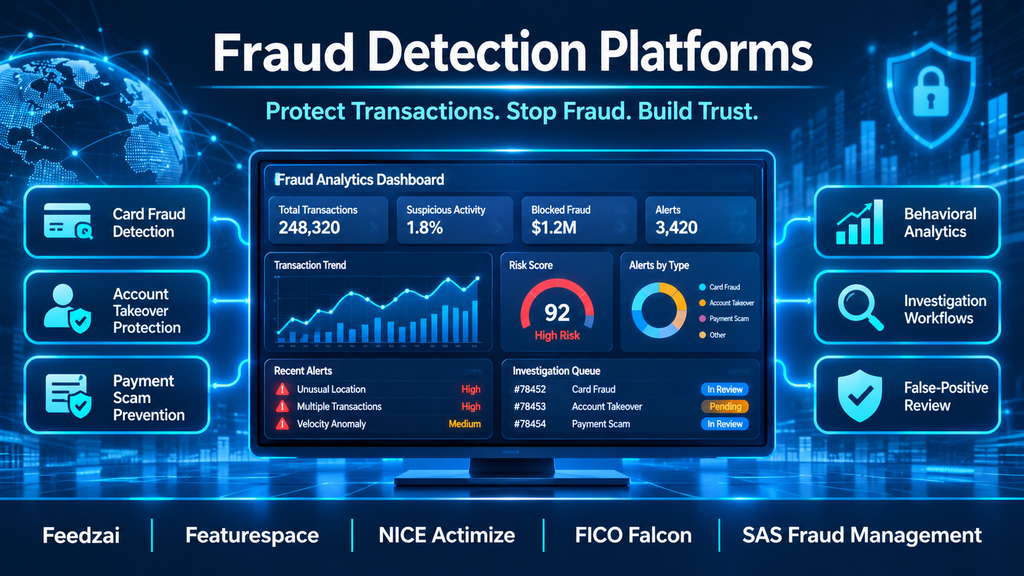
Fraud Detection Platforms: Identifying Suspicious Activity and Preventing Financial Loss in Real Time
Introduction
Fraud has become a complex operational risk for organizations that process payments, manage customer accounts, issue financial products, or conduct business through digital channels. Criminals exploit stolen credentials, compromised devices, synthetic identities, social engineering, payment manipulation, and weaknesses in onboarding processes.
Traditional controls based on static rules and manual reviews remain useful, but they can struggle to keep pace with high transaction volumes and rapidly changing fraud patterns. Organizations need systems that can evaluate activity quickly, connect signals across channels, and distinguish suspicious behavior from legitimate customer activity.
Fraud detection platforms address this challenge by combining transaction monitoring, machine learning, behavioral analytics, risk scoring, and investigation workflows. They help organizations identify potential fraud, prioritize alerts, and apply proportionate responses before losses escalate.
The challenge is not simply detecting more suspicious activity. It is detecting the right activity early enough to act without creating unnecessary friction for legitimate customers.
What Are Fraud Detection Platforms?
Fraud detection platforms are software systems that analyze transactions, account behavior, customer information, devices, and other contextual signals to identify activity that may indicate fraud.
They are used across banking, payments, insurance, e-commerce, lending, telecommunications, and other industries where fraudulent activity can cause financial or reputational damage.
A platform may evaluate a transaction against predefined rules, compare it with historical customer behavior, examine device and network characteristics, and calculate a risk score.
Depending on the organization’s decision policy, the system may:
- Approve the transaction.
- Decline or block the activity.
- Request additional authentication.
- Place the activity under review.
- Generate an alert for a fraud analyst.
- Monitor the account for additional suspicious behavior.
The strongest platforms connect detection with investigation, decision management, and feedback so that organizations can improve controls over time.
Why Organizations Need Fraud Detection Platforms
1. Increasing digital transaction volumes
Digital banking, instant payments, e-commerce, and mobile applications create large volumes of activity that must be evaluated quickly.
Manual review cannot scale to every transaction. Automated detection helps apply consistent risk assessment at operational speed.
2. More sophisticated fraud techniques
Attackers increasingly combine stolen credentials, social engineering, device manipulation, account takeover, and fraudulent identities.
A single transaction may appear legitimate when viewed in isolation. Contextual analysis can reveal unusual patterns across accounts, devices, beneficiaries, and transaction history.
3. The cost of false positives
Blocking legitimate customers can create abandoned transactions, service complaints, and operational costs.
Fraud detection must balance risk reduction with customer experience. Better context, adaptive models, and effective review processes can help reduce unnecessary interventions.
4. Fragmented fraud visibility
Different business units may monitor card payments, digital banking, onboarding, merchant activity, and insurance claims through separate systems.
Fragmented monitoring can make cross-channel patterns harder to identify. Enterprise platforms help consolidate signals and provide a more connected view of risk.
5. Faster investigation and response
Detection is only one part of fraud management. Analysts also need relevant evidence, case histories, linked entities, and clear decision records.
Integrated investigation workflows can reduce repetitive work and help teams prioritize cases more effectively.
Core Features of Fraud Detection Platforms
Real-time transaction monitoring
Real-time monitoring evaluates transactions as they occur or before they are finalized.
The system may consider transaction amount, location, time, frequency, merchant information, account history, beneficiary details, and other contextual attributes.
Latency requirements are especially important for payment authorization and instant-payment environments. Buyers should test performance using realistic transaction volumes and integration conditions.
Rules-based detection
Rules engines allow fraud teams to define conditions that identify suspicious activity.
Examples include:
- Unusually frequent transactions within a short period.
- Large payments inconsistent with historical behavior.
- Multiple failed authentication attempts.
- Rapid changes to account or beneficiary details.
- Transactions from unusual devices or locations.
- Activity that violates established business thresholds.
Rules are transparent and useful for known fraud patterns. However, static rules may require frequent tuning and can struggle to identify complex behavior that does not match predefined conditions.
Machine learning and behavioral analytics
Machine-learning models can analyze historical and current data to identify patterns associated with fraudulent activity.
Behavioral analytics can compare current activity with an individual’s normal transaction patterns, including typical amounts, timing, devices, locations, and interaction behavior.
These methods can identify anomalies that are difficult to capture through simple thresholds.
Models still require quality data, validation, monitoring, and appropriate governance. Their outputs should be evaluated against confirmed fraud outcomes and legitimate activity.
Risk scoring and decision management
A fraud risk score helps prioritize activity according to its estimated level of risk.
Decision engines can combine model outputs, rules, customer context, and business policies to determine whether to approve, block, authenticate, or investigate an event.
Organizations should understand how scores are generated and whether analysts can see the factors influencing a decision.
Device and network intelligence
Device and network signals can provide additional context about suspicious activity.
Depending on the solution and integrations, these signals may include device identifiers, browser characteristics, IP reputation, geolocation consistency, and indicators of automation or device manipulation.
These signals are most useful when evaluated alongside transaction and behavioral context rather than treated as definitive proof of fraud.
Account takeover and scam detection
Account takeover occurs when an unauthorized party gains control of a legitimate account.
Detection systems can look for unusual login behavior, changes to account details, abnormal transaction patterns, new devices, and suspicious beneficiary activity.
Scam detection may also require analyzing the context surrounding a payment, including unusual transfer behavior and indicators of customer manipulation.
Case management and investigation
Fraud analysts need more than alerts. They require tools to review evidence, connect related events, document decisions, and manage investigations.
Useful capabilities include alert prioritization, case assignment, investigation notes, linked-account analysis, evidence history, and escalation workflows.
Model monitoring and feedback
Fraud patterns change continuously. A detection model that performs well today may become less effective as attackers adapt.
Platforms should support monitoring for model drift, performance changes, false positives, and changes in fraud typologies. Confirmed fraud and legitimate outcomes should feed back into the detection process through controlled procedures.
Leading Fraud Detection Platforms
The following products represent established approaches to fraud detection and management. Their capabilities and deployment options should be evaluated against the organization’s specific fraud types, payment channels, architecture, and operational requirements.
1. Feedzai RiskOps Platform
<text weight=”medium” color=”default”>Key focus: AI-driven, cross-channel fraud prevention and financial crime management</text>
Feedzai provides fraud prevention capabilities across payment channels and customer journeys. Its platform uses transaction, behavioral, device, and network signals to support risk decisions.
Its fraud solutions cover areas such as transaction fraud, scam prevention, new-account fraud, and risk management for acquirers. Feedzai also describes network intelligence and explainable AI capabilities intended to support fraud detection while managing customer friction.
The platform is relevant to financial institutions that want to connect risk signals across payment types and customer interactions.
Best suited for: Banks, payment providers, and merchant acquirers seeking cross-channel fraud monitoring and AI-driven decisioning.
2. Featurespace Platform
<text weight=”medium” color=”default”>Key focus: Adaptive behavioral analytics and real-time transaction monitoring</text>
Featurespace provides fraud and financial crime management technology built around behavioral analytics and real-time risk assessment.
Its platform supports use cases including payment fraud, card fraud, merchant acquiring fraud, check fraud, and application fraud. Its approach focuses on modeling individual behavior to identify abnormal activity while helping financial institutions manage false positives.
Deployment options and supported use cases should be assessed against the institution’s processing architecture and operational requirements.
Best suited for: Financial institutions and payment organizations seeking behavioral analytics across multiple fraud types.
3. NICE Actimize Enterprise Fraud Management
<text weight=”medium” color=”default”>Key focus: Enterprise fraud management, decisioning, and investigations</text>
NICE Actimize offers enterprise fraud management capabilities across payments, scams, new-account fraud, authentication, and investigations.
Its platform combines analytics, data orchestration, decisioning, and operational workflows. This broader approach can help financial institutions connect fraud detection with case management and customer protection processes.
Organizations should assess the specific modules, data architecture, and deployment model required for their fraud operations.
Best suited for: Large financial institutions that need enterprise-wide fraud management and investigation capabilities.
4. FICO Falcon Fraud Manager
<text weight=”medium” color=”default”>Key focus: Transaction fraud detection and adaptive decisioning</text>
FICO Falcon Fraud Manager is designed to identify suspicious financial transactions across payment channels.
The platform uses machine-learning techniques and transaction intelligence to support fraud decisioning. Its architecture includes capabilities such as rules management and case management, with integration into payment authorization environments.
Financial institutions should evaluate its performance against their transaction types, decision latency requirements, and existing payment infrastructure.
Best suited for: Financial institutions seeking established transaction and card fraud detection capabilities.
5. SAS Fraud Management
<text weight=”medium” color=”default”>Key focus: Analytics-led fraud detection and enterprise monitoring</text>
SAS provides fraud detection and prevention capabilities through its analytics portfolio. Its solutions support the use of rules, advanced analytics, monitoring, and investigation processes to identify suspicious activity.
SAS deployments can be configured to address different fraud environments and business requirements. Buyers should clarify the relevant product configuration, deployment architecture, and available modules during evaluation.
Best suited for: Organizations with complex analytics requirements and established data management capabilities.
Fraud Detection Platform Comparison
| Platform | Primary focus | Potential fit |
|---|---|---|
| Feedzai RiskOps | AI-driven, cross-channel fraud and financial crime | Banks, payment providers, acquirers |
| Featurespace Platform | Adaptive behavioral analytics and transaction monitoring | Financial institutions and payment businesses |
| NICE Actimize | Enterprise fraud management and investigations | Large financial institutions |
| FICO Falcon Fraud Manager | Transaction and card fraud decisioning | Issuers and payment organizations |
| SAS Fraud Management | Analytics-led fraud detection and monitoring | Organizations with complex analytics needs |
This comparison reflects general product positioning rather than a universal ranking. Product packaging, deployment options, integrations, and licensing should be confirmed directly with vendors.
Common Fraud Types Detected by These Platforms
Payment and card fraud
Payment fraud includes unauthorized card transactions, card-not-present fraud, fraudulent transfers, and other misuse of payment instruments.
Detection systems analyze transaction context, customer behavior, device signals, and historical activity.
Account takeover
Account takeover involves unauthorized access to a legitimate customer’s account.
Indicators may include unusual login behavior, new devices, unexpected password resets, changes to contact details, and abnormal payment activity.
Authorized push payment scams
In authorized push payment scams, victims are manipulated into sending money to fraudulent recipients.
Detection can involve beneficiary information, payment behavior, account context, and indicators of unusual customer activity.
New-account and application fraud
Fraudulent applications may use stolen identities, fabricated information, or synthetic identities.
Detection systems can evaluate application attributes, device signals, identity information, and links to previously identified suspicious activity.
Merchant and acquiring fraud
Merchant fraud can involve suspicious onboarding, abnormal transaction patterns, disputed payments, or misuse of payment processing services.
Acquirers need visibility into merchant behavior as well as individual transactions.
Insurance and claims fraud
Insurance fraud detection can identify unusual claims patterns, inconsistencies, suspicious relationships, and repeated activity that may warrant further investigation.
The relevant capabilities vary significantly by platform and industry.
Common Implementation Challenges
Fragmented data sources
Fraud detection depends on reliable information. Transaction systems, customer databases, device intelligence, authentication services, and external data providers may use different formats and identifiers.
Poor integration can create incomplete customer profiles and reduce detection quality.
High false-positive rates
Excessive alerts increase investigation workloads and can disrupt legitimate customer activity.
Organizations should measure false positives by fraud type, channel, customer segment, and decision outcome rather than relying on one aggregate figure.
Latency and scalability
Real-time decisions must fit within the processing constraints of the payment or application environment.
A solution that performs well in a demonstration may behave differently under peak transaction volumes. Load testing and resilience testing are essential.
Model drift and changing fraud patterns
Fraud tactics evolve. Models can lose effectiveness when customer behavior, payment methods, or attack patterns change.
Continuous monitoring, retraining governance, and controlled model releases are important operational requirements.
Explainability and governance
Fraud decisions can affect access to financial services and customer relationships.
Organizations need appropriate records of decision factors, model versions, rule changes, analyst overrides, and escalation decisions.
Operational integration
Alerts must reach the right teams with enough information to investigate them.
Poor integration with payment systems, identity platforms, customer support, and case management tools can create delays and duplicate work.
How to Select the Right Fraud Detection Platform
1. Define fraud use cases
Identify the fraud types that matter most to the business. Card fraud, instant-payment scams, account takeover, application fraud, merchant risk, and insurance claims fraud may require different data and detection strategies.
2. Map transaction channels and data sources
Document where events originate, how they are processed, and which contextual signals are available.
Include transaction systems, customer profiles, authentication services, devices, networks, and external intelligence providers.
3. Establish performance requirements
Define acceptable decision latency, transaction throughput, availability, and recovery requirements.
These should reflect real production conditions rather than vendor demonstration assumptions.
4. Evaluate detection quality
Use representative historical data to assess detection performance.
Measure confirmed fraud detection, false-positive rates, missed fraud, alert volumes, and investigation effort. Compare results across different fraud scenarios.
5. Assess decision transparency
Ask how the platform explains scores and decisions. Fraud analysts should be able to understand why an event was flagged and what evidence supports further investigation.
6. Review integration and deployment
Validate connectivity with payment processors, core banking systems, identity services, data platforms, and investigation tools.
Assess cloud, hosted, and on-premises options where available, including data residency and operational responsibilities.
7. Examine model governance
Review model validation, version management, performance monitoring, retraining processes, auditability, and human oversight.
8. Calculate total cost of ownership
Include licensing, implementation, integrations, data services, infrastructure, model development, analyst training, and ongoing maintenance.
A Practical Implementation Roadmap
Phase 1: Fraud risk assessment
Identify business-critical fraud scenarios, affected channels, existing controls, and historical loss patterns.
Phase 2: Data and architecture review
Map required data sources, integration methods, event volumes, latency requirements, and data quality issues.
Phase 3: Platform configuration
Configure rules, models, risk thresholds, decision policies, alert routing, and investigation workflows.
Phase 4: Historical testing
Use representative historical transactions to evaluate detection performance and identify false-positive patterns before production deployment.
Phase 5: Controlled pilot
Deploy to a limited channel, product, or transaction segment. Compare automated decisions with existing processes and review analyst feedback.
Phase 6: Production rollout
Expand gradually while monitoring system performance, decision quality, customer impact, and operational workload.
Phase 7: Continuous improvement
Review fraud outcomes, update detection strategies, validate model changes, and adapt controls as attack patterns evolve.
The Role of AI in Fraud Detection
AI and machine learning help fraud teams analyze large volumes of transactions and contextual data more effectively.
Potential applications include:
- Detecting deviations from individual customer behavior.
- Identifying suspicious relationships across accounts and devices.
- Recognizing unusual transaction sequences.
- Prioritizing alerts for investigation.
- Supporting fraud typology discovery.
- Improving risk scoring and decision recommendations.
- Assisting analysts with case summaries and investigative workflows.
AI does not eliminate the need for rules, governance, or human review. Models can produce inaccurate or biased results when data is incomplete, poorly labeled, or unrepresentative.
Organizations should establish controls for model validation, explainability, privacy, monitoring, and human oversight. Automated decisions should be proportionate to risk and aligned with applicable legal and regulatory obligations.
Conclusion
Fraud detection platforms are essential for organizations that need to identify suspicious activity across increasingly complex digital channels. By combining transaction monitoring, rules, machine learning, behavioral analytics, risk scoring, and investigation workflows, they help businesses reduce fraud exposure while protecting legitimate customer experiences.
Feedzai, Featurespace, NICE Actimize, FICO Falcon, and SAS offer different approaches to fraud detection and enterprise risk management. The right solution depends on the organization’s fraud typologies, transaction architecture, data maturity, operational capacity, and governance requirements.
Effective fraud prevention is not simply about blocking more transactions. It is about making better risk decisions, investigating suspicious activity efficiently, and adapting controls as fraud patterns change.
