Upgrade & Secure Your Future with DevOps, SRE, DevSecOps, MLOps!
We spend hours scrolling social media and waste money on things we forget, but won’t spend 30 minutes a day earning certifications that can change our lives.
Master in DevOps, SRE, DevSecOps & MLOps by DevOps School!
Learn from Guru Rajesh Kumar and double your salary in just one year.
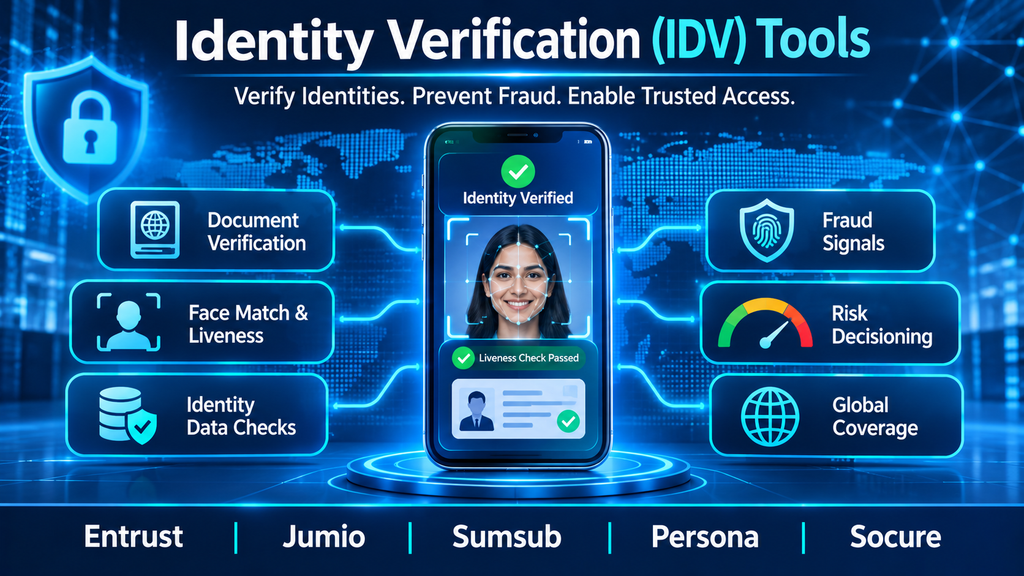
Identity Verification Tools: Securing Digital Onboarding with Reliable Identity Proofing
Introduction
Digital services increasingly depend on knowing who is accessing an account, opening a financial product, requesting a payment, or conducting a sensitive transaction. Organizations need reliable ways to establish identity without making legitimate customers navigate lengthy or confusing verification processes.
At the same time, identity-related fraud continues to evolve. Stolen identity documents, synthetic identities, manipulated images, deepfakes, account impersonation, and automated attacks can undermine basic onboarding checks.
Identity Verification (IDV) tools help organizations establish confidence in a person’s claimed identity through document authentication, biometric verification, liveness detection, trusted data sources, and fraud-risk analysis.
These platforms are used by banks, fintech companies, insurance providers, online marketplaces, telecommunications businesses, healthcare services, and digital platforms. They can support customer onboarding, account recovery, high-risk transaction authorization, age checks, and workforce identity verification.
The challenge is to establish an appropriate level of identity assurance while maintaining a smooth experience for legitimate users.
What Are Identity Verification Tools?
Identity verification tools are software solutions that validate whether an individual is genuinely the person they claim to be.
They examine identity documents, personal information, biometric characteristics, and other contextual signals to determine whether an identity claim can be trusted.
A typical IDV platform may combine:
- Identity document capture and verification.
- Optical character recognition (OCR) and data extraction.
- Facial comparison between a document and a live selfie.
- Liveness detection.
- Trusted database and electronic identity checks.
- NFC-based identity document verification.
- Device and behavioral intelligence.
- Fraud and identity risk scoring.
- Manual review and exception handling.
- Verification records and audit reporting.
Some platforms focus primarily on document and biometric verification, while others offer broader identity intelligence, fraud prevention, and compliance capabilities.
IDV should also be distinguished from authentication. Identity verification establishes confidence in a person’s identity, often during onboarding. Authentication helps determine whether a returning user is the same person associated with an established account.
Both capabilities may be used together throughout the customer lifecycle.
Why Organizations Need Identity Verification Tools
1. Preventing identity fraud
Fraudsters may use stolen documents, altered identity cards, fabricated information, or impersonation techniques to create accounts or access services.
Document checks and biometric comparison help identify inconsistencies that basic form validation cannot detect.
2. Securing digital onboarding
Financial institutions and digital businesses need to verify customers remotely without requiring every applicant to visit a physical location.
IDV platforms automate parts of the verification process and can reduce repetitive manual checks.
3. Supporting KYC and regulatory requirements
Many regulated organizations must establish and verify customer identities as part of their customer due diligence processes.
IDV platforms can support these workflows by collecting identity information, validating documents, and connecting verification results with wider KYC and AML systems.
The specific requirements depend on the jurisdiction, sector, product, and applicable regulations.
4. Reducing account takeover risk
Identity verification can help organizations establish a trusted identity during account creation and strengthen checks during sensitive activities.
For example, additional verification may be requested when a user attempts account recovery, changes important account details, or performs a high-risk transaction.
5. Improving customer experience
Traditional identity checks can involve manual document review, repeated data entry, and lengthy approval processes.
Automated document capture, OCR, biometric comparison, and configurable workflows can reduce unnecessary friction for legitimate customers.
6. Supporting global digital services
Organizations operating internationally must accommodate different identity documents, languages, verification methods, and regional requirements.
A platform with broad document coverage and flexible verification workflows can simplify expansion into additional markets.
Core Features of Identity Verification Software
Identity document verification
Document verification evaluates whether an identity document appears genuine and whether its information is internally consistent.
Depending on the solution, checks may examine:
- Document layout and security features.
- Expiration dates and document eligibility.
- Visual alterations and inconsistencies.
- Machine-readable zones.
- Printed and embedded information.
- Metadata and image manipulation indicators.
- NFC chip information where supported.
Document coverage is an important procurement consideration. A provider may support thousands of document types, but organizations should confirm that it supports the actual identity documents used by their customer population.
OCR and identity data extraction
Optical character recognition extracts information from uploaded identity documents.
This can include names, dates of birth, document numbers, addresses, and expiration dates.
Extracted information can populate onboarding forms and reduce manual data entry. However, extraction should not be confused with verification: accurately reading a document does not prove that the document is authentic.
Facial verification
Facial verification compares a live selfie or video with the portrait contained in an identity document.
The objective is to establish whether the person completing the verification appears to match the individual represented by the document.
Organizations should evaluate accuracy across different demographics, lighting conditions, camera quality, and supported devices.
Liveness detection
Liveness detection helps determine whether a biometric sample comes from a real person who is physically present during the verification process.
Methods may include passive analysis, guided movement, video capture, and other biometric techniques.
Liveness is important because an attacker may attempt to use printed photographs, replayed videos, masks, or synthetic media to impersonate another person.
NFC identity verification
Near-field communication can be used to read information from supported electronic identity documents.
Where available, chip-based verification may provide additional assurance by validating information stored in a document’s electronic chip.
Support depends on the document, device, application, and verification workflow.
Database and electronic identity checks
Some IDV providers use trusted databases and electronic identity sources to validate information supplied by applicants.
These checks can provide additional evidence beyond document-based verification.
Availability and reliability vary by country, data provider, and customer type. Organizations should confirm source coverage and legal permissions for the intended use.
Device and fraud intelligence
Device and behavioral signals can help identify suspicious verification attempts.
Depending on the provider, these may include device characteristics, repeated document usage, unusual session patterns, network information, and indicators of automated or manipulated activity.
These signals should be evaluated as part of a broader risk decision rather than treated as conclusive proof.
Workflow orchestration and manual review
Not every verification attempt produces a clear automated result.
A strong platform should support configurable workflows for approvals, retries, document resubmission, additional checks, and manual review.
It should also preserve the evidence and reasoning associated with important decisions.
Leading Identity Verification Tools
The following platforms illustrate different approaches to document verification, biometric identity proofing, and fraud prevention.
1. Entrust Identity Verification
<text color=”default” weight=”medium”>Key focus: Global document verification, biometrics, and digital identity trust</text>
Entrust Identity Verification builds on the identity verification technology previously associated with Onfido.
Its platform provides document verification, biometric verification, data verification, fraud detection, and identity-related capabilities across customer journeys.
Document verification examines visual, data, and metadata characteristics to help assess document legitimacy. Its broader identity verification capabilities include facial similarity, liveness-related checks, and integration through developer SDKs.
Entrust also positions identity verification as part of a wider digital trust strategy, supporting use cases such as customer onboarding, account recovery, and high-risk interactions.
Organizations should evaluate document coverage, available biometric workflows, regional support, and SDK compatibility for their specific applications.
Best suited for: Organizations requiring global document verification and biometric identity checks as part of a broader digital trust strategy.
2. Jumio Identity Verification
<text color=”default” weight=”medium”>Key focus: Identity intelligence, biometric verification, and fraud-risk signals</text>
Jumio provides identity verification capabilities that combine document checks, selfie verification, biometrics, liveness detection, and additional identity intelligence.
Its broader platform includes risk signals, cross-transaction risk analysis, and AML screening.
Jumio’s Identity Graph connects identity-related information across interactions to help identify patterns that may indicate repeat fraud or suspicious activity.
The platform can support customer onboarding and ongoing identity-related risk assessment. Organizations should assess which capabilities are available in the selected package and how they fit into existing fraud and compliance workflows.
Best suited for: Financial services and digital businesses seeking identity verification combined with fraud intelligence and broader identity risk capabilities.
3. Sumsub Identity Verification
<text color=”default” weight=”medium”>Key focus: Configurable identity verification and global digital onboarding</text>
Sumsub offers identity verification workflows combining document checks, biometric verification, liveness, NFC verification, and trusted data sources.
Its documentation describes support for identity verification across a broad range of countries and document types, with multiple verification methods depending on market and regulatory requirements.
The platform supports configurable verification levels, applicant workflows, SDK and API integration, and sandbox testing.
Organizations can select verification methods according to their onboarding requirements and the assurance level needed for different customer journeys.
Best suited for: Global fintech companies, online platforms, and digital businesses seeking configurable identity verification workflows.
4. Persona
<text color=”default” weight=”medium”>Key focus: Configurable identity verification and onboarding orchestration</text>
Persona provides identity verification and identity management capabilities through configurable workflows.
Its approach supports document verification, biometric checks, database verification, and customizable identity-related processes.
The platform’s workflow-oriented design can help organizations build different verification journeys for customer onboarding, account recovery, and other identity-sensitive interactions.
Organizations should evaluate available verification methods, integration options, geographic coverage, and the level of customization required for their use cases.
Best suited for: Digital businesses seeking flexible identity workflows and configurable onboarding experiences.
5. Socure
<text color=”default” weight=”medium”>Key focus: Digital identity intelligence and fraud prevention</text>
Socure focuses on identity verification and fraud prevention using digital identity intelligence and risk analytics.
Its product portfolio includes identity verification, document and biometric verification capabilities, and solutions addressing synthetic identity and other forms of identity-related fraud.
Socure’s approach is relevant to organizations that want to evaluate identity risk using more than a single document or biometric check.
Buyers should assess supported customer populations, geographic coverage, data-source availability, and how risk decisions can be explained and integrated into onboarding systems.
Best suited for: Financial institutions and digital businesses seeking identity intelligence and fraud-risk assessment capabilities.
Identity Verification Platform Comparison
| Platform | Key focus | Potential fit |
|---|---|---|
| Entrust Identity Verification | Document verification, biometrics, digital trust | Global digital onboarding |
| Jumio | Identity intelligence, biometrics, fraud signals, AML | Financial services and digital platforms |
| Sumsub | Configurable verification and multiple identity methods | Global fintech and online businesses |
| Persona | Flexible identity workflows and onboarding orchestration | Digital businesses with varied verification journeys |
| Socure | Identity intelligence and identity fraud prevention | Financial institutions and digital services |
This comparison reflects general product positioning rather than a universal ranking. Features, country coverage, integrations, and licensing should be validated directly with each vendor.
How Identity Verification Works
A typical IDV workflow consists of several connected steps.
Step 1: Capture identity information
The applicant provides personal details and submits an identity document through a mobile application, website, or other supported channel.
The platform may guide the applicant through document capture to improve image quality and reduce incomplete submissions.
Step 2: Verify the document
The platform evaluates document authenticity and extracts relevant information.
It may check document format, expiration, visual characteristics, data consistency, and other available security signals.
Step 3: Compare facial information
Where required, the applicant submits a selfie or video.
The platform compares the live biometric sample with the portrait on the submitted identity document.
Step 4: Perform liveness checks
Liveness detection helps assess whether the biometric sample represents a real person who is present during verification.
The specific method depends on the provider and configured workflow.
Step 5: Evaluate additional risk signals
Additional checks may include trusted database verification, device intelligence, repeat-document detection, and other fraud indicators.
The platform combines these results according to its configured decision logic.
Step 6: Make a verification decision
The result may be:
- Approved automatically.
- Rejected based on defined criteria.
- Returned for document resubmission.
- Escalated for manual review.
- Routed through additional verification.
Organizations should define appropriate thresholds and review procedures rather than treating every automated result as final.
Step 7: Preserve verification evidence
The platform should retain appropriate verification results, decision records, timestamps, and audit information in accordance with organizational policies and applicable data protection requirements.
Common Identity Verification Challenges
Unsupported identity documents
An applicant may submit a document that the provider does not support or that cannot be reliably captured.
Organizations should test actual customer document types before deployment and provide alternative verification methods where appropriate.
Poor image quality
Blurry photographs, glare, shadows, reflections, and cropped documents can cause verification failures.
Clear capture instructions and automatic image-quality checks can reduce unnecessary retries.
Biometric false rejections
Facial comparison systems may produce incorrect results because of lighting, camera limitations, image quality, or differences in biometric performance across populations.
Organizations should assess performance across relevant demographic groups and provide fair fallback procedures.
Deepfakes and presentation attacks
Attackers may attempt to defeat verification using replayed videos, synthetic faces, manipulated images, or other presentation attacks.
Providers should explain how their systems detect these threats and how they test resistance to advanced attacks.
Injection attacks
Injection attacks attempt to introduce manipulated media or biometric data directly into a verification workflow, bypassing normal camera capture.
Organizations should ask vendors how they detect and mitigate these attacks, especially for high-risk onboarding and account recovery.
Customer drop-off
Long verification journeys and repeated document requests can cause legitimate applicants to abandon onboarding.
Organizations should measure completion rates, retry rates, review times, and abandonment across different devices and customer groups.
Privacy and biometric data protection
Identity verification may involve highly sensitive personal information and biometric data.
Organizations should examine consent requirements, data minimization, retention, deletion, encryption, access controls, and regional hosting arrangements.
How to Select the Right Identity Verification Tool
1. Define the use cases
Determine whether the platform will support new customer onboarding, account recovery, high-risk transactions, workforce verification, age assurance, or several of these activities.
Different use cases may require different assurance levels.
2. Confirm document and geographic coverage
Review the actual identity documents and countries relevant to the customer base.
Ask vendors to demonstrate verification using representative documents rather than relying solely on coverage statistics.
3. Evaluate document fraud detection
Understand how the provider checks visual authenticity, data consistency, metadata, tampering, and document reuse.
Request information about testing methodologies and performance under realistic conditions.
4. Assess biometric verification and liveness
Evaluate facial matching, liveness methods, presentation-attack detection, and resilience against spoofing.
Review performance across different lighting conditions, camera types, and demographic groups.
5. Test deepfake and injection-attack defenses
Ask vendors to explain how they detect manipulated media and attacks that bypass normal capture mechanisms.
Request evidence of security testing and explain how new attack methods are incorporated into detection updates.
6. Review user experience and accessibility
Test the onboarding process on common devices and networks.
Examine retry handling, language support, accessibility, alternative verification paths, and customer support processes.
7. Validate APIs and integration
Evaluate SDKs, APIs, webhooks, identity orchestration, latency, scalability, and integration with existing KYC, CRM, fraud, and authentication systems.
8. Examine privacy and security
Review data retention, biometric data handling, consent, encryption, access controls, audit logging, data residency, and deletion procedures.
9. Calculate total cost of ownership
Include verification volumes, subscription costs, manual review, integration work, support, additional checks, and ongoing administration.
10. Conduct a representative pilot
Test with different identity documents, devices, lighting conditions, customer segments, and known fraud scenarios.
Measure verification completion, false rejection, manual review volume, fraud detection, and onboarding time.
A Practical Implementation Roadmap
Phase 1: Requirements and risk assessment
Define use cases, customer populations, geographic coverage, assurance requirements, and fraud scenarios.
Phase 2: Vendor and capability evaluation
Compare document coverage, biometric methods, liveness, fraud signals, integration options, and privacy controls.
Phase 3: Workflow design
Define the verification journey, decision thresholds, retry logic, escalation paths, manual review, and evidence retention.
Phase 4: Integration and configuration
Connect the platform to onboarding applications, identity systems, KYC processes, fraud tools, and case management systems.
Phase 5: Pilot testing
Test representative documents, devices, user journeys, and fraud scenarios. Review both successful and unsuccessful verification outcomes.
Phase 6: Production deployment
Launch gradually, monitor customer experience, and ensure manual review teams can manage exceptions.
Phase 7: Continuous improvement
Review performance, monitor new attack methods, update workflows, and reassess vendor capabilities as business requirements change.
The Role of AI in Identity Verification
AI is central to many modern identity verification systems.
Machine learning can support document classification, image analysis, facial comparison, liveness detection, fraud pattern recognition, and risk assessment.
Potential applications include:
- Detecting altered or fabricated identity documents.
- Identifying inconsistencies between document information and submitted data.
- Improving facial similarity analysis.
- Detecting deepfakes and synthetic media.
- Identifying repeated or suspicious identity usage.
- Recognizing unusual verification patterns.
- Supporting automated decisioning and manual review prioritization.
However, AI-based verification introduces important governance considerations.
Organizations should examine model performance, demographic fairness, explainability, data protection, and resistance to adversarial manipulation.
Automated decisions should have appropriate review and appeal mechanisms, particularly when verification failures could prevent legitimate customers from accessing essential services.
AI can strengthen identity proofing, but it should operate within a transparent and accountable verification framework.
Conclusion
Identity verification tools are an important foundation for secure digital services. They help organizations validate identity documents, compare biometric information, detect impersonation attempts, and establish confidence in digital onboarding and sensitive account interactions.
Entrust, Jumio, Sumsub, Persona, and Socure demonstrate different approaches to document verification, biometric checks, identity intelligence, and configurable verification workflows.
The right platform depends on geographic coverage, customer demographics, assurance requirements, fraud exposure, privacy obligations, and integration architecture.
Successful identity verification is not simply about checking an identity document. It is about establishing confidence in the person behind a digital interaction while protecting legitimate users from unnecessary friction.
