Upgrade & Secure Your Future with DevOps, SRE, DevSecOps, MLOps!
We spend hours scrolling social media and waste money on things we forget, but won’t spend 30 minutes a day earning certifications that can change our lives.
Master in DevOps, SRE, DevSecOps & MLOps by DevOps School!
Learn from Guru Rajesh Kumar and double your salary in just one year.
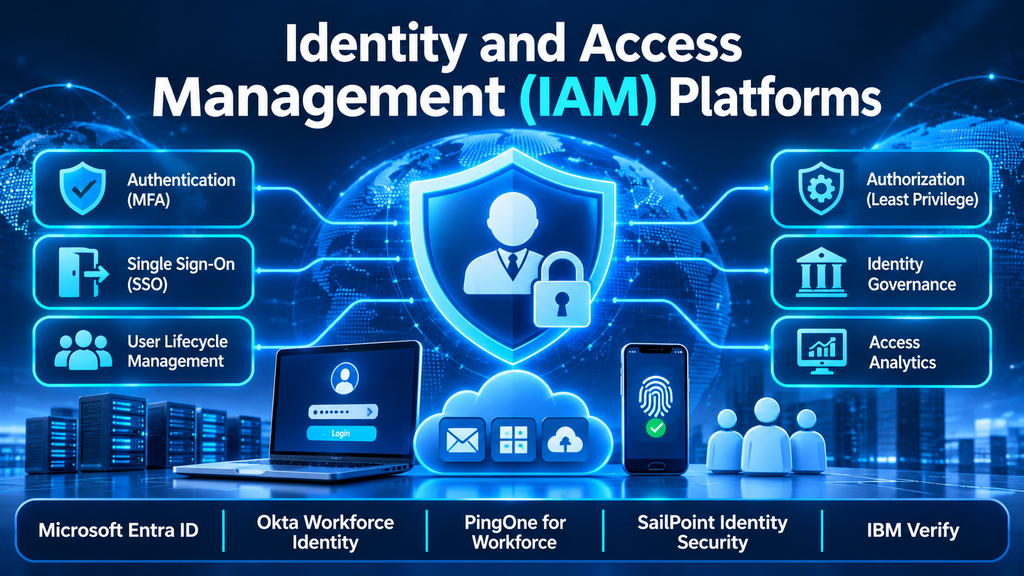
Identity and Access Management Platforms: Securing Workforce Access Across Applications, Systems, and Cloud Environments
Identity has become one of the most important control points in enterprise cybersecurity. Employees, contractors, partners, customers, service accounts, and automated workloads all require access to business applications and infrastructure. As organizations adopt cloud services, remote work, hybrid environments, and AI-powered systems, controlling who can access which resources—and under what conditions—has become increasingly complex.
Identity and Access Management (IAM) platforms provide a framework for managing digital identities, authenticating users, assigning permissions, and governing access throughout the identity lifecycle. Rather than relying on disconnected login systems and manual account administration, IAM helps organizations apply consistent access policies across applications, infrastructure, and data.
The challenge is no longer simply ensuring that users can sign in. Security teams must also prevent excessive privileges, detect compromised identities, remove access promptly when roles change, and demonstrate that access is governed appropriately.
What Are Identity and Access Management Platforms?
Identity and Access Management platforms are systems that manage digital identities and control access to organizational resources. They establish how identities are created, verified, authenticated, authorized, monitored, and eventually deactivated.
IAM generally combines several related capabilities:
- Authentication: Verifying that a user or system is who it claims to be.
- Authorization: Determining which resources and actions an authenticated identity may access.
- Single sign-on (SSO): Allowing users to access multiple connected applications through a centralized authentication experience.
- Multi-factor authentication (MFA): Requiring additional proof beyond a password.
- Identity lifecycle management: Automating account creation, modification, and removal.
- Access governance: Reviewing permissions, enforcing policies, and documenting approvals.
- Privileged access controls: Applying stronger safeguards to administrative and high-impact accounts.
IAM is not synonymous with SSO. SSO is one capability within a broader identity program. An organization can deploy SSO and still have serious problems with excessive permissions, orphaned accounts, weak offboarding, or unmanaged service identities. Microsoft describes its Entra ID offering as combining capabilities such as SSO, MFA, Conditional Access, and—in applicable plans—identity governance and privileged identity management. Microsoft Entra ID
Why Organizations Need Modern IAM
Traditional access administration often depends on separate directories, application-specific accounts, spreadsheets, and manual approval processes. These approaches become difficult to maintain as the organization grows.
1. Growing application environments
Employees may use dozens of SaaS applications alongside legacy systems, cloud consoles, databases, and internal services. Without centralized identity controls, security teams can struggle to maintain consistent authentication and access policies.
2. Remote and hybrid work
Access decisions increasingly involve users connecting from different locations and devices. Organizations need policies that consider identity, authentication strength, device posture, application sensitivity, and risk signals rather than relying only on network location.
3. Excessive and outdated permissions
Employees often accumulate access as they change roles or take on temporary responsibilities. If old permissions are not removed, users may retain access they no longer need.
4. Third-party and contractor access
External users need access to selected applications and information, but their accounts may be managed outside the organization’s normal HR processes. IAM workflows can make sponsorship, approval, expiration, and review more consistent.
5. Non-human identities
Applications, APIs, service accounts, bots, and AI agents can access sensitive resources. These identities require ownership, credential protection, permission limits, and monitoring just as human identities do.
Core Capabilities to Evaluate
Centralized authentication and SSO
A central identity provider can reduce password fatigue and simplify access administration. Standards such as SAML and OpenID Connect allow compatible applications to rely on a common authentication service. OAuth 2.0 is commonly used for delegated authorization, especially in API and application access scenarios.
SSO improves the user experience, but it also concentrates risk. A compromised identity provider account can provide a route into multiple connected applications. Strong MFA, session controls, conditional access, and careful administrator protection are therefore essential.
Multi-factor and passwordless authentication
MFA adds verification beyond a password, using factors such as authenticator applications, security keys, biometrics, or device-based credentials. Passwordless approaches can reduce exposure to phishing and password reuse, particularly when implemented with phishing-resistant methods such as FIDO2 security keys and passkeys.
Identity lifecycle and provisioning
Lifecycle automation connects identity changes to business events. When an employee joins, the system can create accounts and assign role-appropriate access. When the employee changes departments, access can be adjusted. When employment ends, access can be revoked across connected services.
Provisioning standards such as SCIM can help automate account management between identity platforms and supported applications.
Access governance and certification
Governance capabilities help organizations answer questions such as:
- Who has access to a particular application or data set?
- Who approved that access?
- Is the permission still required?
- Are conflicting responsibilities creating risk?
- Can the organization demonstrate that access reviews occurred?
Periodic certifications, access requests, approval workflows, and policy enforcement help make access decisions auditable.
Conditional and risk-based access
Modern access policies can consider contextual signals such as authentication strength, device status, location, session risk, and user behavior. Higher-risk access attempts may require additional verification or be blocked.
Privileged access integration
Administrative accounts deserve stronger controls because they can change configurations, create accounts, access sensitive data, and disable security safeguards. IAM platforms may provide privileged identity features directly or integrate with dedicated Privileged Access Management (PAM) tools.
Leading Identity and Access Management Platforms
The following products illustrate different approaches to workforce identity, authentication, and identity governance. Their capabilities and licensing differ, so organizations should validate specific requirements and product editions during evaluation.
| Platform | Key strengths | Considerations |
|---|---|---|
| Microsoft Entra ID | SSO, MFA, Conditional Access, Microsoft ecosystem integration, governance options | Evaluate licensing tiers and integration needs beyond Microsoft applications |
| Okta Workforce Identity | Workforce SSO, Universal Directory, MFA, lifecycle and access management options | Review integration coverage, add-ons, and total licensing costs |
| PingOne for Workforce | Adaptive authentication, centralized access, passwordless capabilities, hybrid integration | Assess architecture, orchestration requirements, and deployment complexity |
| SailPoint Identity Security | Identity governance, access certifications, lifecycle controls, human and non-human identity governance | Particularly relevant where governance and entitlement visibility are major priorities |
| IBM Verify | Hybrid identity, adaptive access, MFA, identity governance, and support for human and non-human identities | Assess the specific Verify components and operating model required |
Microsoft Entra ID
Microsoft Entra ID provides identity and access capabilities for employees, applications, and organizational resources. Its feature set includes SSO, MFA, Conditional Access, and additional governance and privileged identity capabilities depending on licensing.
It can be a natural option for organizations with substantial Microsoft 365, Azure, and Windows environments. Buyers should nevertheless test integrations with non-Microsoft applications, legacy infrastructure, and specialized business systems.
Official reference: Microsoft Entra ID
Okta Workforce Identity
Okta Workforce Identity focuses on workforce authentication and application access. Its platform includes capabilities such as SSO, MFA, directory services, and additional lifecycle and governance functions through applicable packages and products.
Organizations with diverse SaaS environments may value its application integration ecosystem. Buyers should examine the exact capabilities included in each subscription tier and identify which advanced controls require additional products.
Official reference: Okta pricing and platform options
PingOne for Workforce
PingOne for Workforce supports centralized authentication and workforce access across applications and devices. Its capabilities include SSO, MFA, adaptive authentication, and orchestration options.
It is worth evaluating where an organization has complex identity requirements, hybrid directories, or a need to coordinate access experiences across different systems. Architecture and integration requirements should be tested in a representative pilot.
Official reference: PingOne for Workforce
SailPoint Identity Security
SailPoint emphasizes identity governance and security, helping organizations understand and manage access across users, applications, and other identities. Its capabilities include lifecycle workflows, access recommendations, role modeling, and governance for complex environments.
It is particularly relevant when the central challenge is not only authenticating users, but understanding whether their permissions are appropriate and continuously governed.
Official reference: SailPoint Identity Security
IBM Verify
IBM Verify provides identity capabilities across workforce, customer, and non-human identity use cases. IBM’s portfolio includes authentication, adaptive access, identity governance, and hybrid deployment options.
Organizations with established IBM environments or complex hybrid infrastructure may want to evaluate its deployment flexibility and integration model. It is important to distinguish the capabilities of individual Verify products when comparing proposals.
Official reference: IBM Verify
Common IAM Deployment Challenges
Poor identity data quality
IAM automation depends on reliable identity information. Duplicate accounts, inconsistent employee records, missing managers, and outdated department data can result in incorrect access assignments.
Organizations should establish authoritative identity sources and clear ownership for identity attributes before automating provisioning.
Overly broad access policies
A centralized platform does not automatically create least privilege. If role definitions are too broad or application permissions are poorly understood, IAM may simply automate excessive access at scale.
Start with sensitive applications and high-risk permissions. Use access reviews and entitlement analysis to refine roles over time.
Incomplete application integration
Some legacy applications do not support modern federation or automated provisioning. These systems may require connectors, gateways, agents, custom integration, or compensating controls.
Inventory application protocols and provisioning capabilities before selecting a platform.
Weak offboarding processes
Disabling a central directory account may not revoke every session, API token, local account, or third-party credential. Offboarding procedures should cover connected applications, privileged credentials, active sessions, and non-human identities.
Excessive authentication friction
Security controls that create repeated interruptions can encourage workarounds. Use risk-aware policies and phishing-resistant authentication while testing the experience with real users and different device types.
Unmanaged service and machine accounts
Non-human identities can be overlooked because they do not follow ordinary employee lifecycle processes. Assign owners, rotate credentials, restrict permissions, and monitor usage for these accounts.
How to Select the Right IAM Platform
A structured evaluation should begin with the organization’s identity architecture rather than a vendor feature checklist.
1. Map identity populations. Identify employees, contractors, partners, customers, service accounts, APIs, and other non-human identities. Determine which populations belong in the workforce IAM scope and which need separate customer identity or machine identity controls.
2. Inventory applications and infrastructure. Document cloud applications, on-premises systems, directories, databases, infrastructure consoles, and custom applications. Record support for SAML, OIDC, OAuth, LDAP, SCIM, and other relevant integration methods.
3. Define the primary use cases. Decide whether the immediate priority is SSO and MFA, automated provisioning, identity governance, privileged access, hybrid modernization, or a combination of these capabilities.
4. Assess governance requirements. Identify access certification frequency, approval rules, separation-of-duties requirements, audit evidence, and retention expectations.
5. Evaluate operational fit. Compare administration effort, integration complexity, policy management, reporting, support, deployment models, and the skills required to operate the platform.
6. Run a realistic proof of concept. Test onboarding, role changes, offboarding, MFA enforcement, application federation, access reviews, and recovery procedures. Include at least one legacy application and one high-risk application if they are part of the environment.
7. Model total cost. Consider user counts, product tiers, add-ons, external identities, privileged access integrations, implementation services, and ongoing administration.
Practical IAM Implementation Roadmap
A phased rollout can reduce disruption and make access improvements measurable.
- Phase 1 — Discovery: Inventory identity sources, applications, accounts, authentication methods, and access risks.
- Phase 2 — Foundation: Establish authoritative identity records, directory integration, SSO, and baseline MFA.
- Phase 3 — Lifecycle automation: Connect HR events and application provisioning to onboarding, role changes, and offboarding.
- Phase 4 — Governance: Introduce access requests, approvals, periodic certifications, and least-privilege reviews.
- Phase 5 — Risk-based controls: Apply contextual access policies, stronger administrator protections, and phishing-resistant authentication.
- Phase 6 — Continuous improvement: Monitor exceptions, stale accounts, excessive entitlements, authentication failures, and policy effectiveness.
Useful metrics include MFA coverage, SSO adoption, time to provision and deprovision accounts, percentage of applications connected to centralized authentication, access-review completion, orphaned account counts, and the number of excessive or unused permissions remediated.
Questions to Ask IAM Vendors
Before purchasing, security and IT teams should ask:
- Which authentication and federation standards are supported?
- How are legacy applications and disconnected directories integrated?
- Can provisioning and deprovisioning be automated across the applications we use?
- How are contractors, partners, and temporary identities governed?
- Which MFA and passwordless methods are supported?
- How are privileged users and emergency access accounts protected?
- Can access reviews be delegated and tracked with auditable evidence?
- How are machine identities, service accounts, and AI agents handled?
- Which capabilities are included in the quoted license, and which require add-ons?
- What happens to active sessions and tokens when an identity is disabled or compromised?
The Future of Identity and Access Management
IAM is expanding beyond conventional employee accounts. Cloud-native applications, APIs, automation, and AI agents are increasing the number of identities that organizations must secure.
Non-human identities introduce difficult governance questions: who owns an identity, what permissions does it require, how are credentials protected, and how can its actions be traced to an accountable owner? Organizations will need more consistent discovery, lifecycle management, authorization, and monitoring for these identities.
Passwordless authentication and phishing-resistant credentials are also changing how users prove their identity. At the same time, risk-based access decisions are becoming more context-aware, using device and session signals to adjust authentication requirements.
The direction is toward identity security that combines centralized policy, continuous governance, and visibility across human and non-human identities.
Conclusion
Identity and Access Management platforms are foundational to modern enterprise security. They help organizations centralize authentication, automate identity lifecycles, govern permissions, and apply consistent access policies across cloud and on-premises environments.
The strongest IAM strategy is not simply the one that delivers the smoothest login experience. It is the one that ensures every identity has an accountable owner, every permission has a business purpose, and access is adjusted as risk and organizational needs change.
Organizations should select platforms based on their identity populations, application landscape, governance requirements, and operational capabilities. A phased implementation—starting with reliable identity data, strong authentication, and lifecycle automation—creates a practical foundation for broader identity security.
